 Add to Chrome
 Add to Firefox
 Add to Edge
Capstan-driven Continuum Surgical Robot: Design, Modeling, and Perception
Aug 13, 2026
Shape and force sensing have long been critical bottlenecks in the development of compact capstan-driven continuum surgical robots, primarily due to the difficulty of obtaining cable tension information within the confined capstan assembly. To overcome these challenges, this paper presents an integrated design-modeling-sensing approach based on the concept of actuation-perception co-design. A compliant element is introduced into the motor mounting bracket of the drive system, enabling micro-deformation under the cable reaction force and thereby allowing real-time cable tension measurement without occupying the compact capstan space. To address the modeling complexity arising from unconventional joint configurations introduced by the spatial cable routing strategy, a parallel computation framework based on a multibody short-thick-beam model is proposed, which captures shear effects in short beam segments and synergistic multi-cable interactions while achieving real-time performance. Building on this framework, stable shape and force sensing is achieved by incorporating a proximal multi-axis force/torque sensor as an additional measurement anchor. Following this design-modeling-sensing framework, capstan-driven continuum surgical robots with single- and dual-segment configurations are developed. Experimental results validate the proposed framework in both single- and dual-segment continuum robots, demonstrating real-time tip pose estimation together with contact force and location perception. By enabling cable tension feedback without compromising the compact capstan architecture, the proposed framework makes integrated perception feasible for capstan-driven continuum surgical robots.

Code-Poisoning Property Inference Attacks
Jul 17, 2026The flourishing code hosting platforms and coding agents enable even beginners with private data to build tailored Machine Learning (ML) models using available code quickly. The training data for ML models, often regarded as private property (e.g., clinical records, transaction information), is at significant risk of information leakage. Property Inference Attacks (PIAs), as a significant type of privacy attack, aim to expose global property information of the training set. In this paper, we present Code-Poisoning Property Inference Attack (CPPIA), the first code-level PIA, which overcomes four limitations of existing works: insufficient attack performance, severe degradation of model accuracy, high computational overhead, and failure under defenses. We consider malicious code providers from code hosting platforms (GitHub) and coding agents (Codex). Upon downloading the poisoned code, data holders train models with their private data without professional auditing, subsequently releasing label-only APIs to the public. The adversary embeds the properties into secret samples during training and queries the trained model on these samples later to leak privacy. CPPIA offers 100\% attack accuracy without degrading model accuracy. It is also computationally lightweight and requires no shadow models. We evaluate the attack performance across four datasets, eight model architectures, eighteen properties, and under three defense mechanisms, demonstrating the universality and effectiveness of CPPIA.
A Turbo-Inference Strategy for Object Detection and Instance Segmentation
Jun 10, 2026Object detection and instance segmentation tasks are closely related. Existing top-down instance segmentation methods usually follow a detect-then-segment paradigm, where an initial detector is used to recognize and localize objects with bounding boxes, followed by the segmentation of an instance mask within each bounding box. In such methods, the detection accuracy directly influences the subsequent segmentation performance. However, previous research has seldom explored the impact of the instance segmentation task on object detection. In this paper, we present a turbo-inference strategy for the top-down methods that leverages the complementary information between detection and segmentation tasks iteratively. Specifically we design two modules: turbo-detection head and turbo-segmentation head, which facilitate communication between the tasks. The two modules form a closed loop that interlaces the detection and segmentation results without retraining the model. Comprehensive experiments on the COCO, iFLYTEK, and Cityscapes datasets demonstrate that our method substantially enhances both detection and segmentation accuracies with a certain increase in computational cost. The proposed method represents a tradeoff between prediction accuracy and inference speed. Codes are available at https://github.com/zhaozhen2333/Turbo-Learning.git.
* Preprint version of an article published in Computer Vision and Image Understanding
SonicBench: Dissecting the Physical Perception Bottleneck in Large Audio Language Models
Jan 16, 2026Large Audio Language Models (LALMs) excel at semantic and paralinguistic tasks, yet their ability to perceive the fundamental physical attributes of audio such as pitch, loudness, and spatial location remains under-explored. To bridge this gap, we introduce SonicBench, a psychophysically grounded benchmark that systematically evaluates 12 core physical attributes across five perceptual dimensions. Unlike previous datasets, SonicBench uses a controllable generation toolbox to construct stimuli for two complementary paradigms: recognition (absolute judgment) and comparison (relative judgment). This design allows us to probe not only sensory precision but also relational reasoning capabilities, a domain where humans typically exhibit greater proficiency. Our evaluation reveals a substantial deficiency in LALMs' foundational auditory understanding; most models perform near random guessing and, contrary to human patterns, fail to show the expected advantage on comparison tasks. Furthermore, explicit reasoning yields minimal gains. However, our linear probing analysis demonstrates crucially that frozen audio encoders do successfully capture these physical cues (accuracy at least 60%), suggesting that the primary bottleneck lies in the alignment and decoding stages, where models fail to leverage the sensory signals they have already captured.
OrchANN: A Unified I/O Orchestration Framework for Skewed Out-of-Core Vector Search
Dec 28, 2025Approximate nearest neighbor search (ANNS) at billion scale is fundamentally an out-of-core problem: vectors and indexes live on SSD, so performance is dominated by I/O rather than compute. Under skewed semantic embeddings, existing out-of-core systems break down: a uniform local index mismatches cluster scales, static routing misguides queries and inflates the number of probed partitions, and pruning is incomplete at the cluster level and lossy at the vector level, triggering "fetch-to-discard" reranking on raw vectors. We present OrchANN, an out-of-core ANNS engine that uses an I/O orchestration model for unified I/O governance along the route-access-verify pipeline. OrchANN selects a heterogeneous local index per cluster via offline auto-profiling, maintains a query-aware in-memory navigation graph that adapts to skewed workloads, and applies multi-level pruning with geometric bounds to filter both clusters and vectors before issuing SSD reads. Across five standard datasets under strict out-of-core constraints, OrchANN outperforms four baselines including DiskANN, Starling, SPANN, and PipeANN in both QPS and latency while reducing SSD accesses. Furthermore, OrchANN delivers up to 17.2x higher QPS and 25.0x lower latency than competing systems without sacrificing accuracy.
Semantic Co-Speech Gesture Synthesis and Real-Time Control for Humanoid Robots
Dec 19, 2025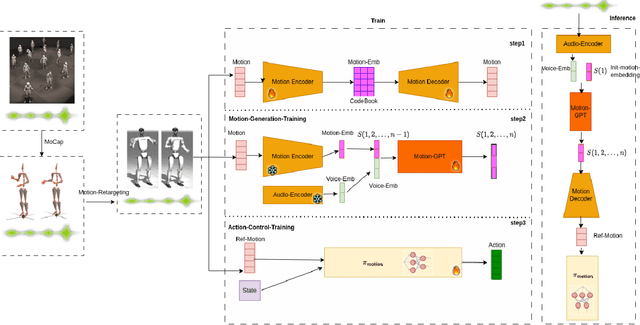
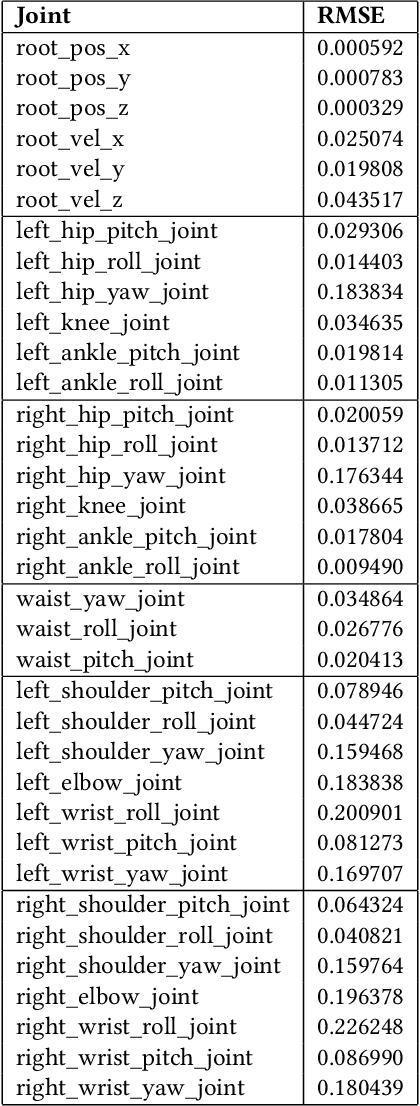
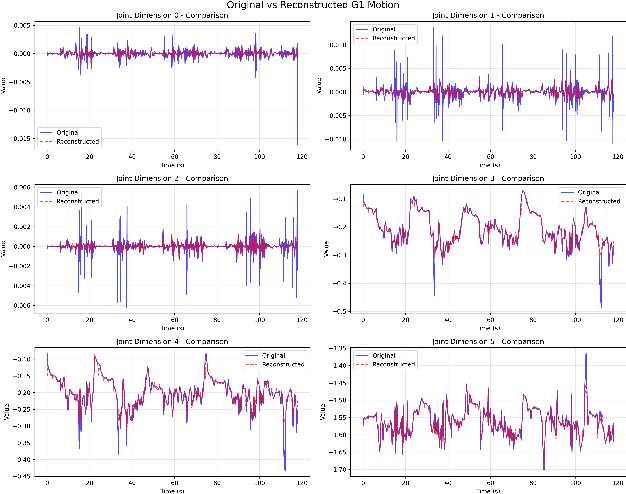
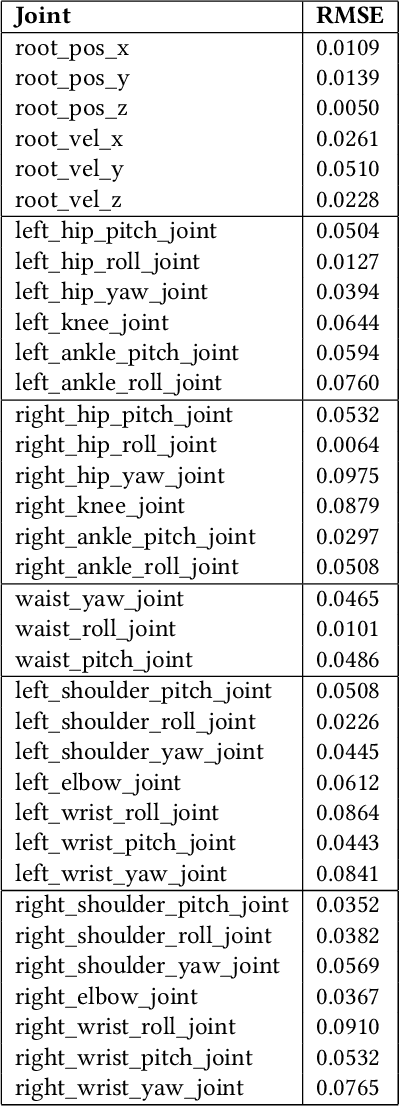
We present an innovative end-to-end framework for synthesizing semantically meaningful co-speech gestures and deploying them in real-time on a humanoid robot. This system addresses the challenge of creating natural, expressive non-verbal communication for robots by integrating advanced gesture generation techniques with robust physical control. Our core innovation lies in the meticulous integration of a semantics-aware gesture synthesis module, which derives expressive reference motions from speech input by leveraging a generative retrieval mechanism based on large language models (LLMs) and an autoregressive Motion-GPT model. This is coupled with a high-fidelity imitation learning control policy, the MotionTracker, which enables the Unitree G1 humanoid robot to execute these complex motions dynamically and maintain balance. To ensure feasibility, we employ a robust General Motion Retargeting (GMR) method to bridge the embodiment gap between human motion data and the robot platform. Through comprehensive evaluation, we demonstrate that our combined system produces semantically appropriate and rhythmically coherent gestures that are accurately tracked and executed by the physical robot. To our knowledge, this work represents a significant step toward general real-world use by providing a complete pipeline for automatic, semantic-aware, co-speech gesture generation and synchronized real-time physical deployment on a humanoid robot.
MMAT-1M: A Large Reasoning Dataset for Multimodal Agent Tuning
Jul 29, 2025Large Language Models (LLMs), enhanced through agent tuning, have demonstrated remarkable capabilities in Chain-of-Thought (CoT) and tool utilization, significantly surpassing the performance of standalone models. However, the multimodal domain still lacks a large-scale, high-quality agent tuning dataset to unlock the full potential of multimodal large language models. To bridge this gap, we introduce MMAT-1M, the first million-scale multimodal agent tuning dataset designed to support CoT, reflection, and dynamic tool usage. Our dataset is constructed through a novel four-stage data engine: 1) We first curate publicly available multimodal datasets containing question-answer pairs; 2) Then, leveraging GPT-4o, we generate rationales for the original question-answer pairs and dynamically integrate API calls and Retrieval Augmented Generation (RAG) information through a multi-turn paradigm; 3) Furthermore, we refine the rationales through reflection to ensure logical consistency and accuracy, creating a multi-turn dialogue dataset with both Rationale and Reflection (RR); 4) Finally, to enhance efficiency, we optionally compress multi-turn dialogues into a One-turn Rationale and Reflection (ORR) format. By fine-tuning open-source multimodal models on the MMAT-1M, we observe significant performance gains. For instance, the InternVL2.5-8B-RR model achieves an average improvement of 2.7% across eight public benchmarks and 8.8% on the RAG benchmark Dyn-VQA, demonstrating the dataset's effectiveness in enhancing multimodal reasoning and tool-based capabilities. The dataset is publicly available at https://github.com/VIS-MPU-Agent/MMAT-1M.
On Data Synthesis and Post-training for Visual Abstract Reasoning
Apr 02, 2025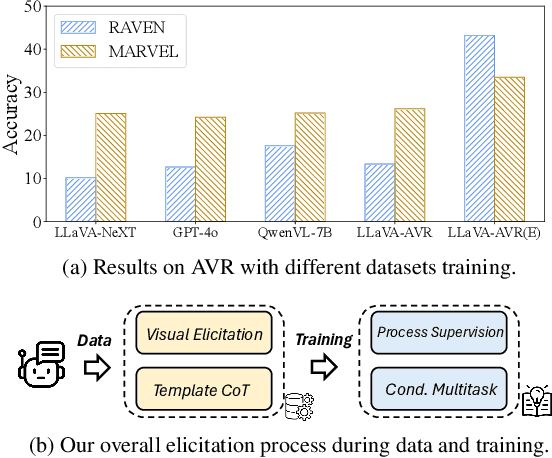
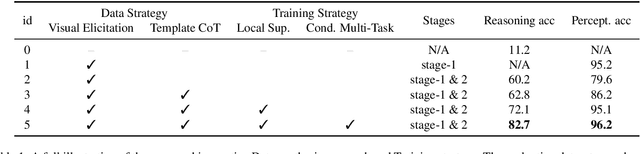
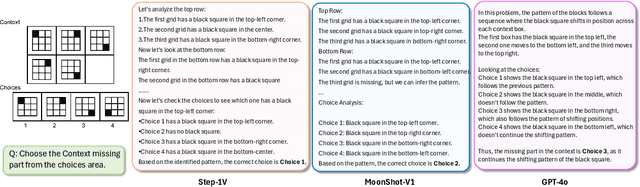
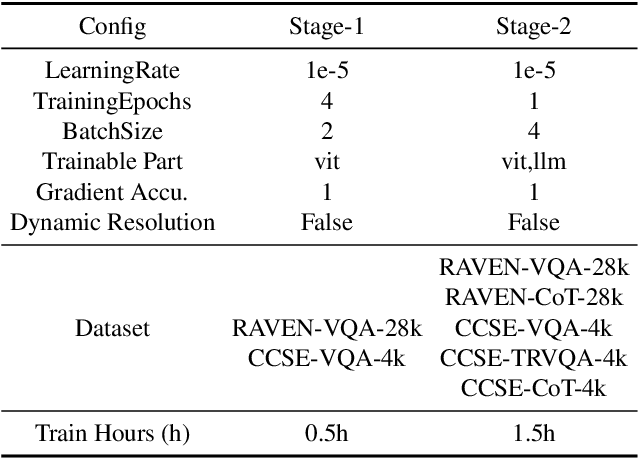
This paper is a pioneering work attempting to address abstract visual reasoning (AVR) problems for large vision-language models (VLMs). We make a common LLaVA-NeXT 7B model capable of perceiving and reasoning about specific AVR problems, surpassing both open-sourced (e.g., Qwen-2-VL-72B) and closed-sourced powerful VLMs (e.g., GPT-4o) with significant margin. This is a great breakthrough since almost all previous VLMs fail or show nearly random performance on representative AVR benchmarks. Our key success is our innovative data synthesis and post-training process, aiming to fully relieve the task difficulty and elicit the model to learn, step by step. Our 7B model is also shown to be behave well on AVR without sacrificing common multimodal comprehension abilities. We hope our paper could serve as an early effort in this area and would inspire further research in abstract visual reasoning.
Humanity's Last Exam
Jan 24, 2025Benchmarks are important tools for tracking the rapid advancements in large language model (LLM) capabilities. However, benchmarks are not keeping pace in difficulty: LLMs now achieve over 90\% accuracy on popular benchmarks like MMLU, limiting informed measurement of state-of-the-art LLM capabilities. In response, we introduce Humanity's Last Exam (HLE), a multi-modal benchmark at the frontier of human knowledge, designed to be the final closed-ended academic benchmark of its kind with broad subject coverage. HLE consists of 3,000 questions across dozens of subjects, including mathematics, humanities, and the natural sciences. HLE is developed globally by subject-matter experts and consists of multiple-choice and short-answer questions suitable for automated grading. Each question has a known solution that is unambiguous and easily verifiable, but cannot be quickly answered via internet retrieval. State-of-the-art LLMs demonstrate low accuracy and calibration on HLE, highlighting a significant gap between current LLM capabilities and the expert human frontier on closed-ended academic questions. To inform research and policymaking upon a clear understanding of model capabilities, we publicly release HLE at https://lastexam.ai.
Interpretable Face Anti-Spoofing: Enhancing Generalization with Multimodal Large Language Models
Jan 03, 2025
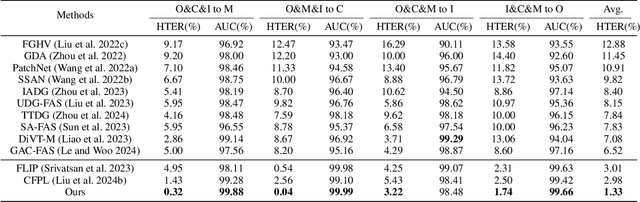


Face Anti-Spoofing (FAS) is essential for ensuring the security and reliability of facial recognition systems. Most existing FAS methods are formulated as binary classification tasks, providing confidence scores without interpretation. They exhibit limited generalization in out-of-domain scenarios, such as new environments or unseen spoofing types. In this work, we introduce a multimodal large language model (MLLM) framework for FAS, termed Interpretable Face Anti-Spoofing (I-FAS), which transforms the FAS task into an interpretable visual question answering (VQA) paradigm. Specifically, we propose a Spoof-aware Captioning and Filtering (SCF) strategy to generate high-quality captions for FAS images, enriching the model's supervision with natural language interpretations. To mitigate the impact of noisy captions during training, we develop a Lopsided Language Model (L-LM) loss function that separates loss calculations for judgment and interpretation, prioritizing the optimization of the former. Furthermore, to enhance the model's perception of global visual features, we design a Globally Aware Connector (GAC) to align multi-level visual representations with the language model. Extensive experiments on standard and newly devised One to Eleven cross-domain benchmarks, comprising 12 public datasets, demonstrate that our method significantly outperforms state-of-the-art methods.