 Add to Chrome
 Add to Firefox
 Add to Edge
Adaptive Siamese Tracking with a Compact Latent Network
Feb 02, 2023
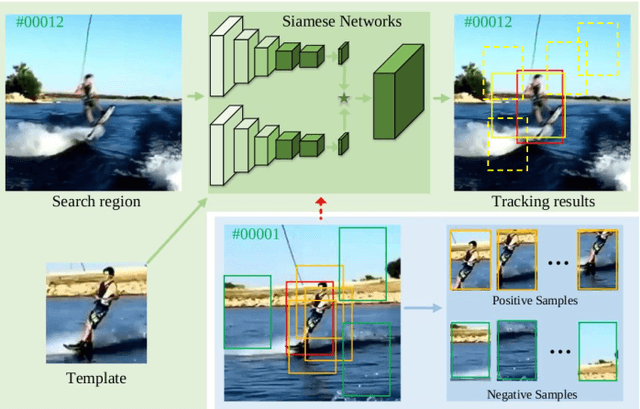
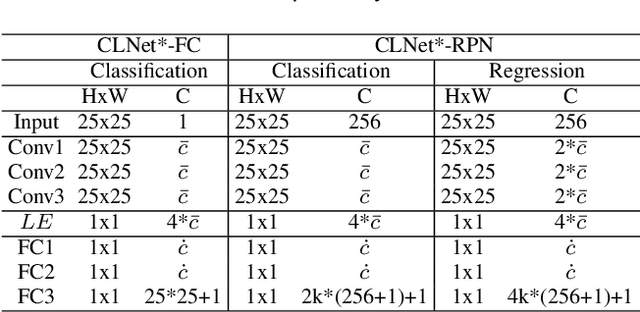
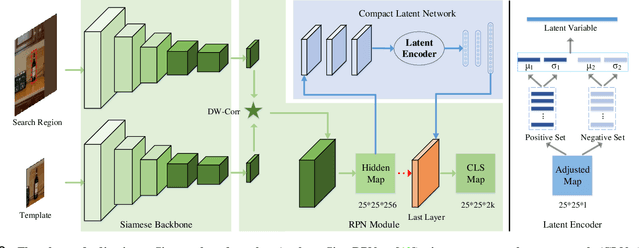

In this paper, we provide an intuitive viewing to simplify the Siamese-based trackers by converting the tracking task to a classification. Under this viewing, we perform an in-depth analysis for them through visual simulations and real tracking examples, and find that the failure cases in some challenging situations can be regarded as the issue of missing decisive samples in offline training. Since the samples in the initial (first) frame contain rich sequence-specific information, we can regard them as the decisive samples to represent the whole sequence. To quickly adapt the base model to new scenes, a compact latent network is presented via fully using these decisive samples. Specifically, we present a statistics-based compact latent feature for fast adjustment by efficiently extracting the sequence-specific information. Furthermore, a new diverse sample mining strategy is designed for training to further improve the discrimination ability of the proposed compact latent network. Finally, a conditional updating strategy is proposed to efficiently update the basic models to handle scene variation during the tracking phase. To evaluate the generalization ability and effectiveness and of our method, we apply it to adjust three classical Siamese-based trackers, namely SiamRPN++, SiamFC, and SiamBAN. Extensive experimental results on six recent datasets demonstrate that all three adjusted trackers obtain the superior performance in terms of the accuracy, while having high running speed.
* Extended version of the paper "CLNet: A Compact Latent Network for Fast Adjusting Siamese Trackers" presented at ECCV 2020. Accepted at TPAMI

Computational Assessment of Hyperpartisanship in News Titles
Jan 16, 2023We first adopt a human-guided machine learning framework to develop a new dataset for hyperpartisan news title detection with 2,200 manually labeled and 1.8 million machine-labeled titles that were posted from 2014 to the present by nine representative media organizations across three media bias groups - Left, Central, and Right in an active learning manner. The fine-tuned transformer-based language model achieves an overall accuracy of 0.84 and an F1 score of 0.78 on an external validation set. Next, we conduct a computational analysis to quantify the extent and dynamics of partisanship in news titles. While some aspects are as expected, our study reveals new or nuanced differences between the three media groups. We find that overall the Right media tends to use proportionally more hyperpartisan titles. Roughly around the 2016 Presidential Election, the proportions of hyperpartisan titles increased in all media bias groups where the relative increase in the proportion of hyperpartisan titles of the Left media was the most. We identify three major topics including foreign issues, political systems, and societal issues that are suggestive of hyperpartisanship in news titles using logistic regression models and the Shapley values. Through an analysis of the topic distribution, we find that societal issues gradually receive more attention from all media groups. We further apply a lexicon-based language analysis tool to the titles of each topic and quantify the linguistic distance between any pairs of the three media groups. Three distinct patterns are discovered. The Left media is linguistically more different from Central and Right in terms of foreign issues. The linguistic distance between the three media groups becomes smaller over recent years. In addition, a seasonal pattern where linguistic difference is associated with elections is observed for societal issues.
QuantArt: Quantizing Image Style Transfer Towards High Visual Fidelity
Dec 20, 2022The mechanism of existing style transfer algorithms is by minimizing a hybrid loss function to push the generated image toward high similarities in both content and style. However, this type of approach cannot guarantee visual fidelity, i.e., the generated artworks should be indistinguishable from real ones. In this paper, we devise a new style transfer framework called QuantArt for high visual-fidelity stylization. QuantArt pushes the latent representation of the generated artwork toward the centroids of the real artwork distribution with vector quantization. By fusing the quantized and continuous latent representations, QuantArt allows flexible control over the generated artworks in terms of content preservation, style similarity, and visual fidelity. Experiments on various style transfer settings show that our QuantArt framework achieves significantly higher visual fidelity compared with the existing style transfer methods.
3D Point Cloud Pre-training with Knowledge Distillation from 2D Images
Dec 17, 2022The recent success of pre-trained 2D vision models is mostly attributable to learning from large-scale datasets. However, compared with 2D image datasets, the current pre-training data of 3D point cloud is limited. To overcome this limitation, we propose a knowledge distillation method for 3D point cloud pre-trained models to acquire knowledge directly from the 2D representation learning model, particularly the image encoder of CLIP, through concept alignment. Specifically, we introduce a cross-attention mechanism to extract concept features from 3D point cloud and compare them with the semantic information from 2D images. In this scheme, the point cloud pre-trained models learn directly from rich information contained in 2D teacher models. Extensive experiments demonstrate that the proposed knowledge distillation scheme achieves higher accuracy than the state-of-the-art 3D pre-training methods for synthetic and real-world datasets on downstream tasks, including object classification, object detection, semantic segmentation, and part segmentation.
Structure-Guided Image Completion with Image-level and Object-level Semantic Discriminators
Dec 13, 2022Structure-guided image completion aims to inpaint a local region of an image according to an input guidance map from users. While such a task enables many practical applications for interactive editing, existing methods often struggle to hallucinate realistic object instances in complex natural scenes. Such a limitation is partially due to the lack of semantic-level constraints inside the hole region as well as the lack of a mechanism to enforce realistic object generation. In this work, we propose a learning paradigm that consists of semantic discriminators and object-level discriminators for improving the generation of complex semantics and objects. Specifically, the semantic discriminators leverage pretrained visual features to improve the realism of the generated visual concepts. Moreover, the object-level discriminators take aligned instances as inputs to enforce the realism of individual objects. Our proposed scheme significantly improves the generation quality and achieves state-of-the-art results on various tasks, including segmentation-guided completion, edge-guided manipulation and panoptically-guided manipulation on Places2 datasets. Furthermore, our trained model is flexible and can support multiple editing use cases, such as object insertion, replacement, removal and standard inpainting. In particular, our trained model combined with a novel automatic image completion pipeline achieves state-of-the-art results on the standard inpainting task.
A Unified Framework for Contrastive Learning from a Perspective of Affinity Matrix
Nov 26, 2022In recent years, a variety of contrastive learning based unsupervised visual representation learning methods have been designed and achieved great success in many visual tasks. Generally, these methods can be roughly classified into four categories: (1) standard contrastive methods with an InfoNCE like loss, such as MoCo and SimCLR; (2) non-contrastive methods with only positive pairs, such as BYOL and SimSiam; (3) whitening regularization based methods, such as W-MSE and VICReg; and (4) consistency regularization based methods, such as CO2. In this study, we present a new unified contrastive learning representation framework (named UniCLR) suitable for all the above four kinds of methods from a novel perspective of basic affinity matrix. Moreover, three variants, i.e., SimAffinity, SimWhitening and SimTrace, are presented based on UniCLR. In addition, a simple symmetric loss, as a new consistency regularization term, is proposed based on this framework. By symmetrizing the affinity matrix, we can effectively accelerate the convergence of the training process. Extensive experiments have been conducted to show that (1) the proposed UniCLR framework can achieve superior results on par with and even be better than the state of the art, (2) the proposed symmetric loss can significantly accelerate the convergence of models, and (3) SimTrace can avoid the mode collapse problem by maximizing the trace of a whitened affinity matrix without relying on asymmetry designs or stop-gradients.
Improving Visual-textual Sentiment Analysis by Fusing Expert Features
Nov 23, 2022Visual-textual sentiment analysis aims to predict sentiment with the input of a pair of image and text. The main challenge of visual-textual sentiment analysis is how to learn effective visual features for sentiment prediction since input images are often very diverse. To address this challenge, we propose a new method that improves visual-textual sentiment analysis by introducing powerful expert visual features. The proposed method consists of four parts: (1) a visual-textual branch to learn features directly from data for sentiment analysis, (2) a visual expert branch with a set of pre-trained "expert" encoders to extract effective visual features, (3) a CLIP branch to implicitly model visual-textual correspondence, and (4) a multimodal feature fusion network based on either BERT or MLP to fuse multimodal features and make sentiment prediction. Extensive experiments on three datasets show that our method produces better visual-textual sentiment analysis performance than existing methods.
Stare at What You See: Masked Image Modeling without Reconstruction
Nov 16, 2022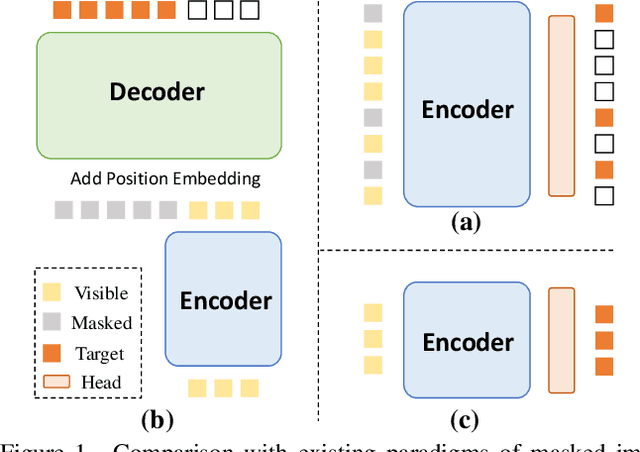
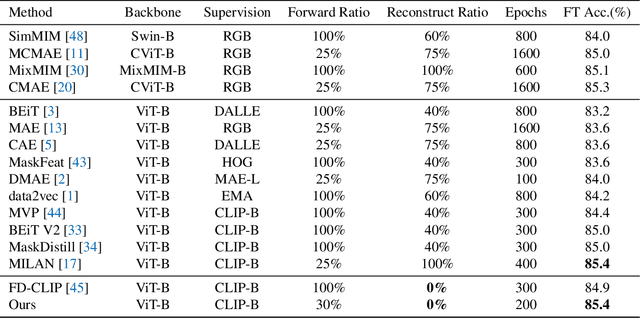
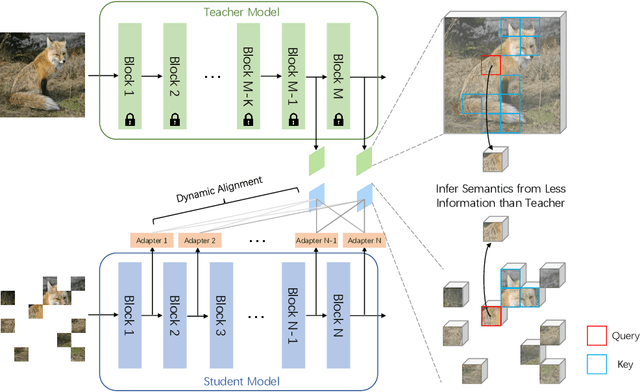
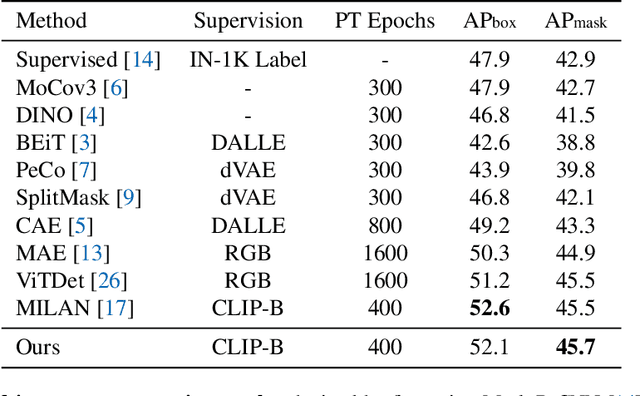
Masked Autoencoders (MAE) have been prevailing paradigms for large-scale vision representation pre-training. By reconstructing masked image patches from a small portion of visible image regions, MAE forces the model to infer semantic correlation within an image. Recently, some approaches apply semantic-rich teacher models to extract image features as the reconstruction target, leading to better performance. However, unlike the low-level features such as pixel values, we argue the features extracted by powerful teacher models already encode rich semantic correlation across regions in an intact image.This raises one question: is reconstruction necessary in Masked Image Modeling (MIM) with a teacher model? In this paper, we propose an efficient MIM paradigm named MaskAlign. MaskAlign simply learns the consistency of visible patch features extracted by the student model and intact image features extracted by the teacher model. To further advance the performance and tackle the problem of input inconsistency between the student and teacher model, we propose a Dynamic Alignment (DA) module to apply learnable alignment. Our experimental results demonstrate that masked modeling does not lose effectiveness even without reconstruction on masked regions. Combined with Dynamic Alignment, MaskAlign can achieve state-of-the-art performance with much higher efficiency. Code and models will be available at https://github.com/OpenPerceptionX/maskalign.
PromptCap: Prompt-Guided Task-Aware Image Captioning
Nov 15, 2022
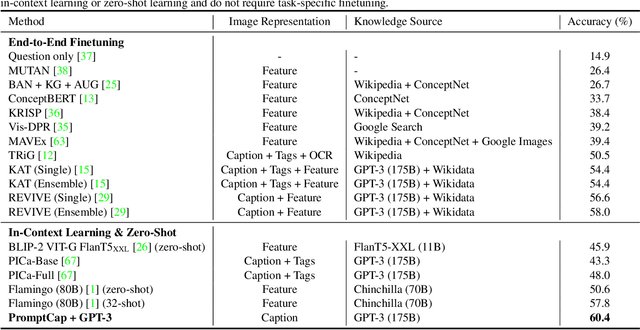
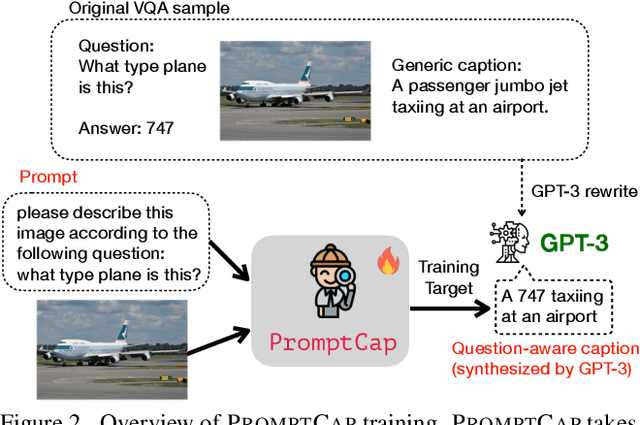
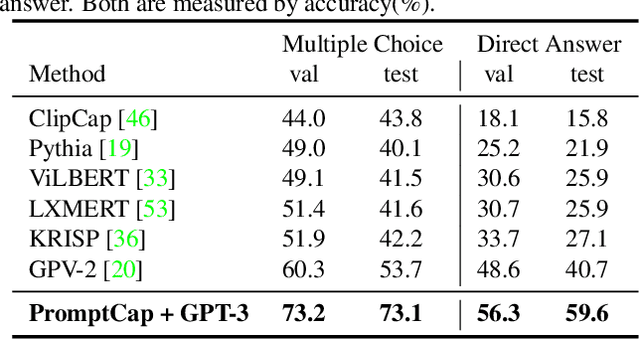
Image captioning aims to describe an image with a natural language sentence, allowing powerful language models to understand images. The framework of combining image captioning with language models has been successful on various vision-language tasks. However, an image contains much more information than a single sentence, leading to underspecification of which visual entities should be described in the caption sentence. For example, when performing visual questioning answering (VQA), generic image captions often miss visual details that are essential for the language model to answer correctly. To address this challenge, we propose PromptCap, a captioning model that takes a natural-language prompt to control the contents of the generated caption. The prompt contains a question that the caption should help to answer, and also supports taking auxiliary text inputs such as scene text within the image itself. To finetune a general image caption model for prompt-guided captioning, we propose a pipeline to synthesize and filter training examples with GPT-3 and existing VQA datasets. For evaluation, we start with an existing pipeline in which a language model is prompted with image captions to carry out VQA. With the same language model, a higher QA accuracy shows that our generated captions are more relevant to the question prompts. PromptCap outperforms generic captions by a large margin on a variety of VQA tasks and achieves the state-of-the-art accuracy of 58.8 % on OK-VQA and 58.0 % on A-OKVQA. Zero-shot experiments on WebQA show that PromptCap generalizes well to unseen domains.
FedX: Federated Learning for Compositional Pairwise Risk Optimization
Oct 26, 2022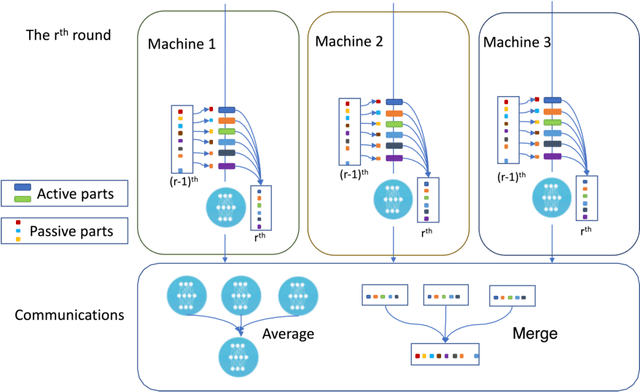
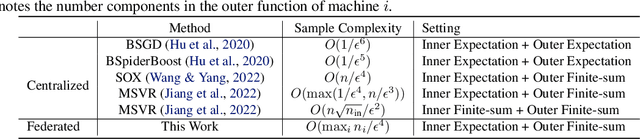
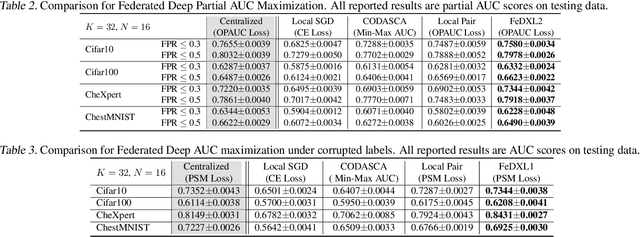

In this paper, we tackle a novel federated learning (FL) problem for optimizing a family of compositional pairwise risks, to which no existing FL algorithms are applicable. In particular, the objective has the form of $\mathbb E_{\mathbf z\sim \mathcal S_1} f(\mathbb E_{\mathbf z'\sim\mathcal S_2} \ell(\mathbf w, \mathbf z, \mathbf z'))$, where two sets of data $\mathcal S_1, \mathcal S_2$ are distributed over multiple machines, $\ell(\cdot; \cdot,\cdot)$ is a pairwise loss that only depends on the prediction outputs of the input data pairs $(\mathbf z, \mathbf z')$, and $f(\cdot)$ is possibly a non-linear non-convex function. This problem has important applications in machine learning, e.g., AUROC maximization with a pairwise loss, and partial AUROC maximization with a compositional loss. The challenges for designing an FL algorithm lie in the non-decomposability of the objective over multiple machines and the interdependency between different machines. We propose two provable FL algorithms (FedX) for handling linear and nonlinear $f$, respectively. To address the challenges, we decouple the gradient's components with two types, namely active parts and lazy parts, where the active parts depend on local data that are computed with the local model and the lazy parts depend on other machines that are communicated/computed based on historical models and samples. We develop a novel theoretical analysis to combat the latency of the lazy parts and the interdependency between the local model parameters and the involved data for computing local gradient estimators. We establish both iteration and communication complexities and show that using the historical samples and models for computing the lazy parts do not degrade the complexities. We conduct empirical studies of FedX for deep AUROC and partial AUROC maximization, and demonstrate their performance compared with several baselines.