 Add to Chrome
 Add to Firefox
 Add to Edge
Act Wisely: Cultivating Meta-Cognitive Tool Use in Agentic Multimodal Models
Apr 09, 2026
The advent of agentic multimodal models has empowered systems to actively interact with external environments. However, current agents suffer from a profound meta-cognitive deficit: they struggle to arbitrate between leveraging internal knowledge and querying external utilities. Consequently, they frequently fall prey to blind tool invocation, resorting to reflexive tool execution even when queries are resolvable from the raw visual context. This pathological behavior precipitates severe latency bottlenecks and injects extraneous noise that derails sound reasoning. Existing reinforcement learning protocols attempt to mitigate this via a scalarized reward that penalizes tool usage. Yet, this coupled formulation creates an irreconcilable optimization dilemma: an aggressive penalty suppresses essential tool use, whereas a mild penalty is entirely subsumed by the variance of the accuracy reward during advantage normalization, rendering it impotent against tool overuse. To transcend this bottleneck, we propose HDPO, a framework that reframes tool efficiency from a competing scalar objective to a strictly conditional one. By eschewing reward scalarization, HDPO maintains two orthogonal optimization channels: an accuracy channel that maximizes task correctness, and an efficiency channel that enforces execution economy exclusively within accurate trajectories via conditional advantage estimation. This decoupled architecture naturally induces a cognitive curriculum-compelling the agent to first master task resolution before refining its self-reliance. Extensive evaluations demonstrate that our resulting model, Metis, reduces tool invocations by orders of magnitude while simultaneously elevating reasoning accuracy.

MM-CondChain: A Programmatically Verified Benchmark for Visually Grounded Deep Compositional Reasoning
Mar 12, 2026Multimodal Large Language Models (MLLMs) are increasingly used to carry out visual workflows such as navigating GUIs, where the next step depends on verified visual compositional conditions (e.g., "if a permission dialog appears and the color of the interface is green, click Allow") and the process may branch or terminate early. Yet this capability remains under-evaluated: existing benchmarks focus on shallow-compositions or independent-constraints rather than deeply chained compositional conditionals. In this paper, we introduce MM-CondChain, a benchmark for visually grounded deep compositional reasoning. Each benchmark instance is organized as a multi-layer reasoning chain, where every layer contains a non-trivial compositional condition grounded in visual evidence and built from multiple objects, attributes, or relations. To answer correctly, an MLLM must perceive the image in detail, reason over multiple visual elements at each step, and follow the resulting execution path to the final outcome. To scalably construct such workflow-style data, we propose an agentic synthesis pipeline: a Planner orchestrates layer-by-layer generation of compositional conditions, while a Verifiable Programmatic Intermediate Representation (VPIR) ensures each layer's condition is mechanically verifiable. A Composer then assembles these verified layers into complete instructions. Using this pipeline, we construct benchmarks across three visual domains: natural images, data charts, and GUI trajectories. Experiments on a range of MLLMs show that even the strongest model attains only 53.33 Path F1, with sharp drops on hard negatives and as depth or predicate complexity grows, confirming that deep compositional reasoning remains a fundamental challenge.
Beyond Scattered Acceptance: Fast and Coherent Inference for DLMs via Longest Stable Prefixes
Mar 05, 2026Diffusion Language Models (DLMs) promise highly parallel text generation, yet their practical inference speed is often bottlenecked by suboptimal decoding schedulers. Standard approaches rely on 'scattered acceptance'-committing high confidence tokens at disjoint positions throughout the sequence. This approach inadvertently fractures the Key-Value (KV) cache, destroys memory locality, and forces the model into costly, repeated repairs across unstable token boundaries. To resolve this, we present the Longest Stable Prefix (LSP) scheduler, a training-free and model-agnostic inference paradigm based on monolithic prefix absorption. In each denoising step, LSP evaluates token stability via a single forward pass, dynamically identifies a contiguous left-aligned block of stable predictions, and snaps its boundary to natural linguistic or structural delimiters before an atomic commitment. This prefix-first topology yields dual benefits: systemically, it converts fragmented KV cache updates into efficient, contiguous appends; algorithmically, it preserves bidirectional lookahead over a geometrically shrinking active suffix, drastically reducing token flip rates and denoiser calls. Extensive evaluations on LLaDA-8B and Dream-7B demonstrate that LSP accelerates inference by up to 3.4x across rigorous benchmarks including mathematical reasoning, code generation, multilingual (CJK) tasks, and creative writing while matching or slightly improving output quality. By fundamentally restructuring the commitment topology, LSP bridges the gap between the theoretical parallelism of DLMs and practical hardware efficiency.
SwimBird: Eliciting Switchable Reasoning Mode in Hybrid Autoregressive MLLMs
Feb 05, 2026Multimodal Large Language Models (MLLMs) have made remarkable progress in multimodal perception and reasoning by bridging vision and language. However, most existing MLLMs perform reasoning primarily with textual CoT, which limits their effectiveness on vision-intensive tasks. Recent approaches inject a fixed number of continuous hidden states as "visual thoughts" into the reasoning process and improve visual performance, but often at the cost of degraded text-based logical reasoning. We argue that the core limitation lies in a rigid, pre-defined reasoning pattern that cannot adaptively choose the most suitable thinking modality for different user queries. We introduce SwimBird, a reasoning-switchable MLLM that dynamically switches among three reasoning modes conditioned on the input: (1) text-only reasoning, (2) vision-only reasoning (continuous hidden states as visual thoughts), and (3) interleaved vision-text reasoning. To enable this capability, we adopt a hybrid autoregressive formulation that unifies next-token prediction for textual thoughts with next-embedding prediction for visual thoughts, and design a systematic reasoning-mode curation strategy to construct SwimBird-SFT-92K, a diverse supervised fine-tuning dataset covering all three reasoning patterns. By enabling flexible, query-adaptive mode selection, SwimBird preserves strong textual logic while substantially improving performance on vision-dense tasks. Experiments across diverse benchmarks covering textual reasoning and challenging visual understanding demonstrate that SwimBird achieves state-of-the-art results and robust gains over prior fixed-pattern multimodal reasoning methods.
CrossLMM: Decoupling Long Video Sequences from LMMs via Dual Cross-Attention Mechanisms
May 22, 2025The advent of Large Multimodal Models (LMMs) has significantly enhanced Large Language Models (LLMs) to process and interpret diverse data modalities (e.g., image and video). However, as input complexity increases, particularly with long video sequences, the number of required tokens has grown significantly, leading to quadratically computational costs. This has made the efficient compression of video tokens in LMMs, while maintaining performance integrity, a pressing research challenge. In this paper, we introduce CrossLMM, decoupling long video sequences from LMMs via a dual cross-attention mechanism, which substantially reduces visual token quantity with minimal performance degradation. Specifically, we first implement a significant token reduction from pretrained visual encoders through a pooling methodology. Then, within LLM layers, we employ a visual-to-visual cross-attention mechanism, wherein the pooled visual tokens function as queries against the original visual token set. This module enables more efficient token utilization while retaining fine-grained informational fidelity. In addition, we introduce a text-to-visual cross-attention mechanism, for which the text tokens are enhanced through interaction with the original visual tokens, enriching the visual comprehension of the text tokens. Comprehensive empirical evaluation demonstrates that our approach achieves comparable or superior performance across diverse video-based LMM benchmarks, despite utilizing substantially fewer computational resources.
Visual Perception by Large Language Model's Weights
May 30, 2024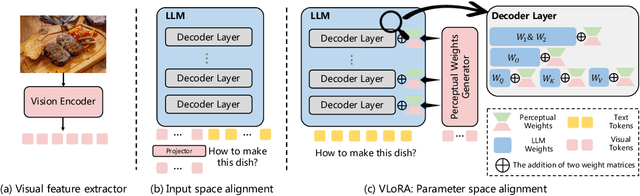

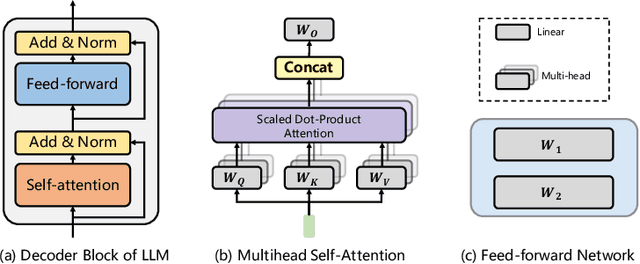

Existing Multimodal Large Language Models (MLLMs) follow the paradigm that perceives visual information by aligning visual features with the input space of Large Language Models (LLMs), and concatenating visual tokens with text tokens to form a unified sequence input for LLMs. These methods demonstrate promising results on various vision-language tasks but are limited by the high computational effort due to the extended input sequence resulting from the involvement of visual tokens. In this paper, instead of input space alignment, we propose a novel parameter space alignment paradigm that represents visual information as model weights. For each input image, we use a vision encoder to extract visual features, convert features into perceptual weights, and merge the perceptual weights with LLM's weights. In this way, the input of LLM does not require visual tokens, which reduces the length of the input sequence and greatly improves efficiency. Following this paradigm, we propose VLoRA with the perceptual weights generator. The perceptual weights generator is designed to convert visual features to perceptual weights with low-rank property, exhibiting a form similar to LoRA. The experimental results show that our VLoRA achieves comparable performance on various benchmarks for MLLMs, while significantly reducing the computational costs for both training and inference. The code and models will be made open-source.
Multi-Modal Generative Embedding Model
May 29, 2024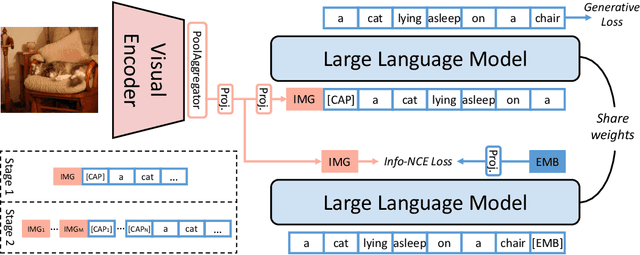


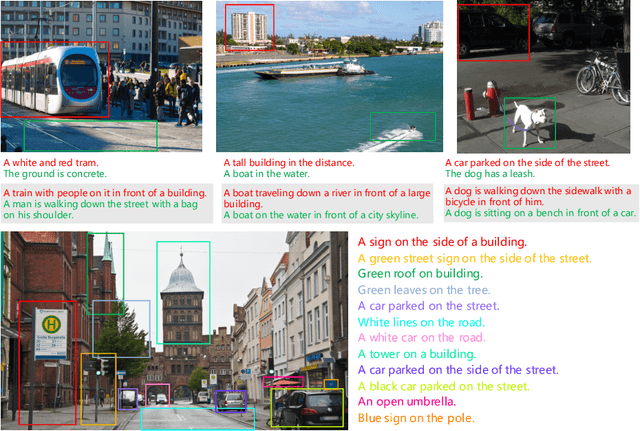
Most multi-modal tasks can be formulated into problems of either generation or embedding. Existing models usually tackle these two types of problems by decoupling language modules into a text decoder for generation, and a text encoder for embedding. To explore the minimalism of multi-modal paradigms, we attempt to achieve only one model per modality in this work. We propose a Multi-Modal Generative Embedding Model (MM-GEM), whereby the generative and embedding objectives are encapsulated in one Large Language Model. We also propose a PoolAggregator to boost efficiency and enable the ability of fine-grained embedding and generation. A surprising finding is that these two objectives do not significantly conflict with each other. For example, MM-GEM instantiated from ViT-Large and TinyLlama shows competitive performance on benchmarks for multimodal embedding models such as cross-modal retrieval and zero-shot classification, while has good ability of image captioning. Additionally, MM-GEM can seamlessly execute region-level image caption generation and retrieval tasks. Besides, the advanced text model in MM-GEM brings over 5% improvement in Recall@1 for long text and image retrieval.
Stare at What You See: Masked Image Modeling without Reconstruction
Nov 16, 2022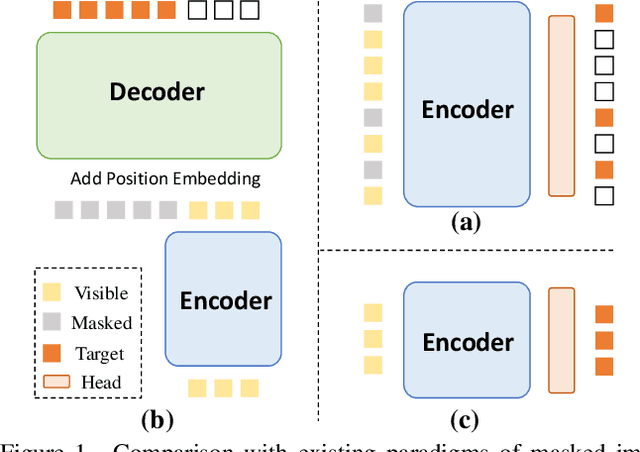
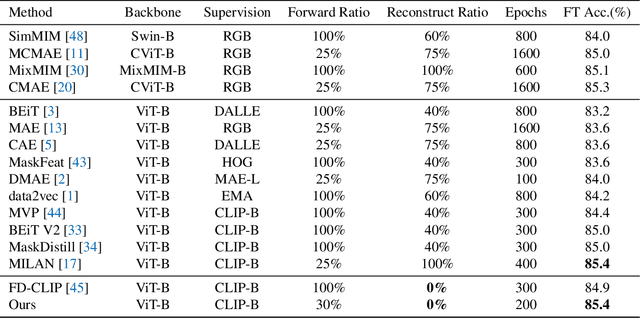
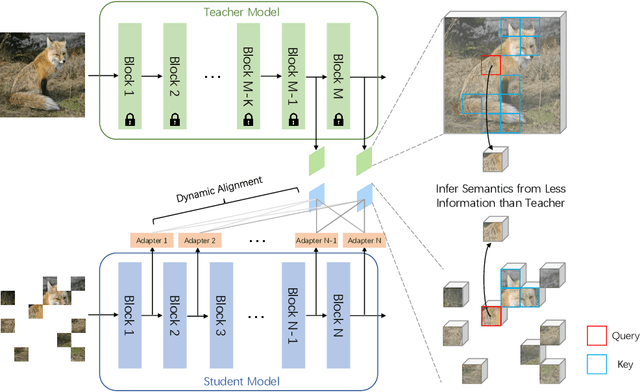
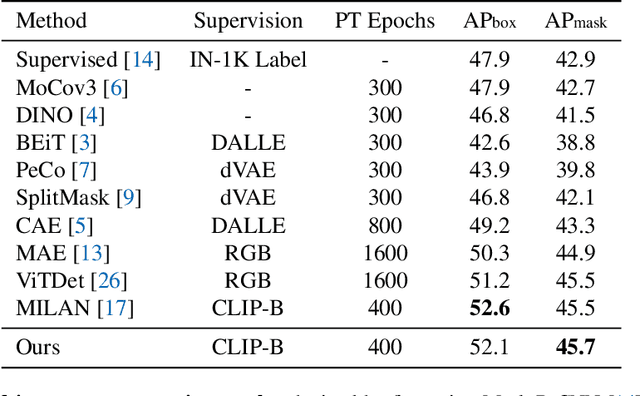
Masked Autoencoders (MAE) have been prevailing paradigms for large-scale vision representation pre-training. By reconstructing masked image patches from a small portion of visible image regions, MAE forces the model to infer semantic correlation within an image. Recently, some approaches apply semantic-rich teacher models to extract image features as the reconstruction target, leading to better performance. However, unlike the low-level features such as pixel values, we argue the features extracted by powerful teacher models already encode rich semantic correlation across regions in an intact image.This raises one question: is reconstruction necessary in Masked Image Modeling (MIM) with a teacher model? In this paper, we propose an efficient MIM paradigm named MaskAlign. MaskAlign simply learns the consistency of visible patch features extracted by the student model and intact image features extracted by the teacher model. To further advance the performance and tackle the problem of input inconsistency between the student and teacher model, we propose a Dynamic Alignment (DA) module to apply learnable alignment. Our experimental results demonstrate that masked modeling does not lose effectiveness even without reconstruction on masked regions. Combined with Dynamic Alignment, MaskAlign can achieve state-of-the-art performance with much higher efficiency. Code and models will be available at https://github.com/OpenPerceptionX/maskalign.
Long-Form Video-Language Pre-Training with Multimodal Temporal Contrastive Learning
Oct 12, 2022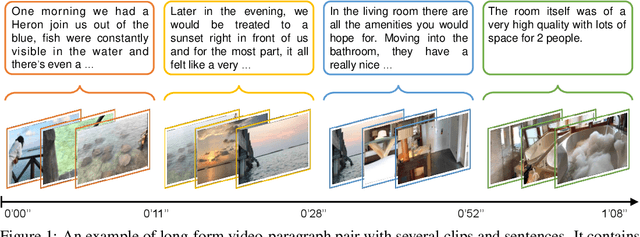
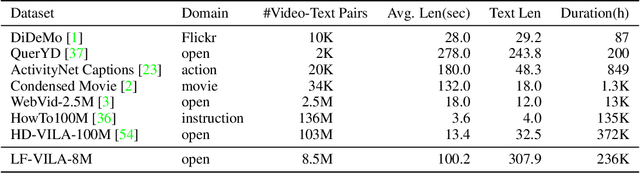
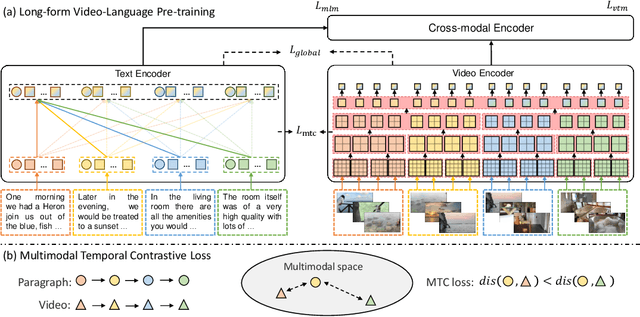
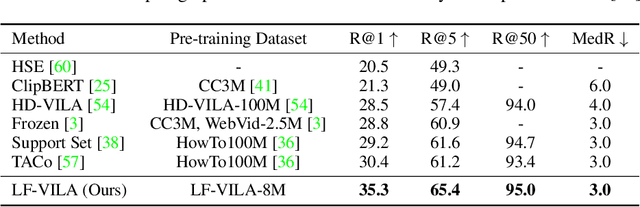
Large-scale video-language pre-training has shown significant improvement in video-language understanding tasks. Previous studies of video-language pretraining mainly focus on short-form videos (i.e., within 30 seconds) and sentences, leaving long-form video-language pre-training rarely explored. Directly learning representation from long-form videos and language may benefit many long-form video-language understanding tasks. However, it is challenging due to the difficulty of modeling long-range relationships and the heavy computational burden caused by more frames. In this paper, we introduce a Long-Form VIdeo-LAnguage pre-training model (LF-VILA) and train it on a large-scale long-form video and paragraph dataset constructed from an existing public dataset. To effectively capture the rich temporal dynamics and to better align video and language in an efficient end-to-end manner, we introduce two novel designs in our LF-VILA model. We first propose a Multimodal Temporal Contrastive (MTC) loss to learn the temporal relation across different modalities by encouraging fine-grained alignment between long-form videos and paragraphs. Second, we propose a Hierarchical Temporal Window Attention (HTWA) mechanism to effectively capture long-range dependency while reducing computational cost in Transformer. We fine-tune the pre-trained LF-VILA model on seven downstream long-form video-language understanding tasks of paragraph-to-video retrieval and long-form video question-answering, and achieve new state-of-the-art performances. Specifically, our model achieves 16.1% relative improvement on ActivityNet paragraph-to-video retrieval task and 2.4% on How2QA task, respectively. We release our code, dataset, and pre-trained models at https://github.com/microsoft/XPretrain.
CLIP-ViP: Adapting Pre-trained Image-Text Model to Video-Language Representation Alignment
Sep 23, 2022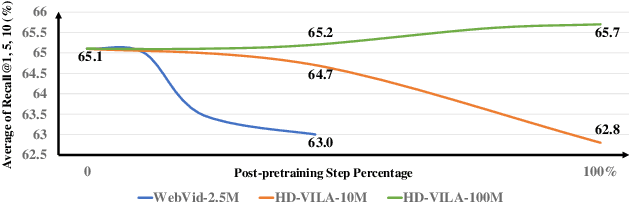
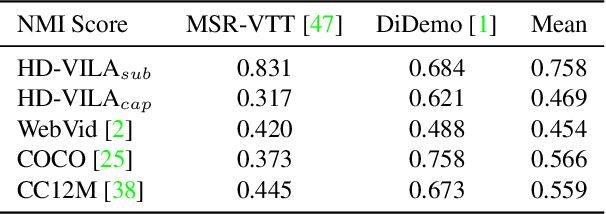
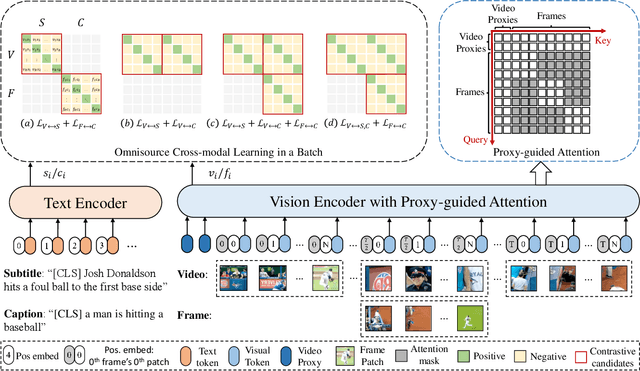
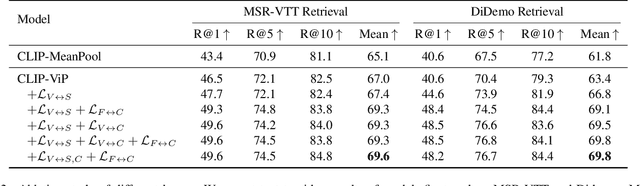
The pre-trained image-text models, like CLIP, have demonstrated the strong power of vision-language representation learned from a large scale of web-collected image-text data. In light of the well-learned visual features, some existing works transfer image representation to video domain and achieve good results. However, how to utilize image-language pre-trained model (e.g., CLIP) for video-language pre-training (post-pretraining) is still under explored. In this paper, we investigate two questions: 1) what are the factors hindering post-pretraining CLIP to further improve the performance on video-language tasks? and 2) how to mitigate the impact of these factors? Through a series of comparative experiments and analyses, we find that the data scale and domain gap between language sources have great impacts. Motivated by these, we propose a Omnisource Cross-modal Learning method equipped with a Video Proxy mechanism on the basis of CLIP, namely CLIP-ViP. Extensive results show that our approach improves the performance of CLIP on video-text retrieval by a large margin. Our model also achieves SOTA results on a variety of datasets, including MSR-VTT, DiDeMo, LSMDC, and ActivityNet. We will release our code and pre-trained CLIP-ViP models at https://github.com/microsoft/XPretrain/tree/main/CLIP-ViP.