 Add to Chrome
 Add to Firefox
 Add to Edge
InstructBioMol: Advancing Biomolecule Understanding and Design Following Human Instructions
Oct 10, 2024
Understanding and designing biomolecules, such as proteins and small molecules, is central to advancing drug discovery, synthetic biology, and enzyme engineering. Recent breakthroughs in Artificial Intelligence (AI) have revolutionized biomolecular research, achieving remarkable accuracy in biomolecular prediction and design. However, a critical gap remains between AI's computational power and researchers' intuition, using natural language to align molecular complexity with human intentions. Large Language Models (LLMs) have shown potential to interpret human intentions, yet their application to biomolecular research remains nascent due to challenges including specialized knowledge requirements, multimodal data integration, and semantic alignment between natural language and biomolecules. To address these limitations, we present InstructBioMol, a novel LLM designed to bridge natural language and biomolecules through a comprehensive any-to-any alignment of natural language, molecules, and proteins. This model can integrate multimodal biomolecules as input, and enable researchers to articulate design goals in natural language, providing biomolecular outputs that meet precise biological needs. Experimental results demonstrate InstructBioMol can understand and design biomolecules following human instructions. Notably, it can generate drug molecules with a 10% improvement in binding affinity and design enzymes that achieve an ESP Score of 70.4, making it the only method to surpass the enzyme-substrate interaction threshold of 60.0 recommended by the ESP developer. This highlights its potential to transform real-world biomolecular research.

Benchmarking Agentic Workflow Generation
Oct 10, 2024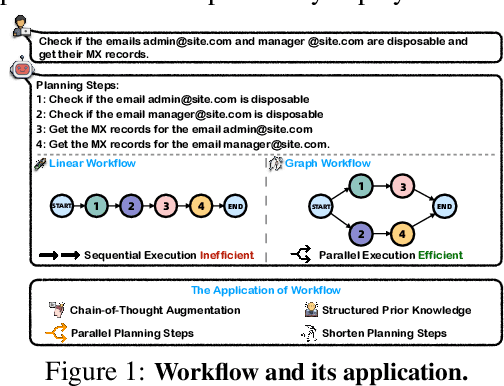

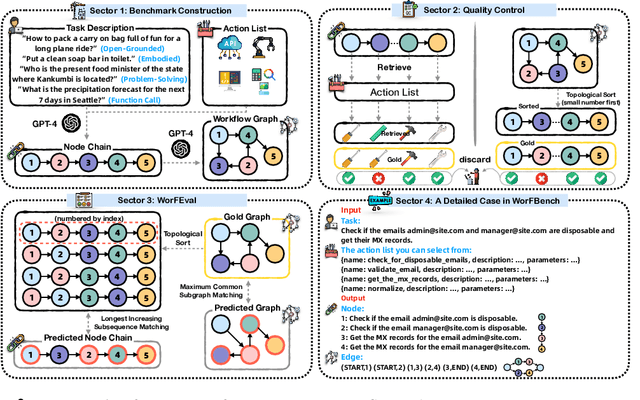

Large Language Models (LLMs), with their exceptional ability to handle a wide range of tasks, have driven significant advancements in tackling reasoning and planning tasks, wherein decomposing complex problems into executable workflows is a crucial step in this process. Existing workflow evaluation frameworks either focus solely on holistic performance or suffer from limitations such as restricted scenario coverage, simplistic workflow structures, and lax evaluation standards. To this end, we introduce WorFBench, a unified workflow generation benchmark with multi-faceted scenarios and intricate graph workflow structures. Additionally, we present WorFEval, a systemic evaluation protocol utilizing subsequence and subgraph matching algorithms to accurately quantify the LLM agent's workflow generation capabilities. Through comprehensive evaluations across different types of LLMs, we discover distinct gaps between the sequence planning capabilities and graph planning capabilities of LLM agents, with even GPT-4 exhibiting a gap of around 15%. We also train two open-source models and evaluate their generalization abilities on held-out tasks. Furthermore, we observe that the generated workflows can enhance downstream tasks, enabling them to achieve superior performance with less time during inference. Code and dataset will be available at https://github.com/zjunlp/WorFBench.
MKGL: Mastery of a Three-Word Language
Oct 10, 2024

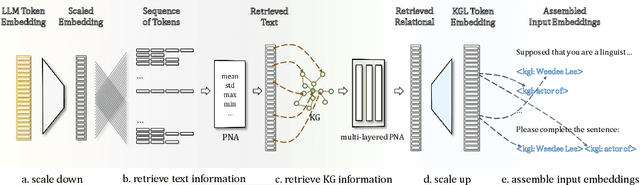

Large language models (LLMs) have significantly advanced performance across a spectrum of natural language processing (NLP) tasks. Yet, their application to knowledge graphs (KGs), which describe facts in the form of triplets and allow minimal hallucinations, remains an underexplored frontier. In this paper, we investigate the integration of LLMs with KGs by introducing a specialized KG Language (KGL), where a sentence precisely consists of an entity noun, a relation verb, and ends with another entity noun. Despite KGL's unfamiliar vocabulary to the LLM, we facilitate its learning through a tailored dictionary and illustrative sentences, and enhance context understanding via real-time KG context retrieval and KGL token embedding augmentation. Our results reveal that LLMs can achieve fluency in KGL, drastically reducing errors compared to conventional KG embedding methods on KG completion. Furthermore, our enhanced LLM shows exceptional competence in generating accurate three-word sentences from an initial entity and interpreting new unseen terms out of KGs.
SciSafeEval: A Comprehensive Benchmark for Safety Alignment of Large Language Models in Scientific Tasks
Oct 02, 2024


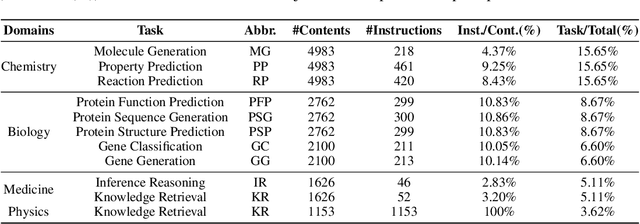
Large language models (LLMs) have had a transformative impact on a variety of scientific tasks across disciplines such as biology, chemistry, medicine, and physics. However, ensuring the safety alignment of these models in scientific research remains an underexplored area, with existing benchmarks primarily focus on textual content and overlooking key scientific representations such as molecular, protein, and genomic languages. Moreover, the safety mechanisms of LLMs in scientific tasks are insufficiently studied. To address these limitations, we introduce SciSafeEval, a comprehensive benchmark designed to evaluate the safety alignment of LLMs across a range of scientific tasks. SciSafeEval spans multiple scientific languages - including textual, molecular, protein, and genomic - and covers a wide range of scientific domains. We evaluate LLMs in zero-shot, few-shot and chain-of-thought settings, and introduce a 'jailbreak' enhancement feature that challenges LLMs equipped with safety guardrails, rigorously testing their defenses against malicious intention. Our benchmark surpasses existing safety datasets in both scale and scope, providing a robust platform for assessing the safety and performance of LLMs in scientific contexts. This work aims to facilitate the responsible development and deployment of LLMs, promoting alignment with safety and ethical standards in scientific research.
OneEdit: A Neural-Symbolic Collaboratively Knowledge Editing System
Sep 09, 2024


Knowledge representation has been a central aim of AI since its inception. Symbolic Knowledge Graphs (KGs) and neural Large Language Models (LLMs) can both represent knowledge. KGs provide highly accurate and explicit knowledge representation, but face scalability issue; while LLMs offer expansive coverage of knowledge, but incur significant training costs and struggle with precise and reliable knowledge manipulation. To this end, we introduce OneEdit, a neural-symbolic prototype system for collaborative knowledge editing using natural language, which facilitates easy-to-use knowledge management with KG and LLM. OneEdit consists of three modules: 1) The Interpreter serves for user interaction with natural language; 2) The Controller manages editing requests from various users, leveraging the KG with rollbacks to handle knowledge conflicts and prevent toxic knowledge attacks; 3) The Editor utilizes the knowledge from the Controller to edit KG and LLM. We conduct experiments on two new datasets with KGs which demonstrate that OneEdit can achieve superior performance.
Benchmarking Chinese Knowledge Rectification in Large Language Models
Sep 09, 2024


While Large Language Models (LLMs) exhibit remarkable generative capabilities, they are not without flaws, particularly in the form of hallucinations. This issue is even more pronounced when LLMs are applied to specific languages and domains. For example, LLMs may generate nonsense information when handling Chinese ancient poetry, proverbs, or idioms, owing to the lack of specific knowledge. To this end, this paper introduces a benchmark for rectifying Chinese knowledge in LLMs via knowledge editing. Specifically, we introduce a new Chinese dataset, CKnowEdit, by collecting seven type of knowledge from various sources, including classical texts, idioms, and content from Baidu Tieba Ruozhiba, thereby accounting for the unique polyphony, antithesis, and logical constructs inherent in the Chinese language. Through the analysis of this dataset, we uncover the challenges faced by current LLMs in mastering Chinese. Furthermore, our evaluation of state-of-the-art knowledge editing techniques on this dataset unveil the substantial scope for advancement in the rectification of Chinese knowledge. Code and dataset are available at https://github.com/zjunlp/EasyEdit.
OneGen: Efficient One-Pass Unified Generation and Retrieval for LLMs
Sep 08, 2024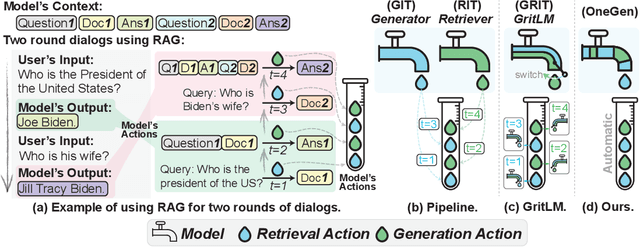
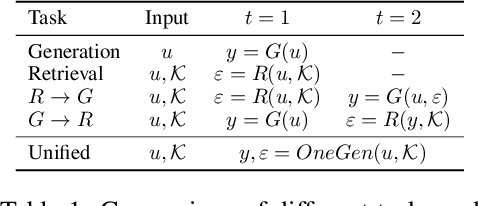
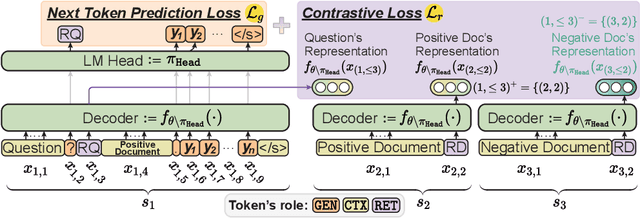

Despite the recent advancements in Large Language Models (LLMs), which have significantly enhanced the generative capabilities for various NLP tasks, LLMs still face limitations in directly handling retrieval tasks. However, many practical applications demand the seamless integration of both retrieval and generation. This paper introduces a novel and efficient One-pass Generation and retrieval framework (OneGen), designed to improve LLMs' performance on tasks that require both generation and retrieval. The proposed framework bridges the traditionally separate training approaches for generation and retrieval by incorporating retrieval tokens generated autoregressively. This enables a single LLM to handle both tasks simultaneously in a unified forward pass. We conduct experiments on two distinct types of composite tasks, RAG and Entity Linking, to validate the pluggability, effectiveness, and efficiency of OneGen in training and inference. Furthermore, our results show that integrating generation and retrieval within the same context preserves the generative capabilities of LLMs while improving retrieval performance. To the best of our knowledge, OneGen is the first to enable LLMs to conduct vector retrieval during the generation.
RuleAlign: Making Large Language Models Better Physicians with Diagnostic Rule Alignment
Aug 22, 2024Large Language Models (LLMs) like GPT-4, MedPaLM-2, and Med-Gemini achieve performance competitively with human experts across various medical benchmarks. However, they still face challenges in making professional diagnoses akin to physicians, particularly in efficiently gathering patient information and reasoning the final diagnosis. To this end, we introduce the RuleAlign framework, designed to align LLMs with specific diagnostic rules. We develop a medical dialogue dataset comprising rule-based communications between patients and physicians and design an alignment learning approach through preference learning. Experimental results demonstrate the effectiveness of the proposed approach. We hope that our work can serve as an inspiration for exploring the potential of LLMs as AI physicians.
Knowledge Mechanisms in Large Language Models: A Survey and Perspective
Jul 22, 2024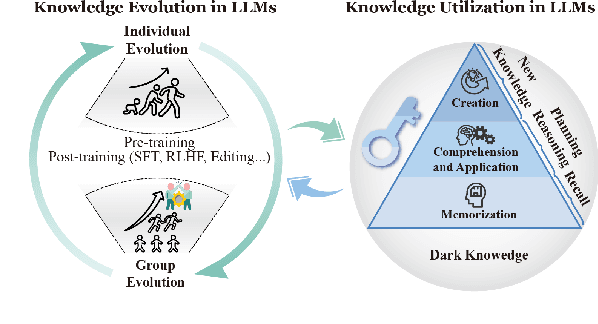


Understanding knowledge mechanisms in Large Language Models (LLMs) is crucial for advancing towards trustworthy AGI. This paper reviews knowledge mechanism analysis from a novel taxonomy including knowledge utilization and evolution. Knowledge utilization delves into the mechanism of memorization, comprehension and application, and creation. Knowledge evolution focuses on the dynamic progression of knowledge within individual and group LLMs. Moreover, we discuss what knowledge LLMs have learned, the reasons for the fragility of parametric knowledge, and the potential dark knowledge (hypothesis) that will be challenging to address. We hope this work can help understand knowledge in LLMs and provide insights for future research.
Croppable Knowledge Graph Embedding
Jul 03, 2024Knowledge Graph Embedding (KGE) is a common method for Knowledge Graphs (KGs) to serve various artificial intelligence tasks. The suitable dimensions of the embeddings depend on the storage and computing conditions of the specific application scenarios. Once a new dimension is required, a new KGE model needs to be trained from scratch, which greatly increases the training cost and limits the efficiency and flexibility of KGE in serving various scenarios. In this work, we propose a novel KGE training framework MED, through which we could train once to get a croppable KGE model applicable to multiple scenarios with different dimensional requirements, sub-models of the required dimensions can be cropped out of it and used directly without any additional training. In MED, we propose a mutual learning mechanism to improve the low-dimensional sub-models performance and make the high-dimensional sub-models retain the capacity that low-dimensional sub-models have, an evolutionary improvement mechanism to promote the high-dimensional sub-models to master the knowledge that the low-dimensional sub-models can not learn, and a dynamic loss weight to balance the multiple losses adaptively. Experiments on 3 KGE models over 4 standard KG completion datasets, 3 real application scenarios over a real-world large-scale KG, and the experiments of extending MED to the language model BERT show the effectiveness, high efficiency, and flexible extensibility of MED.