 Add to Chrome
 Add to Firefox
 Add to Edge
VARM-Bench: Benchmarking Verifiable Structured Reasoning in Chinese Abusive Speech Moderation
Aug 16, 2026
The widespread circulation of abusive online content has increased the need for reliable moderation of Chinese social-media text. Existing Chinese benchmarks support label classification, fine-grained toxicity categorization, and target-aware extraction, but do not provide a unified representation for deterministically verifying the stated basis of a moderation decision. We introduce VARM-Bench, a benchmark for field-anchored chain-of-thought rationales in Chinese abusive-speech moderation. Each instance contains a concise natural-language rationale with explicit anchors for six decisions: target, target type, target explicitness, author stance, harmfulness label, and fine-grained category. Our deterministic protocol evaluates field correctness, target alignment, output validity, complete-record agreement, and hidden record errors conditioned on correct final decisions, without relying on an LLM judge. Under a common structured-output protocol, we evaluate language models across multiple model families using zero-shot prompting, taxonomy guidance, and structured CoT supervision, and analyze lexical-cue sensitivity and field-level errors. Results show that strong label-level performance can conceal substantial errors in complete moderation records. VARM-Bench provides an auditable and reproducible benchmark for evaluating verifiable moderation rationales in Chinese abusive-speech moderation.

When Entropy Is Not Enough: Reclaiming Lost Semantics in LLM Output Length Prediction
Aug 16, 2026Efficient LLM serving is often bottlenecked by the need to pad sequences to a fixed maximum length, and this wastes compute and degrades throughput. Predicting output lengths in advance makes it possible to adopt length-aware scheduling, and this reduces the overhead. This advantage is especially pronounced in long-context reasoning and reinforcement learning applications. Existing approaches, such as entropy-guided token pooling, use token-wise entropy as their primary signal, but they tend to ignore differences in semantic content across tokens. So, important tokens are often underweighted, and tokens carrying little information receive disproportionate emphasis. This hurts the reliability of length prediction. We introduce ESTP (Entropy-and-Semantic Token Pooling), a lightweight framework that addresses this issue by combining entropy with attention-based importance scores. These scores are derived directly from the self-attention weights computed during the LLM prefill phase, and this allows ESTP to capture both uncertainty and semantic importance with minimal additional computation. Since the framework reuses prefill activations, it adds almost no extra memory overhead and introduces only minimal latency. On the ForeLen benchmark, ESTP outperforms baseline methods, achieves better prediction accuracy and lower error rates in most scenarios. When integrated with a length-aware scheduler in end-to-end system tests, it further helps improve overall throughput and reduce the padding ratio. Our results offer a practical and effective building block for length-aware LLM serving systems.
Symbolic and Abstractive Reasoning with Complex Visual Queries
Jun 08, 2026Understanding and reasoning over abstract visual content remains a challenge for current multi-modal large language models (MLLMs). In this paper, we explore a novel abstract data type termed complex visual query (CVQ), designed to probe symbolic and abstractive reasoning, which is a critical yet underexplored dimension of human-like neuro-symbolic reasoning for MLLMs. We present a comprehensive investigation from three perspectives: \textbf{Data $\times$ Paradigm $\times$ Exploration}. Specifically, we propose a scalable pipeline for synthesizing CVQs grounded in large-scale multi-modal knowledge graphs, generating a diverse dataset encompassing 14 distinct query types via systematic combinations of first-order logic operators. We further introduce a two-stage training framework that progressively equips MLLMs with robust visual reasoning capabilities. We conduct extensive experiments to rigorously evaluate MLLMs across multiple dimensions, including reasoning performance on CVQs, as well as cross-task and cross-scenario generalization. We believe our work opens new perspectives and avenues for advancing the reasoning frontiers of MLLMs.
K-ON: Stacking Knowledge On the Head Layer of Large Language Model
Feb 10, 2025


Recent advancements in large language models (LLMs) have significantly improved various natural language processing (NLP) tasks. Typically, LLMs are trained to predict the next token, aligning well with many NLP tasks. However, in knowledge graph (KG) scenarios, entities are the fundamental units and identifying an entity requires at least several tokens. This leads to a granularity mismatch between KGs and natural languages. To address this issue, we propose K-ON, which integrates KG knowledge into the LLM by employing multiple head layers for next k-step prediction. K-ON can not only generate entity-level results in one step, but also enables contrastive loss against entities, which is the most powerful tool in KG representation learning. Experimental results show that K-ON outperforms state-of-the-art methods that incorporate text and even the other modalities.
Have We Designed Generalizable Structural Knowledge Promptings? Systematic Evaluation and Rethinking
Dec 31, 2024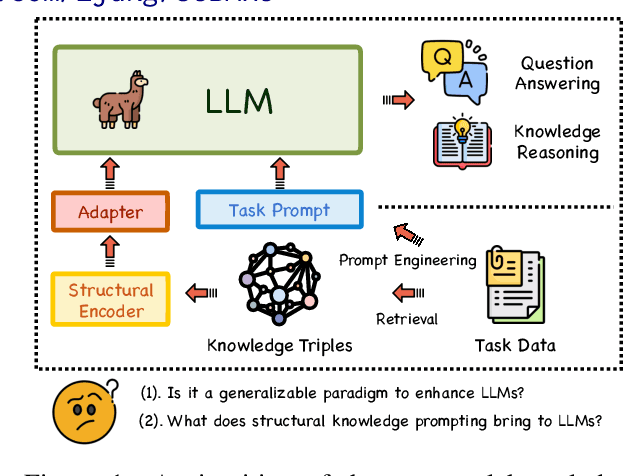
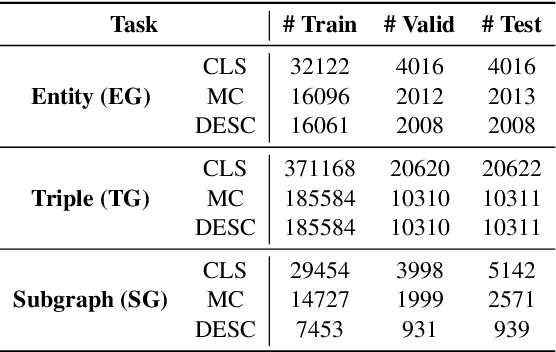
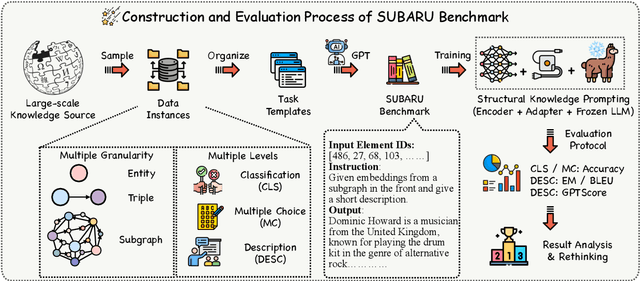
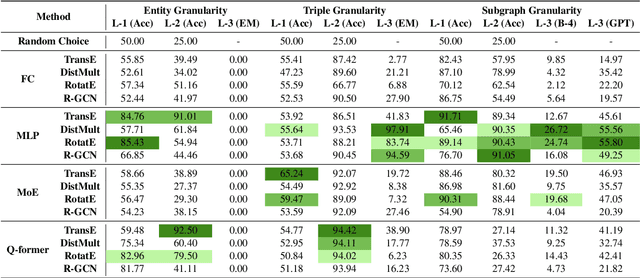
Large language models (LLMs) have demonstrated exceptional performance in text generation within current NLP research. However, the lack of factual accuracy is still a dark cloud hanging over the LLM skyscraper. Structural knowledge prompting (SKP) is a prominent paradigm to integrate external knowledge into LLMs by incorporating structural representations, achieving state-of-the-art results in many knowledge-intensive tasks. However, existing methods often focus on specific problems, lacking a comprehensive exploration of the generalization and capability boundaries of SKP. This paper aims to evaluate and rethink the generalization capability of the SKP paradigm from four perspectives including Granularity, Transferability, Scalability, and Universality. To provide a thorough evaluation, we introduce a novel multi-granular, multi-level benchmark called SUBARU, consisting of 9 different tasks with varying levels of granularity and difficulty.
MKGL: Mastery of a Three-Word Language
Oct 10, 2024

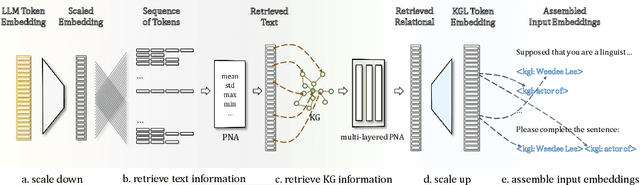

Large language models (LLMs) have significantly advanced performance across a spectrum of natural language processing (NLP) tasks. Yet, their application to knowledge graphs (KGs), which describe facts in the form of triplets and allow minimal hallucinations, remains an underexplored frontier. In this paper, we investigate the integration of LLMs with KGs by introducing a specialized KG Language (KGL), where a sentence precisely consists of an entity noun, a relation verb, and ends with another entity noun. Despite KGL's unfamiliar vocabulary to the LLM, we facilitate its learning through a tailored dictionary and illustrative sentences, and enhance context understanding via real-time KG context retrieval and KGL token embedding augmentation. Our results reveal that LLMs can achieve fluency in KGL, drastically reducing errors compared to conventional KG embedding methods on KG completion. Furthermore, our enhanced LLM shows exceptional competence in generating accurate three-word sentences from an initial entity and interpreting new unseen terms out of KGs.
Mixture of Modality Knowledge Experts for Robust Multi-modal Knowledge Graph Completion
May 27, 2024Multi-modal knowledge graph completion (MMKGC) aims to automatically discover new knowledge triples in the given multi-modal knowledge graphs (MMKGs), which is achieved by collaborative modeling the structural information concealed in massive triples and the multi-modal features of the entities. Existing methods tend to focus on crafting elegant entity-wise multi-modal fusion strategies, yet they overlook the utilization of multi-perspective features concealed within the modalities under diverse relational contexts. To address this issue, we introduce a novel MMKGC framework with Mixture of Modality Knowledge experts (MoMoK for short) to learn adaptive multi-modal embedding under intricate relational contexts. We design relation-guided modality knowledge experts to acquire relation-aware modality embeddings and integrate the predictions from multi-modalities to achieve comprehensive decisions. Additionally, we disentangle the experts by minimizing their mutual information. Experiments on four public MMKG benchmarks demonstrate the outstanding performance of MoMoK under complex scenarios.
Multi-domain Knowledge Graph Collaborative Pre-training and Prompt Tuning for Diverse Downstream Tasks
May 21, 2024
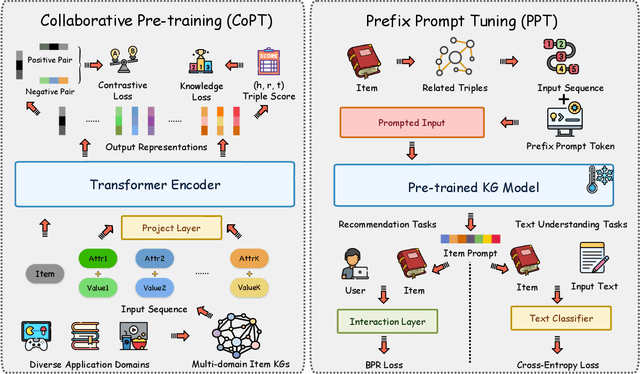

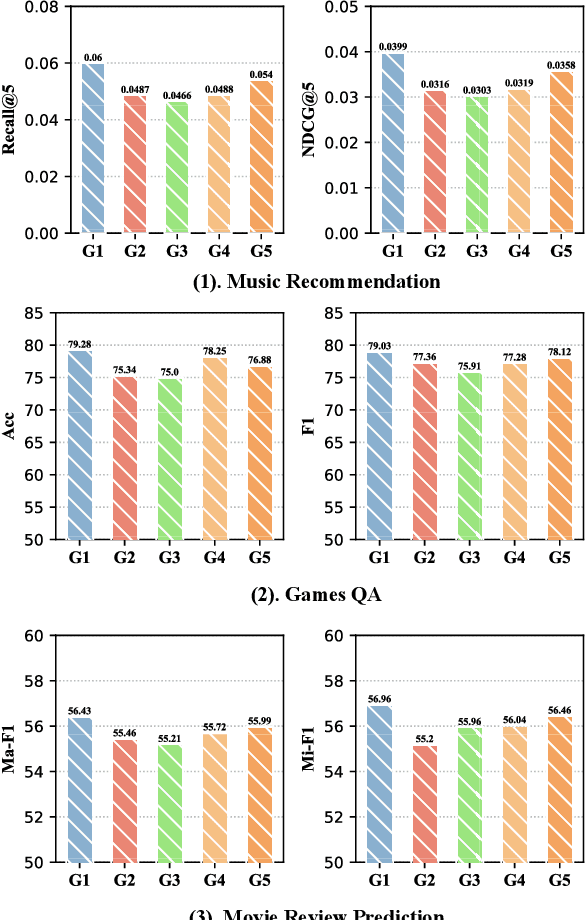
Knowledge graphs (KGs) provide reliable external knowledge for a wide variety of AI tasks in the form of structured triples. Knowledge graph pre-training (KGP) aims to pre-train neural networks on large-scale KGs and provide unified interfaces to enhance different downstream tasks, which is a key direction for KG management, maintenance, and applications. Existing works often focus on purely research questions in open domains, or they are not open source due to data security and privacy in real scenarios. Meanwhile, existing studies have not explored the training efficiency and transferability of KGP models in depth. To address these problems, We propose a framework MuDoK to achieve multi-domain collaborative pre-training and efficient prefix prompt tuning to serve diverse downstream tasks like recommendation and text understanding. Our design is a plug-and-play prompt learning approach that can be flexibly adapted to different downstream task backbones. In response to the lack of open-source benchmarks, we constructed a new multi-domain KGP benchmark called KPI with two large-scale KGs and six different sub-domain tasks to evaluate our method and open-sourced it for subsequent research. We evaluated our approach based on constructed KPI benchmarks using diverse backbone models in heterogeneous downstream tasks. The experimental results show that our framework brings significant performance gains, along with its generality, efficiency, and transferability.
MyGO: Discrete Modality Information as Fine-Grained Tokens for Multi-modal Knowledge Graph Completion
Apr 15, 2024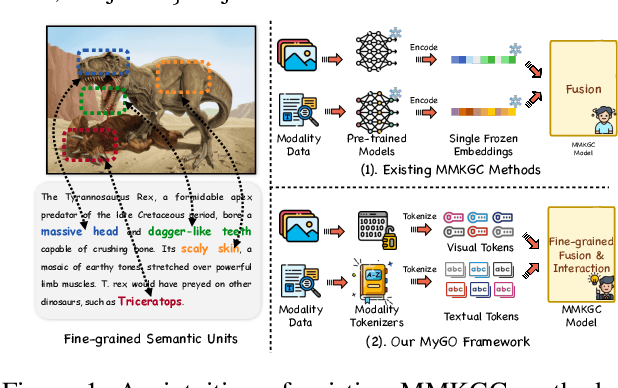
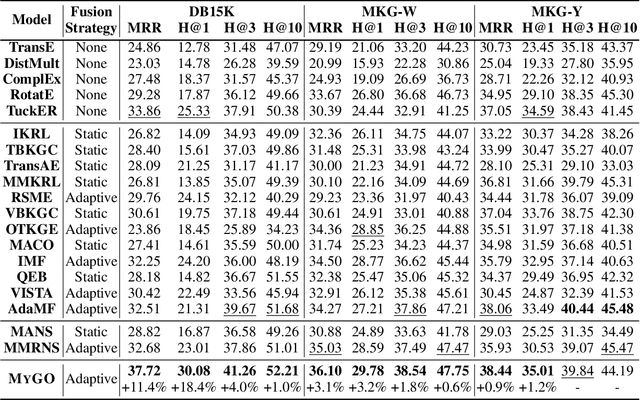
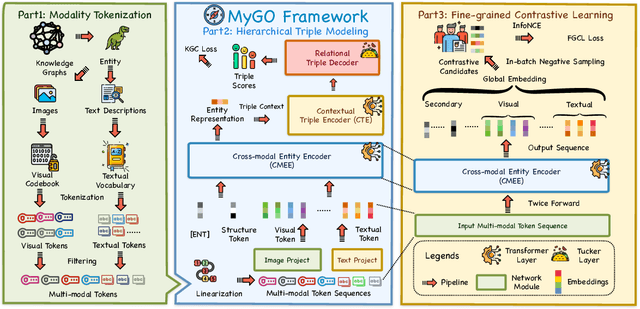
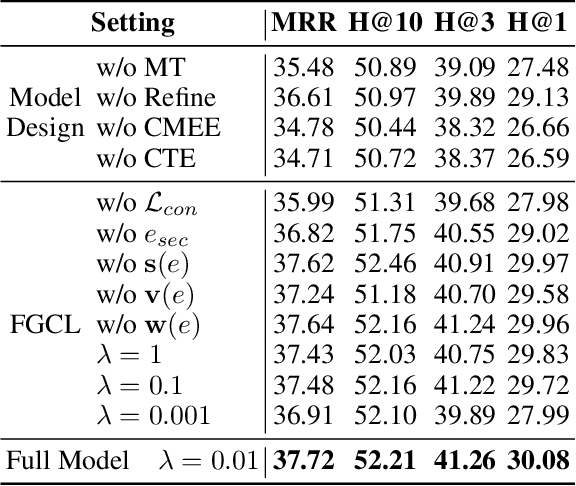
Multi-modal knowledge graphs (MMKG) store structured world knowledge containing rich multi-modal descriptive information. To overcome their inherent incompleteness, multi-modal knowledge graph completion (MMKGC) aims to discover unobserved knowledge from given MMKGs, leveraging both structural information from the triples and multi-modal information of the entities. Existing MMKGC methods usually extract multi-modal features with pre-trained models and employ a fusion module to integrate multi-modal features with triple prediction. However, this often results in a coarse handling of multi-modal data, overlooking the nuanced, fine-grained semantic details and their interactions. To tackle this shortfall, we introduce a novel framework MyGO to process, fuse, and augment the fine-grained modality information from MMKGs. MyGO tokenizes multi-modal raw data as fine-grained discrete tokens and learns entity representations with a cross-modal entity encoder. To further augment the multi-modal representations, MyGO incorporates fine-grained contrastive learning to highlight the specificity of the entity representations. Experiments on standard MMKGC benchmarks reveal that our method surpasses 20 of the latest models, underlining its superior performance. Code and data are available at https://github.com/zjukg/MyGO
The Power of Noise: Toward a Unified Multi-modal Knowledge Graph Representation Framework
Mar 20, 2024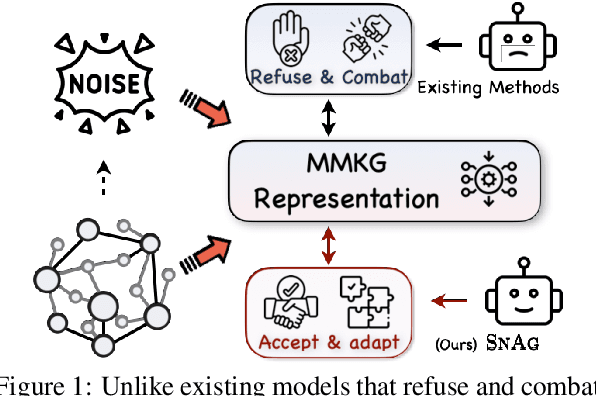
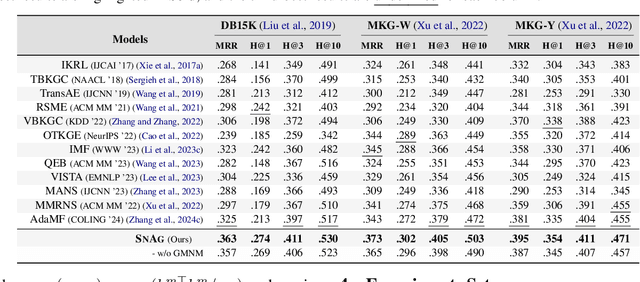
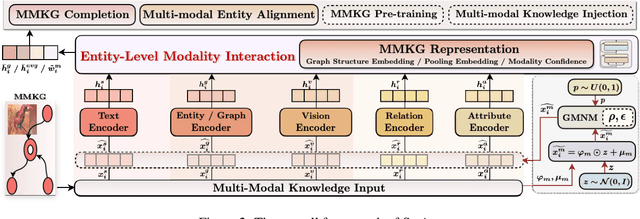
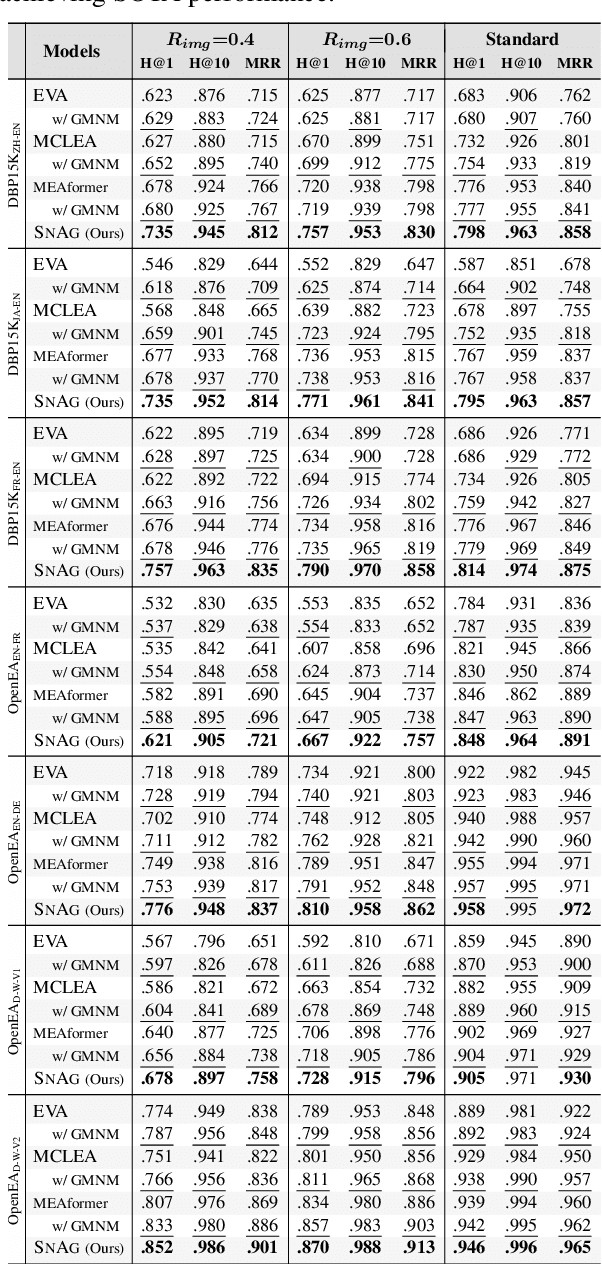
The advancement of Multi-modal Pre-training highlights the necessity for a robust Multi-Modal Knowledge Graph (MMKG) representation learning framework. This framework is crucial for integrating structured knowledge into multi-modal Large Language Models (LLMs) at scale, aiming to alleviate issues like knowledge misconceptions and multi-modal hallucinations. In this work, to evaluate models' ability to accurately embed entities within MMKGs, we focus on two widely researched tasks: Multi-modal Knowledge Graph Completion (MKGC) and Multi-modal Entity Alignment (MMEA). Building on this foundation, we propose a novel SNAG method that utilizes a Transformer-based architecture equipped with modality-level noise masking for the robust integration of multi-modal entity features in KGs. By incorporating specific training objectives for both MKGC and MMEA, our approach achieves SOTA performance across a total of ten datasets (three for MKGC and seven for MEMA), demonstrating its robustness and versatility. Besides, SNAG can not only function as a standalone model but also enhance other existing methods, providing stable performance improvements. Our code and data are available at: https://github.com/zjukg/SNAG.