 Add to Chrome
 Add to Firefox
 Add to Edge
When Should Models Change Their Minds? Contextual Belief Management in Large Language Models
May 28, 2026
Long-horizon interactions require language models to manage accumulating information: when to update their state, when to preserve their state, and what to ignore. We study this challenge as \textbf{Contextual Belief Management (CBM)}: maintaining a predicted belief state aligned with formal evidence while isolating task-irrelevant noise. To make CBM measurable, we introduce BeliefTrack, a closed-world benchmark spanning Rule Discovery and Circuit Diagnosis, where a finite belief space and symbolic verifiers enable exact turn-level evaluation. BeliefTrack diagnoses three failures: Failed Stay, Failed Update, and Failed Isolation. Across multiple LLMs, vanilla models exhibit severe CBM failures, while explicit belief-tracking prompts provide limited gains. In contrast, reinforcement learning with belief-state rewards reduces failure rates by 70.9\% on average. Further probing reveals latent belief-state dynamics behind these failures, and representation-level steering reduces failure rates by 46.1\% across two tasks\footnote{Code is coming soon at https://github.com/zjunlp/CBM.

MemTrace: Tracing and Attributing Errors in Large Language Model Memory Systems
May 27, 2026Memory is essential for enabling large language models to support long-horizon reasoning, yet existing memory systems remain unreliable and difficult to debug. Tracing memory's dynamic evolution is crucial to understand how information is synthesized, propagated, or corrupted over time. In this work, we study the new problem of error tracing and attribution in LLM memory systems. We propose a novel framework that transforms memory pipelines into executable memory evolution graphs, enabling fine-grained tracing of operational information flow. We then construct MemTraceBench, a benchmark collected from representative memory systems such as Long-Context, RAG, Mem0, and EverMemOS, to systematically study memory failure modes. We further introduce an automatic attribution method that iteratively traces operation subgraphs to pinpoint the root cause of any failed case. Our analysis reveals that memory failures are systematic, stemming from operation-level issues like information loss and retrieval misalignment. Crucially, we leverage these fine-grained attribution signals to guide downstream prompt optimization, establishing a closed-loop system that automatically corrects faults and boosts end-task performance by up to 7.62%. Code will be released at https://github.com/zjunlp/MemTrace.
StructMem: Structured Memory for Long-Horizon Behavior in LLMs
Apr 23, 2026Long-term conversational agents need memory systems that capture relationships between events, not merely isolated facts, to support temporal reasoning and multi-hop question answering. Current approaches face a fundamental trade-off: flat memory is efficient but fails to model relational structure, while graph-based memory enables structured reasoning at the cost of expensive and fragile construction. To address these issues, we propose \textbf{StructMem}, a structure-enriched hierarchical memory framework that preserves event-level bindings and induces cross-event connections. By temporally anchoring dual perspectives and performing periodic semantic consolidation, StructMem improves temporal reasoning and multi-hop performance on \texttt{LoCoMo}, while substantially reducing token usage, API calls, and runtime compared to prior memory systems, see https://github.com/zjunlp/LightMem .
CURE:Circuit-Aware Unlearning for LLM-based Recommendation
Apr 04, 2026Recent advances in large language models (LLMs) have opened new opportunities for recommender systems by enabling rich semantic understanding and reasoning about user interests and item attributes. However, as privacy regulations tighten, incorporating user data into LLM-based recommendation (LLMRec) introduces significant privacy risks, making unlearning algorithms increasingly crucial for practical deployment. Despite growing interest in LLMRec unlearning, most existing approaches formulate unlearning as a weighted combination of forgetting and retaining objectives while updating model parameters in a uniform manner. Such formulations inevitably induce gradient conflicts between the two objectives, leading to unstable optimization and resulting in either ineffective unlearning or severe degradation of model utility. Moreover, the unlearning procedure remains largely black-box, undermining its transparency and trustworthiness. To tackle these challenges, we propose CURE, a circuit-aware unlearning framework that disentangles model components into functionally distinct subsets and selectively updates them. Here, a circuit refers to a computational subgraph that is causally responsible for task-specific behaviors. Specifically, we extract the core circuits underlying item recommendation and analyze how individual modules within these circuits contribute to the forget and retain objectives. Based on this analysis, these modules are categorized into forget-specific, retain-specific, and task-shared groups, each subject to function-specific update rules to mitigate gradient conflicts during unlearning. Experiments on real-world datasets show that our approach achieves more effective unlearning than existing baselines.
From Data to Behavior: Predicting Unintended Model Behaviors Before Training
Feb 04, 2026Large Language Models (LLMs) can acquire unintended biases from seemingly benign training data even without explicit cues or malicious content. Existing methods struggle to detect such risks before fine-tuning, making post hoc evaluation costly and inefficient. To address this challenge, we introduce Data2Behavior, a new task for predicting unintended model behaviors prior to training. We also propose Manipulating Data Features (MDF), a lightweight approach that summarizes candidate data through their mean representations and injects them into the forward pass of a base model, allowing latent statistical signals in the data to shape model activations and reveal potential biases and safety risks without updating any parameters. MDF achieves reliable prediction while consuming only about 20% of the GPU resources required for fine-tuning. Experiments on Qwen3-14B, Qwen2.5-32B-Instruct, and Gemma-3-12b-it confirm that MDF can anticipate unintended behaviors and provide insight into pre-training vulnerabilities.
Why Steering Works: Toward a Unified View of Language Model Parameter Dynamics
Feb 02, 2026Methods for controlling large language models (LLMs), including local weight fine-tuning, LoRA-based adaptation, and activation-based interventions, are often studied in isolation, obscuring their connections and making comparison difficult. In this work, we present a unified view that frames these interventions as dynamic weight updates induced by a control signal, placing them within a single conceptual framework. Building on this view, we propose a unified preference-utility analysis that separates control effects into preference, defined as the tendency toward a target concept, and utility, defined as coherent and task-valid generation, and measures both on a shared log-odds scale using polarity-paired contrastive examples. Across methods, we observe a consistent trade-off between preference and utility: stronger control increases preference while predictably reducing utility. We further explain this behavior through an activation manifold perspective, in which control shifts representations along target-concept directions to enhance preference, while utility declines primarily when interventions push representations off the model's valid-generation manifold. Finally, we introduce a new steering approach SPLIT guided by this analysis that improves preference while better preserving utility. Code is available at https://github.com/zjunlp/EasyEdit/blob/main/examples/SPLIT.md.
Aligning Agentic World Models via Knowledgeable Experience Learning
Jan 19, 2026Current Large Language Models (LLMs) exhibit a critical modal disconnect: they possess vast semantic knowledge but lack the procedural grounding to respect the immutable laws of the physical world. Consequently, while these agents implicitly function as world models, their simulations often suffer from physical hallucinations-generating plans that are logically sound but physically unexecutable. Existing alignment strategies predominantly rely on resource-intensive training or fine-tuning, which attempt to compress dynamic environmental rules into static model parameters. However, such parametric encapsulation is inherently rigid, struggling to adapt to the open-ended variability of physical dynamics without continuous, costly retraining. To bridge this gap, we introduce WorldMind, a framework that autonomously constructs a symbolic World Knowledge Repository by synthesizing environmental feedback. Specifically, it unifies Process Experience to enforce physical feasibility via prediction errors and Goal Experience to guide task optimality through successful trajectories. Experiments on EB-ALFRED and EB-Habitat demonstrate that WorldMind achieves superior performance compared to baselines with remarkable cross-model and cross-environment transferability.
Illusions of Confidence? Diagnosing LLM Truthfulness via Neighborhood Consistency
Jan 09, 2026As Large Language Models (LLMs) are increasingly deployed in real-world settings, correctness alone is insufficient. Reliable deployment requires maintaining truthful beliefs under contextual perturbations. Existing evaluations largely rely on point-wise confidence like Self-Consistency, which can mask brittle belief. We show that even facts answered with perfect self-consistency can rapidly collapse under mild contextual interference. To address this gap, we propose Neighbor-Consistency Belief (NCB), a structural measure of belief robustness that evaluates response coherence across a conceptual neighborhood. To validate the efficiency of NCB, we introduce a new cognitive stress-testing protocol that probes outputs stability under contextual interference. Experiments across multiple LLMs show that the performance of high-NCB data is relatively more resistant to interference. Finally, we present Structure-Aware Training (SAT), which optimizes context-invariant belief structure and reduces long-tail knowledge brittleness by approximately 30%. Code will be available at https://github.com/zjunlp/belief.
How Do Large Language Models Learn Concepts During Continual Pre-Training?
Jan 07, 2026Human beings primarily understand the world through concepts (e.g., dog), abstract mental representations that structure perception, reasoning, and learning. However, how large language models (LLMs) acquire, retain, and forget such concepts during continual pretraining remains poorly understood. In this work, we study how individual concepts are acquired and forgotten, as well as how multiple concepts interact through interference and synergy. We link these behavioral dynamics to LLMs' internal Concept Circuits, computational subgraphs associated with specific concepts, and incorporate Graph Metrics to characterize circuit structure. Our analysis reveals: (1) LLMs concept circuits provide a non-trivial, statistically significant signal of concept learning and forgetting; (2) Concept circuits exhibit a stage-wise temporal pattern during continual pretraining, with an early increase followed by gradual decrease and stabilization; (3) concepts with larger learning gains tend to exhibit greater forgetting under subsequent training; (4) semantically similar concepts induce stronger interference than weakly related ones; (5) conceptual knowledge differs in their transferability, with some significantly facilitating the learning of others. Together, our findings offer a circuit-level view of concept learning dynamics and inform the design of more interpretable and robust concept-aware training strategies for LLMs.
LightMem: Lightweight and Efficient Memory-Augmented Generation
Oct 21, 2025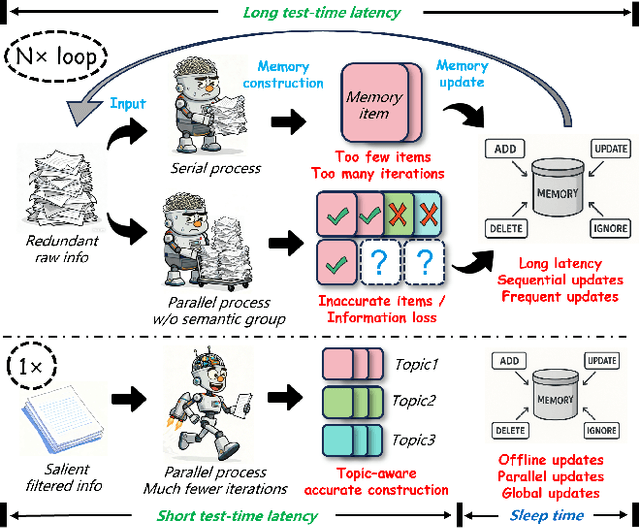
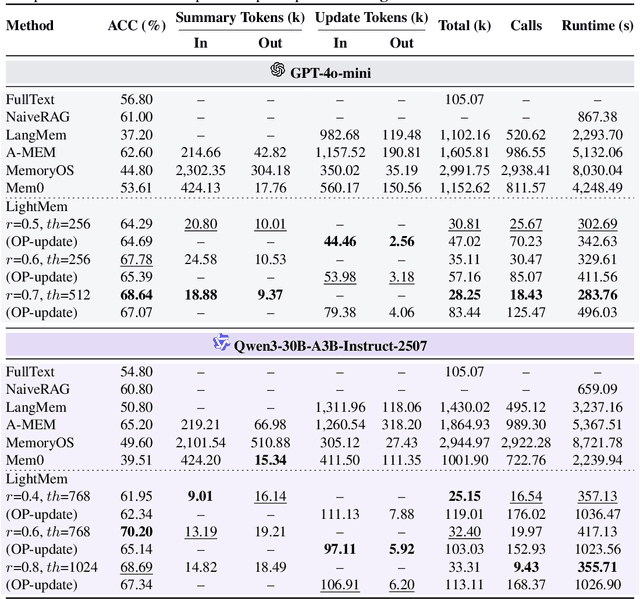
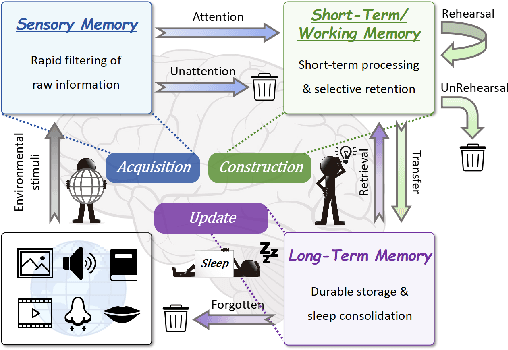
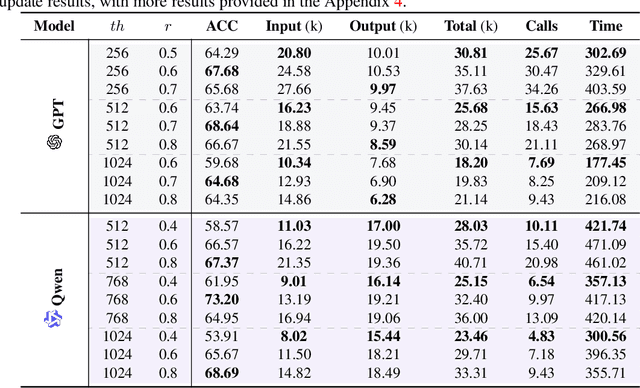
Despite their remarkable capabilities, Large Language Models (LLMs) struggle to effectively leverage historical interaction information in dynamic and complex environments. Memory systems enable LLMs to move beyond stateless interactions by introducing persistent information storage, retrieval, and utilization mechanisms. However, existing memory systems often introduce substantial time and computational overhead. To this end, we introduce a new memory system called LightMem, which strikes a balance between the performance and efficiency of memory systems. Inspired by the Atkinson-Shiffrin model of human memory, LightMem organizes memory into three complementary stages. First, cognition-inspired sensory memory rapidly filters irrelevant information through lightweight compression and groups information according to their topics. Next, topic-aware short-term memory consolidates these topic-based groups, organizing and summarizing content for more structured access. Finally, long-term memory with sleep-time update employs an offline procedure that decouples consolidation from online inference. Experiments on LongMemEval with GPT and Qwen backbones show that LightMem outperforms strong baselines in accuracy (up to 10.9% gains) while reducing token usage by up to 117x, API calls by up to 159x, and runtime by over 12x. The code is available at https://github.com/zjunlp/LightMem.