 Add to Chrome
 Add to Firefox
 Add to Edge
Rectified Diffusion: Straightness Is Not Your Need in Rectified Flow
Oct 09, 2024
Diffusion models have greatly improved visual generation but are hindered by slow generation speed due to the computationally intensive nature of solving generative ODEs. Rectified flow, a widely recognized solution, improves generation speed by straightening the ODE path. Its key components include: 1) using the diffusion form of flow-matching, 2) employing $\boldsymbol v$-prediction, and 3) performing rectification (a.k.a. reflow). In this paper, we argue that the success of rectification primarily lies in using a pretrained diffusion model to obtain matched pairs of noise and samples, followed by retraining with these matched noise-sample pairs. Based on this, components 1) and 2) are unnecessary. Furthermore, we highlight that straightness is not an essential training target for rectification; rather, it is a specific case of flow-matching models. The more critical training target is to achieve a first-order approximate ODE path, which is inherently curved for models like DDPM and Sub-VP. Building on this insight, we propose Rectified Diffusion, which generalizes the design space and application scope of rectification to encompass the broader category of diffusion models, rather than being restricted to flow-matching models. We validate our method on Stable Diffusion v1-5 and Stable Diffusion XL. Our method not only greatly simplifies the training procedure of rectified flow-based previous works (e.g., InstaFlow) but also achieves superior performance with even lower training cost. Our code is available at https://github.com/G-U-N/Rectified-Diffusion.

MC-MoE: Mixture Compressor for Mixture-of-Experts LLMs Gains More
Oct 08, 2024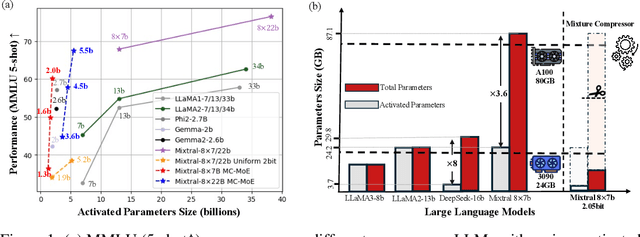
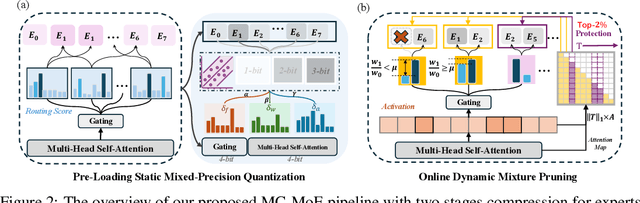

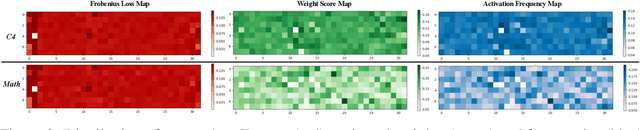
Mixture-of-Experts large language models (MoE-LLMs) marks a significant step forward of language models, however, they encounter two critical challenges in practice: 1) expert parameters lead to considerable memory consumption and loading latency; and 2) the current activated experts are redundant, as many tokens may only require a single expert. Motivated by these issues, we investigate the MoE-LLMs and make two key observations: a) different experts exhibit varying behaviors on activation reconstruction error, routing scores, and activated frequencies, highlighting their differing importance, and b) not all tokens are equally important -- only a small subset is critical. Building on these insights, we propose MC-MoE, a training-free Mixture-Compressor for MoE-LLMs, which leverages the significance of both experts and tokens to achieve an extreme compression. First, to mitigate storage and loading overheads, we introduce Pre-Loading Mixed-Precision Quantization, which formulates the adaptive bit-width allocation as a Linear Programming problem, where the objective function balances multi-factors reflecting the importance of each expert. Additionally, we develop Online Dynamic Pruning, which identifies important tokens to retain and dynamically select activated experts for other tokens during inference to optimize efficiency while maintaining performance. Our MC-MoE integrates static quantization and dynamic pruning to collaboratively achieve extreme compression for MoE-LLMs with less accuracy loss, ensuring an optimal trade-off between performance and efficiency. Extensive experiments confirm the effectiveness of our approach. For instance, at 2.54 bits, MC-MoE compresses 76.6% of the model, with only a 3.8% average accuracy loss. During dynamic inference, we further reduce activated parameters by 15%, with a performance drop of less than 0.6%.
UniAff: A Unified Representation of Affordances for Tool Usage and Articulation with Vision-Language Models
Sep 30, 2024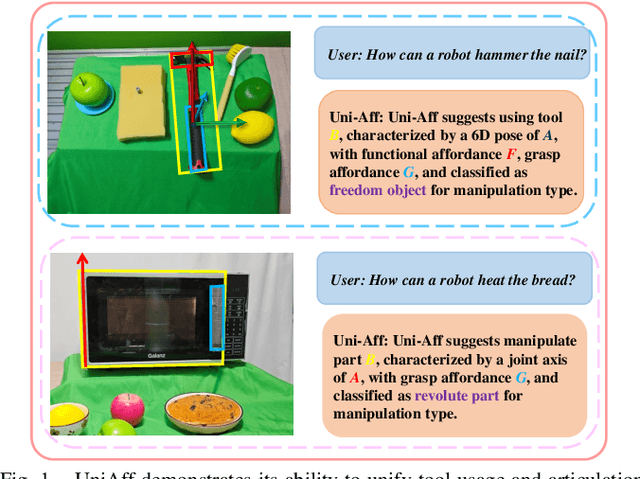
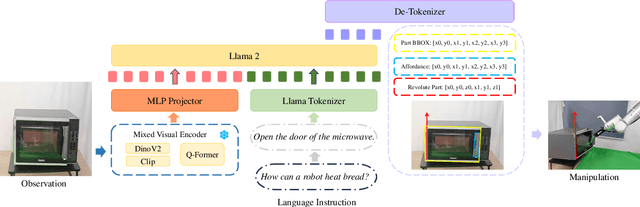
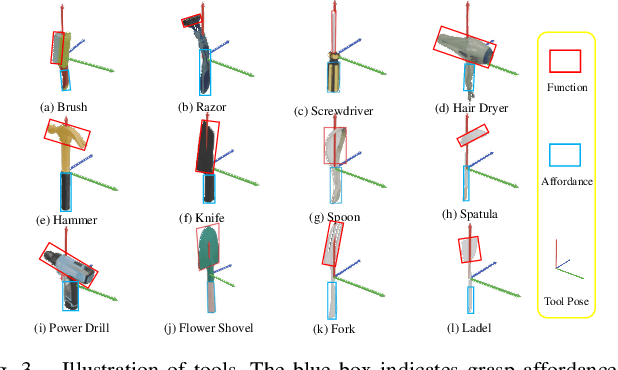
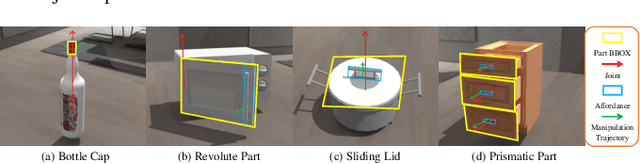
Previous studies on robotic manipulation are based on a limited understanding of the underlying 3D motion constraints and affordances. To address these challenges, we propose a comprehensive paradigm, termed UniAff, that integrates 3D object-centric manipulation and task understanding in a unified formulation. Specifically, we constructed a dataset labeled with manipulation-related key attributes, comprising 900 articulated objects from 19 categories and 600 tools from 12 categories. Furthermore, we leverage MLLMs to infer object-centric representations for manipulation tasks, including affordance recognition and reasoning about 3D motion constraints. Comprehensive experiments in both simulation and real-world settings indicate that UniAff significantly improves the generalization of robotic manipulation for tools and articulated objects. We hope that UniAff will serve as a general baseline for unified robotic manipulation tasks in the future. Images, videos, dataset, and code are published on the project website at:https://sites.google.com/view/uni-aff/home
MedViLaM: A multimodal large language model with advanced generalizability and explainability for medical data understanding and generation
Sep 29, 2024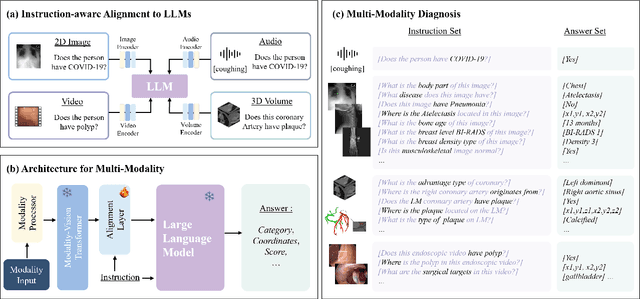
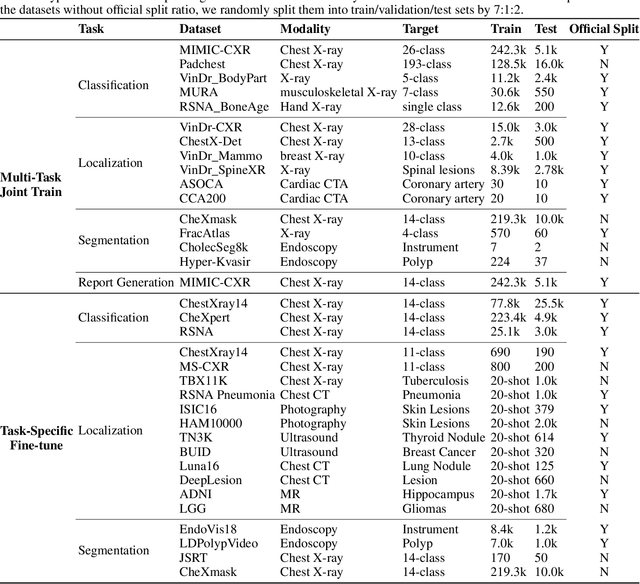
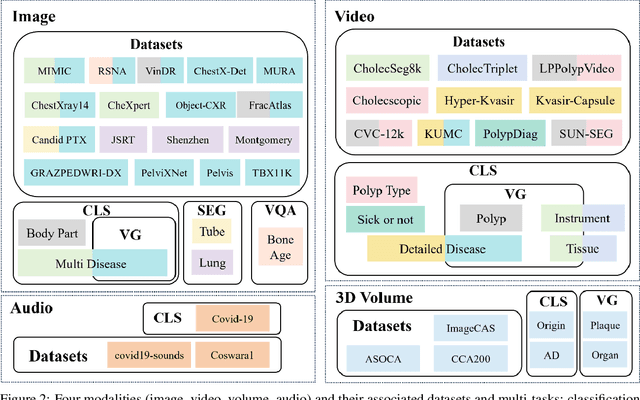

Medicine is inherently multimodal and multitask, with diverse data modalities spanning text, imaging. However, most models in medical field are unimodal single tasks and lack good generalizability and explainability. In this study, we introduce MedViLaM, a unified vision-language model towards a generalist model for medical data that can flexibly encode and interpret various forms of medical data, including clinical language and imaging, all using the same set of model weights. To facilitate the creation of such multi-task model, we have curated MultiMedBench, a comprehensive pretaining dataset and benchmark consisting of several distinct tasks, i.e., continuous question-answering, multi-label disease classification, disease localization, generation and summarization of radiology reports. MedViLaM demonstrates strong performance across all MultiMedBench tasks, frequently outpacing other generalist models by a significant margin. Additionally, we present instances of zero-shot generalization to new medical concepts and tasks, effective transfer learning across different tasks, and the emergence of zero-shot medical reasoning.
SKT: Integrating State-Aware Keypoint Trajectories with Vision-Language Models for Robotic Garment Manipulation
Sep 26, 2024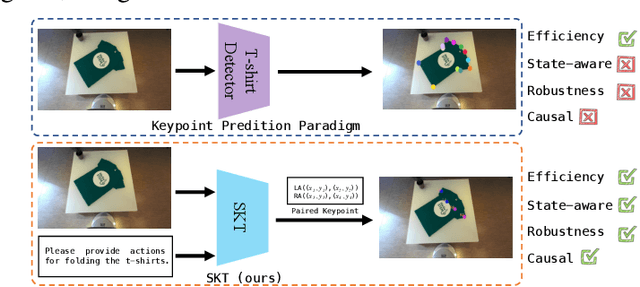
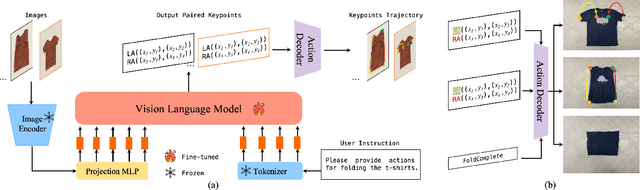
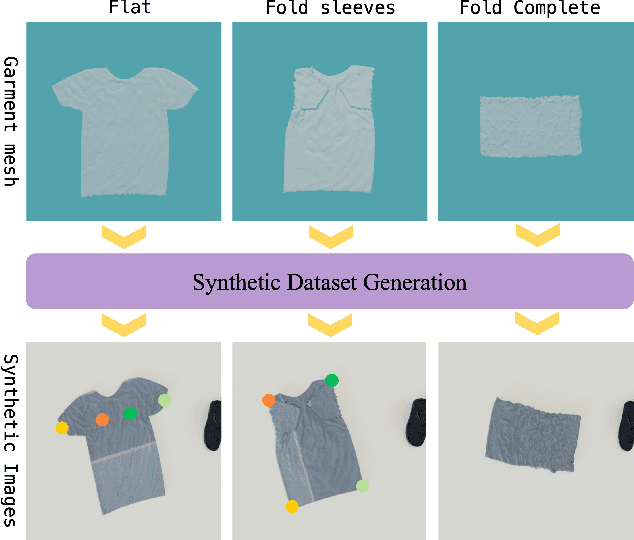
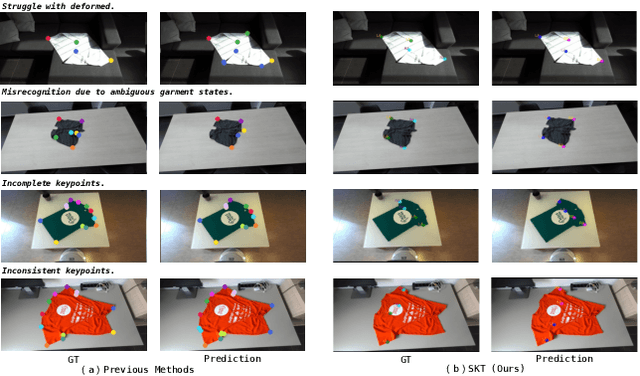
Automating garment manipulation poses a significant challenge for assistive robotics due to the diverse and deformable nature of garments. Traditional approaches typically require separate models for each garment type, which limits scalability and adaptability. In contrast, this paper presents a unified approach using vision-language models (VLMs) to improve keypoint prediction across various garment categories. By interpreting both visual and semantic information, our model enables robots to manage different garment states with a single model. We created a large-scale synthetic dataset using advanced simulation techniques, allowing scalable training without extensive real-world data. Experimental results indicate that the VLM-based method significantly enhances keypoint detection accuracy and task success rates, providing a more flexible and general solution for robotic garment manipulation. In addition, this research also underscores the potential of VLMs to unify various garment manipulation tasks within a single framework, paving the way for broader applications in home automation and assistive robotics for future.
LLaVA-MoD: Making LLaVA Tiny via MoE Knowledge Distillation
Aug 28, 2024We introduce LLaVA-MoD, a novel framework designed to enable the efficient training of small-scale Multimodal Language Models (s-MLLM) by distilling knowledge from large-scale MLLM (l-MLLM). Our approach tackles two fundamental challenges in MLLM distillation. First, we optimize the network structure of s-MLLM by integrating a sparse Mixture of Experts (MoE) architecture into the language model, striking a balance between computational efficiency and model expressiveness. Second, we propose a progressive knowledge transfer strategy to ensure comprehensive knowledge migration. This strategy begins with mimic distillation, where we minimize the Kullback-Leibler (KL) divergence between output distributions to enable the student model to emulate the teacher network's understanding. Following this, we introduce preference distillation via Direct Preference Optimization (DPO), where the key lies in treating l-MLLM as the reference model. During this phase, the s-MLLM's ability to discriminate between superior and inferior examples is significantly enhanced beyond l-MLLM, leading to a better student that surpasses its teacher, particularly in hallucination benchmarks. Extensive experiments demonstrate that LLaVA-MoD outperforms existing models across various multimodal benchmarks while maintaining a minimal number of activated parameters and low computational costs. Remarkably, LLaVA-MoD, with only 2B activated parameters, surpasses Qwen-VL-Chat-7B by an average of 8.8% across benchmarks, using merely 0.3% of the training data and 23% trainable parameters. These results underscore LLaVA-MoD's ability to effectively distill comprehensive knowledge from its teacher model, paving the way for the development of more efficient MLLMs. The code will be available on: https://github.com/shufangxun/LLaVA-MoD.
GenCA: A Text-conditioned Generative Model for Realistic and Drivable Codec Avatars
Aug 24, 2024

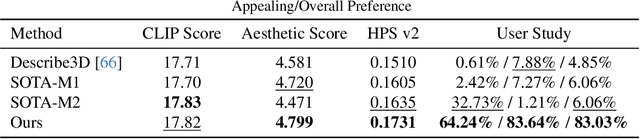

Photo-realistic and controllable 3D avatars are crucial for various applications such as virtual and mixed reality (VR/MR), telepresence, gaming, and film production. Traditional methods for avatar creation often involve time-consuming scanning and reconstruction processes for each avatar, which limits their scalability. Furthermore, these methods do not offer the flexibility to sample new identities or modify existing ones. On the other hand, by learning a strong prior from data, generative models provide a promising alternative to traditional reconstruction methods, easing the time constraints for both data capture and processing. Additionally, generative methods enable downstream applications beyond reconstruction, such as editing and stylization. Nonetheless, the research on generative 3D avatars is still in its infancy, and therefore current methods still have limitations such as creating static avatars, lacking photo-realism, having incomplete facial details, or having limited drivability. To address this, we propose a text-conditioned generative model that can generate photo-realistic facial avatars of diverse identities, with more complete details like hair, eyes and mouth interior, and which can be driven through a powerful non-parametric latent expression space. Specifically, we integrate the generative and editing capabilities of latent diffusion models with a strong prior model for avatar expression driving. Our model can generate and control high-fidelity avatars, even those out-of-distribution. We also highlight its potential for downstream applications, including avatar editing and single-shot avatar reconstruction.
Lumina-mGPT: Illuminate Flexible Photorealistic Text-to-Image Generation with Multimodal Generative Pretraining
Aug 05, 2024
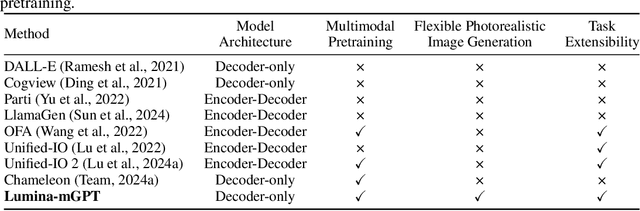
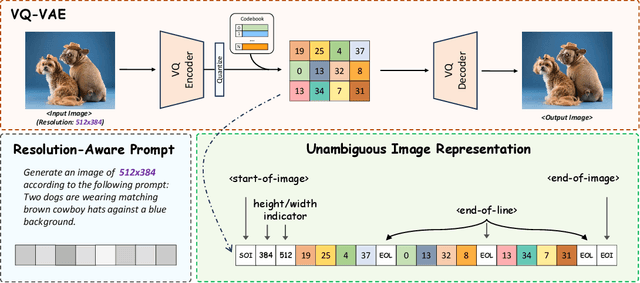
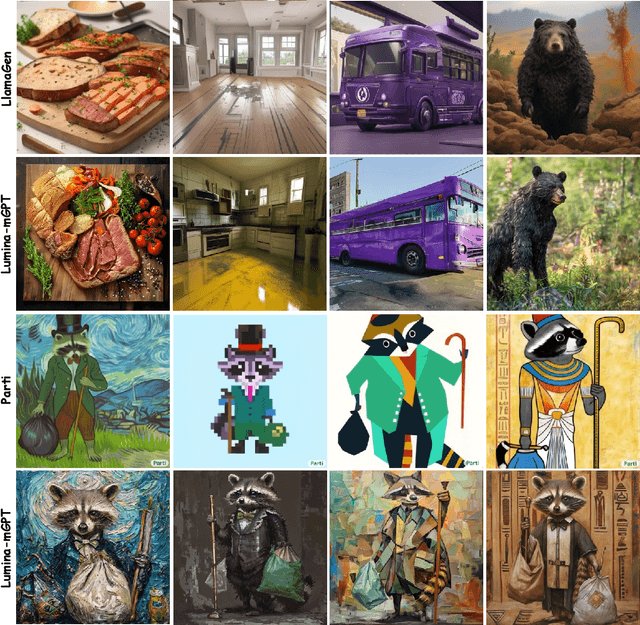
We present Lumina-mGPT, a family of multimodal autoregressive models capable of various vision and language tasks, particularly excelling in generating flexible photorealistic images from text descriptions. Unlike existing autoregressive image generation approaches, Lumina-mGPT employs a pretrained decoder-only transformer as a unified framework for modeling multimodal token sequences. Our key insight is that a simple decoder-only transformer with multimodal Generative PreTraining (mGPT), utilizing the next-token prediction objective on massive interleaved text-image sequences, can learn broad and general multimodal capabilities, thereby illuminating photorealistic text-to-image generation. Building on these pretrained models, we propose Flexible Progressive Supervised Finetuning (FP-SFT) on high-quality image-text pairs to fully unlock their potential for high-aesthetic image synthesis at any resolution while maintaining their general multimodal capabilities. Furthermore, we introduce Ominiponent Supervised Finetuning (Omni-SFT), transforming Lumina-mGPT into a foundation model that seamlessly achieves omnipotent task unification. The resulting model demonstrates versatile multimodal capabilities, including visual generation tasks like flexible text-to-image generation and controllable generation, visual recognition tasks like segmentation and depth estimation, and vision-language tasks like multiturn visual question answering. Additionally, we analyze the differences and similarities between diffusion-based and autoregressive methods in a direct comparison.
MAVIS: Mathematical Visual Instruction Tuning
Jul 11, 2024
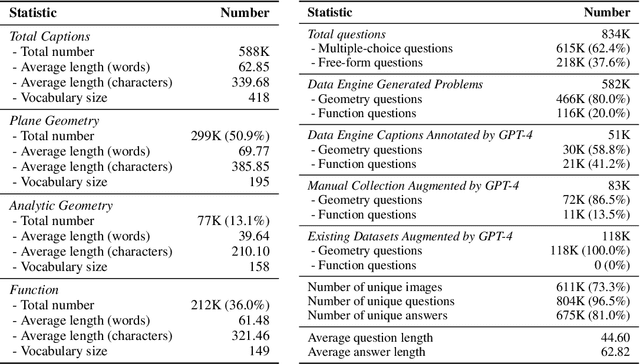


Multi-modal Large Language Models (MLLMs) have recently emerged as a significant focus in academia and industry. Despite their proficiency in general multi-modal scenarios, the mathematical problem-solving capabilities in visual contexts remain insufficiently explored. We identify three key areas within MLLMs that need to be improved: visual encoding of math diagrams, diagram-language alignment, and mathematical reasoning skills. This draws forth an urgent demand for large-scale, high-quality data and training pipelines in visual mathematics. In this paper, we propose MAVIS, the first MAthematical VISual instruction tuning paradigm for MLLMs, involving a series of mathematical visual datasets and specialized MLLMs. Targeting the three issues, MAVIS contains three progressive training stages from scratch. First, we curate MAVIS-Caption, consisting of 558K diagram-caption pairs, to fine-tune a math-specific vision encoder (CLIP-Math) through contrastive learning, tailored for improved diagram visual encoding. Second, we utilize MAVIS-Caption to align the CLIP-Math with a large language model (LLM) by a projection layer, enhancing vision-language alignment in mathematical domains. Third, we introduce MAVIS-Instruct, including 900K meticulously collected and annotated visual math problems, which is adopted to finally instruct-tune the MLLM for robust mathematical reasoning skills. In MAVIS-Instruct, we incorporate complete chain-of-thought (CoT) rationales for each problem, and minimize textual redundancy, thereby concentrating the model towards the visual elements. Data and Models are released at https://github.com/ZrrSkywalker/MAVIS
DailyDVS-200: A Comprehensive Benchmark Dataset for Event-Based Action Recognition
Jul 06, 2024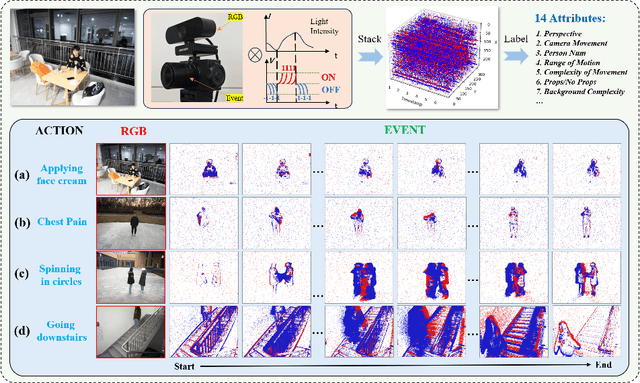
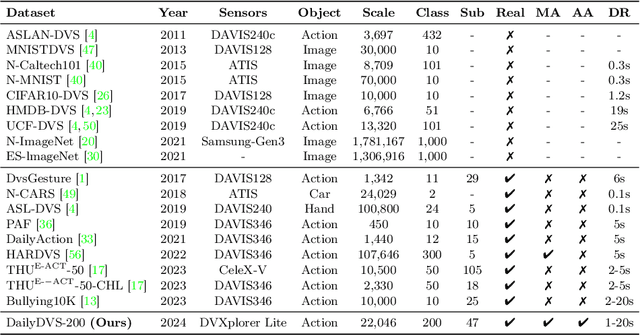
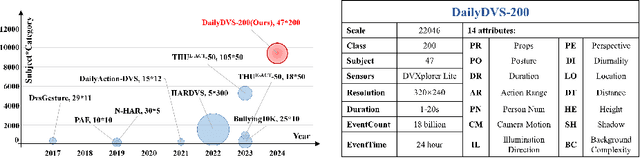
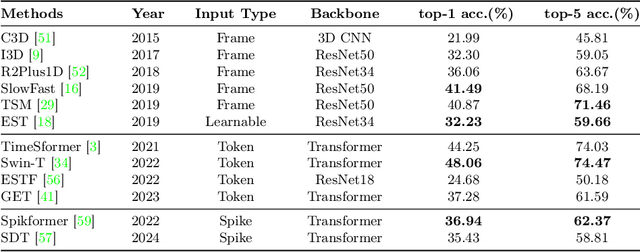
Neuromorphic sensors, specifically event cameras, revolutionize visual data acquisition by capturing pixel intensity changes with exceptional dynamic range, minimal latency, and energy efficiency, setting them apart from conventional frame-based cameras. The distinctive capabilities of event cameras have ignited significant interest in the domain of event-based action recognition, recognizing their vast potential for advancement. However, the development in this field is currently slowed by the lack of comprehensive, large-scale datasets, which are critical for developing robust recognition frameworks. To bridge this gap, we introduces DailyDVS-200, a meticulously curated benchmark dataset tailored for the event-based action recognition community. DailyDVS-200 is extensive, covering 200 action categories across real-world scenarios, recorded by 47 participants, and comprises more than 22,000 event sequences. This dataset is designed to reflect a broad spectrum of action types, scene complexities, and data acquisition diversity. Each sequence in the dataset is annotated with 14 attributes, ensuring a detailed characterization of the recorded actions. Moreover, DailyDVS-200 is structured to facilitate a wide range of research paths, offering a solid foundation for both validating existing approaches and inspiring novel methodologies. By setting a new benchmark in the field, we challenge the current limitations of neuromorphic data processing and invite a surge of new approaches in event-based action recognition techniques, which paves the way for future explorations in neuromorphic computing and beyond. The dataset and source code are available at https://github.com/QiWang233/DailyDVS-200.