 Add to Chrome
 Add to Firefox
 Add to Edge
An Empirical Study of Training Pixel-Space Text-to-Image Diffusion Models
Aug 17, 2026
This paper investigates an increasingly important topic in generative modeling: pixel-space diffusion models. Although numerous studies have explored this topic, most focus on small-scale or class-conditional settings. Consequently, a practical recipe for training pixel-space models that rival or exceed well-established latent-space counterparts remains elusive. Through a comprehensive empirical study, we first observe that direct large-scale pre-training in pixel space converges substantially more slowly than in latent space. This observation motivates a latent-to-pixel strategy that acquires generative priors efficiently in latent space and transitions to pixel space during post-training. We then systematically investigate the key design choices governing this transition, including weight initialization, data composition, prediction target, decoder architecture, and noise schedule, and identify a practical recipe that makes the resulting pixel-space models match or outperform their latent-space counterparts while delivering 3.18 to 4.75 times end-to-end inference speedups. We hope that our findings provide useful empirical insights and practical guidelines for future research on pixel-space generation.

High-Fidelity Two-Step Image Generation via Teacher-Aligned End-to-End Distillation
Jun 10, 2026Few-step diffusion distillation has become increasingly mature for 4-8-step generation, yet pushing further to 2 steps remains challenging. In this work, we introduce Z-Image Turbo++, a high-quality 2-step image generation model distilled from the 8-step Z-Image Turbo teacher. Our method addresses the central bottlenecks of increased task difficulty and limited model capacity in 2-step generation through three simple but effective design choices tailored to this regime. First, we propose Distribution-Aligned Adversarial Learning, which uses teacher-generated images rather than external real images as real samples for GAN training, providing a more attainable and informative adversarial target. Second, we adopt Step-Decoupled Parameterization, assigning independent model parameters to the two denoising steps to better match their distinct capacity demands. Third, we perform End-to-End Training with Iterative Regularization, allowing the first step to receive gradients from final image quality while preserving a meaningful intermediate generation through an explicit step-1 loss. Together, these designs substantially narrow the quality gap between 2-step and 8-step generation in both qualitative and quantitative evaluations, highlighting the potential of carefully tailored distillation strategies for improving the quality-efficiency trade-off in few-step generation.
Action-Prior Denoising for Smooth Real-Time Chunking
May 25, 2026Real-time chunking (RTC) lets chunked action policies operate under inference delay by conditioning a newly generated action chunk on actions already committed by the previous chunk. Training-time RTC simulates this delay during learning and avoids expensive guidance at deployment, but its binary prefix mask treats all non-prefix tokens as fully unconstrained. This under-models asynchronous execution: early overlap actions are fixed, while later overlap actions remain editable but should still stay close to the previous plan. We propose Soft RTC, a training-time RTC generalization based on action-prior denoising. Soft RTC constructs corrupted overlap tokens from partially denoised states instead of pure noise and injects the aligned previous chunk as the same prior during inference through a lightweight token-wise blending rule. On the 12 released large Kinetix levels, a short soft window nearly matches hard training-time RTC in overall solve rate (0.809 vs. 0.815), while a medium window reduces high-delay action delta and jerk by 9.1% and 9.6% relative to hard RTC. Both variants keep near-naive runtime, unlike inference-time RTC baselines. A small preliminary real-robot sorting study provides additional evidence that training-time RTC can improve completion and that Soft RTC gives the lowest commanded-action finite-difference metrics among the tested policies.
D-OPSD: On-Policy Self-Distillation for Continuously Tuning Step-Distilled Diffusion Models
May 06, 2026The landscape of high-performance image generation models is currently shifting from the inefficient multi-step ones to the efficient few-step counterparts (e.g, Z-Image-Turbo and FLUX.2-klein). However, these models present significant challenges for directly continuous supervised fine-tuning. For example, applying the commonly used fine-tuning technique would compromises their inherent few-step inference capability. To address this, we propose D-OPSD, a novel training paradigm for step-distilled diffusion models that enables on-policy learning during supervised fine-tuning. We first find that the modern diffusion model where the LLM/VLM serves as the encoder can inherit its encoder's in-context capabilities. This enables us to make the training as an on-policy self-distillation process. Specifically, during training, we make the model acts as both the teacher and the student with different contexts, where the student is conditioned only on the text feature, while the teacher is conditioned on the multimodal feature of both the text prompt and the target image. Training minimizes the two predicted distributions over the student's own roll-outs. By optimized on the model's own trajectory and under it's own supervision, D-OPSD enables the model to learn new concept, style, etc. without sacrificing the original few-step capacity.
Distribution Matching Distillation Meets Reinforcement Learning
Nov 19, 2025Distribution Matching Distillation (DMD) distills a pre-trained multi-step diffusion model to a few-step one to improve inference efficiency. However, the performance of the latter is often capped by the former. To circumvent this dilemma, we propose DMDR, a novel framework that combines Reinforcement Learning (RL) techniques into the distillation process. We show that for the RL of the few-step generator, the DMD loss itself is a more effective regularization compared to the traditional ones. In turn, RL can help to guide the mode coverage process in DMD more effectively. These allow us to unlock the capacity of the few-step generator by conducting distillation and RL simultaneously. Meanwhile, we design the dynamic distribution guidance and dynamic renoise sampling training strategies to improve the initial distillation process. The experiments demonstrate that DMDR can achieve leading visual quality, prompt coherence among few-step methods, and even exhibit performance that exceeds the multi-step teacher.
Lumina-mGPT 2.0: Stand-Alone AutoRegressive Image Modeling
Jul 23, 2025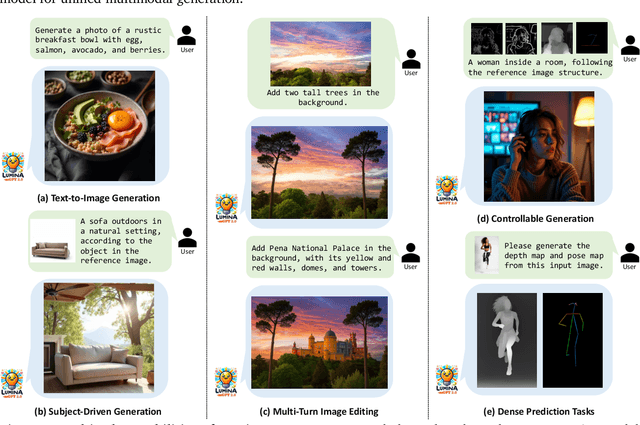
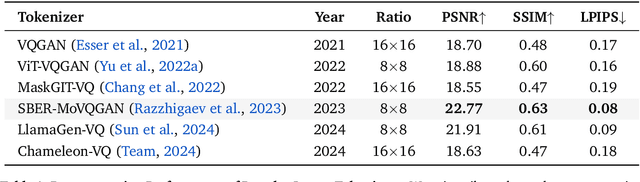
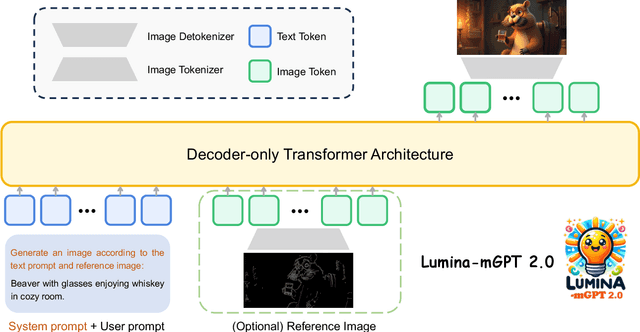

We present Lumina-mGPT 2.0, a stand-alone, decoder-only autoregressive model that revisits and revitalizes the autoregressive paradigm for high-quality image generation and beyond. Unlike existing approaches that rely on pretrained components or hybrid architectures, Lumina-mGPT 2.0 is trained entirely from scratch, enabling unrestricted architectural design and licensing freedom. It achieves generation quality on par with state-of-the-art diffusion models such as DALL-E 3 and SANA, while preserving the inherent flexibility and compositionality of autoregressive modeling. Our unified tokenization scheme allows the model to seamlessly handle a wide spectrum of tasks-including subject-driven generation, image editing, controllable synthesis, and dense prediction-within a single generative framework. To further boost usability, we incorporate efficient decoding strategies like inference-time scaling and speculative Jacobi sampling to improve quality and speed, respectively. Extensive evaluations on standard text-to-image benchmarks (e.g., GenEval, DPG) demonstrate that Lumina-mGPT 2.0 not only matches but in some cases surpasses diffusion-based models. Moreover, we confirm its multi-task capabilities on the Graph200K benchmark, with the native Lumina-mGPT 2.0 performing exceptionally well. These results position Lumina-mGPT 2.0 as a strong, flexible foundation model for unified multimodal generation. We have released our training details, code, and models at https://github.com/Alpha-VLLM/Lumina-mGPT-2.0.
OmniCaptioner: One Captioner to Rule Them All
Apr 09, 2025We propose OmniCaptioner, a versatile visual captioning framework for generating fine-grained textual descriptions across a wide variety of visual domains. Unlike prior methods limited to specific image types (e.g., natural images or geometric visuals), our framework provides a unified solution for captioning natural images, visual text (e.g., posters, UIs, textbooks), and structured visuals (e.g., documents, tables, charts). By converting low-level pixel information into semantically rich textual representations, our framework bridges the gap between visual and textual modalities. Our results highlight three key advantages: (i) Enhanced Visual Reasoning with LLMs, where long-context captions of visual modalities empower LLMs, particularly the DeepSeek-R1 series, to reason effectively in multimodal scenarios; (ii) Improved Image Generation, where detailed captions improve tasks like text-to-image generation and image transformation; and (iii) Efficient Supervised Fine-Tuning (SFT), which enables faster convergence with less data. We believe the versatility and adaptability of OmniCaptioner can offer a new perspective for bridging the gap between language and visual modalities.
LeX-Art: Rethinking Text Generation via Scalable High-Quality Data Synthesis
Mar 27, 2025We introduce LeX-Art, a comprehensive suite for high-quality text-image synthesis that systematically bridges the gap between prompt expressiveness and text rendering fidelity. Our approach follows a data-centric paradigm, constructing a high-quality data synthesis pipeline based on Deepseek-R1 to curate LeX-10K, a dataset of 10K high-resolution, aesthetically refined 1024$\times$1024 images. Beyond dataset construction, we develop LeX-Enhancer, a robust prompt enrichment model, and train two text-to-image models, LeX-FLUX and LeX-Lumina, achieving state-of-the-art text rendering performance. To systematically evaluate visual text generation, we introduce LeX-Bench, a benchmark that assesses fidelity, aesthetics, and alignment, complemented by Pairwise Normalized Edit Distance (PNED), a novel metric for robust text accuracy evaluation. Experiments demonstrate significant improvements, with LeX-Lumina achieving a 79.81% PNED gain on CreateBench, and LeX-FLUX outperforming baselines in color (+3.18%), positional (+4.45%), and font accuracy (+3.81%). Our codes, models, datasets, and demo are publicly available.
Lumina-Image 2.0: A Unified and Efficient Image Generative Framework
Mar 27, 2025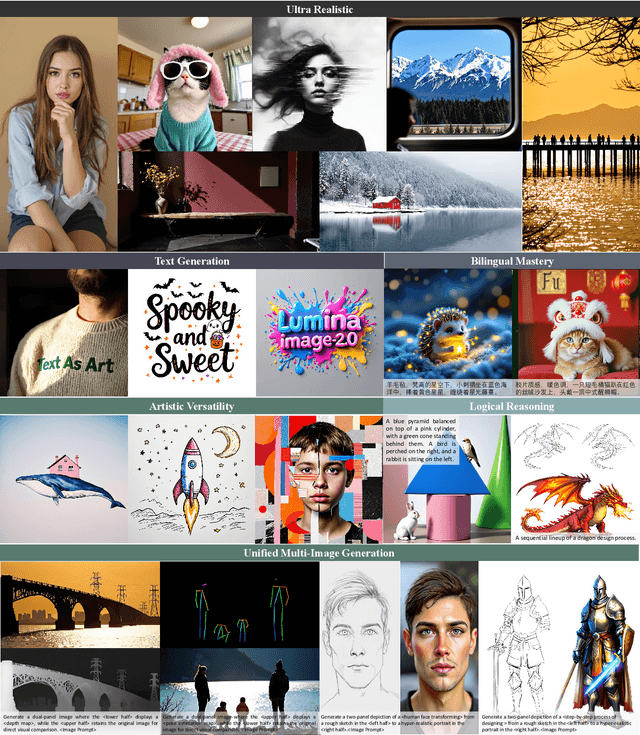
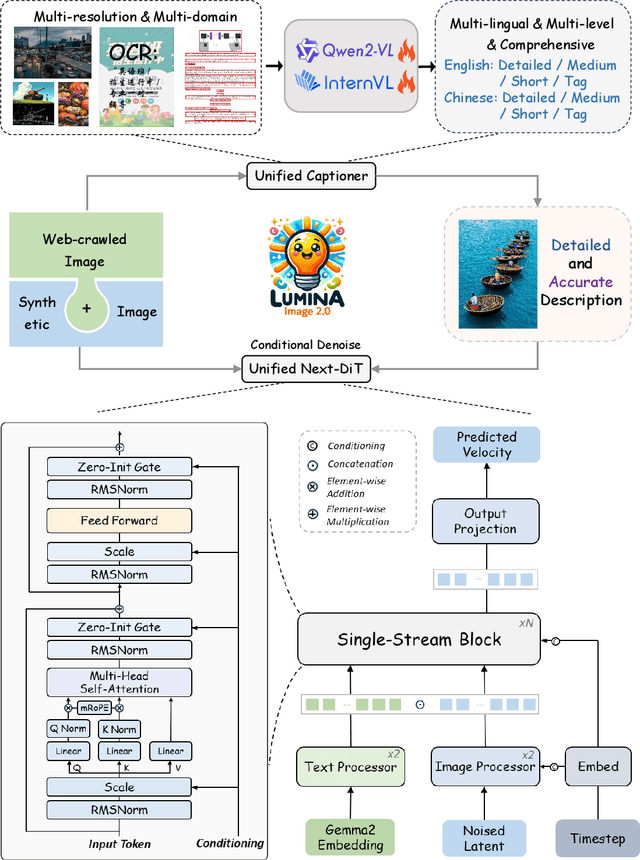

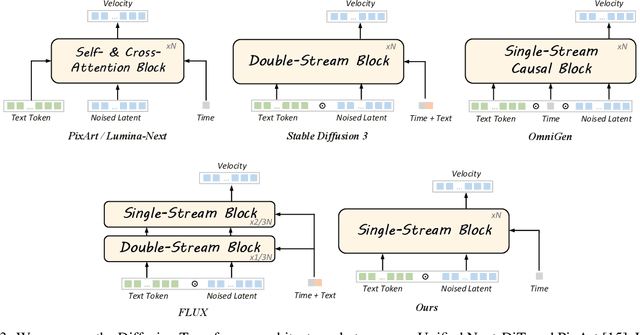
We introduce Lumina-Image 2.0, an advanced text-to-image generation framework that achieves significant progress compared to previous work, Lumina-Next. Lumina-Image 2.0 is built upon two key principles: (1) Unification - it adopts a unified architecture (Unified Next-DiT) that treats text and image tokens as a joint sequence, enabling natural cross-modal interactions and allowing seamless task expansion. Besides, since high-quality captioners can provide semantically well-aligned text-image training pairs, we introduce a unified captioning system, Unified Captioner (UniCap), specifically designed for T2I generation tasks. UniCap excels at generating comprehensive and accurate captions, accelerating convergence and enhancing prompt adherence. (2) Efficiency - to improve the efficiency of our proposed model, we develop multi-stage progressive training strategies and introduce inference acceleration techniques without compromising image quality. Extensive evaluations on academic benchmarks and public text-to-image arenas show that Lumina-Image 2.0 delivers strong performances even with only 2.6B parameters, highlighting its scalability and design efficiency. We have released our training details, code, and models at https://github.com/Alpha-VLLM/Lumina-Image-2.0.
Lumina-Video: Efficient and Flexible Video Generation with Multi-scale Next-DiT
Feb 10, 2025Recent advancements have established Diffusion Transformers (DiTs) as a dominant framework in generative modeling. Building on this success, Lumina-Next achieves exceptional performance in the generation of photorealistic images with Next-DiT. However, its potential for video generation remains largely untapped, with significant challenges in modeling the spatiotemporal complexity inherent to video data. To address this, we introduce Lumina-Video, a framework that leverages the strengths of Next-DiT while introducing tailored solutions for video synthesis. Lumina-Video incorporates a Multi-scale Next-DiT architecture, which jointly learns multiple patchifications to enhance both efficiency and flexibility. By incorporating the motion score as an explicit condition, Lumina-Video also enables direct control of generated videos' dynamic degree. Combined with a progressive training scheme with increasingly higher resolution and FPS, and a multi-source training scheme with mixed natural and synthetic data, Lumina-Video achieves remarkable aesthetic quality and motion smoothness at high training and inference efficiency. We additionally propose Lumina-V2A, a video-to-audio model based on Next-DiT, to create synchronized sounds for generated videos. Codes are released at https://www.github.com/Alpha-VLLM/Lumina-Video.