 Add to Chrome
 Add to Firefox
 Add to Edge
Knowledge-guided Disentanglement with Atomic Actions for Action Recognition
Jul 28, 2026
Action recognition in complex scenes often involves multiple concurrent fine-grained actions, making it challenging to model internal action structures. Most existing methods rely on holistic representations, which are insufficient for capturing subtle interactions and fine-grained semantics. While recent prompt-based approaches introduce disentanglement, they lack explicit semantic guidance, and methods based solely on visual or structured cues remain coarse-grained. In this paper, we propose Knowledge-guided Disentanglement with Atomic Actions (KDA), which leverages fine-grained semantic knowledge to enhance action representations and enable more precise disentanglement. Specifically, we use Large Language Models (LLMs) to decompose action labels into atomic actions, providing explicit spatial-temporal semantics. A Knowledge Injection Module (KIM) first integrates atomic action knowledge into video features. Based on this enhanced representation, a Knowledge Disentanglement Module (KDM) further disentangles atomic action knowledge to produce more precise semantic guidance for action disentanglement. A Knowledge Disentanglement Loss (KD Loss) is introduced to encourage clearer disentanglement of knowledge components within KDM. Extensive experiments demonstrate that KDA improves feature discriminability and achieves state-of-the-art performance on multi-label action recognition benchmarks. Moreover, KIM and KDM can be readily integrated into other methods, demonstrating strong generality.

Look Clearly Before Answering: Mitigating Hallucinations in LVLMs via Saliency-Driven Perceptual Realignment
Jul 18, 2026Large vision-language models (LVLMs) have demonstrated remarkable capabilities in multimodal understanding. However, they remain prone to hallucinations, generating responses that are inconsistent with the visual evidence. Existing mitigation methods largely address language-prior bias or cross-modal imbalance, while progressive visual degradation across perception and memory remains underexplored. In this work, we propose Saliency-Driven Perceptual Realignment (SDPR), a training-free framework that mitigates the degradation of visual awareness throughout inference. Specifically, we first introduce saliency-driven attention redistribution to release attention hijacked by non-semantic sink tokens, thereby recovering critical visual evidence. Second, we identify spatial distortion in the KV cache and propose saliency-driven cache alignment to preserve query-relevant visual features during generation. Finally, we introduce prior-constrained contrastive decoding to penalize unfaithful predictions induced by dominant language priors. Our proposed SDPR is robust against hallucinations due to its holistic alignment of visual awareness across the entire generative trajectory. Extensive experiments across diverse LVLM architectures show that SDPR outperforms state-of-the-art methods on both hallucination and general-purpose benchmarks, requiring no additional training and incurring minimal runtime overhead. The code is available \href{https://github.com/PengSyuChen/SDPR}{\color{blue}{here}}.
Bridging Vision and Language Concepts through Optimal Transport Semantic Flow
Jun 25, 2026Concept Bottleneck Models (CBMs) promise transparent reasoning by predicting through human-interpretable concepts, yet their effectiveness fundamentally depends on how well visual and textual representations are aligned or matched. Existing vision-language CBMs often rely on pre-aligned encoders or global cosine similarity, which obscures fine-grained concept localization and fails to reflect true semantic geometry. In this work, we rethink concept alignment as a dynamic cross-modal transport process instead of static projection and propose the Optimal Transport Flow Concept Bottleneck Model (OTF-CBM). It first learns a data-driven semantic cost via Inverse Optimal Transport to measure cross-modal distances, and then performs unbalanced optimal-transport-based flow matching to model semantic transitions between visual patches and textual concepts. With velocity-based concept activation, OTF-CBM captures interpretable geometric relations without ODE integration. Experiments further show that OTF-CBM achieves superior classification accuracy and concept faithfulness, offering a new geometric and dynamical perspective for interpretable cross-modal reasoning.
SkeletonContext: Skeleton-side Context Prompt Learning for Zero-Shot Skeleton-based Action Recognition
Mar 31, 2026Zero-shot skeleton-based action recognition aims to recognize unseen actions by transferring knowledge from seen categories through semantic descriptions. Most existing methods typically align skeleton features with textual embeddings within a shared latent space. However, the absence of contextual cues, such as objects involved in the action, introduces an inherent gap between skeleton and semantic representations, making it difficult to distinguish visually similar actions. To address this, we propose SkeletonContext, a prompt-based framework that enriches skeletal motion representations with language-driven contextual semantics. Specifically, we introduce a Cross-Modal Context Prompt Module, which leverages a pretrained language model to reconstruct masked contextual prompts under guidance derived from LLMs. This design effectively transfers linguistic context to the skeleton encoder for instance-level semantic grounding and improved cross-modal alignment. In addition, a Key-Part Decoupling Module is incorporated to decouple motion-relevant joint features, ensuring robust action understanding even in the absence of explicit object interactions. Extensive experiments on multiple benchmarks demonstrate that SkeletonContext achieves state-of-the-art performance under both conventional and generalized zero-shot settings, validating its effectiveness in reasoning about context and distinguishing fine-grained, visually similar actions.
FSD-CAP: Fractional Subgraph Diffusion with Class-Aware Propagation for Graph Feature Imputation
Jan 26, 2026Imputing missing node features in graphs is challenging, particularly under high missing rates. Existing methods based on latent representations or global diffusion often fail to produce reliable estimates, and may propagate errors across the graph. We propose FSD-CAP, a two-stage framework designed to improve imputation quality under extreme sparsity. In the first stage, a graph-distance-guided subgraph expansion localizes the diffusion process. A fractional diffusion operator adjusts propagation sharpness based on local structure. In the second stage, imputed features are refined using class-aware propagation, which incorporates pseudo-labels and neighborhood entropy to promote consistency. We evaluated FSD-CAP on multiple datasets. With $99.5\%$ of features missing across five benchmark datasets, FSD-CAP achieves average accuracies of $80.06\%$ (structural) and $81.01\%$ (uniform) in node classification, close to the $81.31\%$ achieved by a standard GCN with full features. For link prediction under the same setting, it reaches AUC scores of $91.65\%$ (structural) and $92.41\%$ (uniform), compared to $95.06\%$ for the fully observed case. Furthermore, FSD-CAP demonstrates superior performance on both large-scale and heterophily datasets when compared to other models.
Multi-Granularity Mutual Refinement Network for Zero-Shot Learning
Nov 11, 2025Zero-shot learning (ZSL) aims to recognize unseen classes with zero samples by transferring semantic knowledge from seen classes. Current approaches typically correlate global visual features with semantic information (i.e., attributes) or align local visual region features with corresponding attributes to enhance visual-semantic interactions. Although effective, these methods often overlook the intrinsic interactions between local region features, which can further improve the acquisition of transferable and explicit visual features. In this paper, we propose a network named Multi-Granularity Mutual Refinement Network (Mg-MRN), which refine discriminative and transferable visual features by learning decoupled multi-granularity features and cross-granularity feature interactions. Specifically, we design a multi-granularity feature extraction module to learn region-level discriminative features through decoupled region feature mining. Then, a cross-granularity feature fusion module strengthens the inherent interactions between region features of varying granularities. This module enhances the discriminability of representations at each granularity level by integrating region representations from adjacent hierarchies, further improving ZSL recognition performance. Extensive experiments on three popular ZSL benchmark datasets demonstrate the superiority and competitiveness of our proposed Mg-MRN method. Our code is available at https://github.com/NingWang2049/Mg-MRN.
DailyDVS-200: A Comprehensive Benchmark Dataset for Event-Based Action Recognition
Jul 06, 2024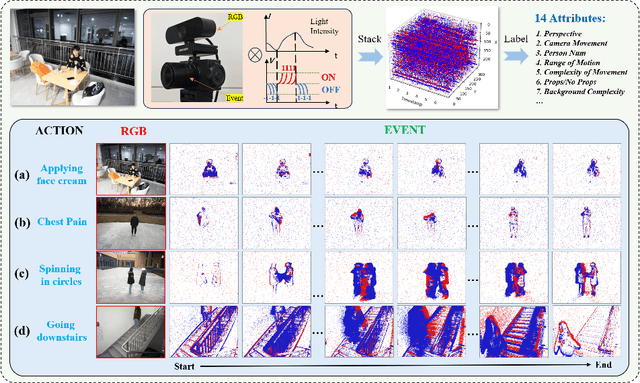
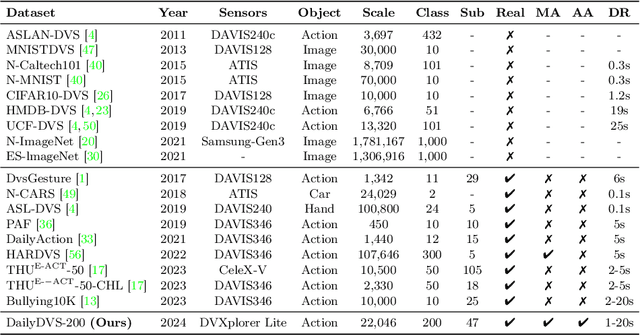
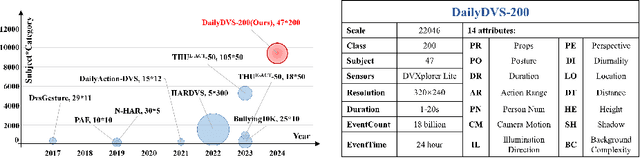
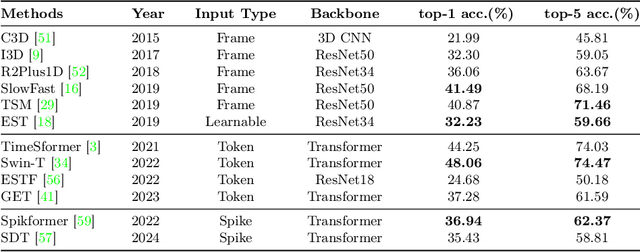
Neuromorphic sensors, specifically event cameras, revolutionize visual data acquisition by capturing pixel intensity changes with exceptional dynamic range, minimal latency, and energy efficiency, setting them apart from conventional frame-based cameras. The distinctive capabilities of event cameras have ignited significant interest in the domain of event-based action recognition, recognizing their vast potential for advancement. However, the development in this field is currently slowed by the lack of comprehensive, large-scale datasets, which are critical for developing robust recognition frameworks. To bridge this gap, we introduces DailyDVS-200, a meticulously curated benchmark dataset tailored for the event-based action recognition community. DailyDVS-200 is extensive, covering 200 action categories across real-world scenarios, recorded by 47 participants, and comprises more than 22,000 event sequences. This dataset is designed to reflect a broad spectrum of action types, scene complexities, and data acquisition diversity. Each sequence in the dataset is annotated with 14 attributes, ensuring a detailed characterization of the recorded actions. Moreover, DailyDVS-200 is structured to facilitate a wide range of research paths, offering a solid foundation for both validating existing approaches and inspiring novel methodologies. By setting a new benchmark in the field, we challenge the current limitations of neuromorphic data processing and invite a surge of new approaches in event-based action recognition techniques, which paves the way for future explorations in neuromorphic computing and beyond. The dataset and source code are available at https://github.com/QiWang233/DailyDVS-200.
Language Model Guided Interpretable Video Action Reasoning
Apr 02, 2024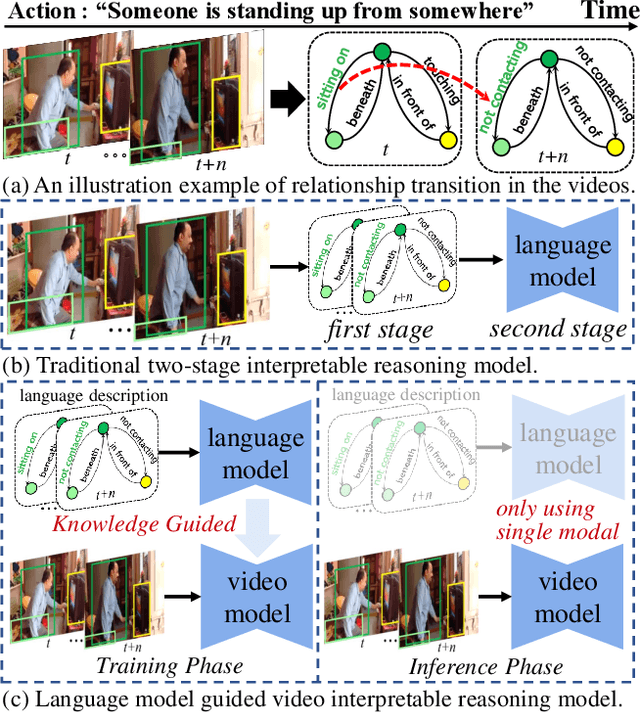
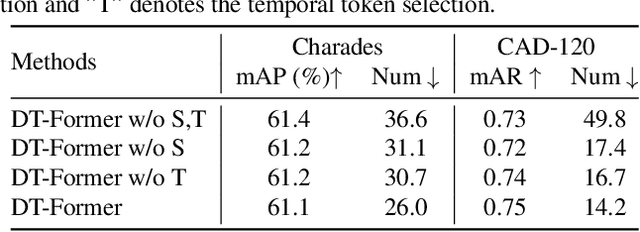
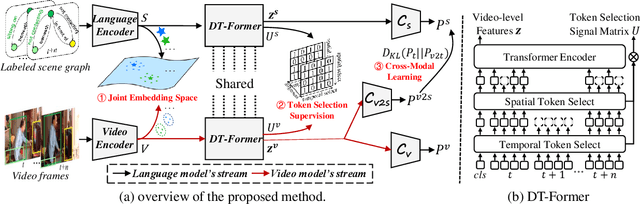
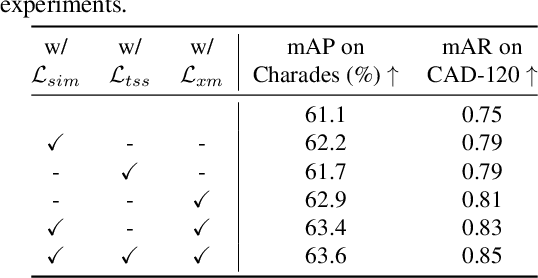
While neural networks have excelled in video action recognition tasks, their black-box nature often obscures the understanding of their decision-making processes. Recent approaches used inherently interpretable models to analyze video actions in a manner akin to human reasoning. These models, however, usually fall short in performance compared to their black-box counterparts. In this work, we present a new framework named Language-guided Interpretable Action Recognition framework (LaIAR). LaIAR leverages knowledge from language models to enhance both the recognition capabilities and the interpretability of video models. In essence, we redefine the problem of understanding video model decisions as a task of aligning video and language models. Using the logical reasoning captured by the language model, we steer the training of the video model. This integrated approach not only improves the video model's adaptability to different domains but also boosts its overall performance. Extensive experiments on two complex video action datasets, Charades & CAD-120, validates the improved performance and interpretability of our LaIAR framework. The code of LaIAR is available at https://github.com/NingWang2049/LaIAR.
The two-way knowledge interaction interface between humans and neural networks
Jan 10, 2024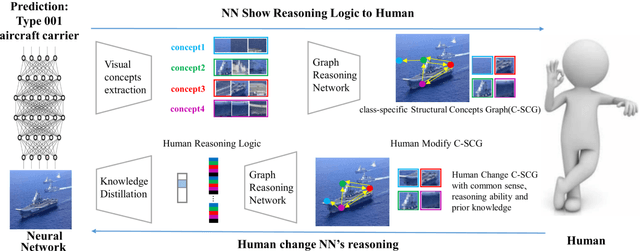
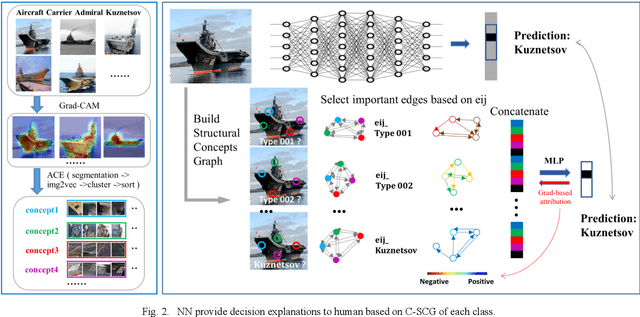
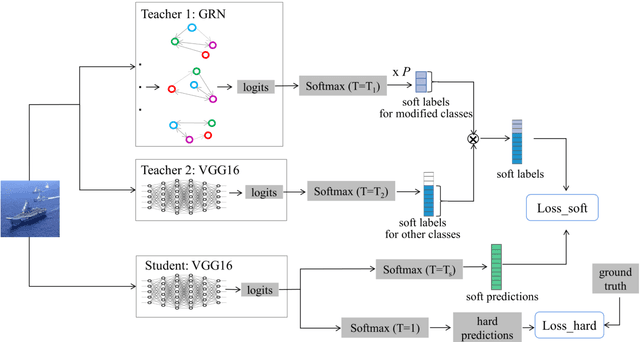
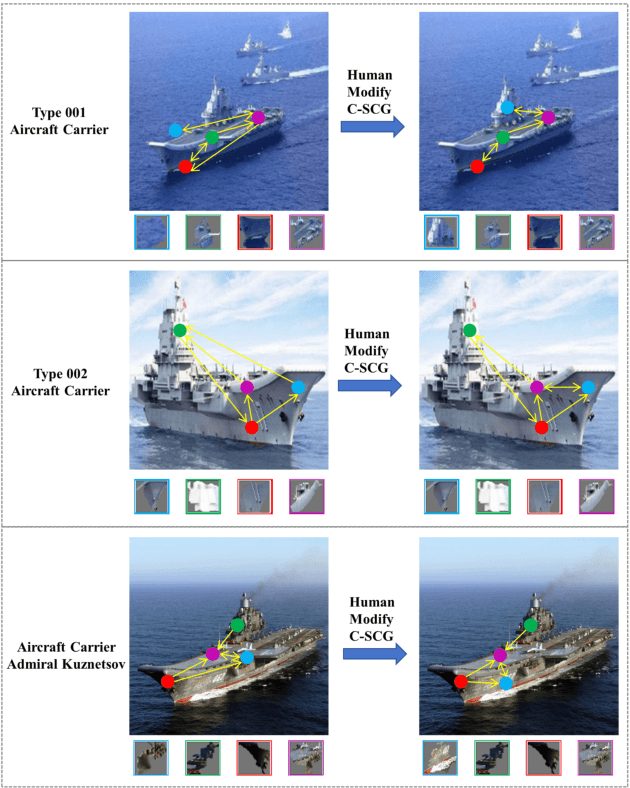
Despite neural networks (NN) have been widely applied in various fields and generally outperforms humans, they still lack interpretability to a certain extent, and humans are unable to intuitively understand the decision logic of NN. This also hinders the knowledge interaction between humans and NN, preventing humans from getting involved to give direct guidance when NN's decisions go wrong. While recent research in explainable AI has achieved interpretability of NN from various perspectives, it has not yet provided effective methods for knowledge exchange between humans and NN. To address this problem, we constructed a two-way interaction interface that uses structured representations of visual concepts and their relationships as the "language" for knowledge exchange between humans and NN. Specifically, NN provide intuitive reasoning explanations to humans based on the class-specific structural concepts graph (C-SCG). On the other hand, humans can modify the biases present in the C-SCG through their prior knowledge and reasoning ability, and thus provide direct knowledge guidance to NN through this interface. Through experimental validation, based on this interaction interface, NN can provide humans with easily understandable explanations of the reasoning process. Furthermore, human involvement and prior knowledge can directly and effectively contribute to enhancing the performance of NN.
Content-Conditioned Generation of Stylized Free hand Sketches
Jan 09, 2024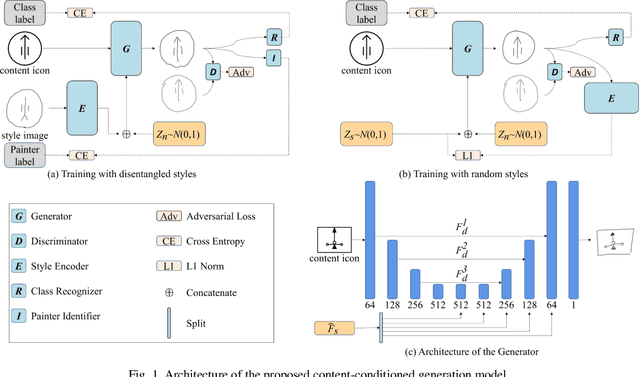
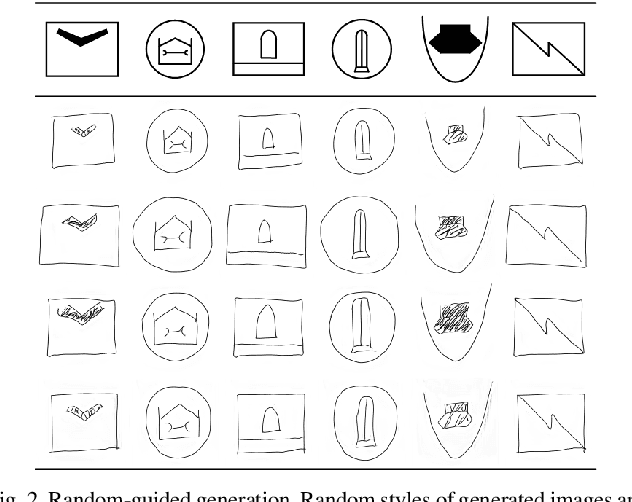
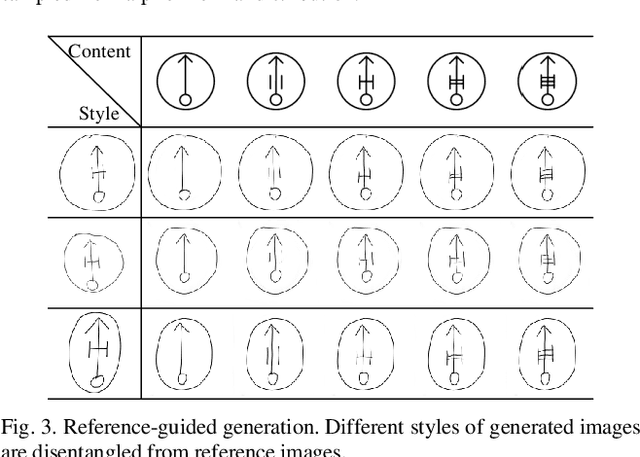
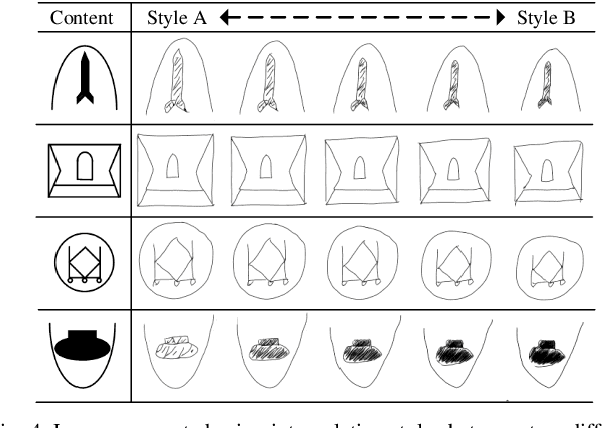
In recent years, the recognition of free-hand sketches has remained a popular task. However, in some special fields such as the military field, free-hand sketches are difficult to sample on a large scale. Common data augmentation and image generation techniques are difficult to produce images with various free-hand sketching styles. Therefore, the recognition and segmentation tasks in related fields are limited. In this paper, we propose a novel adversarial generative network that can accurately generate realistic free-hand sketches with various styles. We explore the performance of the model, including using styles randomly sampled from a prior normal distribution to generate images with various free-hand sketching styles, disentangling the painters' styles from known free-hand sketches to generate images with specific styles, and generating images of unknown classes that are not in the training set. We further demonstrate with qualitative and quantitative evaluations our advantages in visual quality, content accuracy, and style imitation on SketchIME.