 Add to Chrome
 Add to Firefox
 Add to Edge
Flux-OPD: On-Policy Distillation with Evolving Contexts
Jul 30, 2026
Large language model training in open-ended domains lacks verifiable rewards, making task preferences difficult to formalize as effective supervision. Contexts can convey such preferences, yet provide little additional supervision once distilled into the student, motivating contexts that evolve with student performance. However, directly using evolving contexts as in-training supervision results in an unstable distillation target and conflicting distributions, requiring mechanisms to stabilize target and downweight conflicts. In this paper, we analyze the effect of contexts through a decomposition of the reverse KL objective, revealing two findings: the student is distilled toward the geometric mean of context-conditioned teachers, and the objective contains a conflict term that measures conflicts among these teachers. Based on this decomposition, we propose Flux-OPD, an OPD paradigm that uses evolving contexts as in-training supervision to capture task preferences in open-ended domains. Flux-OPD treats the differences between context-conditioned and context-free teachers as contextual difference signals, injects them as contextual corrections into the context-free teacher anchor, and weights their correction strength using the conflict term as an indicator. Experiments on open-ended tasks show that Flux-OPD outperforms existing OPD paradigms, highlighting the potential to combine teacher supervision with evolving contexts.

ARGUS: Stacked Multi-View Identity Mosaic Injection for Subject-Preserving Video Generation
Jun 10, 2026Subject-preserving video generation is not solved by frontal-face similarity alone: a generated person must remain recognizable across motion, large viewpoint changes, expression shifts, occlusion, scale variation, and conflicts among text, first-frame, and identity references. We argue that the central bottleneck is the point-reference paradigm, which collapses identity into a single static observation entangled with pose, accessories, lighting, background, and camera statistics. We introduce Argus, a Wan-based framework centered on Stacked Multi-View Identity Mosaic Injection (SMII). SMII converts MLLM-selected image/video identity evidence into a 3*3 stacked mosaic, synchronizes the mosaic with the current diffusion time, and injects it as negative-time read-only memory in Wan's native token space. This turns identity from an external clean adapter or a single reference image into a compact dynamic distribution. Around SMII, an MLLM Identity Director selects informative identity moments and resolves condition conflicts, while no-cross-pair counterfactual training, Temporal Identity Annealing, and Adaptive Self-Likeness Guidance improve robustness without paired subject-video supervision. We further release HardID-Celeb, a public-figure identity-stress benchmark, and introduce YawScore and OccScore to probe large-yaw and first-frame-occlusion robustness. Argus achieves state-of-the-art results on OpenS2V-Eval Human-Domain, reaching 64.38 Total Score, 71.86 FaceSim, 51.62 NexusScore, and 79.14 NaturalScore. On HardID-Celeb, Argus obtains 76.80 FaceSim and improves YawScore and OccScore by 12.60 and 15.10 points over the strongest baselines, demonstrating that dynamic identity memory and large-scale counterfactual self-supervision are highly effective for subject-preserving video generation.
LatentOmni: Rethinking Omni-Modal Understanding via Unified Audio-Visual Latent Reasoning
May 21, 2026Joint audio-visual reasoning is essential for omnimodal understanding, yet current multimodal large language models (MLLMs) still struggle when reasoning requires fine-grained evidence from both modalities. A central limitation is that explicit text-based chain-of-thought (CoT) compresses continuous audio-visual signals into discrete tokens, weakening temporal grounding and shifting intermediate reasoning toward language priors. We argue that a unified latent space is a better medium for such reasoning because it preserves dense sensory information while remaining compatible with autoregressive generation. Based on this insight, we propose \textbf{LatentOmni}, a cross-modal reasoning framework that interleaves textual reasoning with audio-visual latent states. LatentOmni introduces feature-level supervision to align latent reasoning states with task-relevant sensory features and uses Omni-Sync Position Embedding (OSPE) to maintain temporal consistency between latent audio and visual states. We further construct \textbf{LatentOmni-Instruct-35K}, a dataset of audio-visual interleaved reasoning trajectories for supervising latent-space reasoning. Comprehensive evaluation across multiple audio-visual reasoning benchmarks demonstrates that LatentOmni achieves the best performance among the evaluated open-source models and consistently outperforms the Explicit Text CoT baseline, supporting latent-space joint reasoning as a promising path toward stronger omnimodal understanding.
Artifact-Bench: Evaluating MLLMs on Detecting and Assessing the Artifacts of AI-Generated Videos
May 18, 2026Recent video generative models have greatly improved the realism of AI-generated videos, yet their outputs still exhibit artifacts such as temporal inconsistencies, structural distortions, and semantic incoherence. While Multimodal Large Language Models (MLLMs) show strong visual understanding capabilities, their ability to perceive and reason about such artifacts remains unclear. Existing benchmarks often lack systematic evaluation of artifact-aware perception and fine-grained diagnostic reasoning, especially across diverse AI-generated video domains beyond photorealistic content. To address this gap, we introduce Artifact-Bench, a comprehensive benchmark for evaluating MLLMs on AI-generated video artifact detection and analysis. We first establish a three-level hierarchical taxonomy of realism artifacts, covering photorealistic, animated, and CG-style videos. Based on this taxonomy, Artifact-Bench defines three complementary tasks: real vs. AI-generated video classification, pairwise realism comparison, and fine-grained artifact identification. Experiments on 19 leading MLLMs reveal substantial limitations in artifact perception and reasoning, with many models approaching random or even below-random performance in challenging settings. We further observe significant misalignment between MLLM judgments and human perceptual preferences, highlighting their limited reliability as general evaluators for AI-generated video realism.
OpenWorldLib: A Unified Codebase and Definition of Advanced World Models
Apr 06, 2026World models have garnered significant attention as a promising research direction in artificial intelligence, yet a clear and unified definition remains lacking. In this paper, we introduce OpenWorldLib, a comprehensive and standardized inference framework for Advanced World Models. Drawing on the evolution of world models, we propose a clear definition: a world model is a model or framework centered on perception, equipped with interaction and long-term memory capabilities, for understanding and predicting the complex world. We further systematically categorize the essential capabilities of world models. Based on this definition, OpenWorldLib integrates models across different tasks within a unified framework, enabling efficient reuse and collaborative inference. Finally, we present additional reflections and analyses on potential future directions for world model research. Code link: https://github.com/OpenDCAI/OpenWorldLib
Research on World Models Is Not Merely Injecting World Knowledge into Specific Tasks
Feb 02, 2026World models have emerged as a critical frontier in AI research, aiming to enhance large models by infusing them with physical dynamics and world knowledge. The core objective is to enable agents to understand, predict, and interact with complex environments. However, current research landscape remains fragmented, with approaches predominantly focused on injecting world knowledge into isolated tasks, such as visual prediction, 3D estimation, or symbol grounding, rather than establishing a unified definition or framework. While these task-specific integrations yield performance gains, they often lack the systematic coherence required for holistic world understanding. In this paper, we analyze the limitations of such fragmented approaches and propose a unified design specification for world models. We suggest that a robust world model should not be a loose collection of capabilities but a normative framework that integrally incorporates interaction, perception, symbolic reasoning, and spatial representation. This work aims to provide a structured perspective to guide future research toward more general, robust, and principled models of the world.
CoF-T2I: Video Models as Pure Visual Reasoners for Text-to-Image Generation
Jan 15, 2026Recent video generation models have revealed the emergence of Chain-of-Frame (CoF) reasoning, enabling frame-by-frame visual inference. With this capability, video models have been successfully applied to various visual tasks (e.g., maze solving, visual puzzles). However, their potential to enhance text-to-image (T2I) generation remains largely unexplored due to the absence of a clearly defined visual reasoning starting point and interpretable intermediate states in the T2I generation process. To bridge this gap, we propose CoF-T2I, a model that integrates CoF reasoning into T2I generation via progressive visual refinement, where intermediate frames act as explicit reasoning steps and the final frame is taken as output. To establish such an explicit generation process, we curate CoF-Evol-Instruct, a dataset of CoF trajectories that model the generation process from semantics to aesthetics. To further improve quality and avoid motion artifacts, we enable independent encoding operation for each frame. Experiments show that CoF-T2I significantly outperforms the base video model and achieves competitive performance on challenging benchmarks, reaching 0.86 on GenEval and 7.468 on Imagine-Bench. These results indicate the substantial promise of video models for advancing high-quality text-to-image generation.
Scone: Bridging Composition and Distinction in Subject-Driven Image Generation via Unified Understanding-Generation Modeling
Dec 14, 2025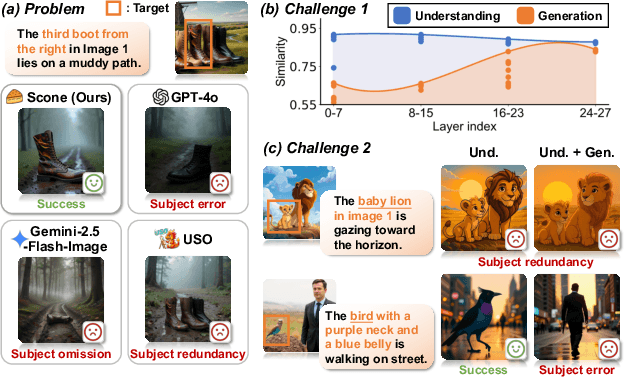
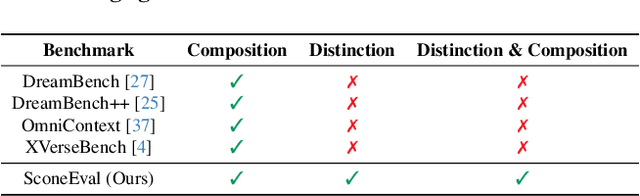
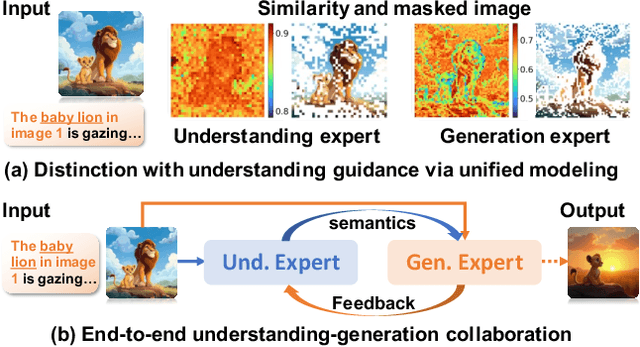
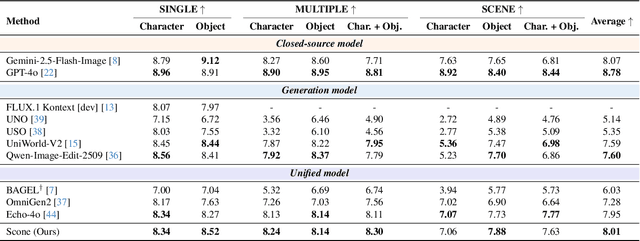
Subject-driven image generation has advanced from single- to multi-subject composition, while neglecting distinction, the ability to identify and generate the correct subject when inputs contain multiple candidates. This limitation restricts effectiveness in complex, realistic visual settings. We propose Scone, a unified understanding-generation method that integrates composition and distinction. Scone enables the understanding expert to act as a semantic bridge, conveying semantic information and guiding the generation expert to preserve subject identity while minimizing interference. A two-stage training scheme first learns composition, then enhances distinction through semantic alignment and attention-based masking. We also introduce SconeEval, a benchmark for evaluating both composition and distinction across diverse scenarios. Experiments demonstrate that Scone outperforms existing open-source models in composition and distinction tasks on two benchmarks. Our model, benchmark, and training data are available at: https://github.com/Ryann-Ran/Scone.
Delving into RL for Image Generation with CoT: A Study on DPO vs. GRPO
May 22, 2025Recent advancements underscore the significant role of Reinforcement Learning (RL) in enhancing the Chain-of-Thought (CoT) reasoning capabilities of large language models (LLMs). Two prominent RL algorithms, Direct Preference Optimization (DPO) and Group Relative Policy Optimization (GRPO), are central to these developments, showcasing different pros and cons. Autoregressive image generation, also interpretable as a sequential CoT reasoning process, presents unique challenges distinct from LLM-based CoT reasoning. These encompass ensuring text-image consistency, improving image aesthetic quality, and designing sophisticated reward models, rather than relying on simpler rule-based rewards. While recent efforts have extended RL to this domain, these explorations typically lack an in-depth analysis of the domain-specific challenges and the characteristics of different RL strategies. To bridge this gap, we provide the first comprehensive investigation of the GRPO and DPO algorithms in autoregressive image generation, evaluating their in-domain performance and out-of-domain generalization, while scrutinizing the impact of different reward models on their respective capabilities. Our findings reveal that GRPO and DPO exhibit distinct advantages, and crucially, that reward models possessing stronger intrinsic generalization capabilities potentially enhance the generalization potential of the applied RL algorithms. Furthermore, we systematically explore three prevalent scaling strategies to enhance both their in-domain and out-of-domain proficiency, deriving unique insights into efficiently scaling performance for each paradigm. We hope our study paves a new path for inspiring future work on developing more effective RL algorithms to achieve robust CoT reasoning in the realm of autoregressive image generation. Code is released at https://github.com/ZiyuGuo99/Image-Generation-CoT
Can We Generate Images with CoT? Let's Verify and Reinforce Image Generation Step by Step
Jan 23, 2025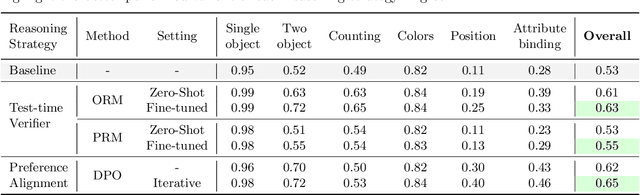


Chain-of-Thought (CoT) reasoning has been extensively explored in large models to tackle complex understanding tasks. However, it still remains an open question whether such strategies can be applied to verifying and reinforcing image generation scenarios. In this paper, we provide the first comprehensive investigation of the potential of CoT reasoning to enhance autoregressive image generation. We focus on three techniques: scaling test-time computation for verification, aligning model preferences with Direct Preference Optimization (DPO), and integrating these techniques for complementary effects. Our results demonstrate that these approaches can be effectively adapted and combined to significantly improve image generation performance. Furthermore, given the pivotal role of reward models in our findings, we propose the Potential Assessment Reward Model (PARM) and PARM++, specialized for autoregressive image generation. PARM adaptively assesses each generation step through a potential assessment approach, merging the strengths of existing reward models, and PARM++ further introduces a reflection mechanism to self-correct the generated unsatisfactory image. Using our investigated reasoning strategies, we enhance a baseline model, Show-o, to achieve superior results, with a significant +24% improvement on the GenEval benchmark, surpassing Stable Diffusion 3 by +15%. We hope our study provides unique insights and paves a new path for integrating CoT reasoning with autoregressive image generation. Code and models are released at https://github.com/ZiyuGuo99/Image-Generation-CoT