 Add to Chrome
 Add to Firefox
 Add to Edge
Hunyuan3D 2.1: From Images to High-Fidelity 3D Assets with Production-Ready PBR Material
Jun 18, 2025
3D AI-generated content (AIGC) is a passionate field that has significantly accelerated the creation of 3D models in gaming, film, and design. Despite the development of several groundbreaking models that have revolutionized 3D generation, the field remains largely accessible only to researchers, developers, and designers due to the complexities involved in collecting, processing, and training 3D models. To address these challenges, we introduce Hunyuan3D 2.1 as a case study in this tutorial. This tutorial offers a comprehensive, step-by-step guide on processing 3D data, training a 3D generative model, and evaluating its performance using Hunyuan3D 2.1, an advanced system for producing high-resolution, textured 3D assets. The system comprises two core components: the Hunyuan3D-DiT for shape generation and the Hunyuan3D-Paint for texture synthesis. We will explore the entire workflow, including data preparation, model architecture, training strategies, evaluation metrics, and deployment. By the conclusion of this tutorial, you will have the knowledge to finetune or develop a robust 3D generative model suitable for applications in gaming, virtual reality, and industrial design.

Break Stylistic Sophon: Are We Really Meant to Confine the Imagination in Style Transfer?
Jun 18, 2025In this pioneering study, we introduce StyleWallfacer, a groundbreaking unified training and inference framework, which not only addresses various issues encountered in the style transfer process of traditional methods but also unifies the framework for different tasks. This framework is designed to revolutionize the field by enabling artist level style transfer and text driven stylization. First, we propose a semantic-based style injection method that uses BLIP to generate text descriptions strictly aligned with the semantics of the style image in CLIP space. By leveraging a large language model to remove style-related descriptions from these descriptions, we create a semantic gap. This gap is then used to fine-tune the model, enabling efficient and drift-free injection of style knowledge. Second, we propose a data augmentation strategy based on human feedback, incorporating high-quality samples generated early in the fine-tuning process into the training set to facilitate progressive learning and significantly reduce its overfitting. Finally, we design a training-free triple diffusion process using the fine-tuned model, which manipulates the features of self-attention layers in a manner similar to the cross-attention mechanism. Specifically, in the generation process, the key and value of the content-related process are replaced with those of the style-related process to inject style while maintaining text control over the model. We also introduce query preservation to mitigate disruptions to the original content. Under such a design, we have achieved high-quality image-driven style transfer and text-driven stylization, delivering artist-level style transfer results while preserving the original image content. Moreover, we achieve image color editing during the style transfer process for the first time.
Non-Overlap-Aware Egocentric Pose Estimation for Collaborative Perception in Connected Autonomy
Jun 17, 2025Egocentric pose estimation is a fundamental capability for multi-robot collaborative perception in connected autonomy, such as connected autonomous vehicles. During multi-robot operations, a robot needs to know the relative pose between itself and its teammates with respect to its own coordinates. However, different robots usually observe completely different views that contains similar objects, which leads to wrong pose estimation. In addition, it is unrealistic to allow robots to share their raw observations to detect overlap due to the limited communication bandwidth constraint. In this paper, we introduce a novel method for Non-Overlap-Aware Egocentric Pose Estimation (NOPE), which performs egocentric pose estimation in a multi-robot team while identifying the non-overlap views and satifying the communication bandwidth constraint. NOPE is built upon an unified hierarchical learning framework that integrates two levels of robot learning: (1) high-level deep graph matching for correspondence identification, which allows to identify if two views are overlapping or not, (2) low-level position-aware cross-attention graph learning for egocentric pose estimation. To evaluate NOPE, we conduct extensive experiments in both high-fidelity simulation and real-world scenarios. Experimental results have demonstrated that NOPE enables the novel capability for non-overlapping-aware egocentric pose estimation and achieves state-of-art performance compared with the existing methods. Our project page at https://hongh0.github.io/NOPE/.
Ego-R1: Chain-of-Tool-Thought for Ultra-Long Egocentric Video Reasoning
Jun 16, 2025We introduce Ego-R1, a novel framework for reasoning over ultra-long (i.e., in days and weeks) egocentric videos, which leverages a structured Chain-of-Tool-Thought (CoTT) process, orchestrated by an Ego-R1 Agent trained via reinforcement learning (RL). Inspired by human problem-solving strategies, CoTT decomposes complex reasoning into modular steps, with the RL agent invoking specific tools, one per step, to iteratively and collaboratively answer sub-questions tackling such tasks as temporal retrieval and multi-modal understanding. We design a two-stage training paradigm involving supervised finetuning (SFT) of a pretrained language model using CoTT data and RL to enable our agent to dynamically propose step-by-step tools for long-range reasoning. To facilitate training, we construct a dataset called Ego-R1 Data, which consists of Ego-CoTT-25K for SFT and Ego-QA-4.4K for RL. Furthermore, our Ego-R1 agent is evaluated on a newly curated week-long video QA benchmark, Ego-R1 Bench, which contains human-verified QA pairs from hybrid sources. Extensive results demonstrate that the dynamic, tool-augmented chain-of-thought reasoning by our Ego-R1 Agent can effectively tackle the unique challenges of understanding ultra-long egocentric videos, significantly extending the time coverage from few hours to a week.
Leveraging Reference Documents for Zero-Shot Ranking via Large Language Models
Jun 13, 2025Large Language Models (LLMs) have demonstrated exceptional performance in the task of text ranking for information retrieval. While Pointwise ranking approaches offer computational efficiency by scoring documents independently, they often yield biased relevance estimates due to the lack of inter-document comparisons. In contrast, Pairwise methods improve ranking accuracy by explicitly comparing document pairs, but suffer from substantial computational overhead with quadratic complexity ($O(n^2)$). To address this tradeoff, we propose \textbf{RefRank}, a simple and effective comparative ranking method based on a fixed reference document. Instead of comparing all document pairs, RefRank prompts the LLM to evaluate each candidate relative to a shared reference anchor. By selecting the reference anchor that encapsulates the core query intent, RefRank implicitly captures relevance cues, enabling indirect comparison between documents via this common anchor. This reduces computational cost to linear time ($O(n)$) while importantly, preserving the advantages of comparative evaluation. To further enhance robustness, we aggregate multiple RefRank outputs using a weighted averaging scheme across different reference choices. Experiments on several benchmark datasets and with various LLMs show that RefRank significantly outperforms Pointwise baselines and could achieve performance at least on par with Pairwise approaches with a significantly lower computational cost.
ReasonMed: A 370K Multi-Agent Generated Dataset for Advancing Medical Reasoning
Jun 11, 2025Though reasoning-based large language models (LLMs) have excelled in mathematics and programming, their capabilities in knowledge-intensive medical question answering remain underexplored. To address this, we introduce ReasonMed, the largest medical reasoning dataset, comprising 370k high-quality examples distilled from 1.7 million initial reasoning paths generated by various LLMs. ReasonMed is constructed through a \textit{multi-agent verification and refinement process}, where we design an \textit{Error Refiner} to enhance the reasoning paths by identifying and correcting error-prone steps flagged by a verifier. Leveraging ReasonMed, we systematically investigate best practices for training medical reasoning models and find that combining detailed Chain-of-Thought (CoT) reasoning with concise answer summaries yields the most effective fine-tuning strategy. Based on this strategy, we train ReasonMed-7B, which sets a new benchmark for sub-10B models, outperforming the prior best by 4.17\% and even exceeding LLaMA3.1-70B on PubMedQA by 4.60\%.
Lingshu: A Generalist Foundation Model for Unified Multimodal Medical Understanding and Reasoning
Jun 08, 2025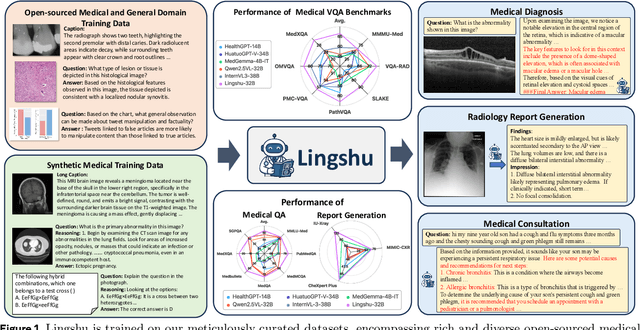
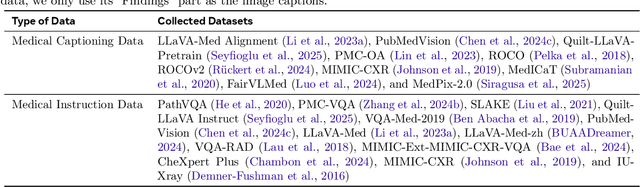
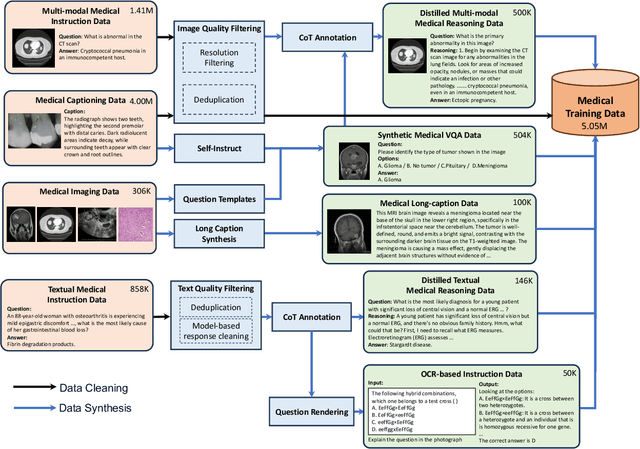
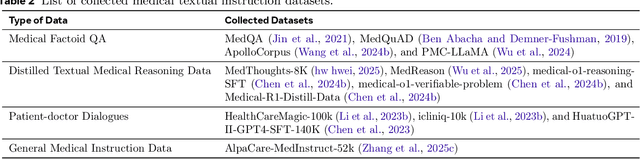
Multimodal Large Language Models (MLLMs) have demonstrated impressive capabilities in understanding common visual elements, largely due to their large-scale datasets and advanced training strategies. However, their effectiveness in medical applications remains limited due to the inherent discrepancies between data and tasks in medical scenarios and those in the general domain. Concretely, existing medical MLLMs face the following critical limitations: (1) limited coverage of medical knowledge beyond imaging, (2) heightened susceptibility to hallucinations due to suboptimal data curation processes, (3) lack of reasoning capabilities tailored for complex medical scenarios. To address these challenges, we first propose a comprehensive data curation procedure that (1) efficiently acquires rich medical knowledge data not only from medical imaging but also from extensive medical texts and general-domain data; and (2) synthesizes accurate medical captions, visual question answering (VQA), and reasoning samples. As a result, we build a multimodal dataset enriched with extensive medical knowledge. Building on the curated data, we introduce our medical-specialized MLLM: Lingshu. Lingshu undergoes multi-stage training to embed medical expertise and enhance its task-solving capabilities progressively. Besides, we preliminarily explore the potential of applying reinforcement learning with verifiable rewards paradigm to enhance Lingshu's medical reasoning ability. Additionally, we develop MedEvalKit, a unified evaluation framework that consolidates leading multimodal and textual medical benchmarks for standardized, fair, and efficient model assessment. We evaluate the performance of Lingshu on three fundamental medical tasks, multimodal QA, text-based QA, and medical report generation. The results show that Lingshu consistently outperforms the existing open-source multimodal models on most tasks ...
Score-based Generative Modeling for Conditional Independence Testing
May 29, 2025Determining conditional independence (CI) relationships between random variables is a fundamental yet challenging task in machine learning and statistics, especially in high-dimensional settings. Existing generative model-based CI testing methods, such as those utilizing generative adversarial networks (GANs), often struggle with undesirable modeling of conditional distributions and training instability, resulting in subpar performance. To address these issues, we propose a novel CI testing method via score-based generative modeling, which achieves precise Type I error control and strong testing power. Concretely, we first employ a sliced conditional score matching scheme to accurately estimate conditional score and use Langevin dynamics conditional sampling to generate null hypothesis samples, ensuring precise Type I error control. Then, we incorporate a goodness-of-fit stage into the method to verify generated samples and enhance interpretability in practice. We theoretically establish the error bound of conditional distributions modeled by score-based generative models and prove the validity of our CI tests. Extensive experiments on both synthetic and real-world datasets show that our method significantly outperforms existing state-of-the-art methods, providing a promising way to revitalize generative model-based CI testing.
MagicTryOn: Harnessing Diffusion Transformer for Garment-Preserving Video Virtual Try-on
May 28, 2025Video Virtual Try-On (VVT) aims to simulate the natural appearance of garments across consecutive video frames, capturing their dynamic variations and interactions with human body motion. However, current VVT methods still face challenges in terms of spatiotemporal consistency and garment content preservation. First, they use diffusion models based on the U-Net, which are limited in their expressive capability and struggle to reconstruct complex details. Second, they adopt a separative modeling approach for spatial and temporal attention, which hinders the effective capture of structural relationships and dynamic consistency across frames. Third, their expression of garment details remains insufficient, affecting the realism and stability of the overall synthesized results, especially during human motion. To address the above challenges, we propose MagicTryOn, a video virtual try-on framework built upon the large-scale video diffusion Transformer. We replace the U-Net architecture with a diffusion Transformer and combine full self-attention to jointly model the spatiotemporal consistency of videos. We design a coarse-to-fine garment preservation strategy. The coarse strategy integrates garment tokens during the embedding stage, while the fine strategy incorporates multiple garment-based conditions, such as semantics, textures, and contour lines during the denoising stage. Moreover, we introduce a mask-aware loss to further optimize garment region fidelity. Extensive experiments on both image and video try-on datasets demonstrate that our method outperforms existing SOTA methods in comprehensive evaluations and generalizes to in-the-wild scenarios.
Fast-dLLM: Training-free Acceleration of Diffusion LLM by Enabling KV Cache and Parallel Decoding
May 28, 2025Diffusion-based large language models (Diffusion LLMs) have shown promise for non-autoregressive text generation with parallel decoding capabilities. However, the practical inference speed of open-sourced Diffusion LLMs often lags behind autoregressive models due to the lack of Key-Value (KV) Cache and quality degradation when decoding multiple tokens simultaneously. To bridge this gap, we introduce a novel block-wise approximate KV Cache mechanism tailored for bidirectional diffusion models, enabling cache reuse with negligible performance drop. Additionally, we identify the root cause of generation quality degradation in parallel decoding as the disruption of token dependencies under the conditional independence assumption. To address this, we propose a confidence-aware parallel decoding strategy that selectively decodes tokens exceeding a confidence threshold, mitigating dependency violations and maintaining generation quality. Experimental results on LLaDA and Dream models across multiple LLM benchmarks demonstrate up to \textbf{27.6$\times$ throughput} improvement with minimal accuracy loss, closing the performance gap with autoregressive models and paving the way for practical deployment of Diffusion LLMs.