 Add to Chrome
 Add to Firefox
 Add to Edge
TRIP: Triangular Document-level Pre-training for Multilingual Language Models
Dec 15, 2022

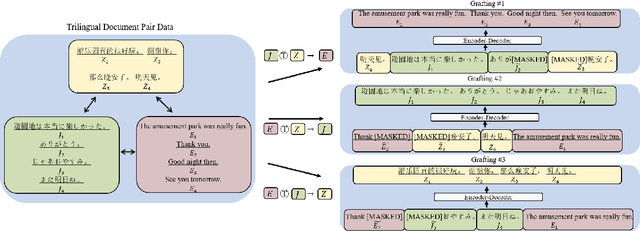
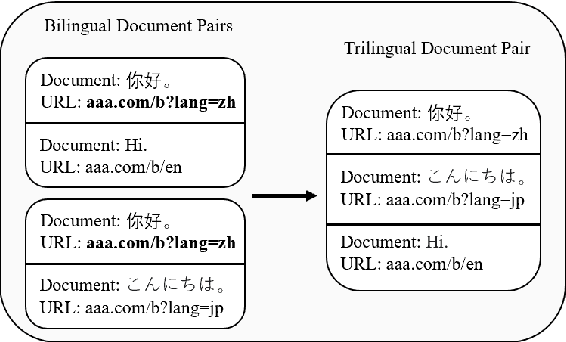
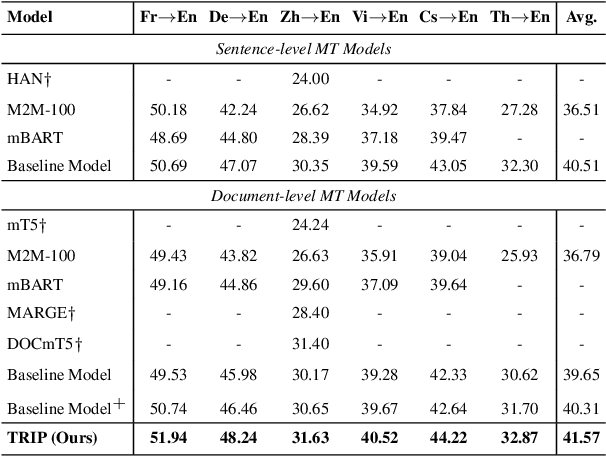
Despite the current success of multilingual pre-training, most prior works focus on leveraging monolingual data or bilingual parallel data and overlooked the value of trilingual parallel data. This paper presents \textbf{Tri}angular Document-level \textbf{P}re-training (\textbf{TRIP}), which is the first in the field to extend the conventional monolingual and bilingual pre-training to a trilingual setting by (i) \textbf{Grafting} the same documents in two languages into one mixed document, and (ii) predicting the remaining one language as the reference translation. Our experiments on document-level MT and cross-lingual abstractive summarization show that TRIP brings by up to 3.65 d-BLEU points and 6.2 ROUGE-L points on three multilingual document-level machine translation benchmarks and one cross-lingual abstractive summarization benchmark, including multiple strong state-of-the-art (SOTA) scores. In-depth analysis indicates that TRIP improves document-level machine translation and captures better document contexts in at least three characteristics: (i) tense consistency, (ii) noun consistency and (iii) conjunction presence.

Structured Prompting: Scaling In-Context Learning to 1,000 Examples
Dec 13, 2022Large language models have exhibited intriguing in-context learning capability, achieving promising zero- and few-shot performance without updating the parameters. However, conventional in-context learning is usually restricted by length constraints, rendering it ineffective to absorb supervision from a large number of examples. In order to go beyond few shots, we introduce structured prompting that breaks the length limit and scales in-context learning to thousands of examples. Specifically, demonstration examples are separately encoded with well-designed position embeddings, and then they are jointly attended by the test example using a rescaled attention mechanism. So we can scale the number of exemplars with linear complexity instead of quadratic complexity with respect to length. Experimental results on a diverse set of tasks show that our approach improves end-task performance and reduces evaluation variance over conventional in-context learning as the number of demonstration examples increases. Code has been released at https://aka.ms/structured-prompting.
Momentum Calibration for Text Generation
Dec 08, 2022The input and output of most text generation tasks can be transformed to two sequences of tokens and they can be modeled using sequence-to-sequence learning modeling tools such as Transformers. These models are usually trained by maximizing the likelihood the output text sequence and assumes the input sequence and all gold preceding tokens are given during training, while during inference the model suffers from the exposure bias problem (i.e., it only has access to its previously predicted tokens rather gold tokens during beam search). In this paper, we propose MoCa ({\bf Mo}mentum {\bf Ca}libration) for text generation. MoCa is an online method that dynamically generates slowly evolving (but consistent) samples using a momentum moving average generator with beam search and MoCa learns to align its model scores of these samples with their actual qualities. Experiments on four text generation datasets (i.e., CNN/DailyMail, XSum, SAMSum and Gigaword) show MoCa consistently improves strong pre-trained transformers using vanilla fine-tuning and we achieve the state-of-the-art results on CNN/DailyMail and SAMSum datasets.
Text Embeddings by Weakly-Supervised Contrastive Pre-training
Dec 07, 2022This paper presents E5, a family of state-of-the-art text embeddings that transfer well to a wide range of tasks. The model is trained in a contrastive manner with weak supervision signals from our curated large-scale text pair dataset (called CCPairs). E5 can be readily used as a general-purpose embedding model for any tasks requiring a single-vector representation of texts such as retrieval, clustering, and classification, achieving strong performance in both zero-shot and fine-tuned settings. We conduct extensive evaluations on 56 datasets from the BEIR and MTEB benchmarks. For zero-shot settings, E5 is the first model that outperforms the strong BM25 baseline on the BEIR retrieval benchmark without using any labeled data. When fine-tuned, E5 obtains the best results on the MTEB benchmark, beating existing embedding models with 40x more parameters.
Extensible Prompts for Language Models
Dec 01, 2022We propose eXtensible Prompt (X-Prompt) for prompting a large language model (LLM) beyond natural language (NL). X-Prompt instructs an LLM with not only NL but also an extensible vocabulary of imaginary words that are introduced to help represent what NL words hardly describe, allowing a prompt to be more descriptive. Like NL prompts, X-Prompt is out-of-distribution (OOD) robust, for which we propose context-guided learning with prompt augmentation to learn its imaginary words for general usability, enabling them to use in different prompt contexts for fine-grain specifications. The promising results of X-Prompt demonstrate its potential of approaching advanced interaction between humans and LLMs to bridge their communication gap.
TorchScale: Transformers at Scale
Nov 23, 2022Large Transformers have achieved state-of-the-art performance across many tasks. Most open-source libraries on scaling Transformers focus on improving training or inference with better parallelization. In this work, we present TorchScale, an open-source toolkit that allows researchers and developers to scale up Transformers efficiently and effectively. TorchScale has the implementation of several modeling techniques, which can improve modeling generality and capability, as well as training stability and efficiency. Experimental results on language modeling and neural machine translation demonstrate that TorchScale can successfully scale Transformers to different sizes without tears. The library is available at https://aka.ms/torchscale.
VATLM: Visual-Audio-Text Pre-Training with Unified Masked Prediction for Speech Representation Learning
Nov 21, 2022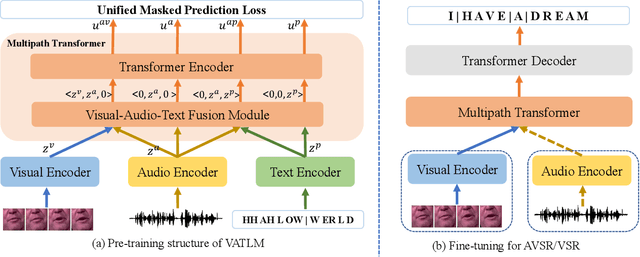
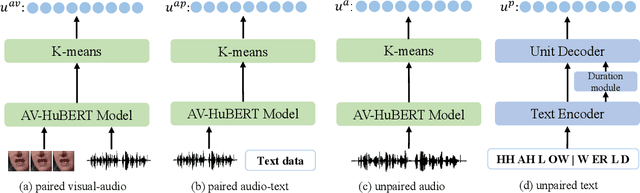
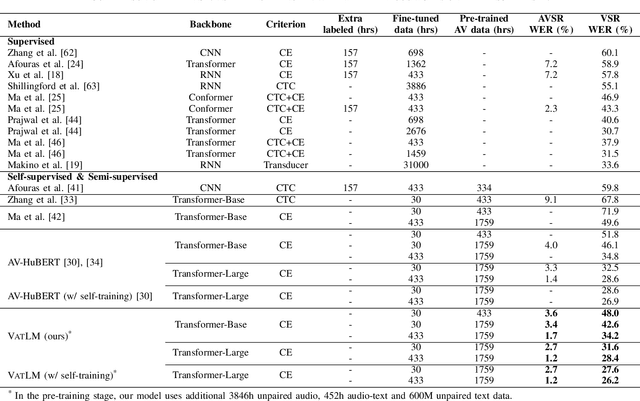
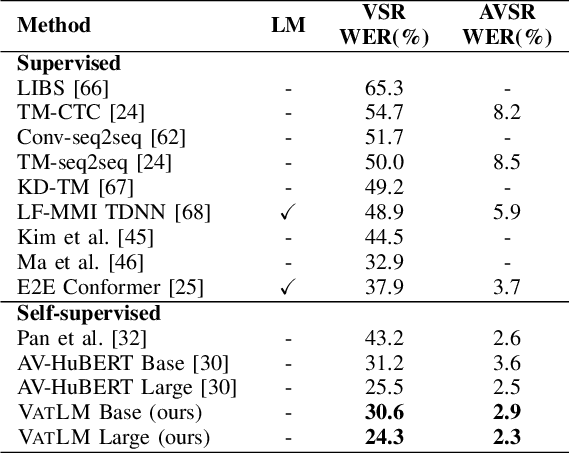
Although speech is a simple and effective way for humans to communicate with the outside world, a more realistic speech interaction contains multimodal information, e.g., vision, text. How to design a unified framework to integrate different modal information and leverage different resources (e.g., visual-audio pairs, audio-text pairs, unlabeled speech, and unlabeled text) to facilitate speech representation learning was not well explored. In this paper, we propose a unified cross-modal representation learning framework VATLM (Visual-Audio-Text Language Model). The proposed VATLM employs a unified backbone network to model the modality-independent information and utilizes three simple modality-dependent modules to preprocess visual, speech, and text inputs. In order to integrate these three modalities into one shared semantic space, VATLM is optimized with a masked prediction task of unified tokens, given by our proposed unified tokenizer. We evaluate the pre-trained VATLM on audio-visual related downstream tasks, including audio-visual speech recognition (AVSR), visual speech recognition (VSR) tasks. Results show that the proposed VATLM outperforms previous the state-of-the-art models, such as audio-visual pre-trained AV-HuBERT model, and analysis also demonstrates that VATLM is capable of aligning different modalities into the same space. To facilitate future research, we release the code and pre-trained models at https://aka.ms/vatlm.
Latent Prompt Tuning for Text Summarization
Nov 03, 2022
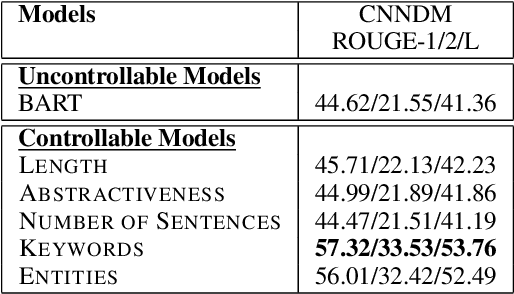
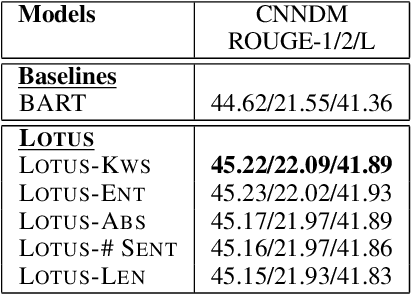

Prompts with different control signals (e.g., length, keywords, etc.) can be used to control text summarization. When control signals are available, they can control the properties of generated summaries and potentially improve summarization quality (since more information are given). Unfortunately, control signals are not already available during inference time. In this paper, we propose Lotus (shorthand for Latent Prompt Tuning for Summarization), which is a single model that can be applied in both controlled and uncontrolled (without control signals) modes. During training, Lotus learns latent prompt representations from prompts with gold control signals using a contrastive learning objective. Experiments show Lotus in uncontrolled mode consistently improves upon strong (uncontrollable) summarization models across four different summarization datasets. We also demonstrate generated summaries can be controlled using prompts with user specified control tokens.
Joint Pre-Training with Speech and Bilingual Text for Direct Speech to Speech Translation
Oct 31, 2022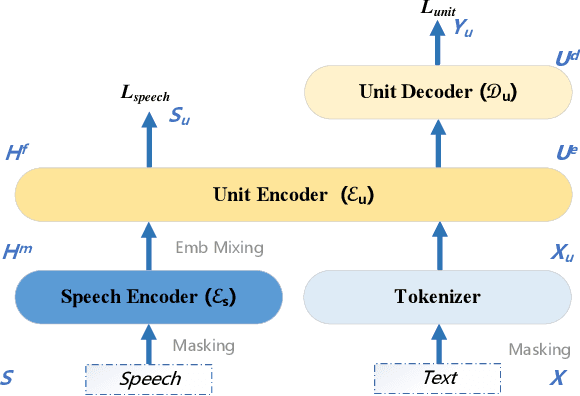
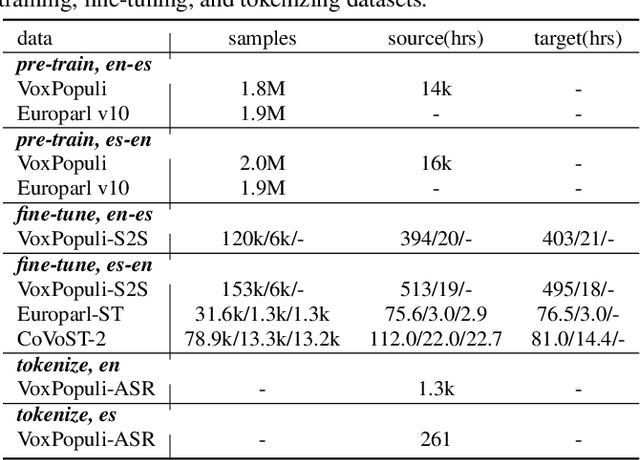
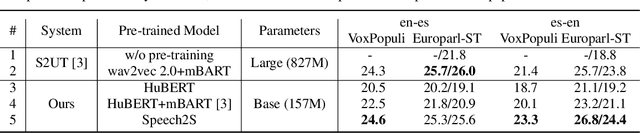
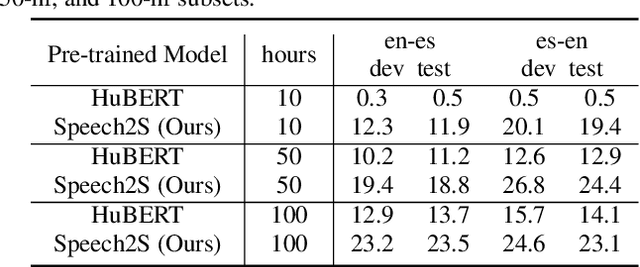
Direct speech-to-speech translation (S2ST) is an attractive research topic with many advantages compared to cascaded S2ST. However, direct S2ST suffers from the data scarcity problem because the corpora from speech of the source language to speech of the target language are very rare. To address this issue, we propose in this paper a Speech2S model, which is jointly pre-trained with unpaired speech and bilingual text data for direct speech-to-speech translation tasks. By effectively leveraging the paired text data, Speech2S is capable of modeling the cross-lingual speech conversion from source to target language. We verify the performance of the proposed Speech2S on Europarl-ST and VoxPopuli datasets. Experimental results demonstrate that Speech2S gets an improvement of about 5 BLEU scores compared to encoder-only pre-training models, and achieves a competitive or even better performance than existing state-of-the-art models1.
Beyond English-Centric Bitexts for Better Multilingual Language Representation Learning
Oct 26, 2022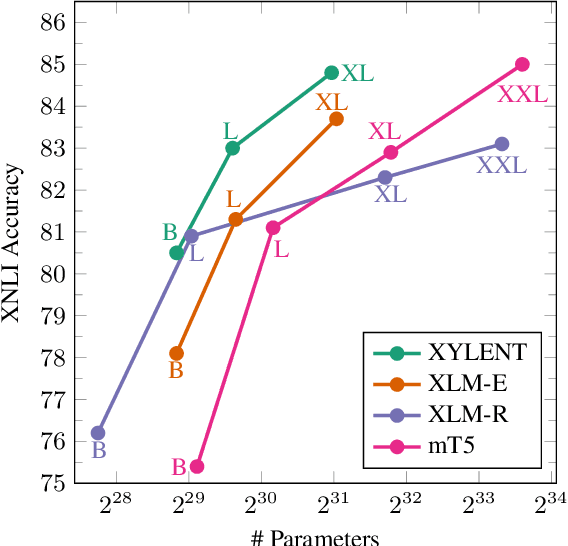
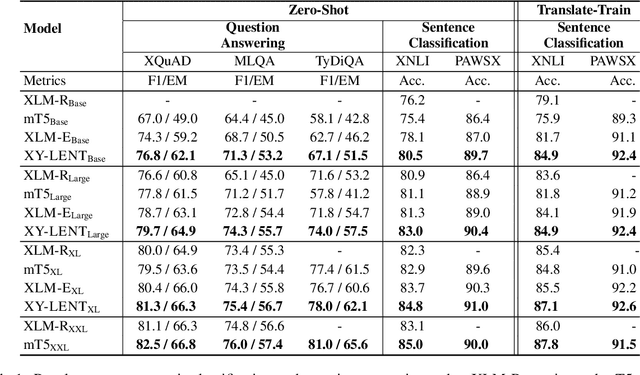
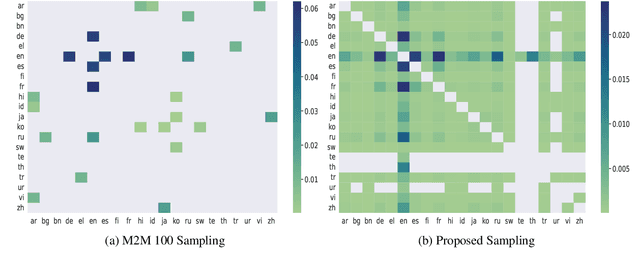
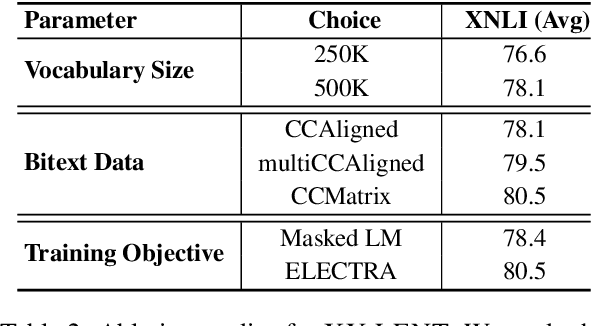
In this paper, we elaborate upon recipes for building multilingual representation models that are not only competitive with existing state-of-the-art models but are also more parameter efficient, thereby promoting better adoption in resource-constrained scenarios and practical applications. We show that going beyond English-centric bitexts, coupled with a novel sampling strategy aimed at reducing under-utilization of training data, substantially boosts performance across model sizes for both Electra and MLM pre-training objectives. We introduce XY-LENT: X-Y bitext enhanced Language ENcodings using Transformers which not only achieves state-of-the-art performance over 5 cross-lingual tasks within all model size bands, is also competitive across bands. Our XY-LENT XL variant outperforms XLM-RXXL and exhibits competitive performance with mT5 XXL while being 5x and 6x smaller respectively. We then show that our proposed method helps ameliorate the curse of multilinguality, with the XY-LENT XL achieving 99.3% GLUE performance and 98.5% SQuAD 2.0 performance compared to a SoTA English only model in the same size band. We then analyze our models performance on extremely low resource languages and posit that scaling alone may not be sufficient for improving the performance in this scenario