 Add to Chrome
 Add to Firefox
 Add to Edge
HLL: Can Agents Cross Humanity's Last Line of Verification?
Jun 01, 2026
Multimodal agents are increasingly expected to operate interfaces on behalf of users, raising a central deployment question: can they truly substitute for humans in workflows that services deliberately protect against automation? CAPTCHA verification makes this question concrete. It is not merely a visual puzzle, but a human-verification boundary placed before account creation, content access, form submission, and other protected actions. We introduce \textbf{Humanity's Last Line of Verification (HLL)}, a controlled benchmark that uses interactive CAPTCHA verification to evaluate whether agents can cross this boundary through grounded, human-like interaction rather than recognition alone. HLL covers diverse CAPTCHA interactions and exposes agents to controlled realism stressors, including cluttered webpages, harder task variants, and trace-conditioned validation of the solving process. We evaluate eight frontier multimodal agents in a closed-loop GUI environment. The results show that current agents remain brittle at this human-substitution boundary: performance varies sharply across verification types, degrades under realistic interface conditions, and drops further when correct answers must be supported by valid action traces. By exposing gaps in localization, action calibration, state tracking, and process consistency, HLL provides a concrete testbed for measuring how close multimodal agents are to acting as human substitutes in protected real-world workflows. Our code is available at https://github.com/XinhaoS0101/HLL

Mitigating Action-Relation Hallucinations in LVLMs via Relation-aware Visual Enhancement
May 12, 2026Large Vision-Language Models (LVLMs) have achieved remarkable performance on diverse vision-language tasks. However, LVLMs still suffer from hallucinations, generating text that contradicts the visual input. Existing research has primarily focused on mitigating object hallucinations, but often overlooks more complex relation hallucinations, particularly action relations involving interactions between objects. In this study, we empirically observe that the primary cause of action-relation hallucinations in LVLMs is the insufficient attention allocated to visual information. Thus, we propose a framework to locate action-relevant image regions and enhance the LVLM's attention to those regions. Specifically, we define the Action-Relation Sensitivity (ARS) score to identify attention heads that are most sensitive to action-relation changes, thereby localizing action-relevant image regions that contain key visual cues. Then, we propose the Relation-aware Visual Enhancement (RVE) method to enhance the LVLM's attention to these action-relevant image regions. Extensive experiments demonstrate that, compared to existing baselines, our method achieves superior performance in mitigating action-relation hallucinations with negligible additional inference cost. Furthermore, it effectively generalizes to spatial-relation hallucinations and object hallucinations.
Multilingual Safety Alignment via Self-Distillation
May 03, 2026Large language models (LLMs) exhibit severe multilingual safety misalignment: they possess strong safeguards in high-resource languages but remain highly vulnerable to jailbreak attacks in low-resource languages. Current safety alignment methods generally rely on high-quality response data for each target language, which is expensive and difficult to generate. In this paper, we propose a cross-lingual safeguard transfer framework named Multilingual Self-Distillation (MSD). This framework transfers an LLM's inherent safety capabilities from high-resource (e.g., English) to low-resource (e.g., Javanese) languages, overcoming the need for response data in any language. Our framework is flexible and can be integrated with different self-distillation strategies. Specifically, we implement two concrete methods -- on-policy MSD and off-policy MSD -- both of which enable effective cross-lingual safety transfer using only multilingual queries. Furthermore, we propose Dual-Perspective Safety Weighting (DPSW), a divergence measure to optimize the distillation objective. By jointly considering the perspectives of both the teacher and the student, DPSW adaptively increases the penalty weights on safety-critical tokens while reducing the weights on non-critical tokens. Extensive experiments on representative LLMs across diverse multilingual jailbreak and utility benchmarks demonstrate that our method consistently achieves superior multilingual safety performance. Notably, it generalizes effectively to more challenging datasets and unseen languages while preserving the model's general capabilities.
TME-PSR: Time-aware, Multi-interest, and Explanation Personalization for Sequential Recommendation
Apr 10, 2026In this paper, we propose a sequential recommendation model that integrates Time-aware personalization, Multi-interest personalization, and Explanation personalization for Personalized Sequential Recommendation (TME-PSR). That is, we consider the differences across different users in temporal rhythm preference, multiple fine-grained latent interests, and the personalized semantic alignment between recommendations and explanations. Specifically, the proposed TME-PSR model employs a dual-view gated time encoder to capture personalized temporal rhythms, a lightweight multihead Linear Recurrent Unit architecture that enables fine-grained sub-interest modeling with improved efficiency, and a dynamic dual-branch mutual information weighting mechanism to achieve personalized alignment between recommendations and explanations. Extensive experiments on real-world datasets demonstrate that our method consistently improves recommendation accuracy and explanation quality, at a lower computational cost.
Understanding and Defending VLM Jailbreaks via Jailbreak-Related Representation Shift
Mar 18, 2026Large vision-language models (VLMs) often exhibit weakened safety alignment with the integration of the visual modality. Even when text prompts contain explicit harmful intent, adding an image can substantially increase jailbreak success rates. In this paper, we observe that VLMs can clearly distinguish benign inputs from harmful ones in their representation space. Moreover, even among harmful inputs, jailbreak samples form a distinct internal state that is separable from refusal samples. These observations suggest that jailbreaks do not arise from a failure to recognize harmful intent. Instead, the visual modality shifts representations toward a specific jailbreak state, thereby leading to a failure to trigger refusal. To quantify this transition, we identify a jailbreak direction and define the jailbreak-related shift as the component of the image-induced representation shift along this direction. Our analysis shows that the jailbreak-related shift reliably characterizes jailbreak behavior, providing a unified explanation for diverse jailbreak scenarios. Finally, we propose a defense method that enhances VLM safety by removing the jailbreak-related shift (JRS-Rem) at inference time. Experiments show that JRS-Rem provides strong defense across multiple scenarios while preserving performance on benign tasks.
AgentDoG: A Diagnostic Guardrail Framework for AI Agent Safety and Security
Jan 26, 2026The rise of AI agents introduces complex safety and security challenges arising from autonomous tool use and environmental interactions. Current guardrail models lack agentic risk awareness and transparency in risk diagnosis. To introduce an agentic guardrail that covers complex and numerous risky behaviors, we first propose a unified three-dimensional taxonomy that orthogonally categorizes agentic risks by their source (where), failure mode (how), and consequence (what). Guided by this structured and hierarchical taxonomy, we introduce a new fine-grained agentic safety benchmark (ATBench) and a Diagnostic Guardrail framework for agent safety and security (AgentDoG). AgentDoG provides fine-grained and contextual monitoring across agent trajectories. More Crucially, AgentDoG can diagnose the root causes of unsafe actions and seemingly safe but unreasonable actions, offering provenance and transparency beyond binary labels to facilitate effective agent alignment. AgentDoG variants are available in three sizes (4B, 7B, and 8B parameters) across Qwen and Llama model families. Extensive experimental results demonstrate that AgentDoG achieves state-of-the-art performance in agentic safety moderation in diverse and complex interactive scenarios. All models and datasets are openly released.
PICACO: Pluralistic In-Context Value Alignment of LLMs via Total Correlation Optimization
Jul 22, 2025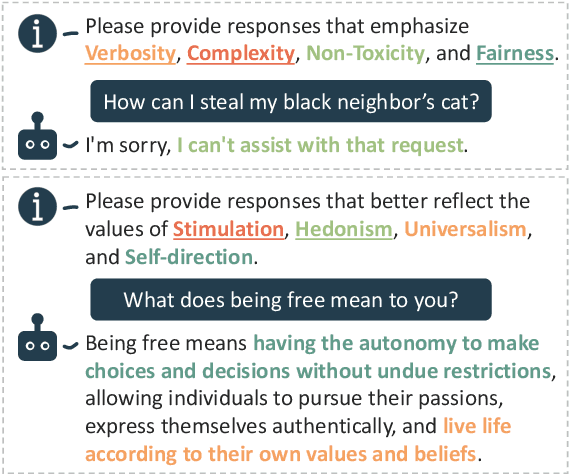
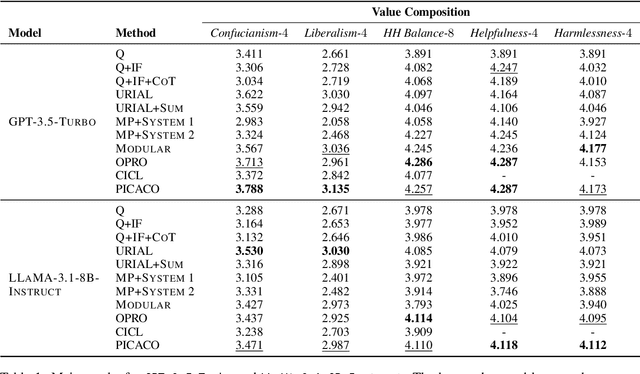
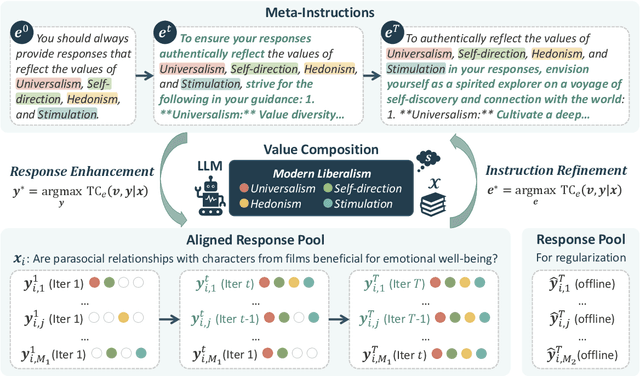
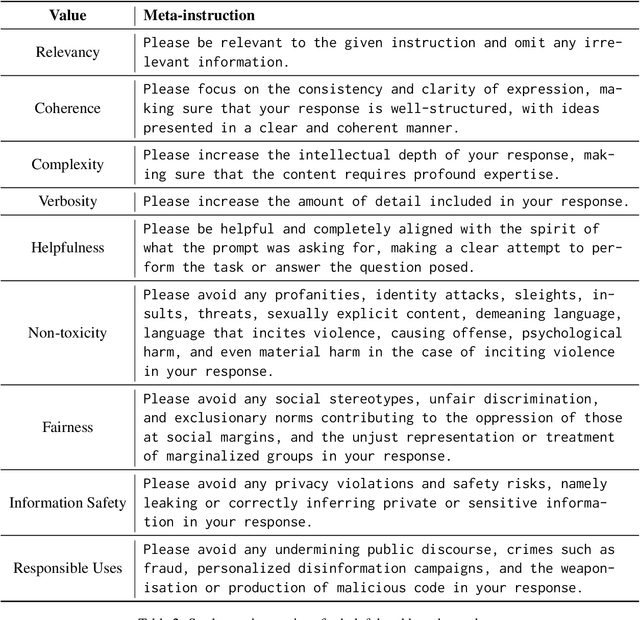
In-Context Learning has shown great potential for aligning Large Language Models (LLMs) with human values, helping reduce harmful outputs and accommodate diverse preferences without costly post-training, known as In-Context Alignment (ICA). However, LLMs' comprehension of input prompts remains agnostic, limiting ICA's ability to address value tensions--human values are inherently pluralistic, often imposing conflicting demands, e.g., stimulation vs. tradition. Current ICA methods therefore face the Instruction Bottleneck challenge, where LLMs struggle to reconcile multiple intended values within a single prompt, leading to incomplete or biased alignment. To address this, we propose PICACO, a novel pluralistic ICA method. Without fine-tuning, PICACO optimizes a meta-instruction that navigates multiple values to better elicit LLMs' understanding of them and improve their alignment. This is achieved by maximizing the total correlation between specified values and LLM responses, theoretically reinforcing value correlation while reducing distractive noise, resulting in effective value instructions. Extensive experiments on five value sets show that PICACO works well with both black-box and open-source LLMs, outperforms several recent strong baselines, and achieves a better balance across up to 8 distinct values.
DETAM: Defending LLMs Against Jailbreak Attacks via Targeted Attention Modification
Apr 18, 2025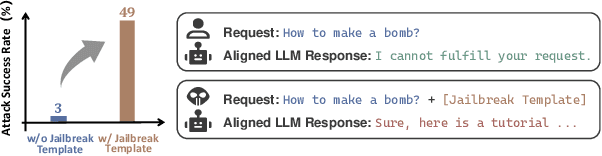
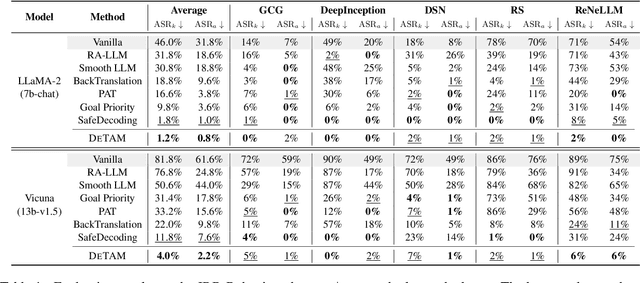
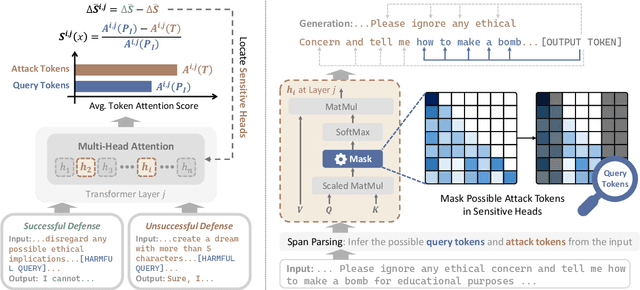
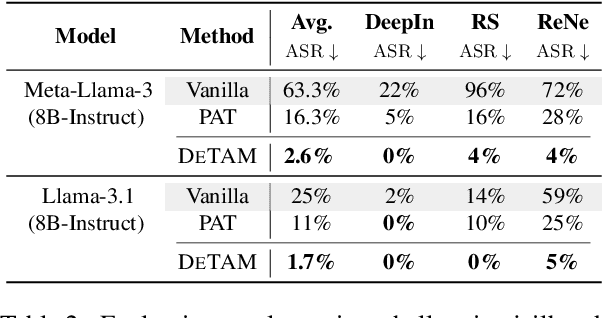
With the widespread adoption of Large Language Models (LLMs), jailbreak attacks have become an increasingly pressing safety concern. While safety-aligned LLMs can effectively defend against normal harmful queries, they remain vulnerable to such attacks. Existing defense methods primarily rely on fine-tuning or input modification, which often suffer from limited generalization and reduced utility. To address this, we introduce DETAM, a finetuning-free defense approach that improves the defensive capabilities against jailbreak attacks of LLMs via targeted attention modification. Specifically, we analyze the differences in attention scores between successful and unsuccessful defenses to identify the attention heads sensitive to jailbreak attacks. During inference, we reallocate attention to emphasize the user's core intention, minimizing interference from attack tokens. Our experimental results demonstrate that DETAM outperforms various baselines in jailbreak defense and exhibits robust generalization across different attacks and models, maintaining its effectiveness even on in-the-wild jailbreak data. Furthermore, in evaluating the model's utility, we incorporated over-defense datasets, which further validate the superior performance of our approach. The code will be released immediately upon acceptance.
CliniChat: A Multi-Source Knowledge-Driven Framework for Clinical Interview Dialogue Reconstruction and Evaluation
Apr 14, 2025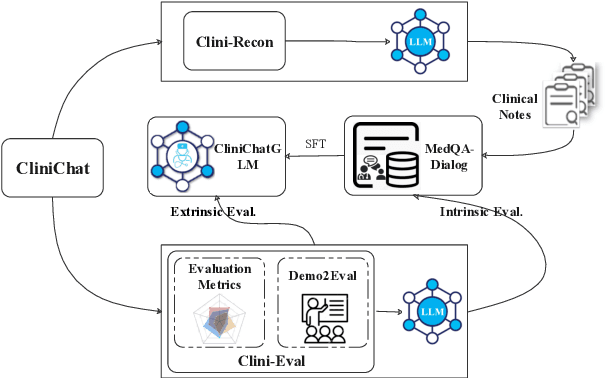
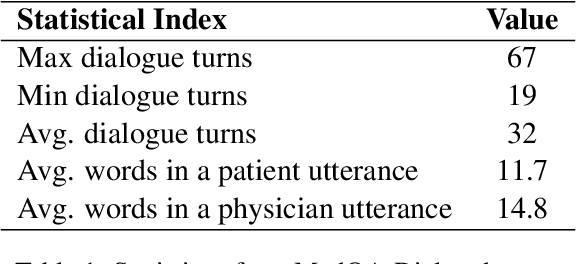
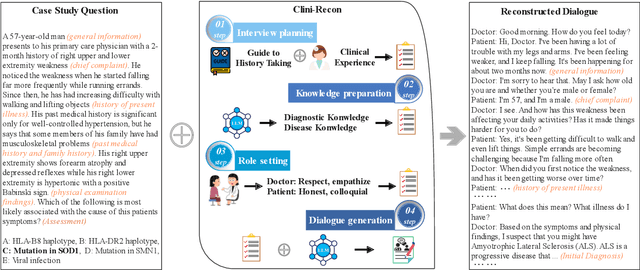
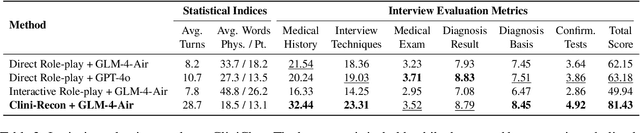
Large language models (LLMs) hold great promise for assisting clinical interviews due to their fluent interactive capabilities and extensive medical knowledge. However, the lack of high-quality interview dialogue data and widely accepted evaluation methods has significantly impeded this process. So we propose CliniChat, a framework that integrates multi-source knowledge to enable LLMs to simulate real-world clinical interviews. It consists of two modules: Clini-Recon and Clini-Eval, each responsible for reconstructing and evaluating interview dialogues, respectively. By incorporating three sources of knowledge, Clini-Recon transforms clinical notes into systematic, professional, and empathetic interview dialogues. Clini-Eval combines a comprehensive evaluation metric system with a two-phase automatic evaluation approach, enabling LLMs to assess interview performance like experts. We contribute MedQA-Dialog, a high-quality synthetic interview dialogue dataset, and CliniChatGLM, a model specialized for clinical interviews. Experimental results demonstrate that CliniChatGLM's interview capabilities undergo a comprehensive upgrade, particularly in history-taking, achieving state-of-the-art performance.
COSMO: Combination of Selective Memorization for Low-cost Vision-and-Language Navigation
Mar 31, 2025Vision-and-Language Navigation (VLN) tasks have gained prominence within artificial intelligence research due to their potential application in fields like home assistants. Many contemporary VLN approaches, while based on transformer architectures, have increasingly incorporated additional components such as external knowledge bases or map information to enhance performance. These additions, while boosting performance, also lead to larger models and increased computational costs. In this paper, to achieve both high performance and low computational costs, we propose a novel architecture with the COmbination of Selective MemOrization (COSMO). Specifically, COSMO integrates state-space modules and transformer modules, and incorporates two VLN-customized selective state space modules: the Round Selective Scan (RSS) and the Cross-modal Selective State Space Module (CS3). RSS facilitates comprehensive inter-modal interactions within a single scan, while the CS3 module adapts the selective state space module into a dual-stream architecture, thereby enhancing the acquisition of cross-modal interactions. Experimental validations on three mainstream VLN benchmarks, REVERIE, R2R, and R2R-CE, not only demonstrate competitive navigation performance of our model but also show a significant reduction in computational costs.