 Add to Chrome
 Add to Firefox
 Add to Edge
Augmenting Language Models with Long-Term Memory
Jun 12, 2023
Existing large language models (LLMs) can only afford fix-sized inputs due to the input length limit, preventing them from utilizing rich long-context information from past inputs. To address this, we propose a framework, Language Models Augmented with Long-Term Memory (LongMem), which enables LLMs to memorize long history. We design a novel decoupled network architecture with the original backbone LLM frozen as a memory encoder and an adaptive residual side-network as a memory retriever and reader. Such a decoupled memory design can easily cache and update long-term past contexts for memory retrieval without suffering from memory staleness. Enhanced with memory-augmented adaptation training, LongMem can thus memorize long past context and use long-term memory for language modeling. The proposed memory retrieval module can handle unlimited-length context in its memory bank to benefit various downstream tasks. Typically, LongMem can enlarge the long-form memory to 65k tokens and thus cache many-shot extra demonstration examples as long-form memory for in-context learning. Experiments show that our method outperforms strong long-context models on ChapterBreak, a challenging long-context modeling benchmark, and achieves remarkable improvements on memory-augmented in-context learning over LLMs. The results demonstrate that the proposed method is effective in helping language models to memorize and utilize long-form contents. Our code is open-sourced at https://aka.ms/LongMem.

Multiview Identifiers Enhanced Generative Retrieval
May 26, 2023Instead of simply matching a query to pre-existing passages, generative retrieval generates identifier strings of passages as the retrieval target. At a cost, the identifier must be distinctive enough to represent a passage. Current approaches use either a numeric ID or a text piece (such as a title or substrings) as the identifier. However, these identifiers cannot cover a passage's content well. As such, we are motivated to propose a new type of identifier, synthetic identifiers, that are generated based on the content of a passage and could integrate contextualized information that text pieces lack. Furthermore, we simultaneously consider multiview identifiers, including synthetic identifiers, titles, and substrings. These views of identifiers complement each other and facilitate the holistic ranking of passages from multiple perspectives. We conduct a series of experiments on three public datasets, and the results indicate that our proposed approach performs the best in generative retrieval, demonstrating its effectiveness and robustness.
VioLA: Unified Codec Language Models for Speech Recognition, Synthesis, and Translation
May 25, 2023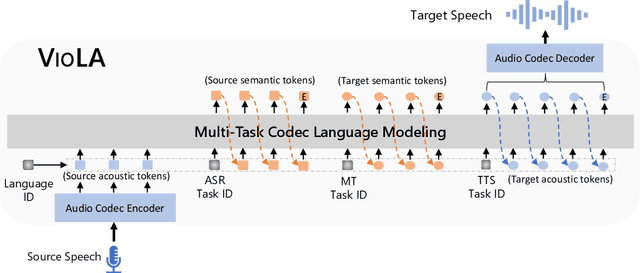
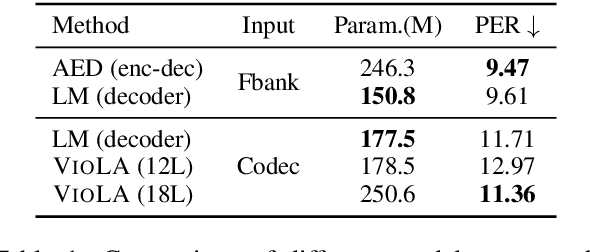
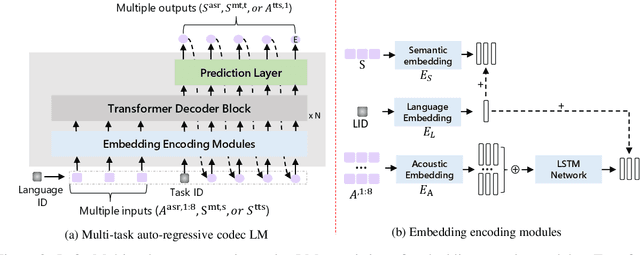
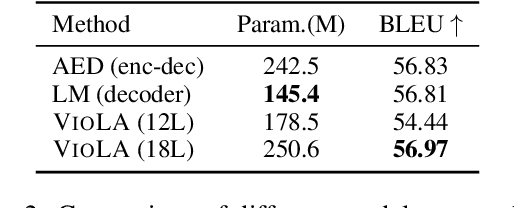
Recent research shows a big convergence in model architecture, training objectives, and inference methods across various tasks for different modalities. In this paper, we propose VioLA, a single auto-regressive Transformer decoder-only network that unifies various cross-modal tasks involving speech and text, such as speech-to-text, text-to-text, text-to-speech, and speech-to-speech tasks, as a conditional codec language model task via multi-task learning framework. To accomplish this, we first convert all the speech utterances to discrete tokens (similar to the textual data) using an offline neural codec encoder. In such a way, all these tasks are converted to token-based sequence conversion problems, which can be naturally handled with one conditional language model. We further integrate task IDs (TID) and language IDs (LID) into the proposed model to enhance the modeling capability of handling different languages and tasks. Experimental results demonstrate that the proposed VioLA model can support both single-modal and cross-modal tasks well, and the decoder-only model achieves a comparable and even better performance than the strong baselines.
One-stop Training of Multiple Capacity Models
May 24, 2023
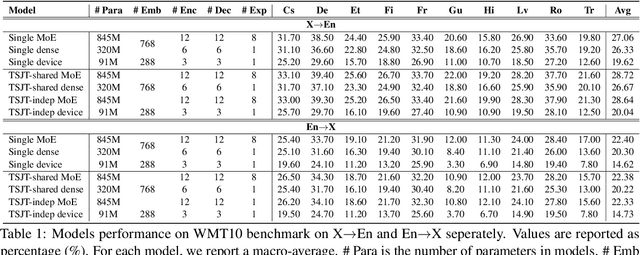


Training models with varying capacities can be advantageous for deploying them in different scenarios. While high-capacity models offer better performance, low-capacity models require fewer computing resources for training and inference. In this work, we propose a novel one-stop training framework to jointly train high-capacity and low-capactiy models. This framework consists of two composite model architectures and a joint training algorithm called Two-Stage Joint-Training (TSJT). Unlike knowledge distillation, where multiple capacity models are trained from scratch separately, our approach integrates supervisions from different capacity models simultaneously, leading to faster and more efficient convergence. Extensive experiments on the multilingual machine translation benchmark WMT10 show that our method outperforms low-capacity baseline models and achieves comparable or better performance on high-capacity models. Notably, the analysis demonstrates that our method significantly influences the initial training process, leading to more efficient convergence and superior solutions.
Not All Metrics Are Guilty: Improving NLG Evaluation with LLM Paraphrasing
May 24, 2023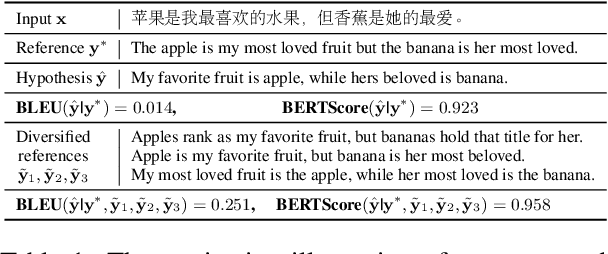
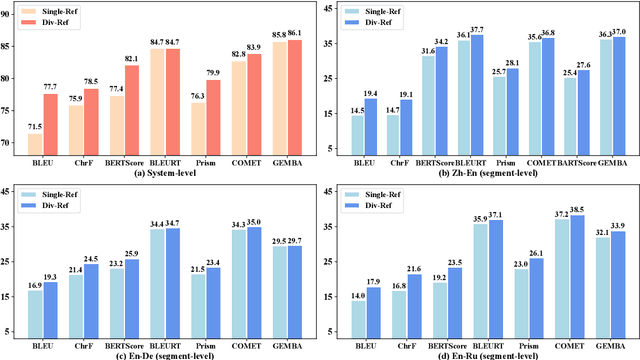
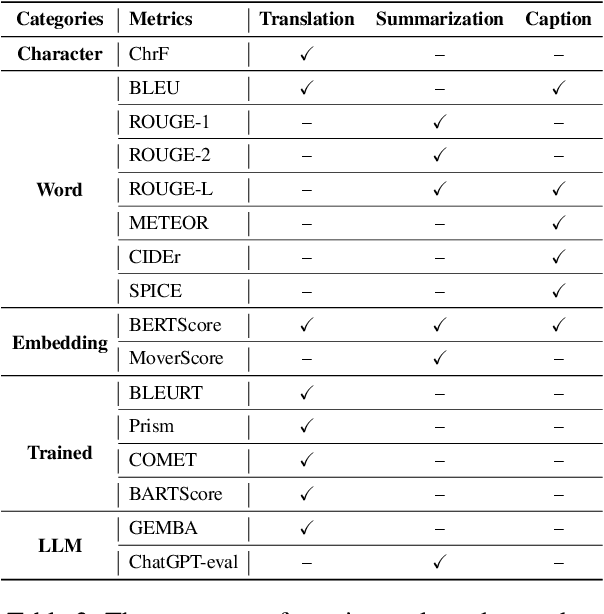
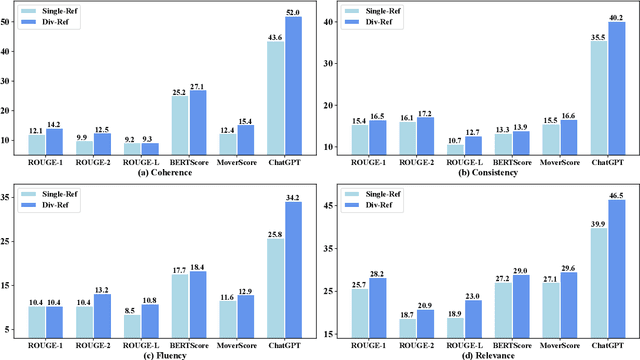
Most research about natural language generation (NLG) relies on evaluation benchmarks with limited references for a sample, which may result in poor correlations with human judgements. The underlying reason is that one semantic meaning can actually be expressed in different forms, and the evaluation with a single or few references may not accurately reflect the quality of the model's hypotheses. To address this issue, this paper presents a novel method, named Para-Ref, to enhance existing evaluation benchmarks by enriching the number of references. We leverage large language models (LLMs) to paraphrase a single reference into multiple high-quality ones in diverse expressions. Experimental results on representative NLG tasks of machine translation, text summarization, and image caption demonstrate that our method can effectively improve the correlation with human evaluation for sixteen automatic evaluation metrics by +7.82% in ratio. We release the code and data at https://github.com/RUCAIBox/Para-Ref.
Chain-of-Dictionary Prompting Elicits Translation in Large Language Models
May 24, 2023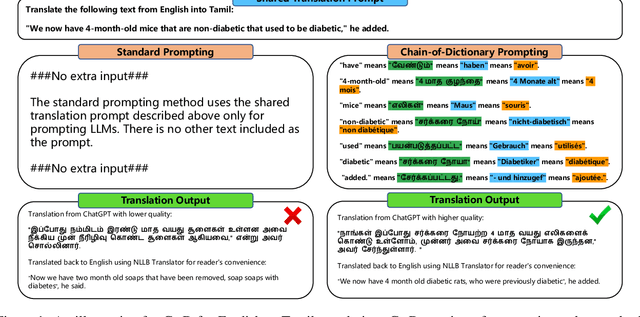


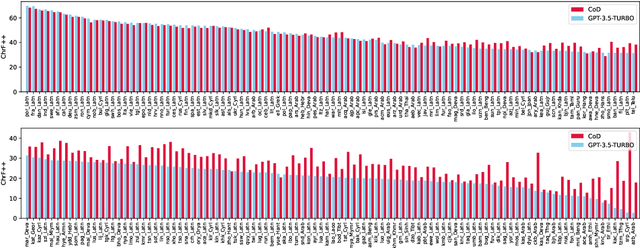
Large language models (LLMs) have shown surprisingly good performance in multilingual neural machine translation (MNMT) even when trained without parallel data. Yet, despite the fact that the amount of training data is gigantic, they still struggle with translating rare words, particularly for low-resource languages. Even worse, it is usually unrealistic to retrieve relevant demonstrations for in-context learning with low-resource languages on LLMs, which restricts the practical use of LLMs for translation -- how should we mitigate this problem? To this end, we present a novel method, CoD, which augments LLMs with prior knowledge with the chains of multilingual dictionaries for a subset of input words to elicit translation abilities for LLMs. Extensive experiments indicate that augmenting ChatGPT with CoD elicits large gains by up to 13x chrF++ points for MNMT (3.08 to 42.63 for English to Serbian written in Cyrillic script) on FLORES-200 full devtest set. We further demonstrate the importance of chaining the multilingual dictionaries, as well as the superiority of CoD to few-shot demonstration for low-resource languages.
TextDiffuser: Diffusion Models as Text Painters
May 24, 2023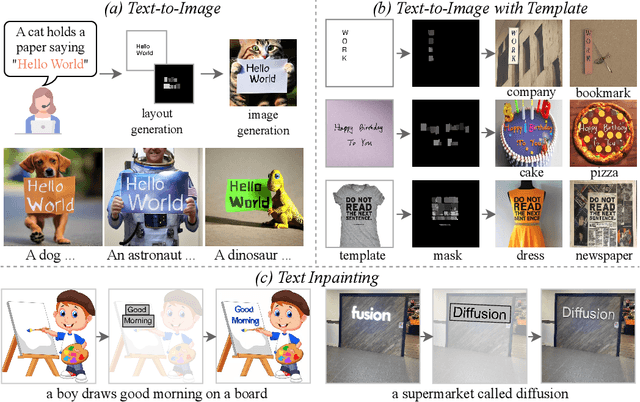
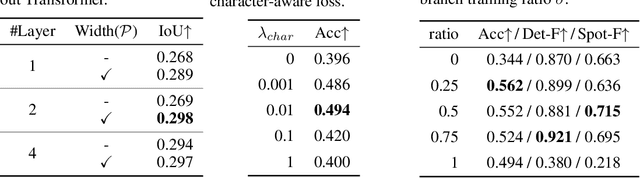
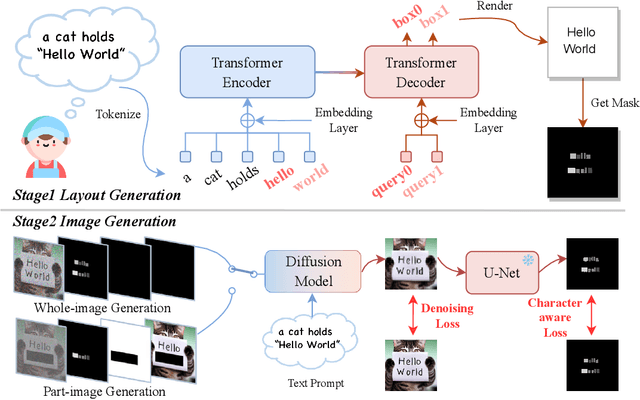
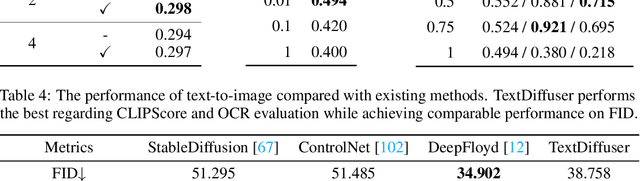
Diffusion models have gained increasing attention for their impressive generation abilities but currently struggle with rendering accurate and coherent text. To address this issue, we introduce TextDiffuser, focusing on generating images with visually appealing text that is coherent with backgrounds. TextDiffuser consists of two stages: first, a Transformer model generates the layout of keywords extracted from text prompts, and then diffusion models generate images conditioned on the text prompt and the generated layout. Additionally, we contribute the first large-scale text images dataset with OCR annotations, MARIO-10M, containing 10 million image-text pairs with text recognition, detection, and character-level segmentation annotations. We further collect the MARIO-Eval benchmark to serve as a comprehensive tool for evaluating text rendering quality. Through experiments and user studies, we show that TextDiffuser is flexible and controllable to create high-quality text images using text prompts alone or together with text template images, and conduct text inpainting to reconstruct incomplete images with text. The code, model, and dataset will be available at \url{https://aka.ms/textdiffuser}.
On the Off-Target Problem of Zero-Shot Multilingual Neural Machine Translation
May 18, 2023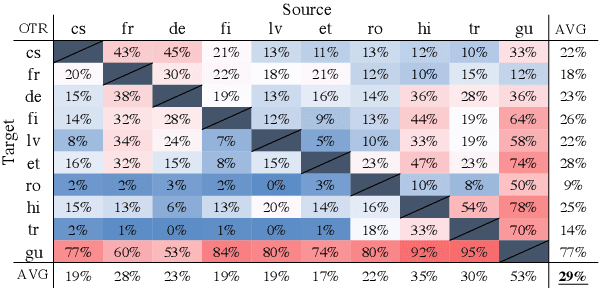
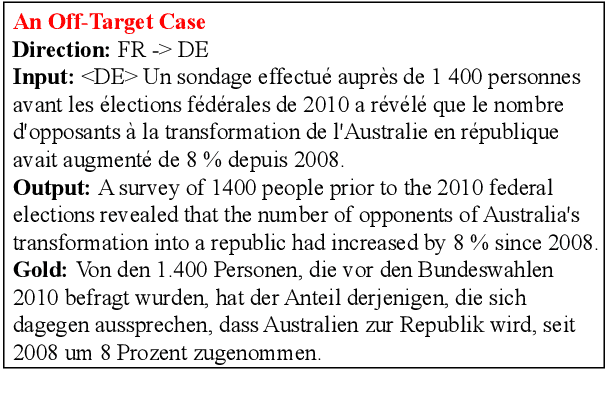
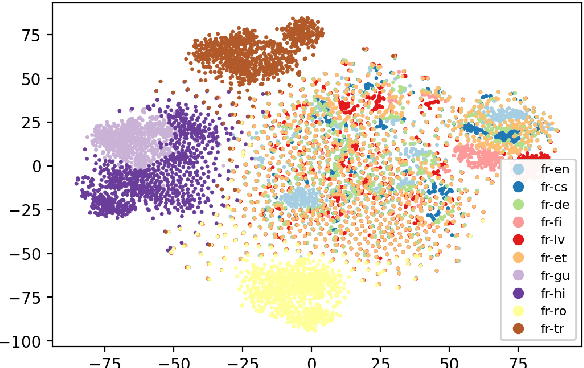
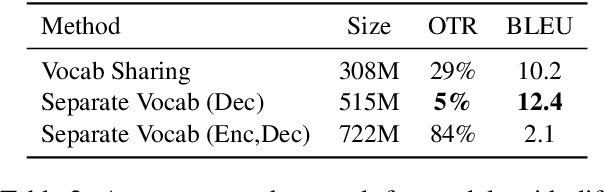
While multilingual neural machine translation has achieved great success, it suffers from the off-target issue, where the translation is in the wrong language. This problem is more pronounced on zero-shot translation tasks. In this work, we find that failing in encoding discriminative target language signal will lead to off-target and a closer lexical distance (i.e., KL-divergence) between two languages' vocabularies is related with a higher off-target rate. We also find that solely isolating the vocab of different languages in the decoder can alleviate the problem. Motivated by the findings, we propose Language Aware Vocabulary Sharing (LAVS), a simple and effective algorithm to construct the multilingual vocabulary, that greatly alleviates the off-target problem of the translation model by increasing the KL-divergence between languages. We conduct experiments on a multilingual machine translation benchmark in 11 languages. Experiments show that the off-target rate for 90 translation tasks is reduced from 29\% to 8\%, while the overall BLEU score is improved by an average of 1.9 points without extra training cost or sacrificing the supervised directions' performance. We release the code at \href{https://github.com/chenllliang/Off-Target-MNMT}{https://github.com/chenllliang/Off-Target-MNMT} for reproduction.
Pre-Training to Learn in Context
May 16, 2023In-context learning, where pre-trained language models learn to perform tasks from task examples and instructions in their contexts, has attracted much attention in the NLP community. However, the ability of in-context learning is not fully exploited because language models are not explicitly trained to learn in context. To this end, we propose PICL (Pre-training for In-Context Learning), a framework to enhance the language models' in-context learning ability by pre-training the model on a large collection of "intrinsic tasks" in the general plain-text corpus using the simple language modeling objective. PICL encourages the model to infer and perform tasks by conditioning on the contexts while maintaining task generalization of pre-trained models. We evaluate the in-context learning performance of the model trained with PICL on seven widely-used text classification datasets and the Super-NaturalInstrctions benchmark, which contains 100+ NLP tasks formulated to text generation. Our experiments show that PICL is more effective and task-generalizable than a range of baselines, outperforming larger language models with nearly 4x parameters. The code is publicly available at https://github.com/thu-coai/PICL.
Dual-Alignment Pre-training for Cross-lingual Sentence Embedding
May 16, 2023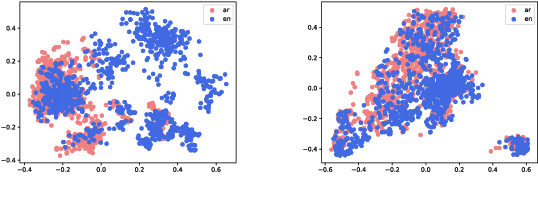
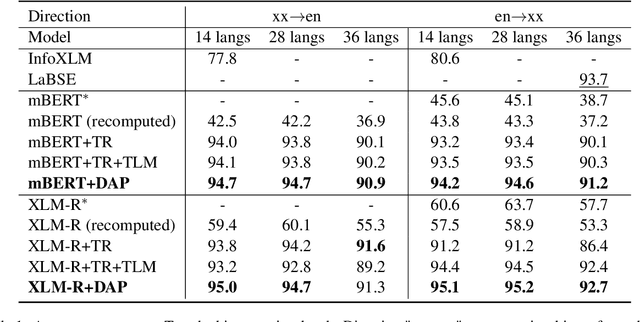
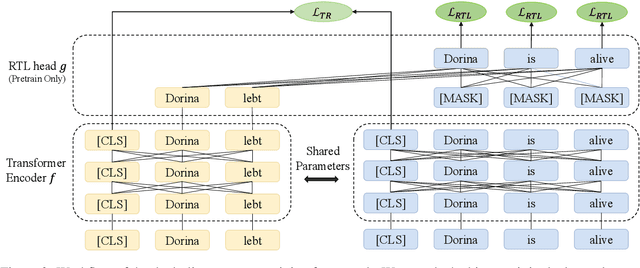
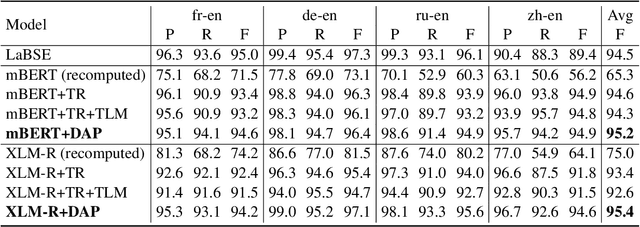
Recent studies have shown that dual encoder models trained with the sentence-level translation ranking task are effective methods for cross-lingual sentence embedding. However, our research indicates that token-level alignment is also crucial in multilingual scenarios, which has not been fully explored previously. Based on our findings, we propose a dual-alignment pre-training (DAP) framework for cross-lingual sentence embedding that incorporates both sentence-level and token-level alignment. To achieve this, we introduce a novel representation translation learning (RTL) task, where the model learns to use one-side contextualized token representation to reconstruct its translation counterpart. This reconstruction objective encourages the model to embed translation information into the token representation. Compared to other token-level alignment methods such as translation language modeling, RTL is more suitable for dual encoder architectures and is computationally efficient. Extensive experiments on three sentence-level cross-lingual benchmarks demonstrate that our approach can significantly improve sentence embedding. Our code is available at https://github.com/ChillingDream/DAP.