 Add to Chrome
 Add to Firefox
 Add to Edge
AdsWorldEngine: A Self-Evolving Conversational Advertising Agent through Orchestrator and Tool Coevolution
Aug 13, 2026
Conversational advertising aims to deliver useful ads within multi-turn assistant interactions. Unlike conventional query-based advertising, where the user's intent is often expressed in a short standalone query, conversational ads must infer latent commercial intent from the current user query, the assistant response, and dialogue history while also deciding whether an ad would be helpful rather than intrusive. We propose AdsWorldEngine, an agentic framework for conversational advertising. AdsWorldEngine uses an Opportunity Gate to determine whether ads should be shown, an Orchestrator to generate commercial intents, call advertising tools, and construct a top-3 ad slate, and an Evaluator to score delivered ads for offline optimization. The central contribution is an iterative actor-tool training procedure: we first train the Orchestrator with supervised fine-tuning and agentic reinforcement learning, then use high- and low-reward rollouts to construct preference data to train tools. This creates a self-improving loop in which the system learns not only how to use advertising tools, but also how to improve them from rewarded behavior. To support subjective production decisions, we introduce label grounded judgment modeling, which trains judgment models from human labels collected under explicit guidelines. It enriches labels with thinking traces, filters inconsistent rationales through reflection, and further optimizes binary judgments with a cost sensitive GRPO variant that preserves asymmetric reward gaps. Offline, AdsWorldEngine improves diversity by 60% and relevance by 80% over the current production ad delivery system. In an online A/B test, it increases RPM by 22% and ads coverage by 74%.

FlashTrie: A GPU-Accelerated Constrained Beam Search for Generative Retrieval
Jul 10, 2026Constrained decoding is essential in generative retrieval, where document identifiers generated directly from a query must exactly match a predefined library of valid IDs. At scale, decoding is often constrained using a trie with beam search but most implementations run on CPU. Limited parallelism then makes trie traversal and candidate validation a serving bottleneck as beam width grows. We present FlashTrie, which addresses this limitation by optimizing constrained beam search on GPUs. It introduces an integer-aware succinct trie layout that uses bit compression to reduce memory footprint while keeping the full index in GPU high-bandwidth memory reducing memory stalls, and a cooperative CUDA kernel that performs beam expansion, validation, and pruning entirely on-device without per-step host orchestration. It further replaces CPU-style irregular lookup and heap maintenance with GPU-aware parallel primitives, improving warp utilization and reducing divergence. Together, these designs significantly reduce decoding latency and increase throughput while preserving retrieval quality. On a library of 800M keywords with beam widths up to 1000, FlashTrie reduces trie-search latency to under 3 ms, achieving up to 24x speedup over a highly optimized multi-threaded CPU baseline. These improvements enable FlashTrie to scale beam sizes by up to 5x in latency-critical applications such as sponsored search. In a large-scale online A/B experiment on a popular commercial search engine, it delivers a statistically significant +0.71% revenue lift, enabling real-time constrained decoding at a scale previously feasible only offline. The FlashTrie code will be publicly released after the review process.
Task Oriented In-Domain Data Augmentation
Jun 24, 2024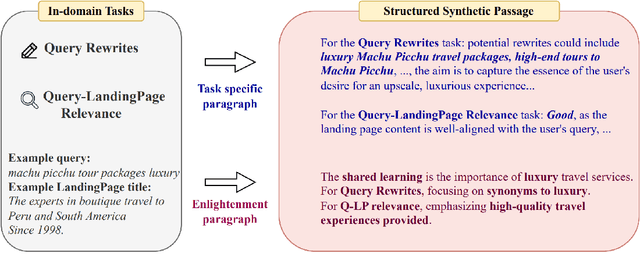
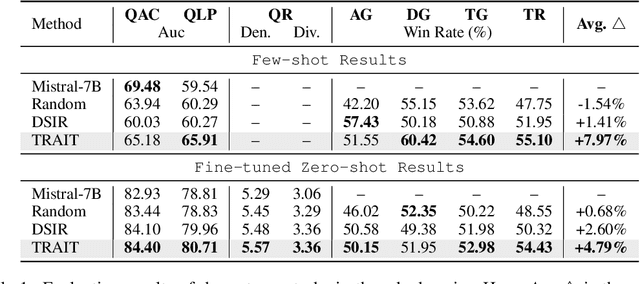
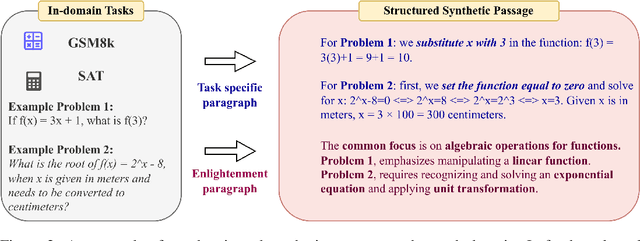
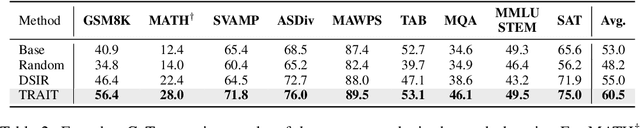
Large Language Models (LLMs) have shown superior performance in various applications and fields. To achieve better performance on specialized domains such as law and advertisement, LLMs are often continue pre-trained on in-domain data. However, existing approaches suffer from two major issues. First, in-domain data are scarce compared with general domain-agnostic data. Second, data used for continual pre-training are not task-aware, such that they may not be helpful to downstream applications. We propose TRAIT, a task-oriented in-domain data augmentation framework. Our framework is divided into two parts: in-domain data selection and task-oriented synthetic passage generation. The data selection strategy identifies and selects a large amount of in-domain data from general corpora, and thus significantly enriches domain knowledge in the continual pre-training data. The synthetic passages contain guidance on how to use domain knowledge to answer questions about downstream tasks. By training on such passages, the model aligns with the need of downstream applications. We adapt LLMs to two domains: advertisement and math. On average, TRAIT improves LLM performance by 8% in the advertisement domain and 7.5% in the math domain.
Evoke: Evoking Critical Thinking Abilities in LLMs via Reviewer-Author Prompt Editing
Oct 20, 2023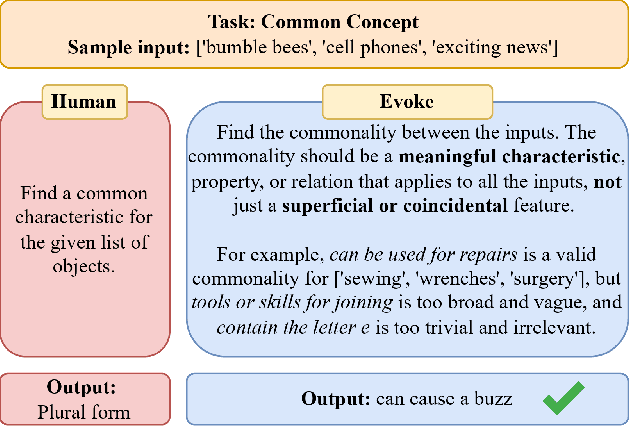
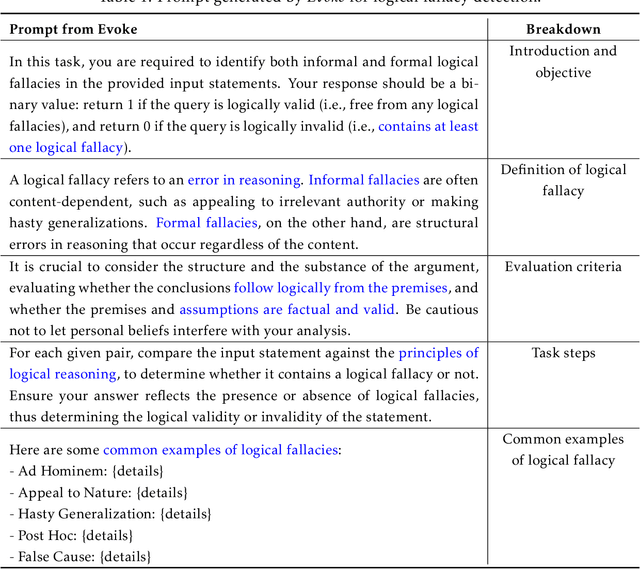
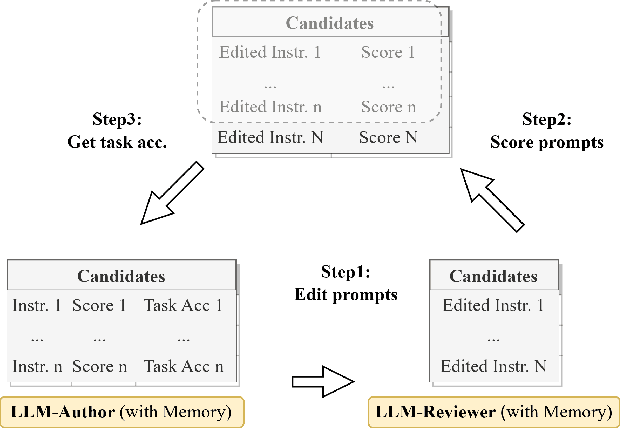
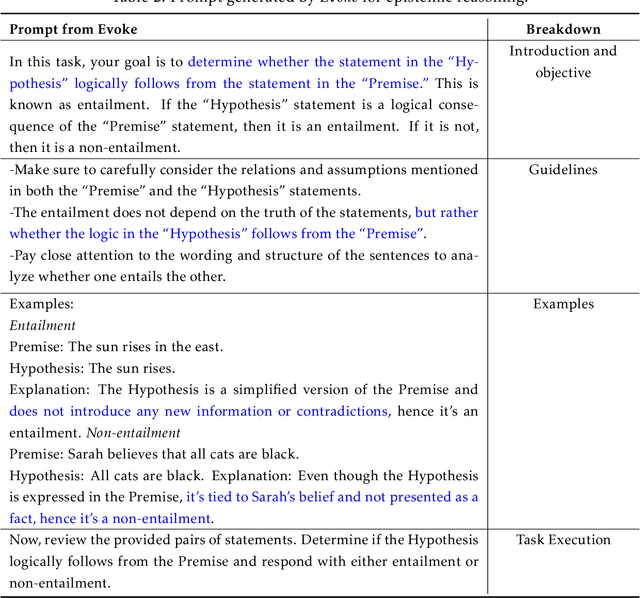
Large language models (LLMs) have made impressive progress in natural language processing. These models rely on proper human instructions (or prompts) to generate suitable responses. However, the potential of LLMs are not fully harnessed by commonly-used prompting methods: many human-in-the-loop algorithms employ ad-hoc procedures for prompt selection; while auto prompt generation approaches are essentially searching all possible prompts randomly and inefficiently. We propose Evoke, an automatic prompt refinement framework. In Evoke, there are two instances of a same LLM: one as a reviewer (LLM-Reviewer), it scores the current prompt; the other as an author (LLM-Author), it edits the prompt by considering the edit history and the reviewer's feedback. Such an author-reviewer feedback loop ensures that the prompt is refined in each iteration. We further aggregate a data selection approach to Evoke, where only the hard samples are exposed to the LLM. The hard samples are more important because the LLM can develop deeper understanding of the tasks out of them, while the model may already know how to solve the easier cases. Experimental results show that Evoke significantly outperforms existing methods. For instance, in the challenging task of logical fallacy detection, Evoke scores above 80, while all other baseline methods struggle to reach 20.
DeepTagger: Knowledge Enhanced Named Entity Recognition for Web-Based Ads Queries
Jun 30, 2023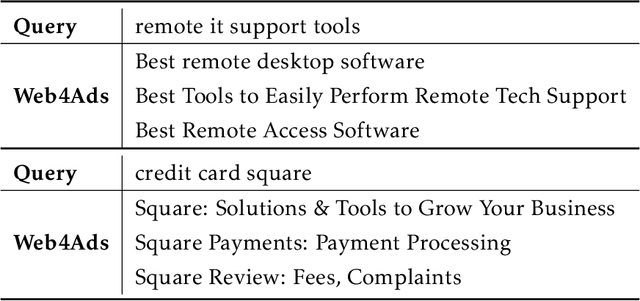
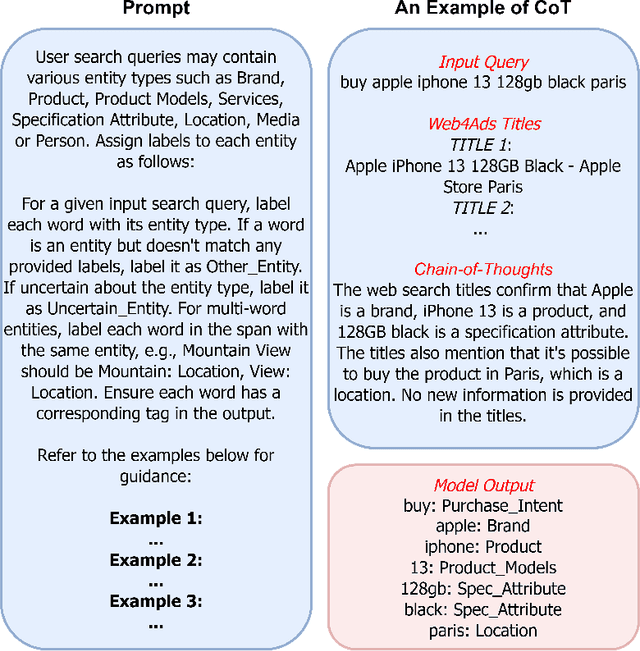
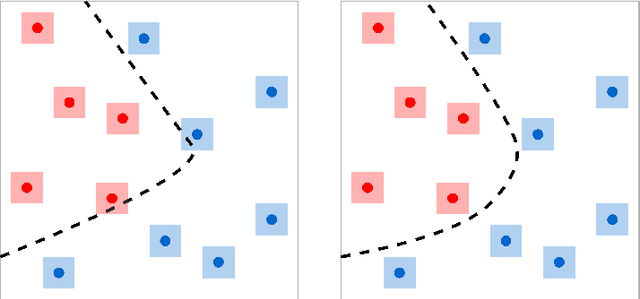
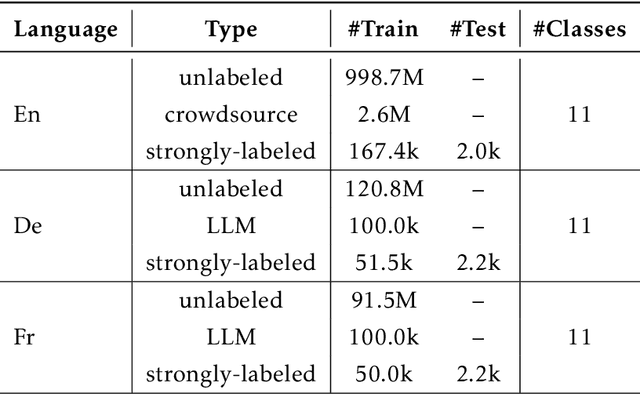
Named entity recognition (NER) is a crucial task for online advertisement. State-of-the-art solutions leverage pre-trained language models for this task. However, three major challenges remain unresolved: web queries differ from natural language, on which pre-trained models are trained; web queries are short and lack contextual information; and labeled data for NER is scarce. We propose DeepTagger, a knowledge-enhanced NER model for web-based ads queries. The proposed knowledge enhancement framework leverages both model-free and model-based approaches. For model-free enhancement, we collect unlabeled web queries to augment domain knowledge; and we collect web search results to enrich the information of ads queries. We further leverage effective prompting methods to automatically generate labels using large language models such as ChatGPT. Additionally, we adopt a model-based knowledge enhancement method based on adversarial data augmentation. We employ a three-stage training framework to train DeepTagger models. Empirical results in various NER tasks demonstrate the effectiveness of the proposed framework.
Dual-Alignment Pre-training for Cross-lingual Sentence Embedding
May 16, 2023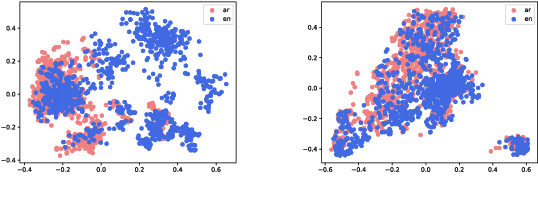
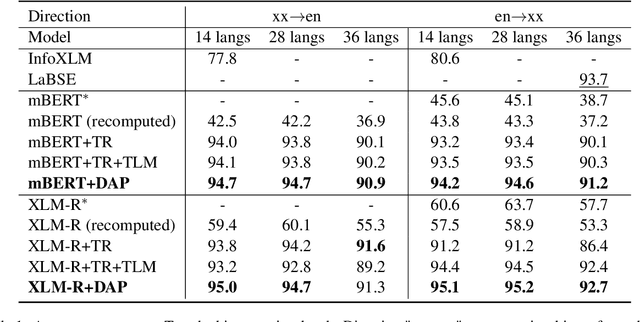
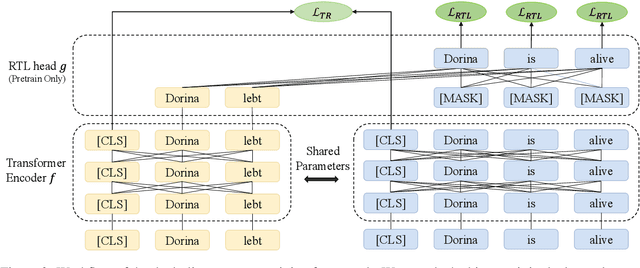
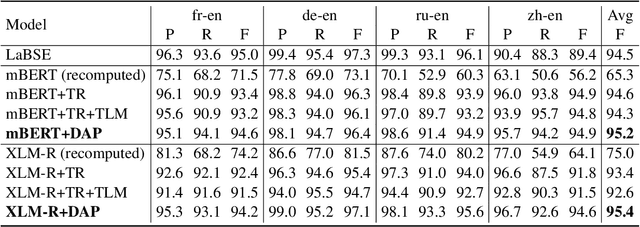
Recent studies have shown that dual encoder models trained with the sentence-level translation ranking task are effective methods for cross-lingual sentence embedding. However, our research indicates that token-level alignment is also crucial in multilingual scenarios, which has not been fully explored previously. Based on our findings, we propose a dual-alignment pre-training (DAP) framework for cross-lingual sentence embedding that incorporates both sentence-level and token-level alignment. To achieve this, we introduce a novel representation translation learning (RTL) task, where the model learns to use one-side contextualized token representation to reconstruct its translation counterpart. This reconstruction objective encourages the model to embed translation information into the token representation. Compared to other token-level alignment methods such as translation language modeling, RTL is more suitable for dual encoder architectures and is computationally efficient. Extensive experiments on three sentence-level cross-lingual benchmarks demonstrate that our approach can significantly improve sentence embedding. Our code is available at https://github.com/ChillingDream/DAP.