 Add to Chrome
 Add to Firefox
 Add to Edge
PP-YOLOE-R: An Efficient Anchor-Free Rotated Object Detector
Nov 04, 2022

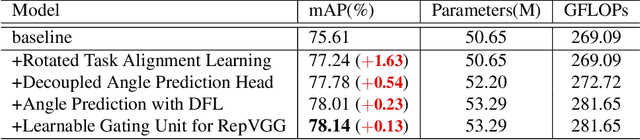

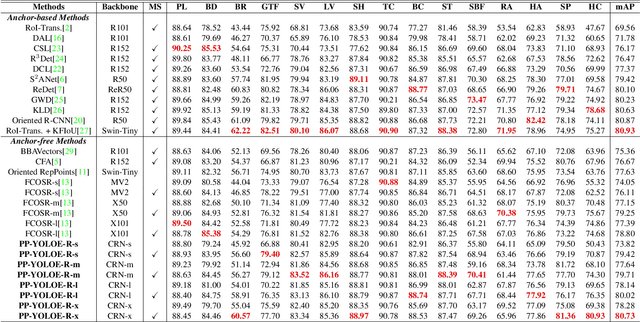
Arbitrary-oriented object detection is a fundamental task in visual scenes involving aerial images and scene text. In this report, we present PP-YOLOE-R, an efficient anchor-free rotated object detector based on PP-YOLOE. We introduce a bag of useful tricks in PP-YOLOE-R to improve detection precision with marginal extra parameters and computational cost. As a result, PP-YOLOE-R-l and PP-YOLOE-R-x achieve 78.14 and 78.28 mAP respectively on DOTA 1.0 dataset with single-scale training and testing, which outperform almost all other rotated object detectors. With multi-scale training and testing, PP-YOLOE-R-l and PP-YOLOE-R-x further improve the detection precision to 80.02 and 80.73 mAP. In this case, PP-YOLOE-R-x surpasses all anchor-free methods and demonstrates competitive performance to state-of-the-art anchor-based two-stage models. Further, PP-YOLOE-R is deployment friendly and PP-YOLOE-R-s/m/l/x can reach 69.8/55.1/48.3/37.1 FPS respectively on RTX 2080 Ti with TensorRT and FP16-precision. Source code and pre-trained models are available at https://github.com/PaddlePaddle/PaddleDetection, which is powered by https://github.com/PaddlePaddle/Paddle.

PP-StructureV2: A Stronger Document Analysis System
Oct 11, 2022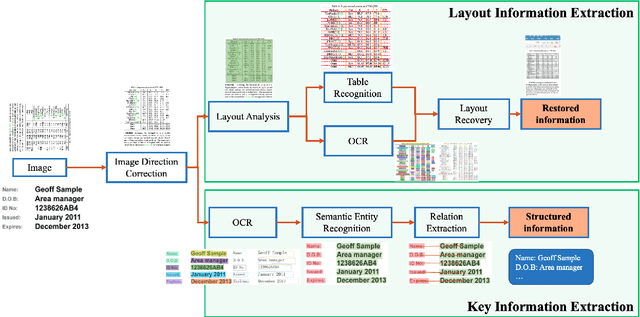
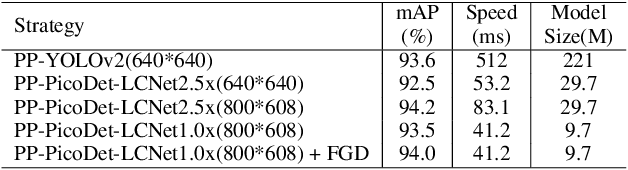
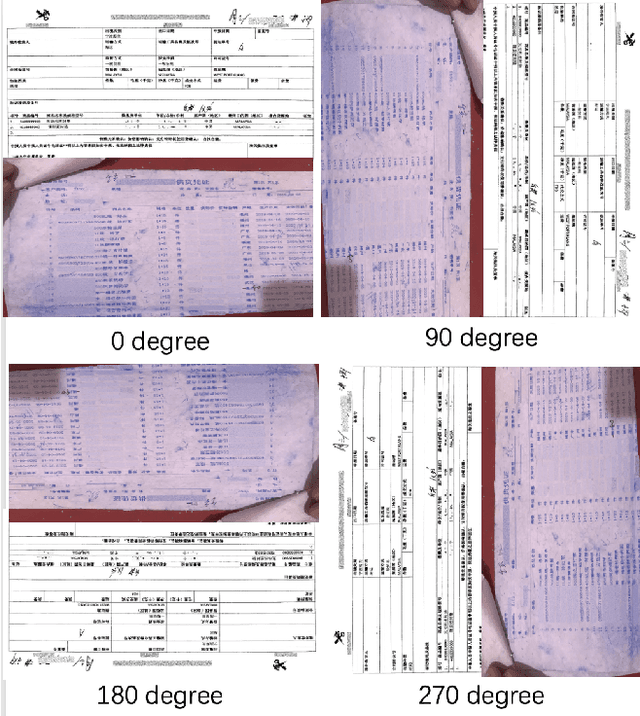
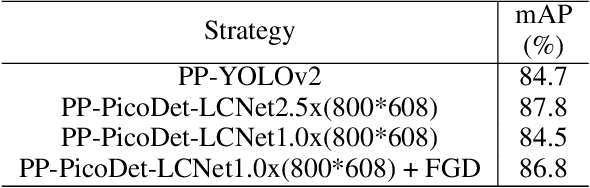
A large amount of document data exists in unstructured form such as raw images without any text information. Designing a practical document image analysis system is a meaningful but challenging task. In previous work, we proposed an intelligent document analysis system PP-Structure. In order to further upgrade the function and performance of PP-Structure, we propose PP-StructureV2 in this work, which contains two subsystems: Layout Information Extraction and Key Information Extraction. Firstly, we integrate Image Direction Correction module and Layout Restoration module to enhance the functionality of the system. Secondly, 8 practical strategies are utilized in PP-StructureV2 for better performance. For Layout Analysis model, we introduce ultra light-weight detector PP-PicoDet and knowledge distillation algorithm FGD for model lightweighting, which increased the inference speed by 11 times with comparable mAP. For Table Recognition model, we utilize PP-LCNet, CSP-PAN and SLAHead to optimize the backbone module, feature fusion module and decoding module, respectively, which improved the table structure accuracy by 6\% with comparable inference speed. For Key Information Extraction model, we introduce VI-LayoutXLM which is a visual-feature independent LayoutXLM architecture, TB-YX sorting algorithm and U-DML knowledge distillation algorithm, which brought 2.8\% and 9.1\% improvement respectively on the Hmean of Semantic Entity Recognition and Relation Extraction tasks. All the above mentioned models and code are open-sourced in the GitHub repository PaddleOCR.
ERNIE-mmLayout: Multi-grained MultiModal Transformer for Document Understanding
Sep 18, 2022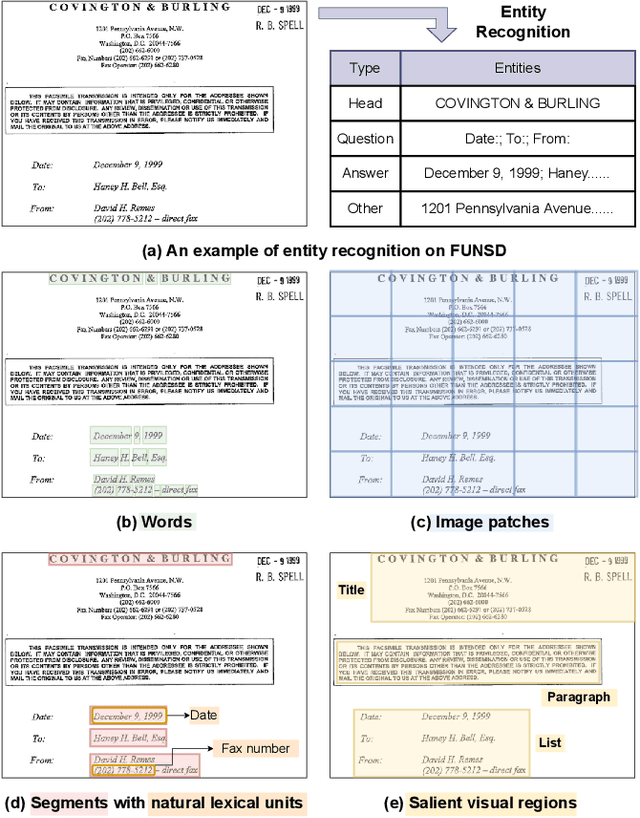
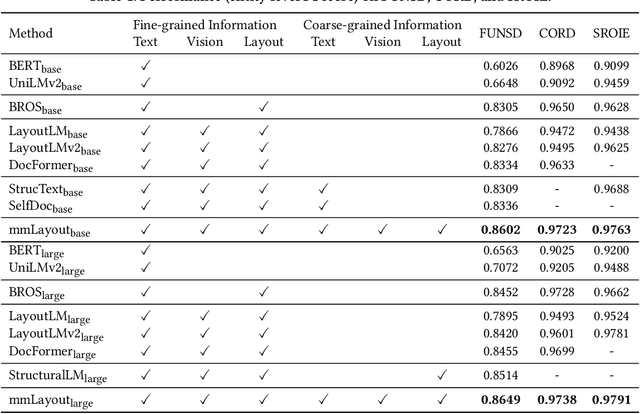
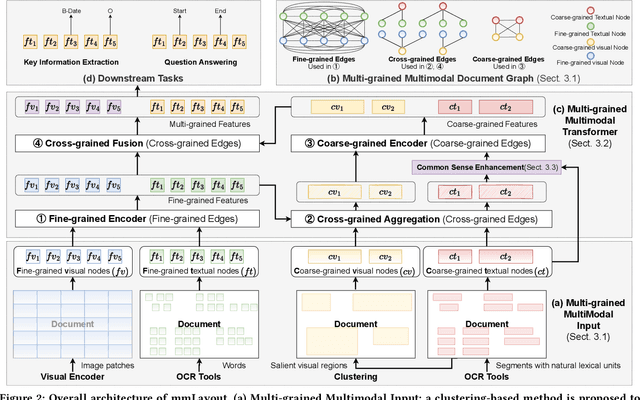
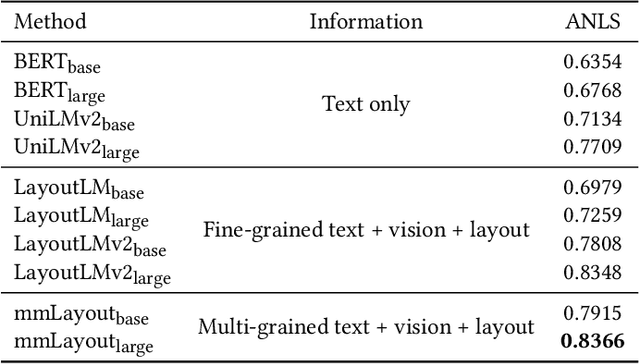
Recent efforts of multimodal Transformers have improved Visually Rich Document Understanding (VrDU) tasks via incorporating visual and textual information. However, existing approaches mainly focus on fine-grained elements such as words and document image patches, making it hard for them to learn from coarse-grained elements, including natural lexical units like phrases and salient visual regions like prominent image regions. In this paper, we attach more importance to coarse-grained elements containing high-density information and consistent semantics, which are valuable for document understanding. At first, a document graph is proposed to model complex relationships among multi-grained multimodal elements, in which salient visual regions are detected by a cluster-based method. Then, a multi-grained multimodal Transformer called mmLayout is proposed to incorporate coarse-grained information into existing pre-trained fine-grained multimodal Transformers based on the graph. In mmLayout, coarse-grained information is aggregated from fine-grained, and then, after further processing, is fused back into fine-grained for final prediction. Furthermore, common sense enhancement is introduced to exploit the semantic information of natural lexical units. Experimental results on four tasks, including information extraction and document question answering, show that our method can improve the performance of multimodal Transformers based on fine-grained elements and achieve better performance with fewer parameters. Qualitative analyses show that our method can capture consistent semantics in coarse-grained elements.
Large-scale Knowledge Distillation with Elastic Heterogeneous Computing Resources
Jul 14, 2022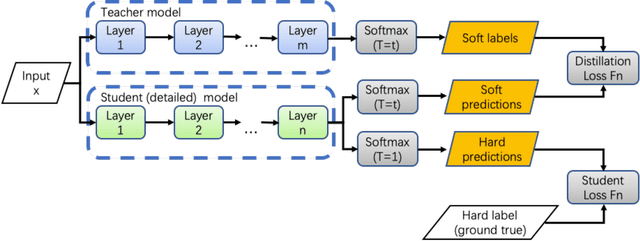

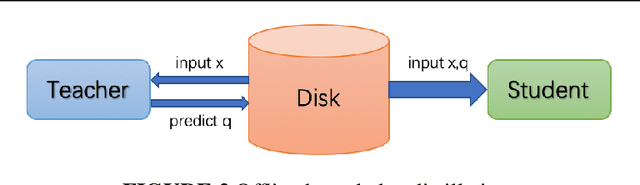
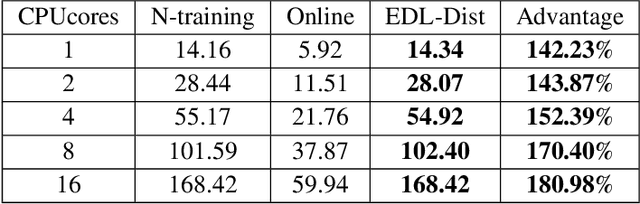
Although more layers and more parameters generally improve the accuracy of the models, such big models generally have high computational complexity and require big memory, which exceed the capacity of small devices for inference and incurs long training time. In addition, it is difficult to afford long training time and inference time of big models even in high performance servers, as well. As an efficient approach to compress a large deep model (a teacher model) to a compact model (a student model), knowledge distillation emerges as a promising approach to deal with the big models. Existing knowledge distillation methods cannot exploit the elastic available computing resources and correspond to low efficiency. In this paper, we propose an Elastic Deep Learning framework for knowledge Distillation, i.e., EDL-Dist. The advantages of EDL-Dist are three-fold. First, the inference and the training process is separated. Second, elastic available computing resources can be utilized to improve the efficiency. Third, fault-tolerance of the training and inference processes is supported. We take extensive experimentation to show that the throughput of EDL-Dist is up to 3.125 times faster than the baseline method (online knowledge distillation) while the accuracy is similar or higher.
HelixFold: An Efficient Implementation of AlphaFold2 using PaddlePaddle
Jul 13, 2022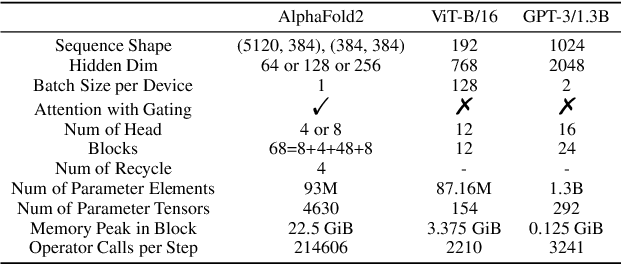
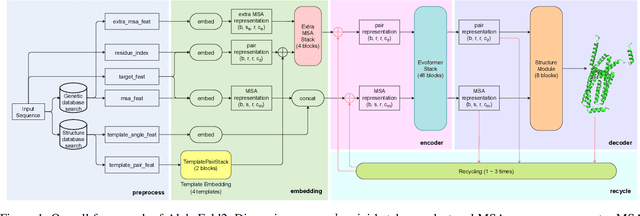

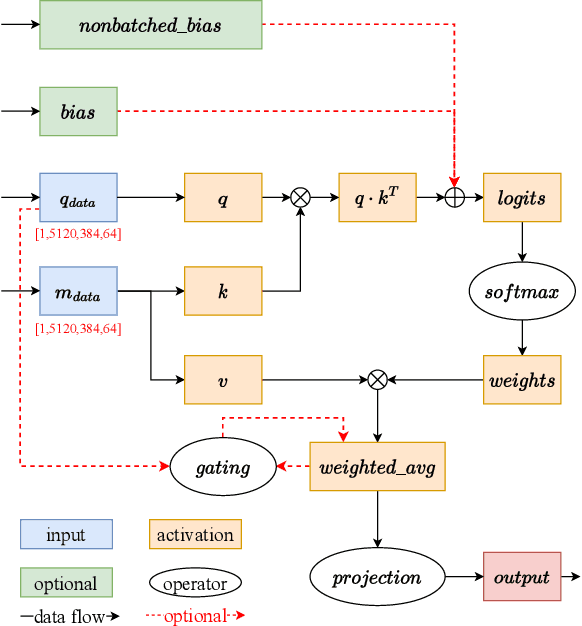
Accurate protein structure prediction can significantly accelerate the development of life science. The accuracy of AlphaFold2, a frontier end-to-end structure prediction system, is already close to that of the experimental determination techniques. Due to the complex model architecture and large memory consumption, it requires lots of computational resources and time to implement the training and inference of AlphaFold2 from scratch. The cost of running the original AlphaFold2 is expensive for most individuals and institutions. Therefore, reducing this cost could accelerate the development of life science. We implement AlphaFold2 using PaddlePaddle, namely HelixFold, to improve training and inference speed and reduce memory consumption. The performance is improved by operator fusion, tensor fusion, and hybrid parallelism computation, while the memory is optimized through Recompute, BFloat16, and memory read/write in-place. Compared with the original AlphaFold2 (implemented with Jax) and OpenFold (implemented with PyTorch), HelixFold needs only 7.5 days to complete the full end-to-end training and only 5.3 days when using hybrid parallelism, while both AlphaFold2 and OpenFold take about 11 days. HelixFold saves 1x training time. We verified that HelixFold's accuracy could be on par with AlphaFold2 on the CASP14 and CAMEO datasets. HelixFold's code is available on GitHub for free download: https://github.com/PaddlePaddle/PaddleHelix/tree/dev/apps/protein_folding/helixfold, and we also provide stable web services on https://paddlehelix.baidu.com/app/drug/protein/forecast.
PP-OCRv3: More Attempts for the Improvement of Ultra Lightweight OCR System
Jun 07, 2022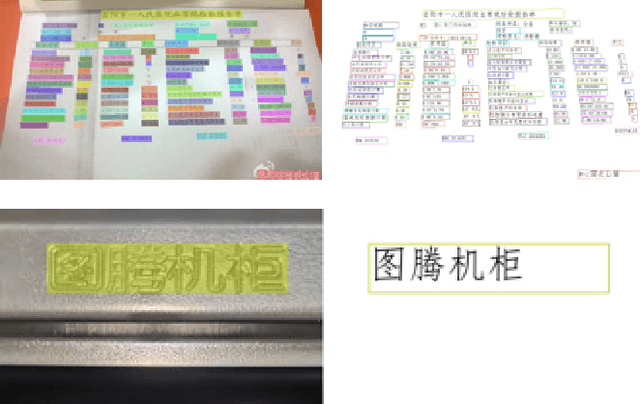

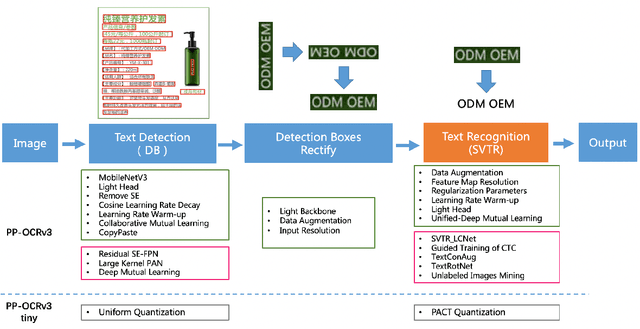
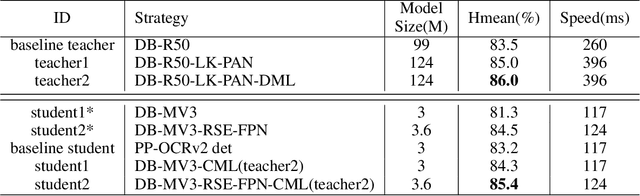
Optical character recognition (OCR) technology has been widely used in various scenes, as shown in Figure 1. Designing a practical OCR system is still a meaningful but challenging task. In previous work, considering the efficiency and accuracy, we proposed a practical ultra lightweight OCR system (PP-OCR), and an optimized version PP-OCRv2. In order to further improve the performance of PP-OCRv2, a more robust OCR system PP-OCRv3 is proposed in this paper. PP-OCRv3 upgrades the text detection model and text recognition model in 9 aspects based on PP-OCRv2. For text detector, we introduce a PAN module with large receptive field named LK-PAN, a FPN module with residual attention mechanism named RSE-FPN, and DML distillation strategy. For text recognizer, the base model is replaced from CRNN to SVTR, and we introduce lightweight text recognition network SVTR LCNet, guided training of CTC by attention, data augmentation strategy TextConAug, better pre-trained model by self-supervised TextRotNet, UDML, and UIM to accelerate the model and improve the effect. Experiments on real data show that the hmean of PP-OCRv3 is 5% higher than PP-OCRv2 under comparable inference speed. All the above mentioned models are open-sourced and the code is available in the GitHub repository PaddleOCR which is powered by PaddlePaddle.
PaddleSpeech: An Easy-to-Use All-in-One Speech Toolkit
May 20, 2022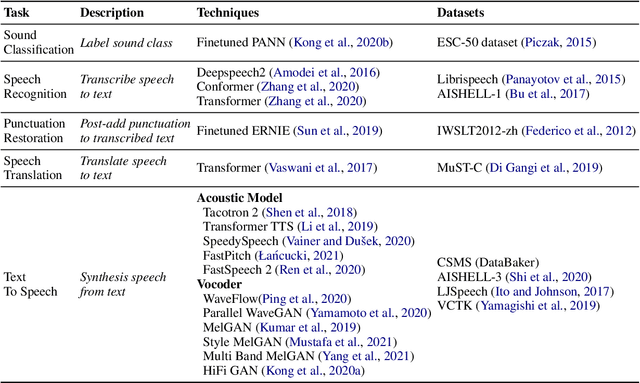
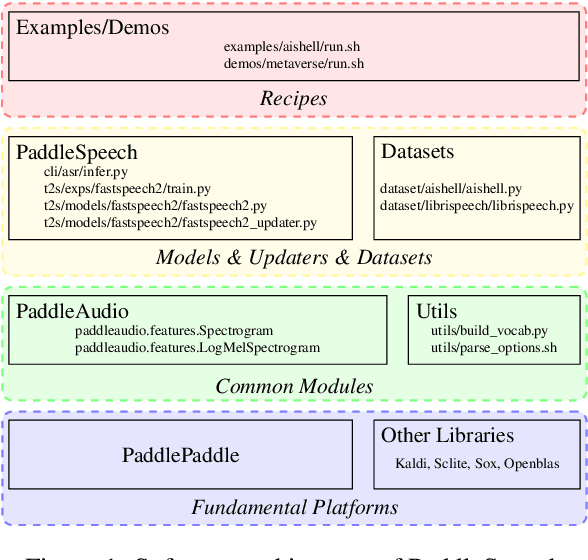
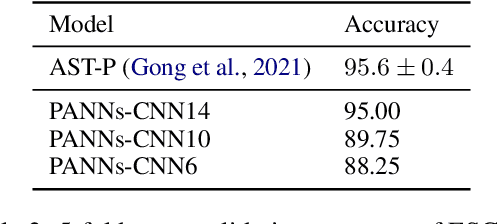
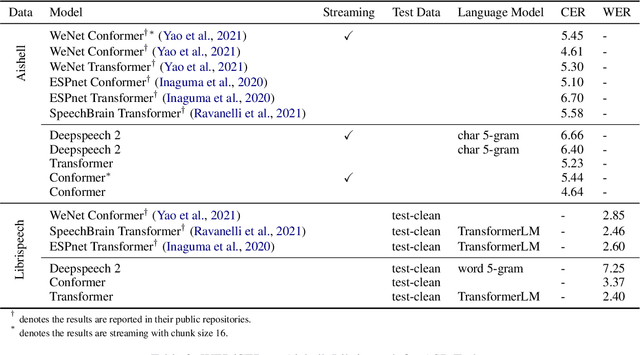
PaddleSpeech is an open-source all-in-one speech toolkit. It aims at facilitating the development and research of speech processing technologies by providing an easy-to-use command-line interface and a simple code structure. This paper describes the design philosophy and core architecture of PaddleSpeech to support several essential speech-to-text and text-to-speech tasks. PaddleSpeech achieves competitive or state-of-the-art performance on various speech datasets and implements the most popular methods. It also provides recipes and pretrained models to quickly reproduce the experimental results in this paper. PaddleSpeech is publicly avaiable at https://github.com/PaddlePaddle/PaddleSpeech.
SE-MoE: A Scalable and Efficient Mixture-of-Experts Distributed Training and Inference System
May 20, 2022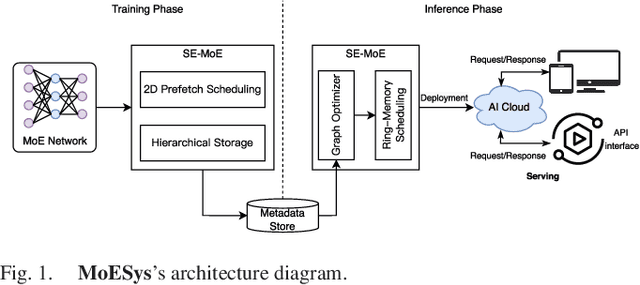
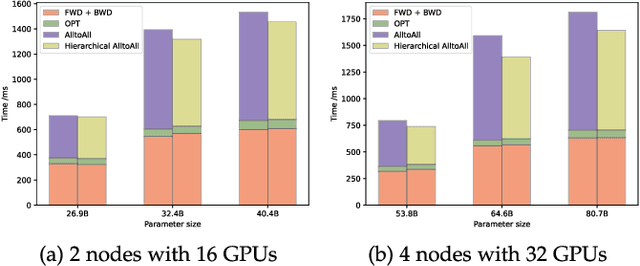
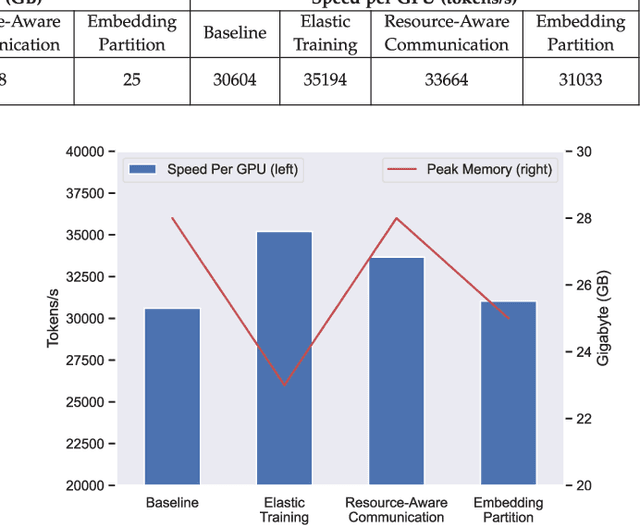
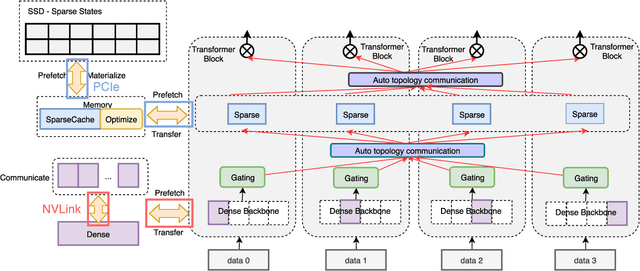
With the increasing diversity of ML infrastructures nowadays, distributed training over heterogeneous computing systems is desired to facilitate the production of big models. Mixture-of-Experts (MoE) models have been proposed to lower the cost of training subject to the overall size of models/data through gating and parallelism in a divide-and-conquer fashion. While DeepSpeed has made efforts in carrying out large-scale MoE training over heterogeneous infrastructures, the efficiency of training and inference could be further improved from several system aspects, including load balancing, communication/computation efficiency, and memory footprint limits. In this work, we present SE-MoE that proposes Elastic MoE training with 2D prefetch and Fusion communication over Hierarchical storage, so as to enjoy efficient parallelisms in various types. For scalable inference in a single node, especially when the model size is larger than GPU memory, SE-MoE forms the CPU-GPU memory jointly into a ring of sections to load the model, and executes the computation tasks across the memory sections in a round-robin manner for efficient inference. We carried out extensive experiments to evaluate SE-MoE, where SE-MoE successfully trains a Unified Feature Optimization (UFO) model with a Sparsely-Gated Mixture-of-Experts model of 12B parameters in 8 days on 48 A100 GPU cards. The comparison against the state-of-the-art shows that SE-MoE outperformed DeepSpeed with 33% higher throughput (tokens per second) in training and 13% higher throughput in inference in general. Particularly, under unbalanced MoE Tasks, e.g., UFO, SE-MoE achieved 64% higher throughput with 18% lower memory footprints. The code of the framework will be released on: https://github.com/PaddlePaddle/Paddle.
Nebula-I: A General Framework for Collaboratively Training Deep Learning Models on Low-Bandwidth Cloud Clusters
May 19, 2022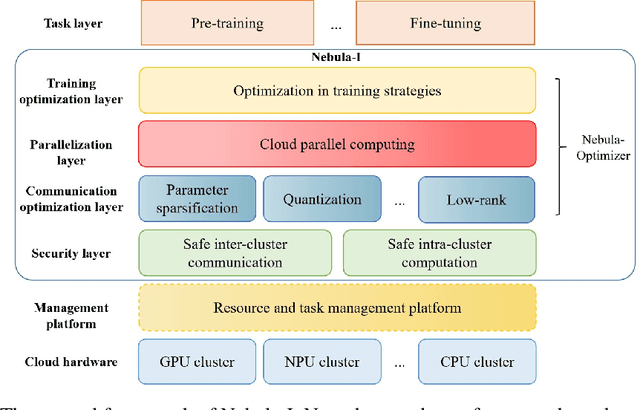
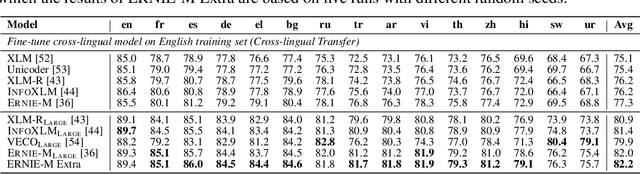
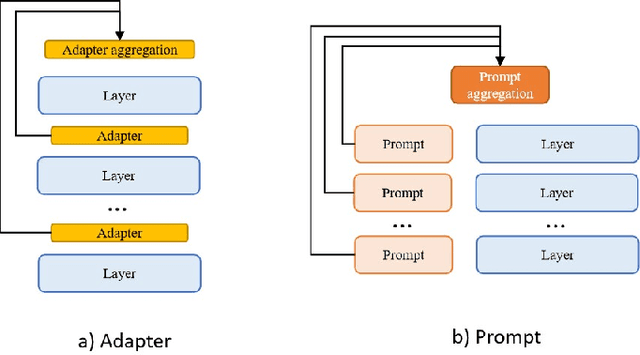
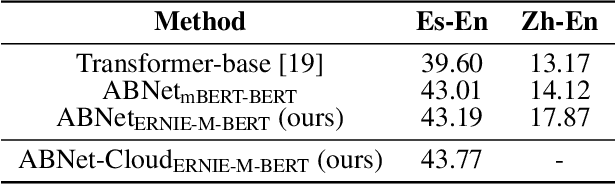
The ever-growing model size and scale of compute have attracted increasing interests in training deep learning models over multiple nodes. However, when it comes to training on cloud clusters, especially across remote clusters, huge challenges are faced. In this work, we introduce a general framework, Nebula-I, for collaboratively training deep learning models over remote heterogeneous clusters, the connections between which are low-bandwidth wide area networks (WANs). We took natural language processing (NLP) as an example to show how Nebula-I works in different training phases that include: a) pre-training a multilingual language model using two remote clusters; and b) fine-tuning a machine translation model using knowledge distilled from pre-trained models, which run through the most popular paradigm of recent deep learning. To balance the accuracy and communication efficiency, in Nebula-I, parameter-efficient training strategies, hybrid parallel computing methods and adaptive communication acceleration techniques are jointly applied. Meanwhile, security strategies are employed to guarantee the safety, reliability and privacy in intra-cluster computation and inter-cluster communication. Nebula-I is implemented with the PaddlePaddle deep learning framework, which can support collaborative training over heterogeneous hardware, e.g. GPU and NPU. Experiments demonstrate that the proposed framework could substantially maximize the training efficiency while preserving satisfactory NLP performance. By using Nebula-I, users can run large-scale training tasks over cloud clusters with minimum developments, and the utility of existed large pre-trained models could be further promoted. We also introduced new state-of-the-art results on cross-lingual natural language inference tasks, which are generated based upon a novel learning framework and Nebula-I.
Simple and Effective Relation-based Embedding Propagation for Knowledge Representation Learning
May 13, 2022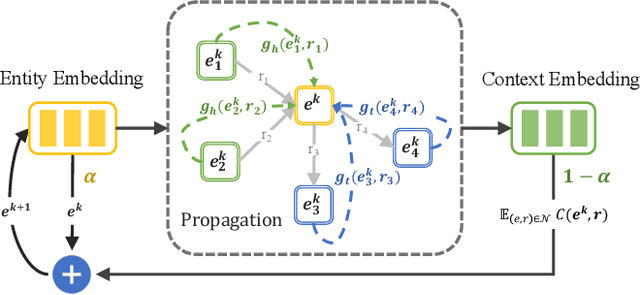

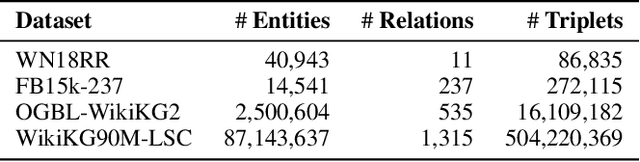
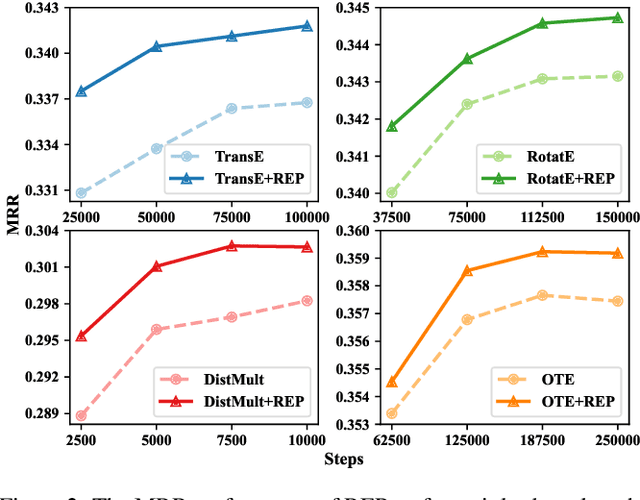
Relational graph neural networks have garnered particular attention to encode graph context in knowledge graphs (KGs). Although they achieved competitive performance on small KGs, how to efficiently and effectively utilize graph context for large KGs remains an open problem. To this end, we propose the Relation-based Embedding Propagation (REP) method. It is a post-processing technique to adapt pre-trained KG embeddings with graph context. As relations in KGs are directional, we model the incoming head context and the outgoing tail context separately. Accordingly, we design relational context functions with no external parameters. Besides, we use averaging to aggregate context information, making REP more computation-efficient. We theoretically prove that such designs can avoid information distortion during propagation. Extensive experiments also demonstrate that REP has significant scalability while improving or maintaining prediction quality. Notably, it averagely brings about 10% relative improvement to triplet-based embedding methods on OGBL-WikiKG2 and takes 5%-83% time to achieve comparable results as the state-of-the-art GC-OTE.