 Add to Chrome
 Add to Firefox
 Add to Edge
A Unified Algorithmic Framework for Hybrid Reinforcement Learning in Tabular MDPs with Shifted Transition Dynamics
Jul 28, 2026
This paper investigates a hybrid reinforcement learning setting in tabular Markov Decision Processes (MDPs), where an agent aims to learn an optimal policy by combining online interactions with a target environment and offline data from a source environment. A central challenge is that offline data may be collected from outdated environments with shifted transition dynamics, making naive integration of historical data ineffective. To address this, we propose a unified algorithmic framework featuring two algorithms: MIN-UCB-VI for regret minimization and MAX-LCB-VI for best policy identification. Both algorithms leverage fine-grained bias information to more effectively exploit offline data under general transition shifts. We provide theoretical guarantees for our framework, including both instance-dependent and independent upper bounds on regret and sub-optimality gap. Furthermore, we establish matching lower bounds to demonstrate the optimality of our approach and validate our theoretical findings through extensive experiments.

SciDA: Scientific Dynamic Assessor of LLMs
Jun 15, 2025Advancement in Large Language Models (LLMs) reasoning capabilities enables them to solve scientific problems with enhanced efficacy. Thereby, a high-quality benchmark for comprehensive and appropriate assessment holds significance, while existing ones either confront the risk of data contamination or lack involved disciplines. To be specific, due to the data source overlap of LLMs training and static benchmark, the keys or number pattern of answers inadvertently memorized (i.e. data contamination), leading to systematic overestimation of their reasoning capabilities, especially numerical reasoning. We propose SciDA, a multidisciplinary benchmark that consists exclusively of over 1k Olympic-level numerical computation problems, allowing randomized numerical initializations for each inference round to avoid reliance on fixed numerical patterns. We conduct a series of experiments with both closed-source and open-source top-performing LLMs, and it is observed that the performance of LLMs drop significantly under random numerical initialization. Thus, we provide truthful and unbiased assessments of the numerical reasoning capabilities of LLMs. The data is available at https://huggingface.co/datasets/m-a-p/SciDA
Seed1.5-VL Technical Report
May 11, 2025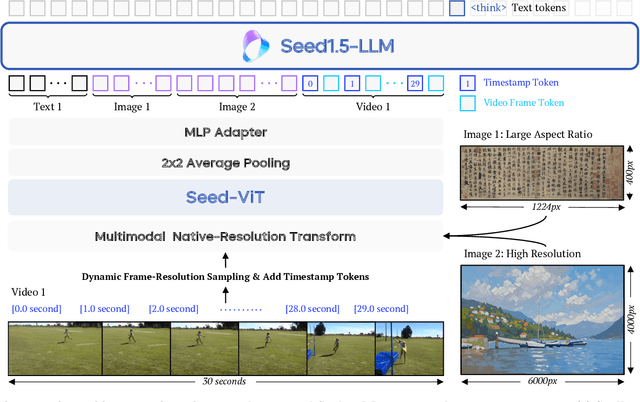

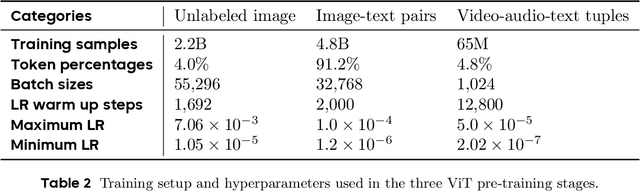
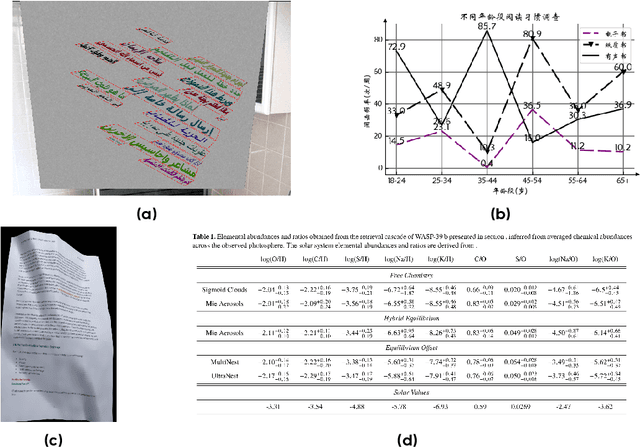
We present Seed1.5-VL, a vision-language foundation model designed to advance general-purpose multimodal understanding and reasoning. Seed1.5-VL is composed with a 532M-parameter vision encoder and a Mixture-of-Experts (MoE) LLM of 20B active parameters. Despite its relatively compact architecture, it delivers strong performance across a wide spectrum of public VLM benchmarks and internal evaluation suites, achieving the state-of-the-art performance on 38 out of 60 public benchmarks. Moreover, in agent-centric tasks such as GUI control and gameplay, Seed1.5-VL outperforms leading multimodal systems, including OpenAI CUA and Claude 3.7. Beyond visual and video understanding, it also demonstrates strong reasoning abilities, making it particularly effective for multimodal reasoning challenges such as visual puzzles. We believe these capabilities will empower broader applications across diverse tasks. In this report, we mainly provide a comprehensive review of our experiences in building Seed1.5-VL across model design, data construction, and training at various stages, hoping that this report can inspire further research. Seed1.5-VL is now accessible at https://www.volcengine.com/ (Volcano Engine Model ID: doubao-1-5-thinking-vision-pro-250428)
Flaming-hot Initiation with Regular Execution Sampling for Large Language Models
Oct 28, 2024


Since the release of ChatGPT, large language models (LLMs) have demonstrated remarkable capabilities across various domains. A key challenge in developing these general capabilities is efficiently sourcing diverse, high-quality data. This becomes especially critical in reasoning-related tasks with sandbox checkers, such as math or code, where the goal is to generate correct solutions to specific problems with higher probability. In this work, we introduce Flaming-hot Initiation with Regular Execution (FIRE) sampling, a simple yet highly effective method to efficiently find good responses. Our empirical findings show that FIRE sampling enhances inference-time generation quality and also benefits training in the alignment stage. Furthermore, we explore how FIRE sampling improves performance by promoting diversity and analyze the impact of employing FIRE at different positions within a response.
Process Supervision-Guided Policy Optimization for Code Generation
Oct 23, 2024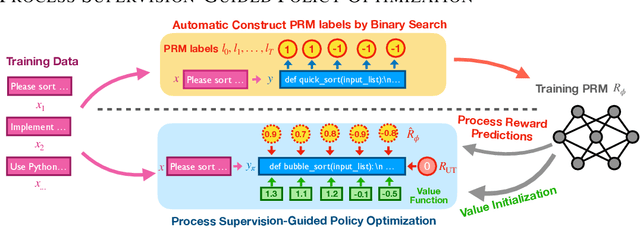
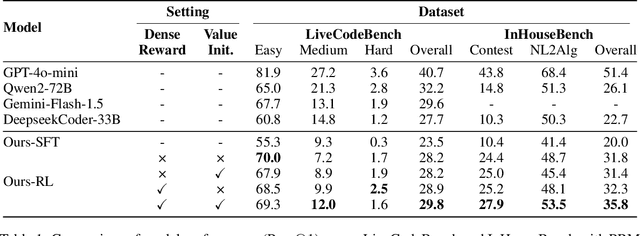


Reinforcement Learning (RL) with unit test feedback has enhanced large language models (LLMs) code generation, but relies on sparse rewards provided only after complete code evaluation, limiting learning efficiency and incremental improvements. When generated code fails all unit tests, no learning signal is received, hindering progress on complex tasks. To address this, we propose a Process Reward Model (PRM) that delivers dense, line-level feedback on code correctness during generation, mimicking human code refinement and providing immediate guidance. We explore various strategies for training PRMs and integrating them into the RL framework, finding that using PRMs both as dense rewards and for value function initialization significantly boosts performance. Our approach increases our in-house LLM's pass rate from 28.2% to 29.8% on LiveCodeBench and from 31.8% to 35.8% on our internal benchmark. Our experimental results highlight the effectiveness of PRMs in enhancing RL-driven code generation, especially for long-horizon scenarios.
Enhancing Multi-Step Reasoning Abilities of Language Models through Direct Q-Function Optimization
Oct 11, 2024
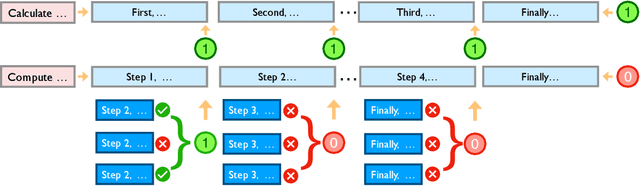
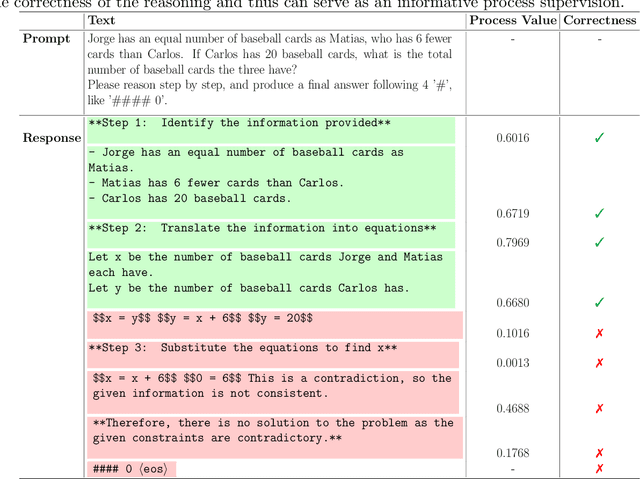
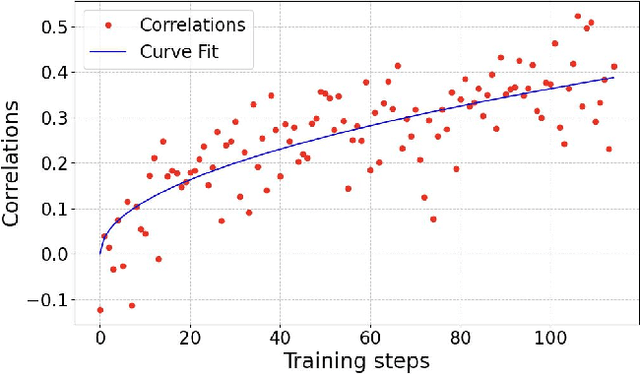
Reinforcement Learning (RL) plays a crucial role in aligning large language models (LLMs) with human preferences and improving their ability to perform complex tasks. However, current approaches either require significant computational resources due to the use of multiple models and extensive online sampling for training (e.g., PPO) or are framed as bandit problems (e.g., DPO, DRO), which often struggle with multi-step reasoning tasks, such as math problem-solving and complex reasoning that involve long chains of thought. To overcome these limitations, we introduce Direct Q-function Optimization (DQO), which formulates the response generation process as a Markov Decision Process (MDP) and utilizes the soft actor-critic (SAC) framework to optimize a Q-function directly parameterized by the language model. The MDP formulation of DQO offers structural advantages over bandit-based methods, enabling more effective process supervision. Experimental results on two math problem-solving datasets, GSM8K and MATH, demonstrate that DQO outperforms previous methods, establishing it as a promising offline reinforcement learning approach for aligning language models.
ERNIE-SAT: Speech and Text Joint Pretraining for Cross-Lingual Multi-Speaker Text-to-Speech
Nov 07, 2022


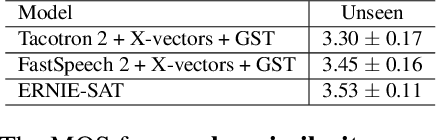
Speech representation learning has improved both speech understanding and speech synthesis tasks for single language. However, its ability in cross-lingual scenarios has not been explored. In this paper, we extend the pretraining method for cross-lingual multi-speaker speech synthesis tasks, including cross-lingual multi-speaker voice cloning and cross-lingual multi-speaker speech editing. We propose a speech-text joint pretraining framework, where we randomly mask the spectrogram and the phonemes given a speech example and its transcription. By learning to reconstruct the masked parts of the input in different languages, our model shows great improvements over speaker-embedding-based multi-speaker TTS methods. Moreover, our framework is end-to-end for both the training and the inference without any finetuning effort. In cross-lingual multi-speaker voice cloning and cross-lingual multi-speaker speech editing tasks, our experiments show that our model outperforms speaker-embedding-based multi-speaker TTS methods. The code and model are publicly available at PaddleSpeech.
PaddleSpeech: An Easy-to-Use All-in-One Speech Toolkit
May 20, 2022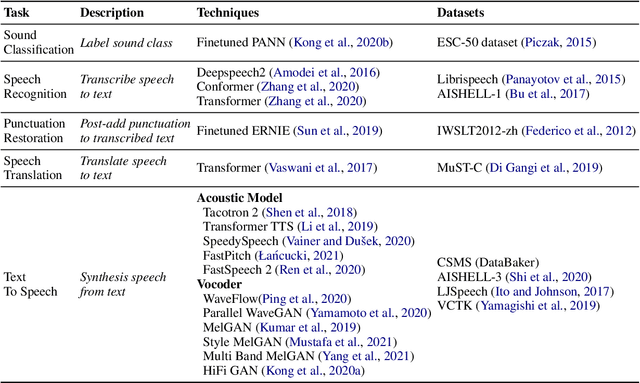
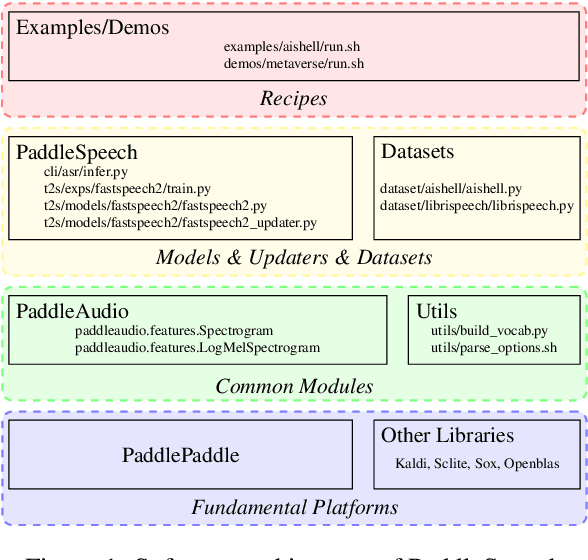
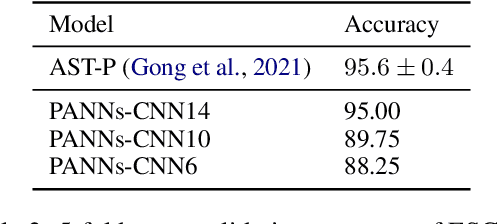
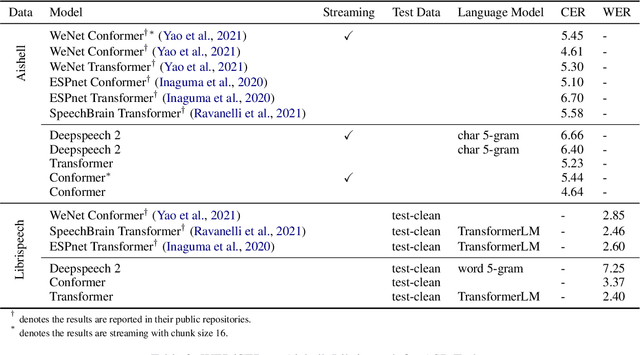
PaddleSpeech is an open-source all-in-one speech toolkit. It aims at facilitating the development and research of speech processing technologies by providing an easy-to-use command-line interface and a simple code structure. This paper describes the design philosophy and core architecture of PaddleSpeech to support several essential speech-to-text and text-to-speech tasks. PaddleSpeech achieves competitive or state-of-the-art performance on various speech datasets and implements the most popular methods. It also provides recipes and pretrained models to quickly reproduce the experimental results in this paper. PaddleSpeech is publicly avaiable at https://github.com/PaddlePaddle/PaddleSpeech.
Data-Driven Adaptive Simultaneous Machine Translation
Apr 27, 2022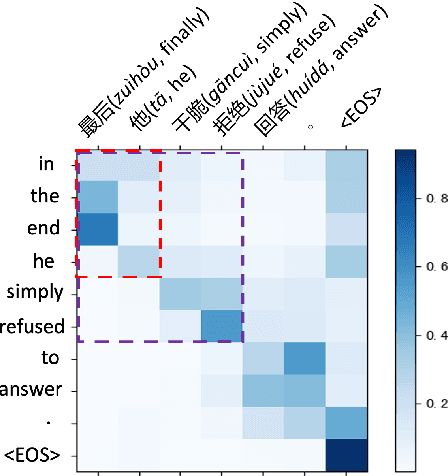
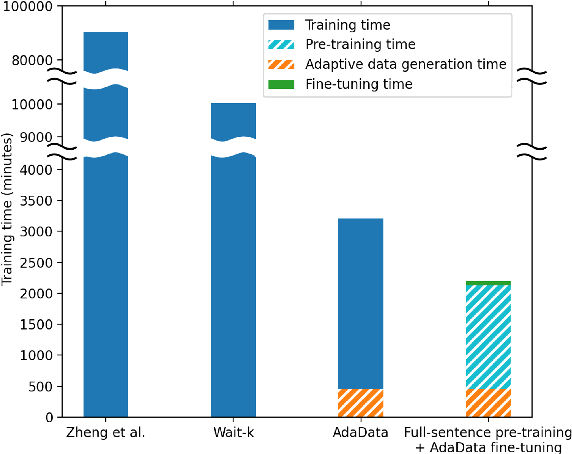
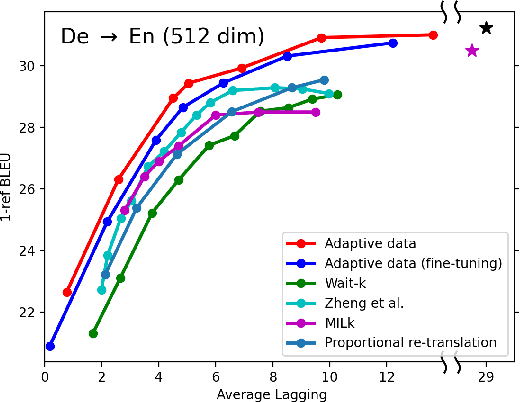
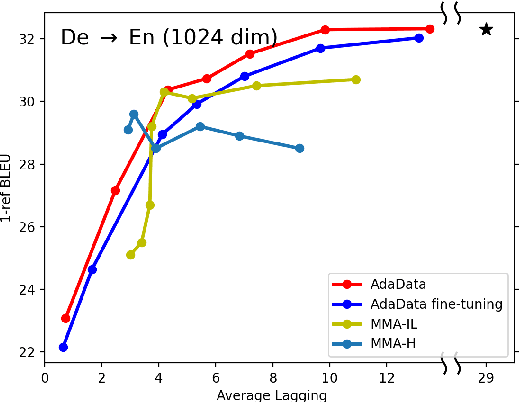
In simultaneous translation (SimulMT), the most widely used strategy is the wait-k policy thanks to its simplicity and effectiveness in balancing translation quality and latency. However, wait-k suffers from two major limitations: (a) it is a fixed policy that can not adaptively adjust latency given context, and (b) its training is much slower than full-sentence translation. To alleviate these issues, we propose a novel and efficient training scheme for adaptive SimulMT by augmenting the training corpus with adaptive prefix-to-prefix pairs, while the training complexity remains the same as that of training full-sentence translation models. Experiments on two language pairs show that our method outperforms all strong baselines in terms of translation quality and latency.
A$^3$T: Alignment-Aware Acoustic and Text Pretraining for Speech Synthesis and Editing
Mar 18, 2022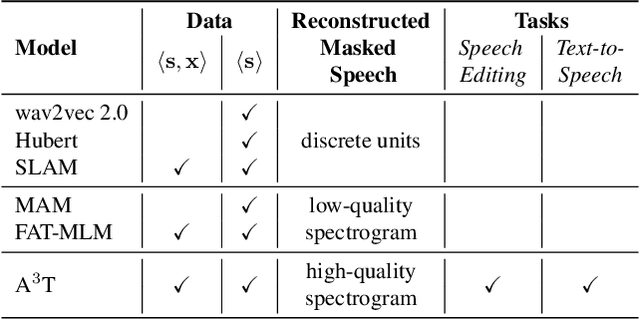
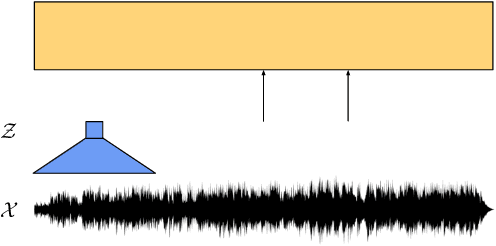
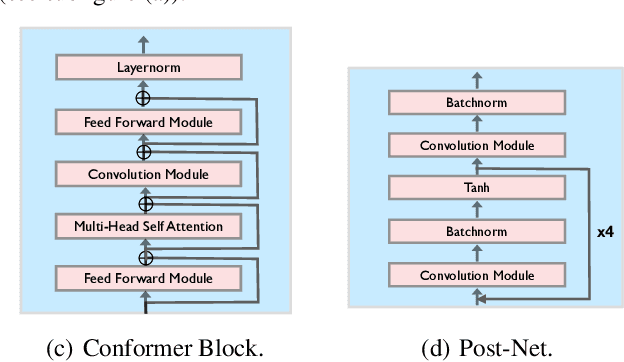
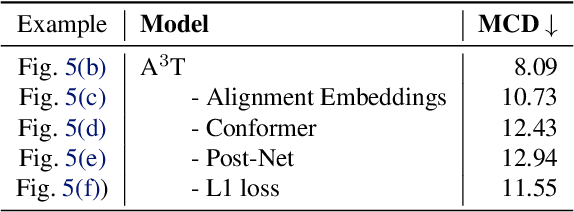
Recently, speech representation learning has improved many speech-related tasks such as speech recognition, speech classification, and speech-to-text translation. However, all the above tasks are in the direction of speech understanding, but for the inverse direction, speech synthesis, the potential of representation learning is yet to be realized, due to the challenging nature of generating high-quality speech. To address this problem, we propose our framework, Alignment-Aware Acoustic-Text Pretraining (A$^3$T), which reconstructs masked acoustic signals with text input and acoustic-text alignment during training. In this way, the pretrained model can generate high quality of reconstructed spectrogram, which can be applied to the speech editing and unseen speaker TTS directly. Experiments show A$^3$T outperforms SOTA models on speech editing, and improves multi-speaker speech synthesis without the external speaker verification model.