 Add to Chrome
 Add to Firefox
 Add to Edge
Synergistic Perception and Generative Recomposition: A Multi-Agent Orchestration for Expert-Level Building Inspection
Mar 20, 2026
Building facade defect inspection is fundamental to structural health monitoring and sustainable urban maintenance, yet it remains a formidable challenge due to extreme geometric variability, low contrast against complex backgrounds, and the inherent complexity of composite defects (e.g., cracks co-occurring with spalling). Such characteristics lead to severe pixel imbalance and feature ambiguity, which, coupled with the critical scarcity of high-quality pixel-level annotations, hinder the generalization of existing detection and segmentation models. To address gaps, we propose \textit{FacadeFixer}, a unified multi-agent framework that treats defect perception as a collaborative reasoning task rather than isolated recognition. Specifically,\textit{FacadeFixer} orchestrates specialized agents for detection and segmentation to handle multi-type defect interference, working in tandem with a generative agent to enable semantic recomposition. This process decouples intricate defects from noisy backgrounds and realistically synthesizes them onto diverse clean textures, generating high-fidelity augmented data with precise expert-level masks. To support this, we introduce a comprehensive multi-task dataset covering six primary facade categories with pixel-level annotations. Extensive experiments demonstrate that \textit{FacadeFixer} significantly outperforms state-of-the-art (SOTA) baselines. Specifically, it excels in capturing pixel-level structural anomalies and highlights generative synthesis as a robust solution to data scarcity in infrastructure inspection. Our code and dataset will be made publicly available.

Can Large Multimodal Models Inspect Buildings? A Hierarchical Benchmark for Structural Pathology Reasoning
Mar 20, 2026Automated building facade inspection is a critical component of urban resilience and smart city maintenance. Traditionally, this field has relied on specialized discriminative models (e.g., YOLO, Mask R-CNN) that excel at pixel-level localization but are constrained to passive perception and worse generization without the visual understandng to interpret structural topology. Large Multimodal Models (LMMs) promise a paradigm shift toward active reasoning, yet their application in such high-stakes engineering domains lacks rigorous evaluation standards. To bridge this gap, we introduce a human-in-the-loop semi-automated annotation framework, leveraging expert-proposal verification to unify 12 fragmented datasets into a standardized, hierarchical ontology. Building on this foundation, we present \textit{DefectBench}, the first multi-dimensional benchmark designed to interrogate LMMs beyond basic semantic recognition. \textit{DefectBench} evaluates 18 state-of-the-art (SOTA) LMMs across three escalating cognitive dimensions: Semantic Perception, Spatial Localization, and Generative Geometry Segmentation. Extensive experiments reveal that while current LMMs demonstrate exceptional topological awareness and semantic understanding (effectively diagnosing "what" and "how"), they exhibit significant deficiencies in metric localization precision ("where"). Crucially, however, we validate the viability of zero-shot generative segmentation, showing that general-purpose foundation models can rival specialized supervised networks without domain-specific training. This work provides both a rigorous benchmarking standard and a high-quality open-source database, establishing a new baseline for the advancement of autonomous AI agents in civil engineering.
ERNIE 5.0 Technical Report
Feb 04, 2026In this report, we introduce ERNIE 5.0, a natively autoregressive foundation model desinged for unified multimodal understanding and generation across text, image, video, and audio. All modalities are trained from scratch under a unified next-group-of-tokens prediction objective, based on an ultra-sparse mixture-of-experts (MoE) architecture with modality-agnostic expert routing. To address practical challenges in large-scale deployment under diverse resource constraints, ERNIE 5.0 adopts a novel elastic training paradigm. Within a single pre-training run, the model learns a family of sub-models with varying depths, expert capacities, and routing sparsity, enabling flexible trade-offs among performance, model size, and inference latency in memory- or time-constrained scenarios. Moreover, we systematically address the challenges of scaling reinforcement learning to unified foundation models, thereby guaranteeing efficient and stable post-training under ultra-sparse MoE architectures and diverse multimodal settings. Extensive experiments demonstrate that ERNIE 5.0 achieves strong and balanced performance across multiple modalities. To the best of our knowledge, among publicly disclosed models, ERNIE 5.0 represents the first production-scale realization of a trillion-parameter unified autoregressive model that supports both multimodal understanding and generation. To facilitate further research, we present detailed visualizations of modality-agnostic expert routing in the unified model, alongside comprehensive empirical analysis of elastic training, aiming to offer profound insights to the community.
A Physics-informed End-to-End Occupancy Framework for Motion Planning of Autonomous Vehicles
May 08, 2025Accurate and interpretable motion planning is essential for autonomous vehicles (AVs) navigating complex and uncertain environments. While recent end-to-end occupancy prediction methods have improved environmental understanding, they typically lack explicit physical constraints, limiting safety and generalization. In this paper, we propose a unified end-to-end framework that integrates verifiable physical rules into the occupancy learning process. Specifically, we embed artificial potential fields (APF) as physics-informed guidance during network training to ensure that predicted occupancy maps are both data-efficient and physically plausible. Our architecture combines convolutional and recurrent neural networks to capture spatial and temporal dependencies while preserving model flexibility. Experimental results demonstrate that our method improves task completion rate, safety margins, and planning efficiency across diverse driving scenarios, confirming its potential for reliable deployment in real-world AV systems.
Deployment-friendly Lane-changing Intention Prediction Powered by Brain-inspired Spiking Neural Networks
Feb 09, 2025Accurate and real-time prediction of surrounding vehicles' lane-changing intentions is a critical challenge in deploying safe and efficient autonomous driving systems in open-world scenarios. Existing high-performing methods remain hard to deploy due to their high computational cost, long training times, and excessive memory requirements. Here, we propose an efficient lane-changing intention prediction approach based on brain-inspired Spiking Neural Networks (SNN). By leveraging the event-driven nature of SNN, the proposed approach enables us to encode the vehicle's states in a more efficient manner. Comparison experiments conducted on HighD and NGSIM datasets demonstrate that our method significantly improves training efficiency and reduces deployment costs while maintaining comparable prediction accuracy. Particularly, compared to the baseline, our approach reduces training time by 75% and memory usage by 99.9%. These results validate the efficiency and reliability of our method in lane-changing predictions, highlighting its potential for safe and efficient autonomous driving systems while offering significant advantages in deployment, including reduced training time, lower memory usage, and faster inference.
High-resolution on-road air pollution exposure informed by taxi-based mobile monitoring sensors
Dec 13, 2024Air pollutant exposure exhibits significant spatial and temporal variability, with localized hotspots, particularly in traffic microenvironments, posing health risks to commuters. Although widely used for air quality assessment, fixed-site monitoring stations are limited by sparse distribution, high costs, and maintenance needs, making them less effective in capturing on-road pollution levels. This study utilizes a fleet of 314 taxis equipped with sensors to measure NO\textsubscript{2}, PM\textsubscript{2.5}, and PM\textsubscript{10} concentrations and identify high-exposure hotspots. The findings reveal disparities between mobile and stationary measurements, map the spatiotemporal exposure patterns, and highlight local hotspots. These results demonstrate the potential of mobile monitoring to provide fine-scale, on-road air pollution assessments, offering valuable insights for policymakers to design targeted interventions and protect public health, particularly for sensitive populations.
EcoFollower: An Environment-Friendly Car Following Model Considering Fuel Consumption
Jul 22, 2024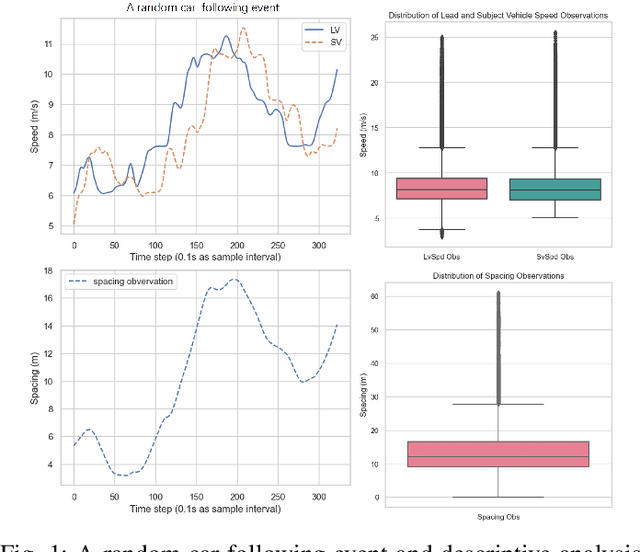
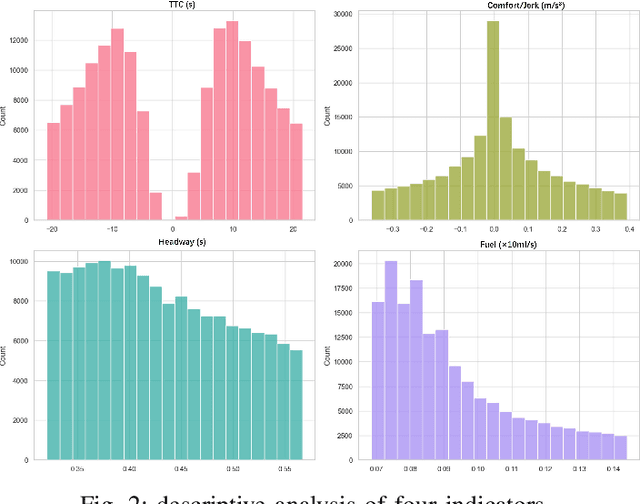
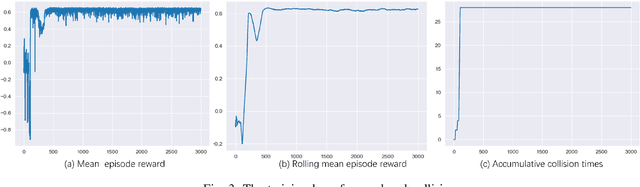
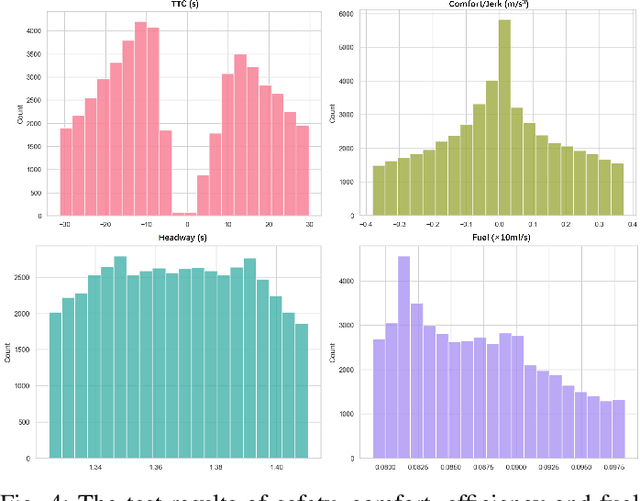
To alleviate energy shortages and environmental impacts caused by transportation, this study introduces EcoFollower, a novel eco-car-following model developed using reinforcement learning (RL) to optimize fuel consumption in car-following scenarios. Employing the NGSIM datasets, the performance of EcoFollower was assessed in comparison with the well-established Intelligent Driver Model (IDM). The findings demonstrate that EcoFollower excels in simulating realistic driving behaviors, maintaining smooth vehicle operations, and closely matching the ground truth metrics of time-to-collision (TTC), headway, and comfort. Notably, the model achieved a significant reduction in fuel consumption, lowering it by 10.42\% compared to actual driving scenarios. These results underscore the capability of RL-based models like EcoFollower to enhance autonomous vehicle algorithms, promoting safer and more energy-efficient driving strategies.
Harnessing Inherent Noises for Privacy Preservation in Quantum Machine Learning
Dec 18, 2023


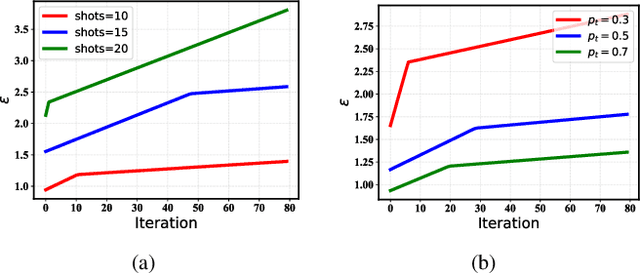
Quantum computing revolutionizes the way of solving complex problems and handling vast datasets, which shows great potential to accelerate the machine learning process. However, data leakage in quantum machine learning (QML) may present privacy risks. Although differential privacy (DP), which protects privacy through the injection of artificial noise, is a well-established approach, its application in the QML domain remains under-explored. In this paper, we propose to harness inherent quantum noises to protect data privacy in QML. Especially, considering the Noisy Intermediate-Scale Quantum (NISQ) devices, we leverage the unavoidable shot noise and incoherent noise in quantum computing to preserve the privacy of QML models for binary classification. We mathematically analyze that the gradient of quantum circuit parameters in QML satisfies a Gaussian distribution, and derive the upper and lower bounds on its variance, which can potentially provide the DP guarantee. Through simulations, we show that a target privacy protection level can be achieved by running the quantum circuit a different number of times.
BEVGPT: Generative Pre-trained Large Model for Autonomous Driving Prediction, Decision-Making, and Planning
Oct 16, 2023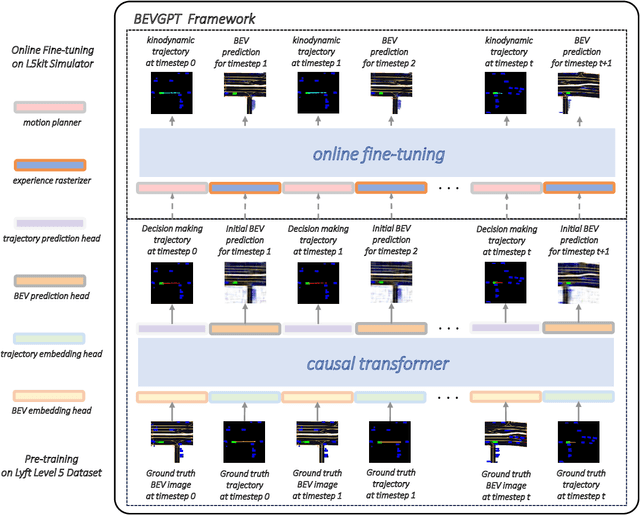
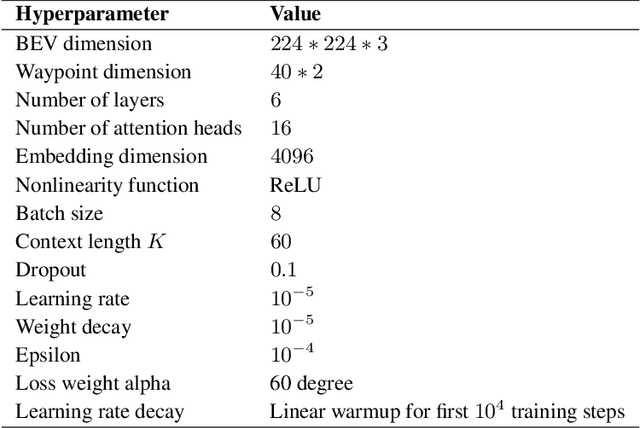
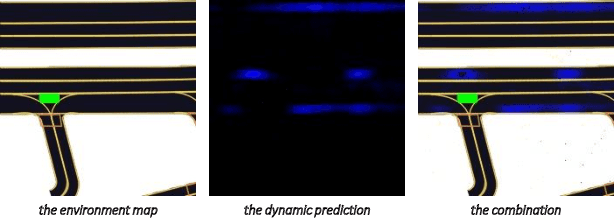
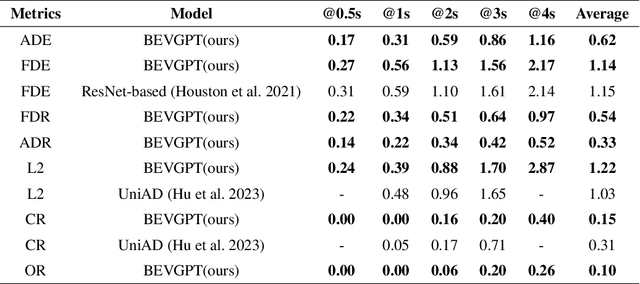
Prediction, decision-making, and motion planning are essential for autonomous driving. In most contemporary works, they are considered as individual modules or combined into a multi-task learning paradigm with a shared backbone but separate task heads. However, we argue that they should be integrated into a comprehensive framework. Although several recent approaches follow this scheme, they suffer from complicated input representations and redundant framework designs. More importantly, they can not make long-term predictions about future driving scenarios. To address these issues, we rethink the necessity of each module in an autonomous driving task and incorporate only the required modules into a minimalist autonomous driving framework. We propose BEVGPT, a generative pre-trained large model that integrates driving scenario prediction, decision-making, and motion planning. The model takes the bird's-eye-view (BEV) images as the only input source and makes driving decisions based on surrounding traffic scenarios. To ensure driving trajectory feasibility and smoothness, we develop an optimization-based motion planning method. We instantiate BEVGPT on Lyft Level 5 Dataset and use Woven Planet L5Kit for realistic driving simulation. The effectiveness and robustness of the proposed framework are verified by the fact that it outperforms previous methods in 100% decision-making metrics and 66% motion planning metrics. Furthermore, the ability of our framework to accurately generate BEV images over the long term is demonstrated through the task of driving scenario prediction. To the best of our knowledge, this is the first generative pre-trained large model for autonomous driving prediction, decision-making, and motion planning with only BEV images as input.
Eve Said Yes: AirBone Authentication for Head-Wearable Smart Voice Assistant
Sep 26, 2023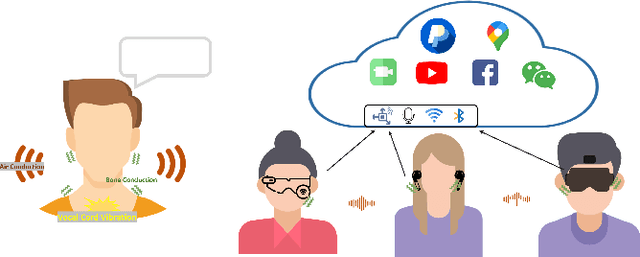
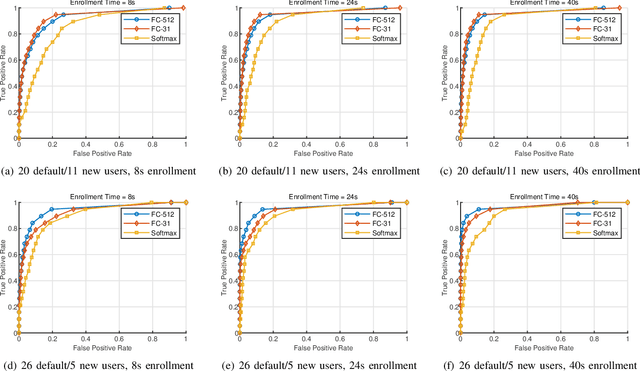
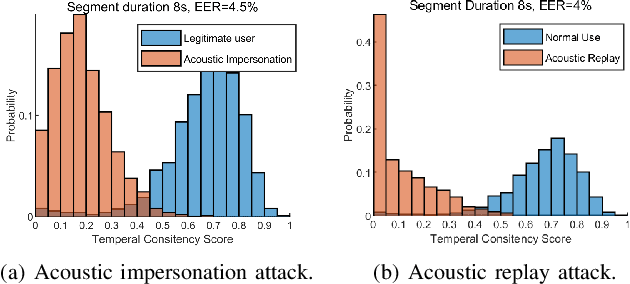
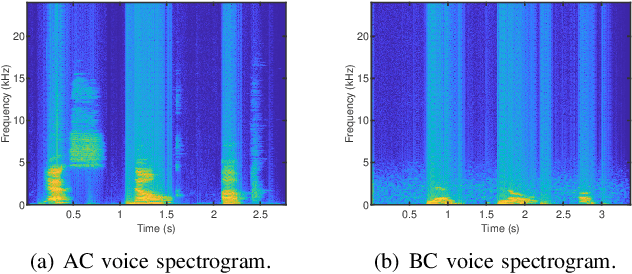
Recent advances in machine learning and natural language processing have fostered the enormous prosperity of smart voice assistants and their services, e.g., Alexa, Google Home, Siri, etc. However, voice spoofing attacks are deemed to be one of the major challenges of voice control security, and never stop evolving such as deep-learning-based voice conversion and speech synthesis techniques. To solve this problem outside the acoustic domain, we focus on head-wearable devices, such as earbuds and virtual reality (VR) headsets, which are feasible to continuously monitor the bone-conducted voice in the vibration domain. Specifically, we identify that air and bone conduction (AC/BC) from the same vocalization are coupled (or concurrent) and user-level unique, which makes them suitable behavior and biometric factors for multi-factor authentication (MFA). The legitimate user can defeat acoustic domain and even cross-domain spoofing samples with the proposed two-stage AirBone authentication. The first stage answers \textit{whether air and bone conduction utterances are time domain consistent (TC)} and the second stage runs \textit{bone conduction speaker recognition (BC-SR)}. The security level is hence increased for two reasons: (1) current acoustic attacks on smart voice assistants cannot affect bone conduction, which is in the vibration domain; (2) even for advanced cross-domain attacks, the unique bone conduction features can detect adversary's impersonation and machine-induced vibration. Finally, AirBone authentication has good usability (the same level as voice authentication) compared with traditional MFA and those specially designed to enhance smart voice security. Our experimental results show that the proposed AirBone authentication is usable and secure, and can be easily equipped by commercial off-the-shelf head wearables with good user experience.