 Add to Chrome
 Add to Firefox
 Add to Edge
Magnetically Self-Sealed MR Haptic Actuator With PWM-Based Excitation and High-Fidelity Torque Control
Aug 20, 2026
Accurate and stable torque rendering is essential for safe and perceptive human--machine interaction. Magnetorheological fluid (MRF)-based actuators offer a compact and rapidly controllable solution for haptic feedback, but their practical implementation requires reliable fluid sealing, low-hysteresis excitation, accurate torque control, and stable long-duration operation. This article presents an integrated MRF haptic system featuring a compact magnetically self-sealed rotary actuator, low-hysteresis PWM operation, high-fidelity model-based torque rendering, and stable performance during long-time operation. Magnetostatic simulation guides the arrangement of magnetic and nonmagnetic materials to focus flux in the multidisk torque and permanent-magnet sealing regions, enabling a maximum 600 N$\cdot$mm/A output. Experiments show that higher PWM frequencies reduce hysteresis and improve repeatability. At 10 kHz, the response is represented by a nonlinear model that varies with the direction and speed of torque change. The real-time controller combines feedforward, hysteresis compensation, PI feedback, and sliding-mode correction. Compared with PID, it reduces square-wave overshoot, undershoot, and steady-state RMSE by 77.4\%, 61.9\%, and 68.3\%, respectively. It tracks sinusoidal and biomechanics-model-based references, and a 1.5-h test shows only a 2.5 $^\circ$C rise near the coil with no clear tracking loss. This high-fidelity torque rendering will fundamentally transform human--robot collaboration by making interactions safer, more efficient, and more intuitive.

ERNIE-SAT: Speech and Text Joint Pretraining for Cross-Lingual Multi-Speaker Text-to-Speech
Nov 07, 2022


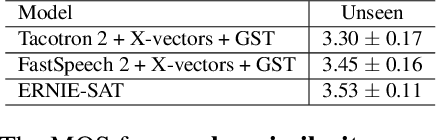
Speech representation learning has improved both speech understanding and speech synthesis tasks for single language. However, its ability in cross-lingual scenarios has not been explored. In this paper, we extend the pretraining method for cross-lingual multi-speaker speech synthesis tasks, including cross-lingual multi-speaker voice cloning and cross-lingual multi-speaker speech editing. We propose a speech-text joint pretraining framework, where we randomly mask the spectrogram and the phonemes given a speech example and its transcription. By learning to reconstruct the masked parts of the input in different languages, our model shows great improvements over speaker-embedding-based multi-speaker TTS methods. Moreover, our framework is end-to-end for both the training and the inference without any finetuning effort. In cross-lingual multi-speaker voice cloning and cross-lingual multi-speaker speech editing tasks, our experiments show that our model outperforms speaker-embedding-based multi-speaker TTS methods. The code and model are publicly available at PaddleSpeech.
PaddleSpeech: An Easy-to-Use All-in-One Speech Toolkit
May 20, 2022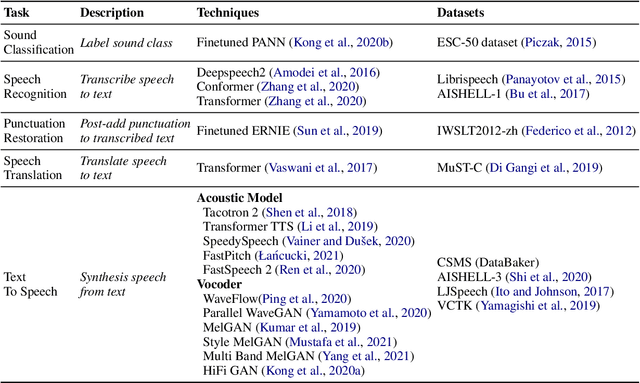
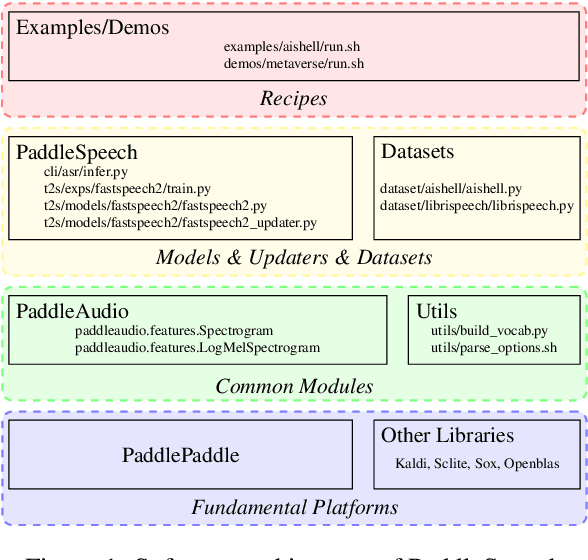
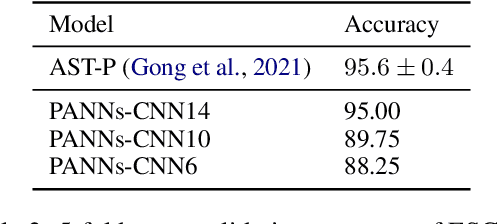
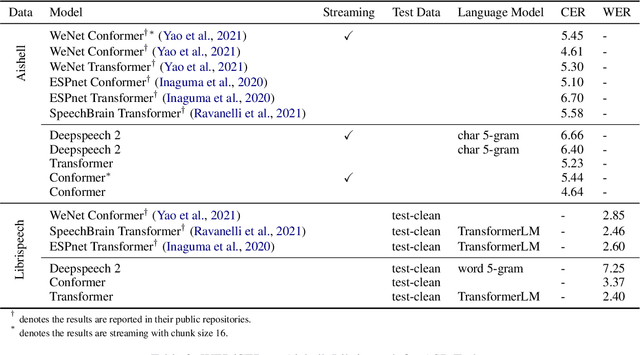
PaddleSpeech is an open-source all-in-one speech toolkit. It aims at facilitating the development and research of speech processing technologies by providing an easy-to-use command-line interface and a simple code structure. This paper describes the design philosophy and core architecture of PaddleSpeech to support several essential speech-to-text and text-to-speech tasks. PaddleSpeech achieves competitive or state-of-the-art performance on various speech datasets and implements the most popular methods. It also provides recipes and pretrained models to quickly reproduce the experimental results in this paper. PaddleSpeech is publicly avaiable at https://github.com/PaddlePaddle/PaddleSpeech.