 Add to Chrome
 Add to Firefox
 Add to Edge
Beyond Correctness: Benchmarking and Aligning Response Behaviors in Hybrid-Thinking MLLMs
Aug 13, 2026
Hybrid-thinking multimodal large language models (MLLMs) allow a single model to alternate between deliberative thinking and latency-efficient non-thinking inference. Although these modes differ in reasoning budget, their delivered responses should satisfy the same user-facing standard. Correctness alone may not characterize this response quality; we therefore evaluate task accuracy and response-pattern failures as complementary outcomes. We study this gap through \textbf{response-pattern alignment}: whether thinking and non-thinking interfaces preserve acceptable final-response behavior. We introduce \textbf{PatternEval}, a failure-enriched diagnostic benchmark comprising 2,415 multimodal prompts spanning visual perception and grounding, structured image understanding, and multimodal knowledge reasoning. PatternEval tests four recurrent failures: chain-of-thought leakage, response repetition, logical contradiction, and performative reasoning. Response-pattern failures are widespread across models from different providers, with non-thinking inference exhibiting substantially higher failure rates and thereby creating systematic misalignment between thinking and non-thinking interfaces. Motivated by this diagnosis, we develop \textbf{PatternRM}, a response-level reward model, and \textbf{PatternRL}, which introduces pattern-specific penalties during reinforcement learning. Experiments on Qwen3-VL-4B and Qwen3-VL-8B show that incorporating pattern-specific penalties into reinforcement learning can mitigate cross-mode misalignment while incurring a marginal task performance trade-off. Together, PatternEval and PatternRL provide an evaluation-and-training framework for aligning user-visible response patterns across hybrid-thinking interfaces.

ERNIE-Layout: Layout Knowledge Enhanced Pre-training for Visually-rich Document Understanding
Oct 14, 2022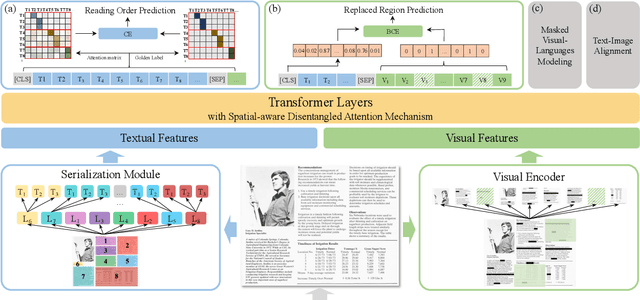
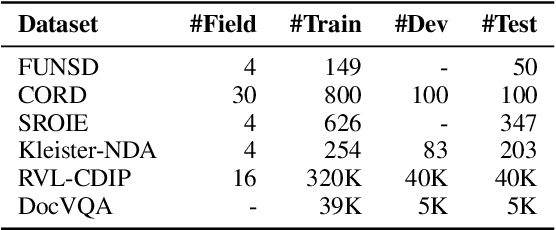
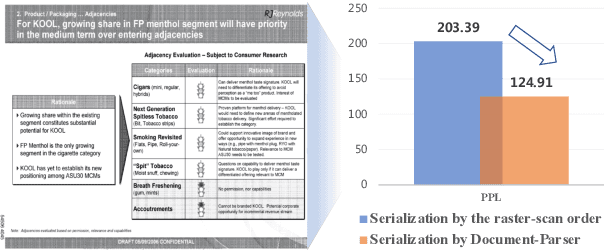
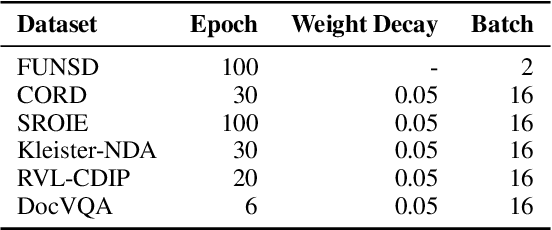
Recent years have witnessed the rise and success of pre-training techniques in visually-rich document understanding. However, most existing methods lack the systematic mining and utilization of layout-centered knowledge, leading to sub-optimal performances. In this paper, we propose ERNIE-Layout, a novel document pre-training solution with layout knowledge enhancement in the whole workflow, to learn better representations that combine the features from text, layout, and image. Specifically, we first rearrange input sequences in the serialization stage, and then present a correlative pre-training task, reading order prediction, to learn the proper reading order of documents. To improve the layout awareness of the model, we integrate a spatial-aware disentangled attention into the multi-modal transformer and a replaced regions prediction task into the pre-training phase. Experimental results show that ERNIE-Layout achieves superior performance on various downstream tasks, setting new state-of-the-art on key information extraction, document image classification, and document question answering datasets. The code and models are publicly available at http://github.com/PaddlePaddle/PaddleNLP/tree/develop/model_zoo/ernie-layout.
ERNIE-mmLayout: Multi-grained MultiModal Transformer for Document Understanding
Sep 18, 2022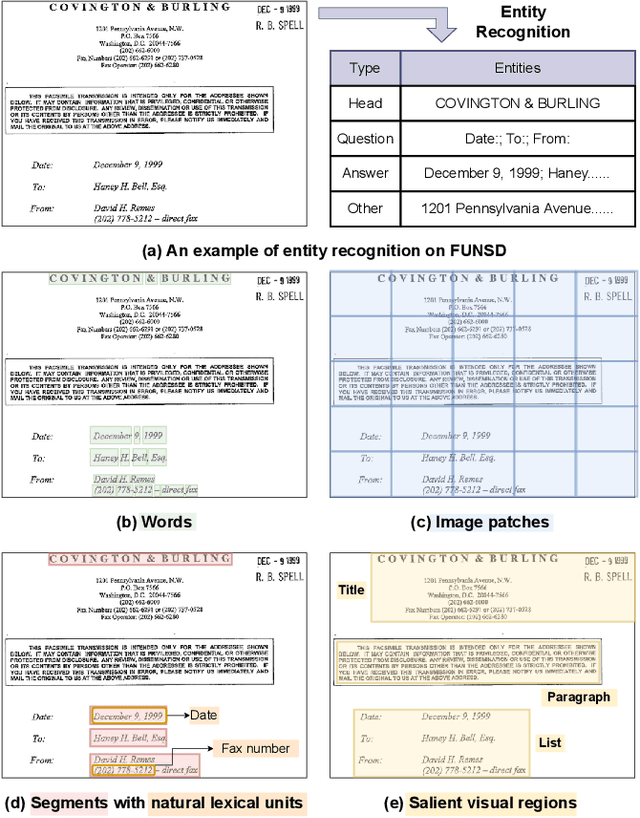
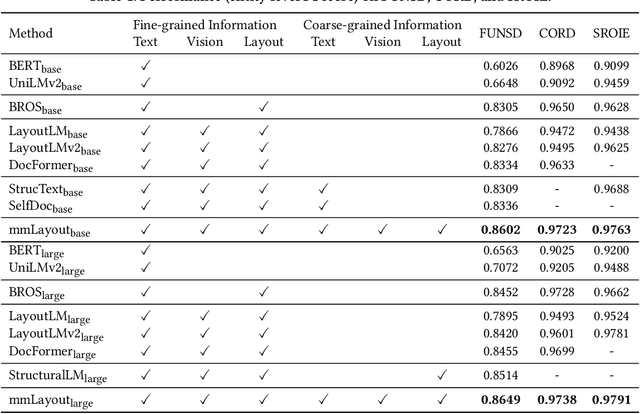
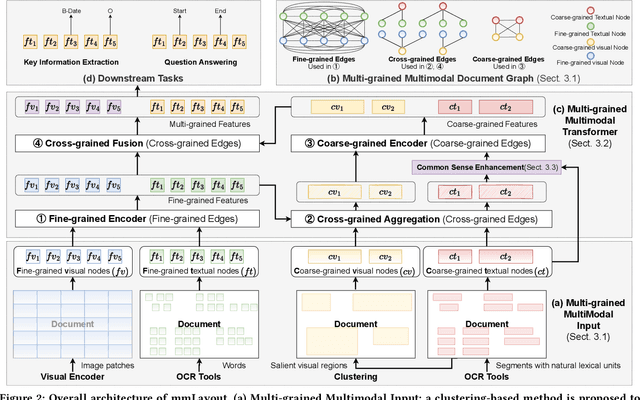
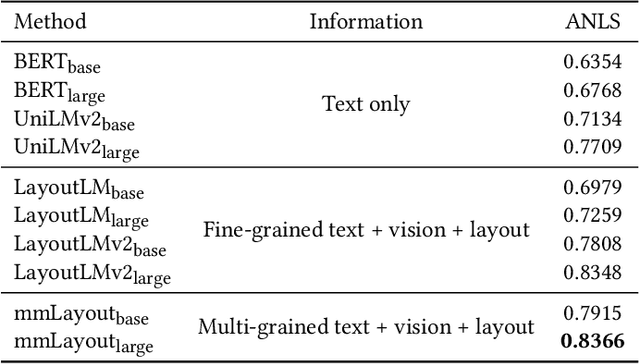
Recent efforts of multimodal Transformers have improved Visually Rich Document Understanding (VrDU) tasks via incorporating visual and textual information. However, existing approaches mainly focus on fine-grained elements such as words and document image patches, making it hard for them to learn from coarse-grained elements, including natural lexical units like phrases and salient visual regions like prominent image regions. In this paper, we attach more importance to coarse-grained elements containing high-density information and consistent semantics, which are valuable for document understanding. At first, a document graph is proposed to model complex relationships among multi-grained multimodal elements, in which salient visual regions are detected by a cluster-based method. Then, a multi-grained multimodal Transformer called mmLayout is proposed to incorporate coarse-grained information into existing pre-trained fine-grained multimodal Transformers based on the graph. In mmLayout, coarse-grained information is aggregated from fine-grained, and then, after further processing, is fused back into fine-grained for final prediction. Furthermore, common sense enhancement is introduced to exploit the semantic information of natural lexical units. Experimental results on four tasks, including information extraction and document question answering, show that our method can improve the performance of multimodal Transformers based on fine-grained elements and achieve better performance with fewer parameters. Qualitative analyses show that our method can capture consistent semantics in coarse-grained elements.