 Add to Chrome
 Add to Firefox
 Add to Edge
An Anatomy of Vision-Language-Action Models: From Modules to Milestones and Challenges
Dec 19, 2025
Vision-Language-Action (VLA) models are driving a revolution in robotics, enabling machines to understand instructions and interact with the physical world. This field is exploding with new models and datasets, making it both exciting and challenging to keep pace with. This survey offers a clear and structured guide to the VLA landscape. We design it to follow the natural learning path of a researcher: we start with the basic Modules of any VLA model, trace the history through key Milestones, and then dive deep into the core Challenges that define recent research frontier. Our main contribution is a detailed breakdown of the five biggest challenges in: (1) Representation, (2) Execution, (3) Generalization, (4) Safety, and (5) Dataset and Evaluation. This structure mirrors the developmental roadmap of a generalist agent: establishing the fundamental perception-action loop, scaling capabilities across diverse embodiments and environments, and finally ensuring trustworthy deployment-all supported by the essential data infrastructure. For each of them, we review existing approaches and highlight future opportunities. We position this paper as both a foundational guide for newcomers and a strategic roadmap for experienced researchers, with the dual aim of accelerating learning and inspiring new ideas in embodied intelligence. A live version of this survey, with continuous updates, is maintained on our \href{https://suyuz1.github.io/VLA-Survey-Anatomy/}{project page}.

Simultaneous Classical and Quantum Communications: Recent Progress and Three Challenges
Dec 11, 2025A critical aspect of next-generation wireless networks is the integration of quantum communications to guard against quantum computing threats to classical networks. Despite successful experimental demonstrations, integrating quantum communications into the classical infrastructure faces substantial challenges, including high costs, compatibility issues, and extra hardware deployment to accommodate both classical and quantum communication equipment. To mitigate these challenges, we explore novel protocols that enable simultaneous classical and quantum communications, relying on a single set of transceivers to jointly modulate and decode classical and quantum information onto the same signal. Additionally, we emphasize extending quantum communication capabilities beyond traditional optical bands into the terahertz, even possibly to millimeter-wave and microwave frequencies, thereby broadening the potential horizon of quantum-secure applications. Finally, we identify open problems that must be addressed to facilitate practical implementation.
Chemistry-Enhanced Diffusion-Based Framework for Small-to-Large Molecular Conformation Generation
Nov 15, 2025Obtaining 3D conformations of realistic polyatomic molecules at the quantum chemistry level remains challenging, and although recent machine learning advances offer promise, predicting large-molecule structures still requires substantial computational effort. Here, we introduce StoL, a diffusion model-based framework that enables rapid and knowledge-free generation of large molecular structures from small-molecule data. Remarkably, StoL assembles molecules in a LEGO-style fashion from scratch, without seeing the target molecules or any structures of comparable size during training. Given a SMILES input, it decomposes the molecule into chemically valid fragments, generates their 3D structures with a diffusion model trained on small molecules, and assembles them into diverse conformations. This fragment-based strategy eliminates the need for large-molecule training data while maintaining high scalability and transferability. By embedding chemical principles into key steps, StoL ensures faster convergence, chemically rational structures, and broad configurational coverage, as confirmed against DFT calculations.
Binary Split Categorical feature with Mean Absolute Error Criteria in CART
Nov 11, 2025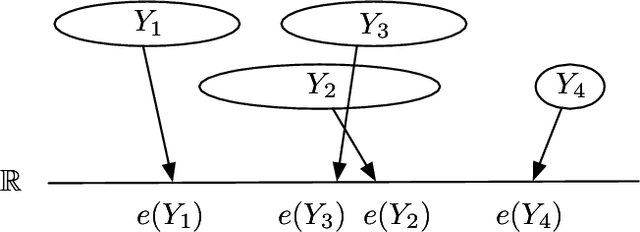
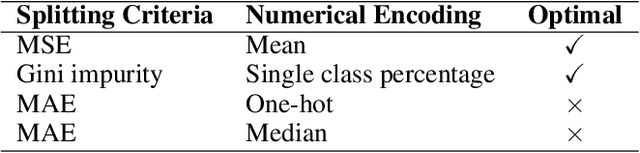
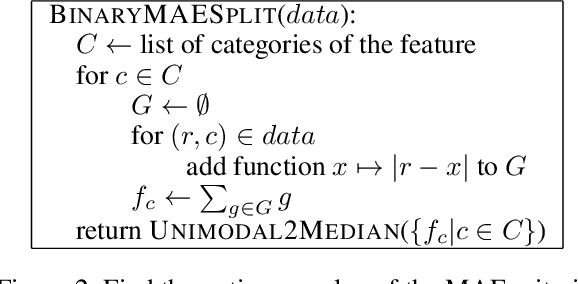
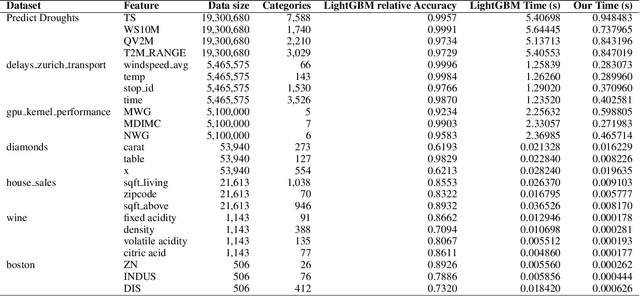
In the context of the Classification and Regression Trees (CART) algorithm, the efficient splitting of categorical features using standard criteria like GINI and Entropy is well-established. However, using the Mean Absolute Error (MAE) criterion for categorical features has traditionally relied on various numerical encoding methods. This paper demonstrates that unsupervised numerical encoding methods are not viable for the MAE criteria. Furthermore, we present a novel and efficient splitting algorithm that addresses the challenges of handling categorical features with the MAE criterion. Our findings underscore the limitations of existing approaches and offer a promising solution to enhance the handling of categorical data in CART algorithms.
Language Model Based Text-to-Audio Generation: Anti-Causally Aligned Collaborative Residual Transformers
Oct 06, 2025While language models (LMs) paired with residual vector quantization (RVQ) tokenizers have shown promise in text-to-audio (T2A) generation, they still lag behind diffusion-based models by a non-trivial margin. We identify a critical dilemma underpinning this gap: incorporating more RVQ layers improves audio reconstruction fidelity but exceeds the generation capacity of conventional LMs. To address this, we first analyze RVQ dynamics and uncover two key limitations: 1) orthogonality of features across RVQ layers hinders effective LMs training, and 2) descending semantic richness in tokens from deeper RVQ layers exacerbates exposure bias during autoregressive decoding. Based on these insights, we propose Siren, a novel LM-based framework that employs multiple isolated transformers with causal conditioning and anti-causal alignment via reinforcement learning. Extensive experiments demonstrate that Siren outperforms both existing LM-based and diffusion-based T2A systems, achieving state-of-the-art results. By bridging the representational strengths of LMs with the fidelity demands of audio synthesis, our approach repositions LMs as competitive contenders against diffusion models in T2A tasks. Moreover, by aligning audio representations with linguistic structures, Siren facilitates a promising pathway toward unified multi-modal generation frameworks.
MinerU2.5: A Decoupled Vision-Language Model for Efficient High-Resolution Document Parsing
Sep 26, 2025We introduce MinerU2.5, a 1.2B-parameter document parsing vision-language model that achieves state-of-the-art recognition accuracy while maintaining exceptional computational efficiency. Our approach employs a coarse-to-fine, two-stage parsing strategy that decouples global layout analysis from local content recognition. In the first stage, the model performs efficient layout analysis on downsampled images to identify structural elements, circumventing the computational overhead of processing high-resolution inputs. In the second stage, guided by the global layout, it performs targeted content recognition on native-resolution crops extracted from the original image, preserving fine-grained details in dense text, complex formulas, and tables. To support this strategy, we developed a comprehensive data engine that generates diverse, large-scale training corpora for both pretraining and fine-tuning. Ultimately, MinerU2.5 demonstrates strong document parsing ability, achieving state-of-the-art performance on multiple benchmarks, surpassing both general-purpose and domain-specific models across various recognition tasks, while maintaining significantly lower computational overhead.
AniME: Adaptive Multi-Agent Planning for Long Animation Generation
Aug 27, 2025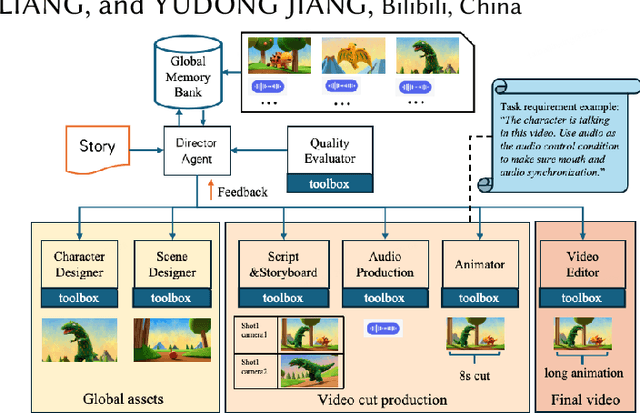
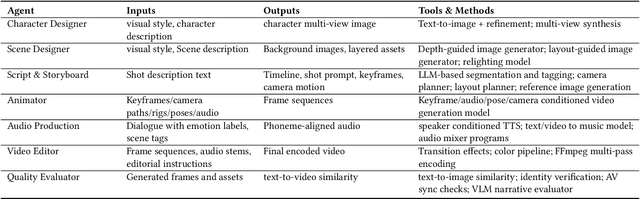
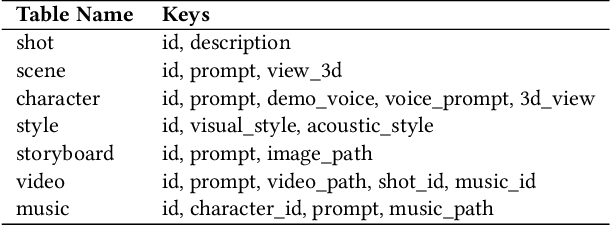
We present AniME, a director-oriented multi-agent system for automated long-form anime production, covering the full workflow from a story to the final video. The director agent keeps a global memory for the whole workflow, and coordinates several downstream specialized agents. By integrating customized Model Context Protocol (MCP) with downstream model instruction, the specialized agent adaptively selects control conditions for diverse sub-tasks. AniME produces cinematic animation with consistent characters and synchronized audio visual elements, offering a scalable solution for AI-driven anime creation.
TAR-TVG: Enhancing VLMs with Timestamp Anchor-Constrained Reasoning for Temporal Video Grounding
Aug 11, 2025Temporal Video Grounding (TVG) aims to precisely localize video segments corresponding to natural language queries, which is a critical capability for long-form video understanding. Although existing reinforcement learning approaches encourage models to generate reasoning chains before predictions, they fail to explicitly constrain the reasoning process to ensure the quality of the final temporal predictions. To address this limitation, we propose Timestamp Anchor-constrained Reasoning for Temporal Video Grounding (TAR-TVG), a novel framework that introduces timestamp anchors within the reasoning process to enforce explicit supervision to the thought content. These anchors serve as intermediate verification points. More importantly, we require each reasoning step to produce increasingly accurate temporal estimations, thereby ensuring that the reasoning process contributes meaningfully to the final prediction. To address the challenge of low-probability anchor generation in models (e.g., Qwen2.5-VL-3B), we develop an efficient self-distillation training strategy: (1) initial GRPO training to collect 30K high-quality reasoning traces containing multiple timestamp anchors, (2) supervised fine-tuning (SFT) on distilled data, and (3) final GRPO optimization on the SFT-enhanced model. This three-stage training strategy enables robust anchor generation while maintaining reasoning quality. Experiments show that our model achieves state-of-the-art performance while producing interpretable, verifiable reasoning chains with progressively refined temporal estimations.
BokehDiff: Neural Lens Blur with One-Step Diffusion
Jul 24, 2025We introduce BokehDiff, a novel lens blur rendering method that achieves physically accurate and visually appealing outcomes, with the help of generative diffusion prior. Previous methods are bounded by the accuracy of depth estimation, generating artifacts in depth discontinuities. Our method employs a physics-inspired self-attention module that aligns with the image formation process, incorporating depth-dependent circle of confusion constraint and self-occlusion effects. We adapt the diffusion model to the one-step inference scheme without introducing additional noise, and achieve results of high quality and fidelity. To address the lack of scalable paired data, we propose to synthesize photorealistic foregrounds with transparency with diffusion models, balancing authenticity and scene diversity.
Ground-Effect-Aware Modeling and Control for Multicopters
Jun 24, 2025The ground effect on multicopters introduces several challenges, such as control errors caused by additional lift, oscillations that may occur during near-ground flight due to external torques, and the influence of ground airflow on models such as the rotor drag and the mixing matrix. This article collects and analyzes the dynamics data of near-ground multicopter flight through various methods, including force measurement platforms and real-world flights. For the first time, we summarize the mathematical model of the external torque of multicopters under ground effect. The influence of ground airflow on rotor drag and the mixing matrix is also verified through adequate experimentation and analysis. Through simplification and derivation, the differential flatness of the multicopter's dynamic model under ground effect is confirmed. To mitigate the influence of these disturbance models on control, we propose a control method that combines dynamic inverse and disturbance models, ensuring consistent control effectiveness at both high and low altitudes. In this method, the additional thrust and variations in rotor drag under ground effect are both considered and compensated through feedforward models. The leveling torque of ground effect can be equivalently represented as variations in the center of gravity and the moment of inertia. In this way, the leveling torque does not explicitly appear in the dynamic model. The final experimental results show that the method proposed in this paper reduces the control error (RMSE) by \textbf{45.3\%}. Please check the supplementary material at: https://github.com/ZJU-FAST-Lab/Ground-effect-controller.