 Add to Chrome
 Add to Firefox
 Add to Edge
Simultaneous Classical and Quantum Communications: Recent Progress and Three Challenges
Dec 11, 2025
A critical aspect of next-generation wireless networks is the integration of quantum communications to guard against quantum computing threats to classical networks. Despite successful experimental demonstrations, integrating quantum communications into the classical infrastructure faces substantial challenges, including high costs, compatibility issues, and extra hardware deployment to accommodate both classical and quantum communication equipment. To mitigate these challenges, we explore novel protocols that enable simultaneous classical and quantum communications, relying on a single set of transceivers to jointly modulate and decode classical and quantum information onto the same signal. Additionally, we emphasize extending quantum communication capabilities beyond traditional optical bands into the terahertz, even possibly to millimeter-wave and microwave frequencies, thereby broadening the potential horizon of quantum-secure applications. Finally, we identify open problems that must be addressed to facilitate practical implementation.

Quantum Internet in the Sky: Vision, Challenges, Solutions, and Future Directions
Dec 11, 2025This article envisions the concept of a ``Quantum Internet in the Sky", aiming to establish ubiquitous quantum communication links among distant nodes via free-space optical channels. Our key focus is on deploying quantum communication terminals on non-terrestrial platforms, specifically unmanned aerial vehicles and satellites, at various altitudes. By highlighting the unique characteristics of these platforms compared to terrestrial counterparts, we address inherent challenges and discuss potential solutions through meticulous system designs and analyses of typical non-terrestrial quantum communication scenarios. Finally, we illuminate the path forward by proposing essential future directions that underscore the integration of high-dimensional multipartite quantum communications with sensing, computing, and intelligence for multiple users en route to realizing a fully operational Quantum Internet.
* 7 pages, 4 figures, 1 table
Optical RISs Improve the Secret Key Rate of Free-Space QKD in HAP-to-UAV Scenarios
Aug 12, 2024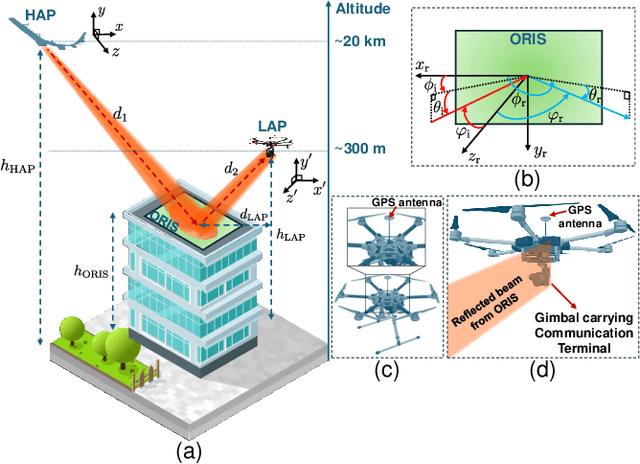
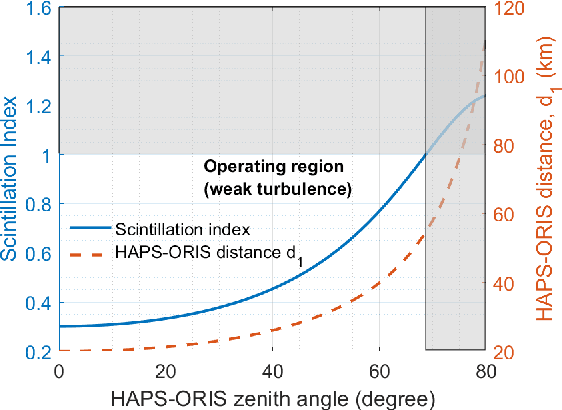
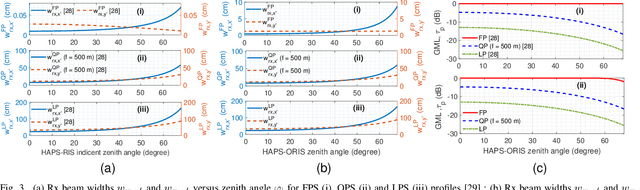
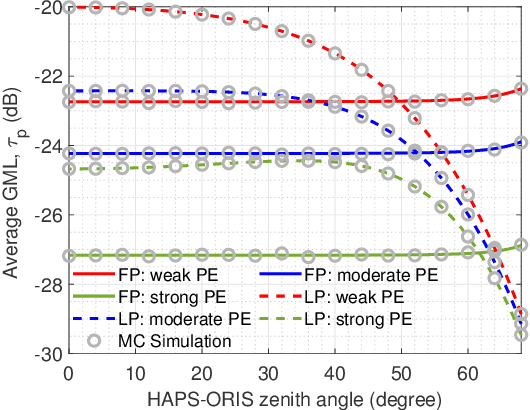
Large optical reconfigurable intelligent surfaces (ORISs) are proposed for employment on building rooftops to facilitate free-space quantum key distribution (QKD) between high-altitude platforms (HAPs) and low-altitude platforms (LAPs). Due to practical constraints, the communication terminals can only be positioned beneath the LAPs, preventing direct upward links to HAPs. By deploying ORISs on rooftops to reflect the beam arriving from HAPs towards LAPs from below, reliable HAP-to-LAP links can be established. To accurately characterize the optical beam propagation, we develop an analytical channel model based on extended Huygens-Fresnel principles for representing both the atmospheric turbulence effects and the hovering fluctuations of LAPs. This model facilitates adaptive ORIS beam-width control through linear, quadratic, and focusing phase shifts, which are capable of effectively mitigating the detrimental effects of beam broadening and pointing errors (PE). Furthermore, we derive a closed-form expression for the information-theoretic bound of the QKD secret key rate (SKR) of the HAP-to-LAP links. Our findings demonstrate that quadratic phase shifts enhance the SKR at high HAP-ORIS zenith angles or mild PE conditions by narrowing the beam to optimal sizes. By contrast, linear phase shifts are advantageous at low HAP-ORIS zenith angles under moderate-to-high PE by diverging the beam to mitigate LAP fluctuations.
Development of a miniaturized laser-communication terminal for small satellites
Nov 11, 2021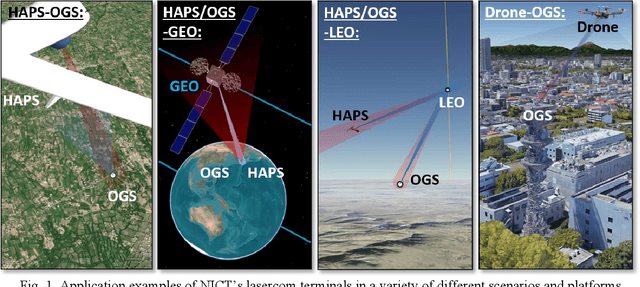
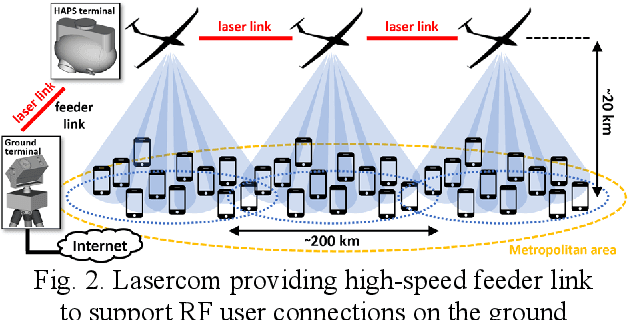
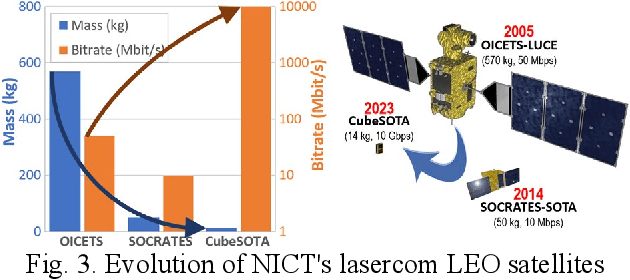
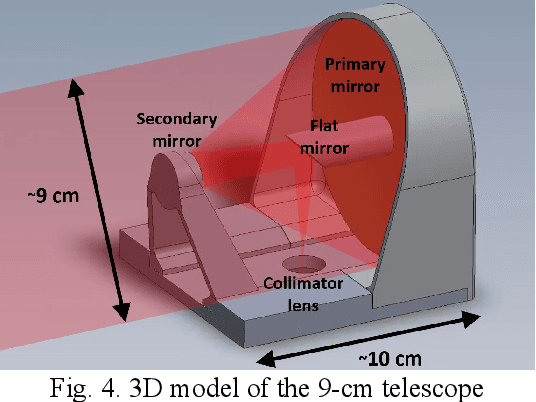
Free-space optical communication is becoming a mature technology that has been demonstrated in space a number of times in the last few years. The Japanese National Institute of Information and Communications Technology (NICT) has carried out some of the most-significant in-orbit demonstrations over the last three decades. However, this technology has not reached a wide commercial adoption yet. For this reason, NICT is currently working towards the development of a miniaturized laser-communication terminal that can be installed in very-small satellites, while also compatible with a variety of other different platforms, meeting a wide span of bandwidth requirements. The strategy adopted in this design has been to create a versatile lasercom terminal that can operate in multiple scenarios and platforms without the need of extensive customization. This manuscript describes the current efforts in NICT towards the development of this terminal, and it shows the prototype that has been already developed for the preliminary tests, which are described as well. These tests will include the performance verification using drones first with the goal of installing the prototype on High-Altitude Platform Systems (HAPS) to carry out communication links between HAPS and ground, and later with the Geostationary (GEO) orbit, covering this way a wide range of operating conditions. For these tests, in the former case the counter terminal is a simple transmitter in the case of the drone, and a transportable ground station in the case of the HAPS; and in the latter case the counter terminal is the GEO satellite ETS-IX, foreseen to be launched by NICT in 2023.
* 5 pages, 9 figures