 Add to Chrome
 Add to Firefox
 Add to Edge
D-VLC: Decentralized Vision-Language Collaboration for Heterogeneous Embodied Multi-Robot Systems in Unknown Environments
Aug 03, 2026
Multi-robot systems, particularly heterogeneous robot swarms, can improve the efficiency of complex task execution through parallel collaboration and complementary capabilities. However, conventional rule-based methods rely on predefined task models and specialized decision making programs, making it difficult to understand complex semantic instructions and coordinate heterogeneous robots. LLMs introduce strong language understanding and task reasoning capabilities, allowing multi-robot systems to interpret instructions, decompose tasks, and assign roles according to task semantics. VLMs further incorporate visual perception, enabling robots to reason about objects, regions, and spatial relationships in physical environments. Nevertheless, existing LLM/VLM based methods often depend on known maps, centralized and synchronized decision making, limiting their generalization to heterogeneous robots and unseen tasks. We therefore propose a framework that combines decentralized asynchronous reasoning, lightweight information sharing, capability aware collaboration, and a unified action interface, enabling general purpose VLMs to generate robot specific actions executed by learning free experts without task or robot specific training. Experiments across diverse scenarios and multiple VLMs show success rates above 70\%, with completion time reduced by up to 55.8\% relative to the geometric greedy baseline.

Towards Precise Intent-Aligned VLA Aerial Navigation via Expert-Guided GRPO
Jun 01, 2026Vision-Language-Action (VLA) models offer a promising end-to-end paradigm for unmanned aerial vehicles (UAVs) to accomplish complex tasks specified by fine-grained instructions. However, standard supervised fine-tuning (SFT) suffers from data scarcity, limited generalization, and weak supervision for nuanced and complicated human intents. Reinforcement fine-tuning offers a natural way to mitigate these challenges and align policy behaviors with human intents through designable feedback, but applying it to aerial navigation remains challenging due to inefficient exploration in expansive continuous spaces. To address these challenges, we introduce an efficient reinforcement learning (RL) framework for VLA-based aerial navigation. At its core, we propose EG-GRPO (Expert-Guided Group Relative Policy Optimization) to augment online rollouts with few-shot expert data. Additionally, we design a heterogeneous pipeline enabling parallel simulation and inference, which reduces rollout time by 43.5%. Across multiple tasks specified by complex human intents, EG-GRPO improves the success rate to 2.13x that of the SFT baseline, while improving intent alignment performance by 60.9%. These results demonstrate that our framework can move aerial navigation toward precise intent-aligned flight.
Can MLLMs Reason Beyond Language? VisReason: A Comprehensive Benchmark for Vision-Centric Reasoning
May 25, 2026Recent multimodal large language models (MLLMs) achieve strong performance on visual reasoning benchmarks, yet it remains unclear to what extent such performance reflects reasoning directly grounded in visual evidence. We introduce VisReason, a benchmark for vision-centric reasoning in everyday scenarios where perception and inference are tightly coupled. VisReason contains 1,505 questions across 10 categories spanning perceptual, structural, and conceptual reasoning. Our evaluation shows that VisReason poses a qualitatively different challenge from existing benchmarks, exposing substantial gaps between humans and current MLLMs and revealing limited benefits from test-time reasoning strategies. VisReason offers a focused diagnostic for evaluating vision-centric reasoning beyond language.
FlyMirage: A Fully Automated Generation Pipeline for Diverse and Scalable UAV Flight Data via Generative World Model
May 19, 2026In the field of Vision-Language Navigation (VLN), aerial datasets remain limited in their ability to combine scale, diversity, and realism, often relying on either costly real-world scenes or visually limited simulations. To address these challenges, we introduce FlyMirage, a highly scalable and fully automated data generation pipeline for aerial VLN. Our approach leverages large language models (LLM) as an environment designer to promote scene diversity, paired with a generative world model that instantiates these designs into high-fidelity 3D Gaussian Splatting (3DGS) scenes. To substantially reduce human labor and ensure the feasibility of flight data, FlyMirage automates scene exploration and semantic information acquisition, and further integrates a dynamically feasible planner for uncrewed aerial vehicle (UAV) trajectory generation. Utilizing this toolchain, we generate a large-scale, diverse, and photorealistic aerial VLN dataset, with dynamically feasible flying trajectories, designed to support the development of next-generation embodied navigation models.
Precise Aggressive Aerial Maneuvers with Sensorimotor Policies
Apr 07, 2026Precise aggressive maneuvers with lightweight onboard sensors remains a key bottleneck in fully exploiting the maneuverability of drones. Such maneuvers are critical for expanding the systems' accessible area by navigating through narrow openings in the environment. Among the most relevant problems, a representative one is aggressive traversal through narrow gaps with quadrotors under SE(3) constraints, which require the quadrotors to leverage a momentary tilted attitude and the asymmetry of the airframe to navigate through gaps. In this paper, we achieve such maneuvers by developing sensorimotor policies directly mapping onboard vision and proprioception into low-level control commands. The policies are trained using reinforcement learning (RL) with end-to-end policy distillation in simulation. We mitigate the fundamental hardness of model-free RL's exploration on the restricted solution space with an initialization strategy leveraging trajectories generated by a model-based planner. Careful sim-to-real design allows the policy to control a quadrotor through narrow gaps with low clearances and high repeatability. For instance, the proposed method enables a quadrotor to navigate a rectangular gap at a 5 cm clearance, tilted at up to 90-degree orientation, without knowledge of the gap's position or orientation. Without training on dynamic gaps, the policy can reactively servo the quadrotor to traverse through a moving gap. The proposed method is also validated by training and deploying policies on challenging tracks of narrow gaps placed closely. The flexibility of the policy learning method is demonstrated by developing policies for geometrically diverse gaps, without relying on manually defined traversal poses and visual features.
NavDreamer: Video Models as Zero-Shot 3D Navigators
Feb 10, 2026Previous Vision-Language-Action models face critical limitations in navigation: scarce, diverse data from labor-intensive collection and static representations that fail to capture temporal dynamics and physical laws. We propose NavDreamer, a video-based framework for 3D navigation that leverages generative video models as a universal interface between language instructions and navigation trajectories. Our main hypothesis is that video's ability to encode spatiotemporal information and physical dynamics, combined with internet-scale availability, enables strong zero-shot generalization in navigation. To mitigate the stochasticity of generative predictions, we introduce a sampling-based optimization method that utilizes a VLM for trajectory scoring and selection. An inverse dynamics model is employed to decode executable waypoints from generated video plans for navigation. To systematically evaluate this paradigm in several video model backbones, we introduce a comprehensive benchmark covering object navigation, precise navigation, spatial grounding, language control, and scene reasoning. Extensive experiments demonstrate robust generalization across novel objects and unseen environments, with ablation studies revealing that navigation's high-level decision-making nature makes it particularly suited for video-based planning.
A Precise Real-Time Force-Aware Grasping System for Robust Aerial Manipulation
Feb 09, 2026Aerial manipulation requires force-aware capabilities to enable safe and effective grasping and physical interaction. Previous works often rely on heavy, expensive force sensors unsuitable for typical quadrotor platforms, or perform grasping without force feedback, risking damage to fragile objects. To address these limitations, we propose a novel force-aware grasping framework incorporating six low-cost, sensitive skin-like tactile sensors. We introduce a magnetic-based tactile sensing module that provides high-precision three-dimensional force measurements. We eliminate geomagnetic interference through a reference Hall sensor and simplify the calibration process compared to previous work. The proposed framework enables precise force-aware grasping control, allowing safe manipulation of fragile objects and real-time weight measurement of grasped items. The system is validated through comprehensive real-world experiments, including balloon grasping, dynamic load variation tests, and ablation studies, demonstrating its effectiveness in various aerial manipulation scenarios. Our approach achieves fully onboard operation without external motion capture systems, significantly enhancing the practicality of force-sensitive aerial manipulation. The supplementary video is available at: https://www.youtube.com/watch?v=mbcZkrJEf1I.
USS-Nav: Unified Spatio-Semantic Scene Graph for Lightweight UAV Zero-Shot Object Navigation
Feb 03, 2026Zero-Shot Object Navigation in unknown environments poses significant challenges for Unmanned Aerial Vehicles (UAVs) due to the conflict between high-level semantic reasoning requirements and limited onboard computational resources. To address this, we present USS-Nav, a lightweight framework that incrementally constructs a Unified Spatio-Semantic scene graph and enables efficient Large Language Model (LLM)-augmented Zero-Shot Object Navigation in unknown environments. Specifically, we introduce an incremental Spatial Connectivity Graph generation method utilizing polyhedral expansion to capture global geometric topology, which is dynamically partitioned into semantic regions via graph clustering. Concurrently, open-vocabulary object semantics are instantiated and anchored to this topology to form a hierarchical environmental representation. Leveraging this hierarchical structure, we present a coarse-to-fine exploration strategy: LLM grounded in the scene graph's semantics to determine global target regions, while a local planner optimizes frontier coverage based on information gain. Experimental results demonstrate that our framework outperforms state-of-the-art methods in terms of computational efficiency and real-time update frequency (15 Hz) on a resource-constrained platform. Furthermore, ablation studies confirm the effectiveness of our framework, showing substantial improvements in Success weighted by Path Length (SPL). The source code will be made publicly available to foster further research.
VLA-AN: An Efficient and Onboard Vision-Language-Action Framework for Aerial Navigation in Complex Environments
Dec 19, 2025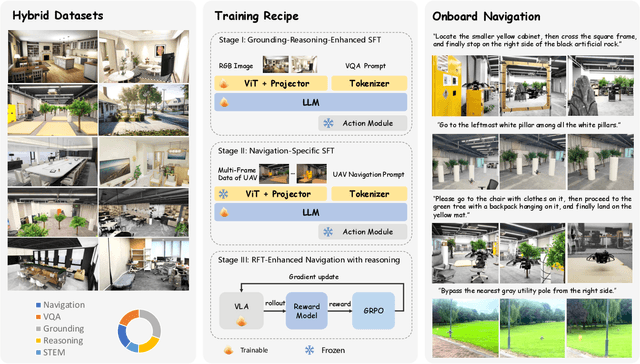
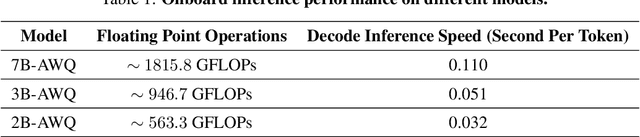
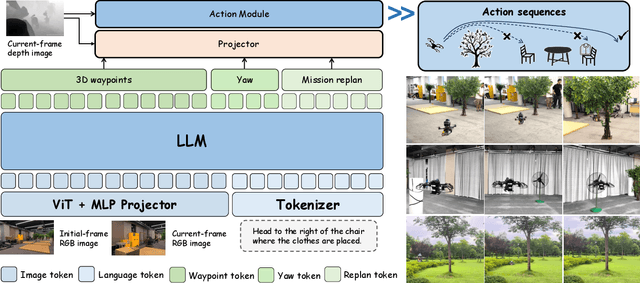
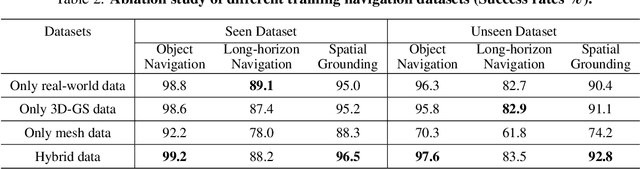
This paper proposes VLA-AN, an efficient and onboard Vision-Language-Action (VLA) framework dedicated to autonomous drone navigation in complex environments. VLA-AN addresses four major limitations of existing large aerial navigation models: the data domain gap, insufficient temporal navigation with reasoning, safety issues with generative action policies, and onboard deployment constraints. First, we construct a high-fidelity dataset utilizing 3D Gaussian Splatting (3D-GS) to effectively bridge the domain gap. Second, we introduce a progressive three-stage training framework that sequentially reinforces scene comprehension, core flight skills, and complex navigation capabilities. Third, we design a lightweight, real-time action module coupled with geometric safety correction. This module ensures fast, collision-free, and stable command generation, mitigating the safety risks inherent in stochastic generative policies. Finally, through deep optimization of the onboard deployment pipeline, VLA-AN achieves a robust real-time 8.3x improvement in inference throughput on resource-constrained UAVs. Extensive experiments demonstrate that VLA-AN significantly improves spatial grounding, scene reasoning, and long-horizon navigation, achieving a maximum single-task success rate of 98.1%, and providing an efficient, practical solution for realizing full-chain closed-loop autonomy in lightweight aerial robots.
Ground-Effect-Aware Modeling and Control for Multicopters
Jun 24, 2025The ground effect on multicopters introduces several challenges, such as control errors caused by additional lift, oscillations that may occur during near-ground flight due to external torques, and the influence of ground airflow on models such as the rotor drag and the mixing matrix. This article collects and analyzes the dynamics data of near-ground multicopter flight through various methods, including force measurement platforms and real-world flights. For the first time, we summarize the mathematical model of the external torque of multicopters under ground effect. The influence of ground airflow on rotor drag and the mixing matrix is also verified through adequate experimentation and analysis. Through simplification and derivation, the differential flatness of the multicopter's dynamic model under ground effect is confirmed. To mitigate the influence of these disturbance models on control, we propose a control method that combines dynamic inverse and disturbance models, ensuring consistent control effectiveness at both high and low altitudes. In this method, the additional thrust and variations in rotor drag under ground effect are both considered and compensated through feedforward models. The leveling torque of ground effect can be equivalently represented as variations in the center of gravity and the moment of inertia. In this way, the leveling torque does not explicitly appear in the dynamic model. The final experimental results show that the method proposed in this paper reduces the control error (RMSE) by \textbf{45.3\%}. Please check the supplementary material at: https://github.com/ZJU-FAST-Lab/Ground-effect-controller.