 Add to Chrome
 Add to Firefox
 Add to Edge
Reduced-Overhead Channel Estimation and Iterative Detection of FTN Signaling Based on Pilot Superimposition and Spectral Interference Alignment
Mar 20, 2026
This paper proposes low-overhead and low-complexity channel estimation (CE) of frequency-domain equalization aided faster-than-Nyquist (FTN) signaling. In the proposed CE scheme, the concept of pilot superimposition is employed, where the FTN block is designed to superimpose pilot symbols with information symbols, and thus, no dedicated time and frequency resources nor guard bands are required, resulting in a 50% reduction of the overhead. Furthermore, interference induced by the pilot superimposition is eliminated by invoking a novel scheme, referred to as spectral interference alignment, where a data-dependent sequence is subtracted from transmitted information symbols. The theoretical mean-square error (MSE) of the proposed CE is derived, which verifies that the MSE is no longer affected by interference due to the pilot superimposition.

Exploiting Skyrmions in Free-Space Optical Communication
Mar 12, 2026In this paper, we propose a novel free-space optical (FSO) communication system utilizing optical skyrmions. We introduce a scheme referred to as skyrmion number modulation (SkM), which employs index modulation by encoding information onto the skyrmion number, a topological invariant preserved during free-space propagation. This topological nature offers the potential for inherent robustness against atmospheric turbulence-induced wavefront distortions, which limit the performance of conventional FSO systems. More specifically, we demonstrate that the fluctuation of the received skyrmion number is mitigated by a proposed intensity-based masking technique. Finally, our performance analysis based on a discrete memoryless channel framework confirms that the proposed system exhibits near-ideal robustness under weak turbulence and supports high-order modulation in moderate regimes.
Delay-Doppler-Domain Channel Estimation and Reduced-Complexity Detection of Faster-than-Nyquist Signaling Aided OTFS
Jan 17, 2026We conceive a novel channel estimation and data detection scheme for OTFS-modulated faster-than-Nyquist (FTN) transmission over doubly selective fading channels, aiming for enhancing the spectral efficiency and Doppler resilience. The delay-Doppler (DD) domain's input-output relationship of OTFS-FTN signaling is derived by employing a root-raised cosine (RRC) shaping filter. More specifically, we design our DD-domain channel estimator for FTN-based pilot transmission, where the pilot symbol interval is lower than that defined by the classic Nyquist criterion. Moreover, we propose a reduced-complexity linear minimum mean square error equalizer, supporting noise whitening, where the FTN-induced inter-symbol interference (ISI) matrix is approximated by a sparse one. Our performance results demonstrate that the proposed OTFS-FTN scheme is capable of enhancing the achievable information rate, while attaining a comparable BER performance to both that of its Nyquist-based OTFS counterpart and to other FTN transmission schemes, which employ the same RRC shaping filter.
Simultaneous Classical and Quantum Communications: Recent Progress and Three Challenges
Dec 11, 2025A critical aspect of next-generation wireless networks is the integration of quantum communications to guard against quantum computing threats to classical networks. Despite successful experimental demonstrations, integrating quantum communications into the classical infrastructure faces substantial challenges, including high costs, compatibility issues, and extra hardware deployment to accommodate both classical and quantum communication equipment. To mitigate these challenges, we explore novel protocols that enable simultaneous classical and quantum communications, relying on a single set of transceivers to jointly modulate and decode classical and quantum information onto the same signal. Additionally, we emphasize extending quantum communication capabilities beyond traditional optical bands into the terahertz, even possibly to millimeter-wave and microwave frequencies, thereby broadening the potential horizon of quantum-secure applications. Finally, we identify open problems that must be addressed to facilitate practical implementation.
Quantum Internet in the Sky: Vision, Challenges, Solutions, and Future Directions
Dec 11, 2025This article envisions the concept of a ``Quantum Internet in the Sky", aiming to establish ubiquitous quantum communication links among distant nodes via free-space optical channels. Our key focus is on deploying quantum communication terminals on non-terrestrial platforms, specifically unmanned aerial vehicles and satellites, at various altitudes. By highlighting the unique characteristics of these platforms compared to terrestrial counterparts, we address inherent challenges and discuss potential solutions through meticulous system designs and analyses of typical non-terrestrial quantum communication scenarios. Finally, we illuminate the path forward by proposing essential future directions that underscore the integration of high-dimensional multipartite quantum communications with sensing, computing, and intelligence for multiple users en route to realizing a fully operational Quantum Internet.
* 7 pages, 4 figures, 1 table
Precoded faster-than-Nyquist signaling using optimal power allocation for OTFS
Nov 02, 2024


A precoded orthogonal time frequency space (OTFS) modulation scheme relying on faster-than-Nyquist (FTN) transmission over doubly selective fading channels is {proposed}, which enhances the spectral efficiency and improves the Doppler resilience. We derive the input-output relationship of the FTN signaling in the delay-Doppler domain. Eigenvalue decomposition (EVD) is used for eliminating both the effects of inter-symbol interference and correlated additive noise encountered in the delay-Doppler domain to enable efficient symbol-by-symbol demodulation. Furthermore, the power allocation coefficients of individual frames are optimized for maximizing the mutual information under the constraint of the derived total transmit power. Our performance results demonstrate that the proposed FTN-based OTFS scheme can enhance the information rate while achieving a comparable BER performance to that of its conventional Nyquist-based OTFS counterpart that employs the same root-raised-cosine shaping filter.
* 5 pages, 3 figures
Optical RISs Improve the Secret Key Rate of Free-Space QKD in HAP-to-UAV Scenarios
Aug 12, 2024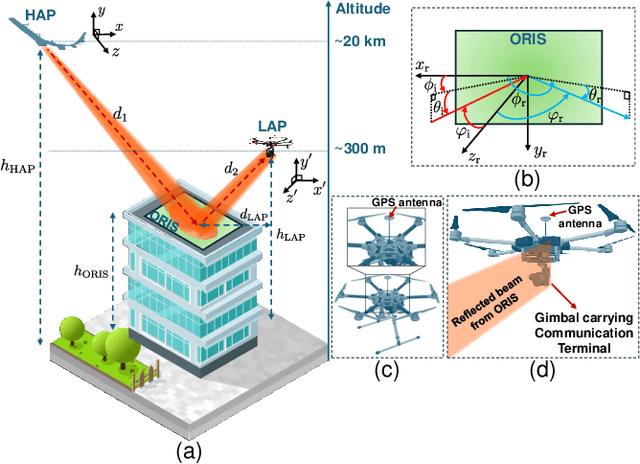
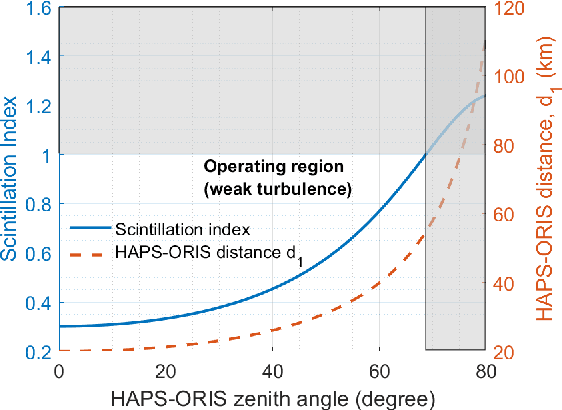
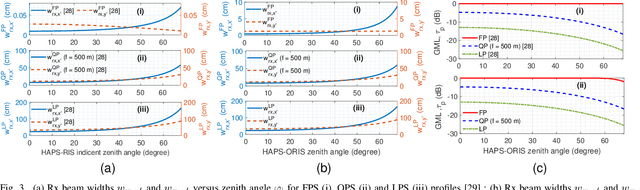
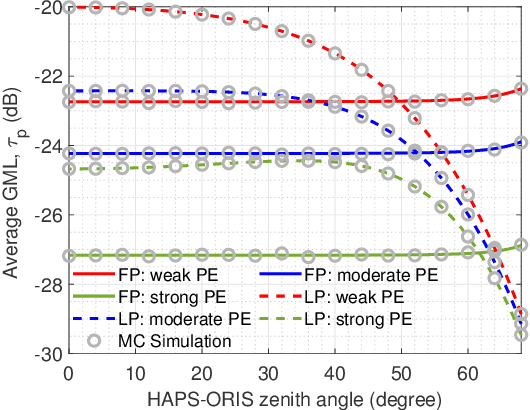
Large optical reconfigurable intelligent surfaces (ORISs) are proposed for employment on building rooftops to facilitate free-space quantum key distribution (QKD) between high-altitude platforms (HAPs) and low-altitude platforms (LAPs). Due to practical constraints, the communication terminals can only be positioned beneath the LAPs, preventing direct upward links to HAPs. By deploying ORISs on rooftops to reflect the beam arriving from HAPs towards LAPs from below, reliable HAP-to-LAP links can be established. To accurately characterize the optical beam propagation, we develop an analytical channel model based on extended Huygens-Fresnel principles for representing both the atmospheric turbulence effects and the hovering fluctuations of LAPs. This model facilitates adaptive ORIS beam-width control through linear, quadratic, and focusing phase shifts, which are capable of effectively mitigating the detrimental effects of beam broadening and pointing errors (PE). Furthermore, we derive a closed-form expression for the information-theoretic bound of the QKD secret key rate (SKR) of the HAP-to-LAP links. Our findings demonstrate that quadratic phase shifts enhance the SKR at high HAP-ORIS zenith angles or mild PE conditions by narrowing the beam to optimal sizes. By contrast, linear phase shifts are advantageous at low HAP-ORIS zenith angles under moderate-to-high PE by diverging the beam to mitigate LAP fluctuations.