 Add to Chrome
 Add to Firefox
 Add to Edge
Vorch-Omni: Multi-Task Orchestration of Sight and Sound
Aug 06, 2026
Recent advances in generative video modeling have enabled diverse generation, reference-based synthesis, extension, and editing, but existing approaches often rely on fragmented task-specific models. A general model must distinguish heterogeneous target, source, and reference signals to determine what to generate, preserve, or use as guidance, while reducing interference among tasks. Joint audio-visual generation further increases this challenge by introducing diverse conditioning and output configurations across modalities. We present Vorch-Omni, a unified multi-task framework for audio-visual synthesis based on an arbitrary-condition-to-arbitrary-output formulation. It flexibly treats video and audio signals as either conditioning inputs or generation targets. Token-level conditioning masks and task identifiers distinguish targets, source content, and references, while position types separate temporal context from independent conditions. To capture semantic and structural information, Vorch-Omni employs complementary visual conditioning pathways: a vision-language model interprets sampled frames with text instructions, and a video VAE encodes conditions into latent tokens for direct guidance. We further build a distributed data pipeline to curate diverse temporally aligned audio-visual clips, generate structured captions and metadata, and balance heterogeneous task distributions. Built on a single flow-matching diffusion transformer without task-specific architectural changes, Vorch-Omni supports over 10 tasks, including text-to-video, text-to-audio-video, image- and reference-conditioned generation, temporal extension, audio-driven generation, video transformation, and audio-visual editing. This unified framework provides a scalable foundation for general-purpose audio-visual generation and manipulation.

Vorch-Director: Interactive World Story Model via Noise-Aware Error Rectification
Aug 06, 2026Autoregressive continuation provides a natural path toward minute-scale audio-visual generation by repeatedly extending a short-window generator conditioned on previously generated video and audio. However, models are trained on clean ground-truth histories, while inference relies on their own generated histories, where accumulated errors cause identity drift, over-smoothing, and audio-visual desynchronization. Recent methods reduce this mismatch by reusing prediction residuals as synthetic corruption, but we observe that the effectiveness of residual correction critically depends on the flow-matching noise level at which residuals are produced. We propose Vorch-Director, a noise-level-aware residual correction strategy that associates each residual with its originating noise level and injects residuals from matched noise regimes during training. By aligning injected errors with the denoising process, Vorch-Director produces more realistic autoregressive histories while retaining efficient teacher-forcing training. Built on the audio-visual LTX-2 diffusion transformer, Vorch-Director further introduces task embeddings to distinguish historical video, reference images, and target video, enabling unified conditioning for long-horizon generation. Together with a clean conditioning sink and mixed-task training, Vorch-Director supports multi-shot, multi-subject, reference-guided audio-visual long-video generation. We evaluate Vorch-Director on ST-Bench and introduce a new long-horizon audio-visual benchmark with metrics for quality drift and long-range consistency. Extensive experiments demonstrate improved stability and audio-visual fidelity over strong baselines.
TIDE: Task-Isolated Diffusion for Unified Video Editing and Generation
Jun 06, 2026Recent advances in Diffusion Transformers have driven rapid progress in video generation and editing, yet these capabilities are still handled by separate, task-specific models. Building a unified framework that supports diverse video tasks remains an open challenge: existing unified attempts either require dedicated auxiliary encoders or lack explicit mechanisms to distinguish heterogeneous conditioning tokens, struggling when the number and type of visual conditions vary across tasks. We propose TIDE, a unified framework that integrates instruction-based editing, reference-guided editing, and multi-reference generation. At its core, we introduce per-token task embeddings that assign each input token a task-specific identifier, enabling the model to explicitly disambiguate target, source, and reference tokens. To simultaneously capture high-level semantic understanding and fine-grained structural fidelity, we design a dual-path conditioning scheme that couples a vision-language model with a VAE latent path for complementary signals. We further devise a multi-task progressive training strategy that incrementally introduces tasks of increasing complexity, effectively harmonizing diverse objectives and enabling smooth generalization across heterogeneous task distributions. Extensive experiments on multiple video editing and generation benchmarks demonstrate that TIDE achieves state-of-the-art performance across all evaluated tasks. Our project page is available at https://LittleWork123.github.io/tide.
AniME: Adaptive Multi-Agent Planning for Long Animation Generation
Aug 27, 2025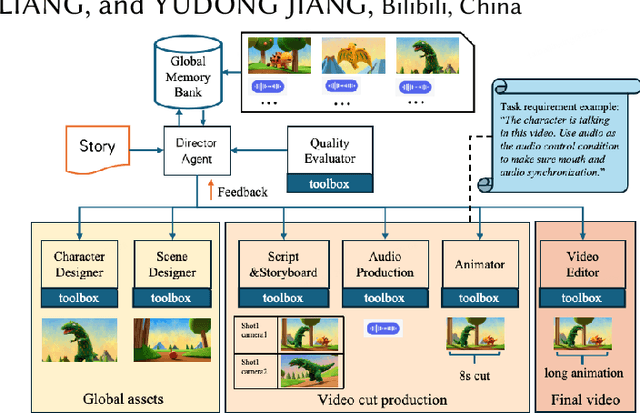
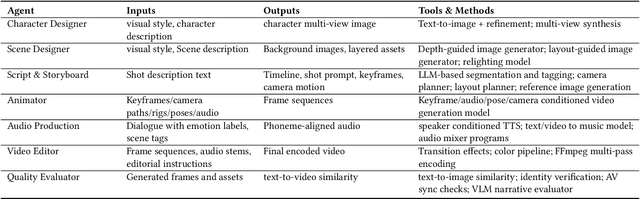
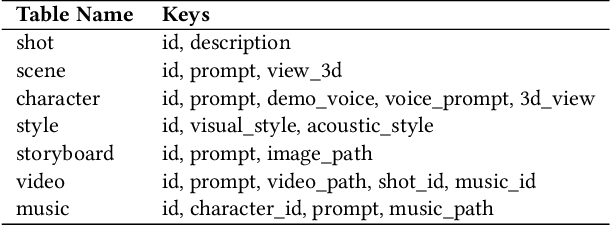
We present AniME, a director-oriented multi-agent system for automated long-form anime production, covering the full workflow from a story to the final video. The director agent keeps a global memory for the whole workflow, and coordinates several downstream specialized agents. By integrating customized Model Context Protocol (MCP) with downstream model instruction, the specialized agent adaptively selects control conditions for diverse sub-tasks. AniME produces cinematic animation with consistent characters and synchronized audio visual elements, offering a scalable solution for AI-driven anime creation.
AsyncDSB: Schedule-Asynchronous Diffusion Schrödinger Bridge for Image Inpainting
Dec 11, 2024

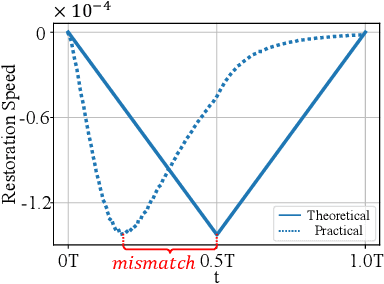
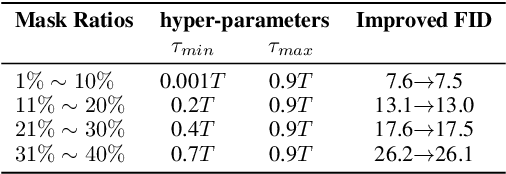
Image inpainting is an important image generation task, which aims to restore corrupted image from partial visible area. Recently, diffusion Schr\"odinger bridge methods effectively tackle this task by modeling the translation between corrupted and target images as a diffusion Schr\"odinger bridge process along a noising schedule path. Although these methods have shown superior performance, in this paper, we find that 1) existing methods suffer from a schedule-restoration mismatching issue, i.e., the theoretical schedule and practical restoration processes usually exist a large discrepancy, which theoretically results in the schedule not fully leveraged for restoring images; and 2) the key reason causing such issue is that the restoration process of all pixels are actually asynchronous but existing methods set a synchronous noise schedule to them, i.e., all pixels shares the same noise schedule. To this end, we propose a schedule-Asynchronous Diffusion Schr\"odinger Bridge (AsyncDSB) for image inpainting. Our insight is preferentially scheduling pixels with high frequency (i.e., large gradients) and then low frequency (i.e., small gradients). Based on this insight, given a corrupted image, we first train a network to predict its gradient map in corrupted area. Then, we regard the predicted image gradient as prior and design a simple yet effective pixel-asynchronous noise schedule strategy to enhance the diffusion Schr\"odinger bridge. Thanks to the asynchronous schedule at pixels, the temporal interdependence of restoration process between pixels can be fully characterized for high-quality image inpainting. Experiments on real-world datasets show that our AsyncDSB achieves superior performance, especially on FID with around 3% - 14% improvement over state-of-the-art baseline methods.
FashionSAP: Symbols and Attributes Prompt for Fine-grained Fashion Vision-Language Pre-training
Apr 11, 2023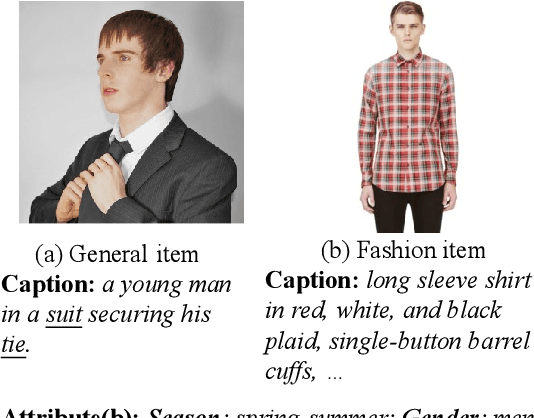
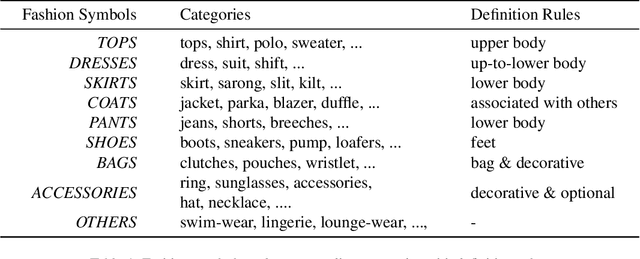
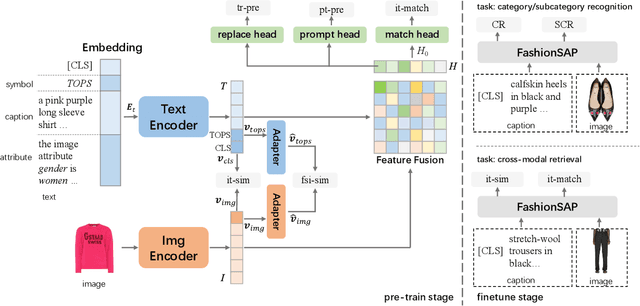
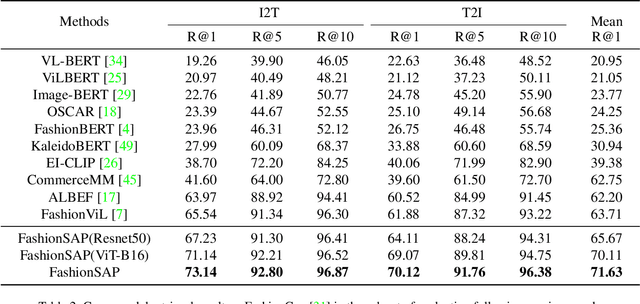
Fashion vision-language pre-training models have shown efficacy for a wide range of downstream tasks. However, general vision-language pre-training models pay less attention to fine-grained domain features, while these features are important in distinguishing the specific domain tasks from general tasks. We propose a method for fine-grained fashion vision-language pre-training based on fashion Symbols and Attributes Prompt (FashionSAP) to model fine-grained multi-modalities fashion attributes and characteristics. Firstly, we propose the fashion symbols, a novel abstract fashion concept layer, to represent different fashion items and to generalize various kinds of fine-grained fashion features, making modelling fine-grained attributes more effective. Secondly, the attributes prompt method is proposed to make the model learn specific attributes of fashion items explicitly. We design proper prompt templates according to the format of fashion data. Comprehensive experiments are conducted on two public fashion benchmarks, i.e., FashionGen and FashionIQ, and FashionSAP gets SOTA performances for four popular fashion tasks. The ablation study also shows the proposed abstract fashion symbols, and the attribute prompt method enables the model to acquire fine-grained semantics in the fashion domain effectively. The obvious performance gains from FashionSAP provide a new baseline for future fashion task research.
Replacement as a Self-supervision for Fine-grained Vision-language Pre-training
Mar 09, 2023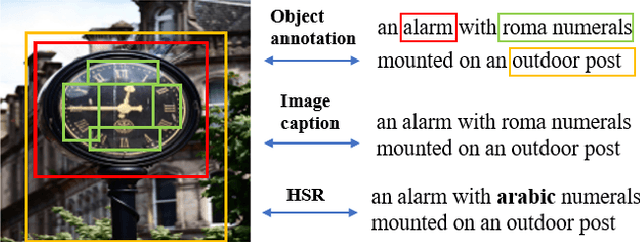

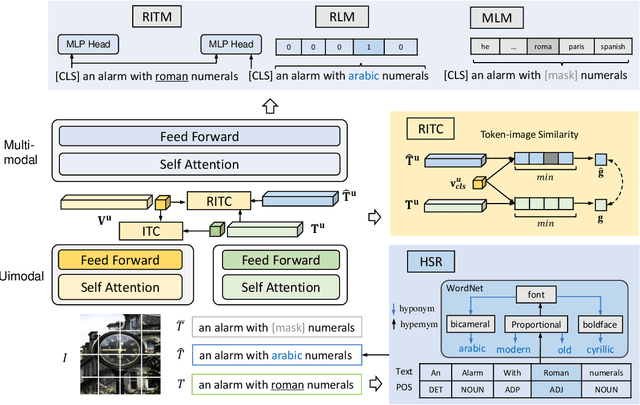
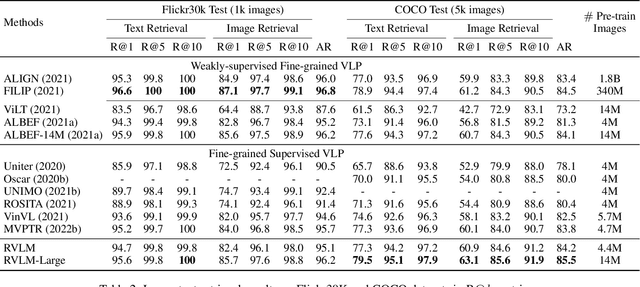
Fine-grained supervision based on object annotations has been widely used for vision and language pre-training (VLP). However, in real-world application scenarios, aligned multi-modal data is usually in the image-caption format, which only provides coarse-grained supervision. It is cost-expensive to collect object annotations and build object annotation pre-extractor for different scenarios. In this paper, we propose a fine-grained self-supervision signal without object annotations from a replacement perspective. First, we propose a homonym sentence rewriting (HSR) algorithm to provide token-level supervision. The algorithm replaces a verb/noun/adjective/quantifier word of the caption with its homonyms from WordNet. Correspondingly, we propose a replacement vision-language modeling (RVLM) framework to exploit the token-level supervision. Two replaced modeling tasks, i.e., replaced language contrastive (RLC) and replaced language modeling (RLM), are proposed to learn the fine-grained alignment. Extensive experiments on several downstream tasks demonstrate the superior performance of the proposed method.
VLDeformer: Learning Visual-Semantic Embeddings by Vision-Language Transformer Decomposing
Oct 20, 2021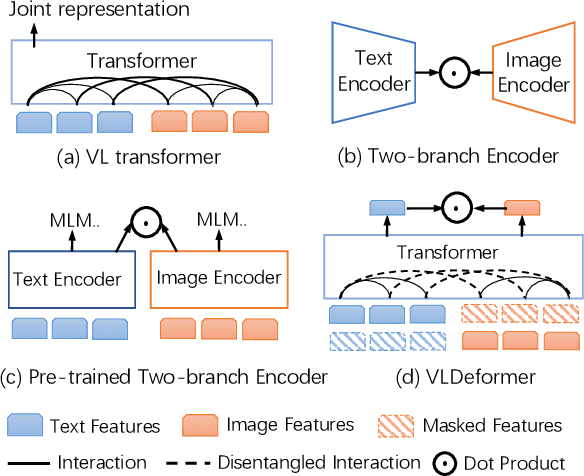
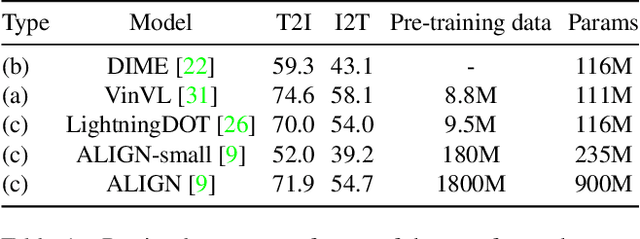
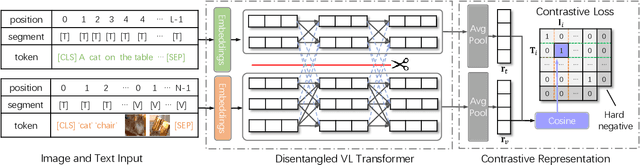
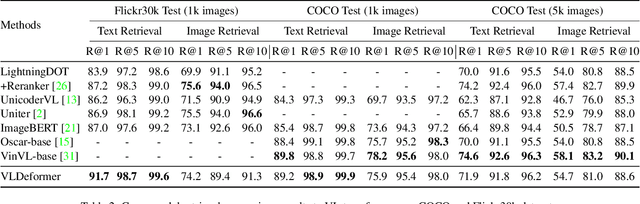
Vision-language transformers (VL transformers) have shown impressive accuracy in cross-modal retrieval. However, most of the existing VL transformers use early-interaction dataflow that computes a joint representation for the text-image input. In the retrieval stage, such models need to infer on all the matched text-image combinations, which causes high computing costs. The goal of this paper is to decompose the early-interaction dataflow inside the pre-trained VL transformer to achieve acceleration while maintaining its outstanding accuracy. To achieve this, we propose a novel Vision-language Transformer Decomposing (VLDeformer) to modify the VL transformer as an individual encoder for a single image or text through contrastive learning, which accelerates retrieval speed by thousands of times. Meanwhile, we propose to compose bi-modal hard negatives for the contrastive learning objective, which enables the VLDeformer to maintain the outstanding accuracy of the backbone VL transformer. Extensive experiments on COCO and Flickr30k datasets demonstrate the superior performance of the proposed method. Considering both effectiveness and efficiency, VLDeformer provides a superior selection for cross-modal retrieval in the similar pre-training datascale.
Multi-hop Graph Convolutional Network with High-order Chebyshev Approximation for Text Reasoning
Jun 08, 2021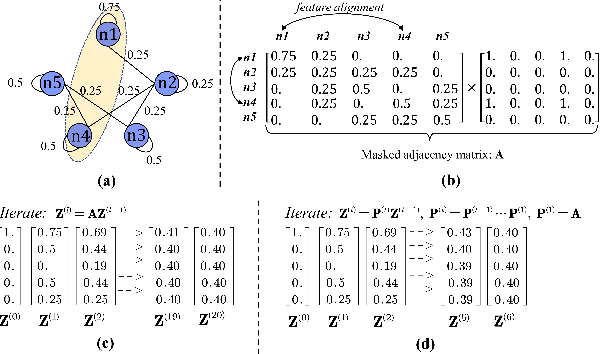
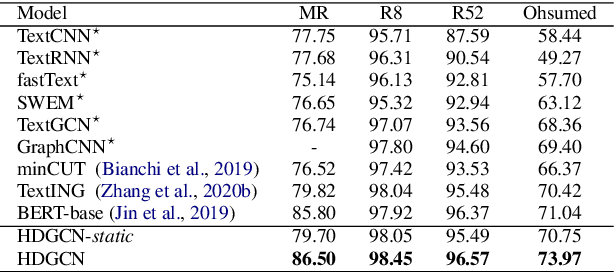
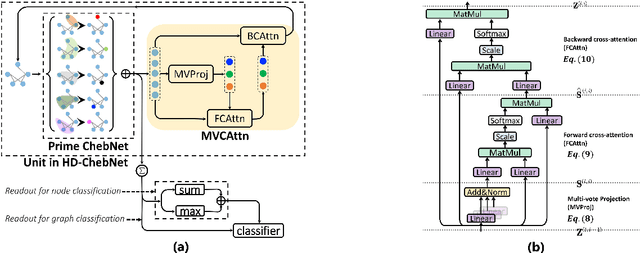
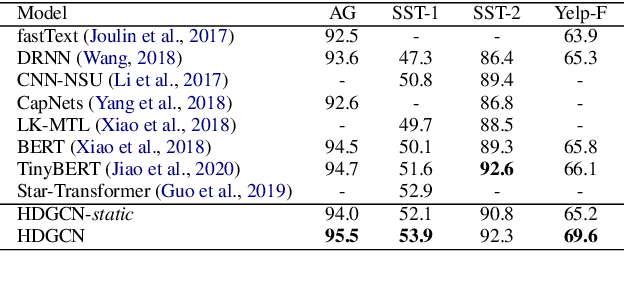
Graph convolutional network (GCN) has become popular in various natural language processing (NLP) tasks with its superiority in long-term and non-consecutive word interactions. However, existing single-hop graph reasoning in GCN may miss some important non-consecutive dependencies. In this study, we define the spectral graph convolutional network with the high-order dynamic Chebyshev approximation (HDGCN), which augments the multi-hop graph reasoning by fusing messages aggregated from direct and long-term dependencies into one convolutional layer. To alleviate the over-smoothing in high-order Chebyshev approximation, a multi-vote-based cross-attention (MVCAttn) with linear computation complexity is also proposed. The empirical results on four transductive and inductive NLP tasks and the ablation study verify the efficacy of the proposed model. Our source code is available at https://github.com/MathIsAll/HDGCN-pytorch.
Prototype Completion with Primitive Knowledge for Few-Shot Learning
Sep 12, 2020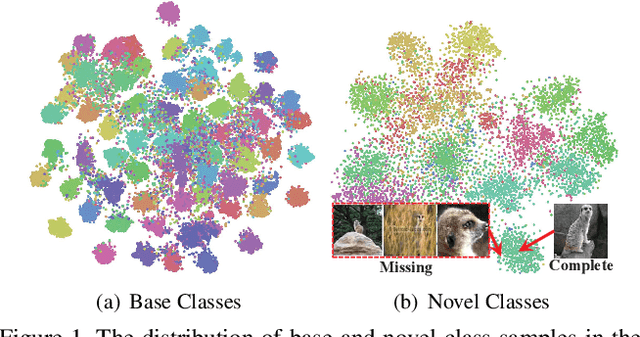
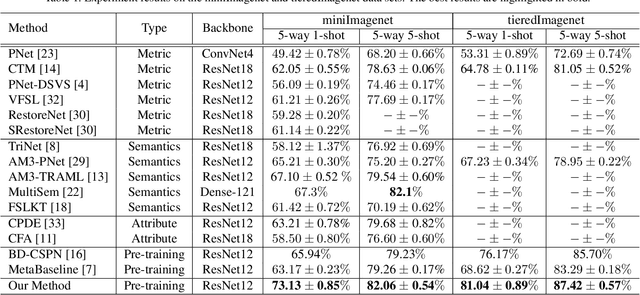
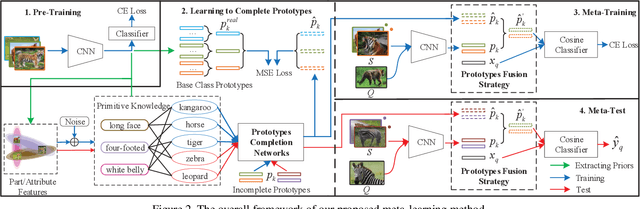
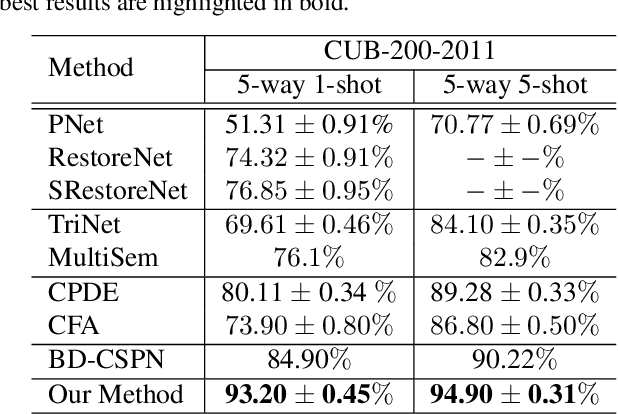
Few-shot learning is a challenging task, which aims to learn a classifier for novel classes with few labeled samples. Previous studies mainly focus on two-phase meta-learning methods. Recently, researchers find that introducing an extra pre-training phase can significantly improve the performance. The key idea is to learn a feature extractor with pre-training and then fine-tune it through the nearest centroid based meta-learning. However, results show that the fine-tuning step makes very marginal improvements. We thus argue that the current meta-learning scheme does not fully explore the power of the pre-training. The reason roots in the fact that in the pre-trained feature space, the base classes already form compact clusters while novel classes spread as groups with large variances. In this case, fine-tuning the feature extractor is less meaningful than estimating more representative prototypes. However, making such an estimation from few labeled samples is challenging because they may miss representative attribute features. In this paper, we propose a novel prototype completion based meta-learning framework. The framework first introduces primitive knowledge (i.e., class-level attribute or part annotations) and extracts representative attribute features as priors. A prototype completion network is then designed to learn to complement the missing attribute features with the priors. Finally, we develop a Gaussian based prototype fusion strategy to combine the mean-based and the complemented prototypes, which can effectively exploit the unlabeled samples. Extensive experimental results on three real-world data sets demonstrate that our method: (i) can obtain more accurate prototypes; (ii) outperforms state-of-the-art techniques by 2% - 9% on classification accuracy.