 Add to Chrome
 Add to Firefox
 Add to Edge
Step 3.5 Flash: Open Frontier-Level Intelligence with 11B Active Parameters
Feb 11, 2026
We introduce Step 3.5 Flash, a sparse Mixture-of-Experts (MoE) model that bridges frontier-level agentic intelligence and computational efficiency. We focus on what matters most when building agents: sharp reasoning and fast, reliable execution. Step 3.5 Flash pairs a 196B-parameter foundation with 11B active parameters for efficient inference. It is optimized with interleaved 3:1 sliding-window/full attention and Multi-Token Prediction (MTP-3) to reduce the latency and cost of multi-round agentic interactions. To reach frontier-level intelligence, we design a scalable reinforcement learning framework that combines verifiable signals with preference feedback, while remaining stable under large-scale off-policy training, enabling consistent self-improvement across mathematics, code, and tool use. Step 3.5 Flash demonstrates strong performance across agent, coding, and math tasks, achieving 85.4% on IMO-AnswerBench, 86.4% on LiveCodeBench-v6 (2024.08-2025.05), 88.2% on tau2-Bench, 69.0% on BrowseComp (with context management), and 51.0% on Terminal-Bench 2.0, comparable to frontier models such as GPT-5.2 xHigh and Gemini 3.0 Pro. By redefining the efficiency frontier, Step 3.5 Flash provides a high-density foundation for deploying sophisticated agents in real-world industrial environments.

Step-DeepResearch Technical Report
Dec 24, 2025As LLMs shift toward autonomous agents, Deep Research has emerged as a pivotal metric. However, existing academic benchmarks like BrowseComp often fail to meet real-world demands for open-ended research, which requires robust skills in intent recognition, long-horizon decision-making, and cross-source verification. To address this, we introduce Step-DeepResearch, a cost-effective, end-to-end agent. We propose a Data Synthesis Strategy Based on Atomic Capabilities to reinforce planning and report writing, combined with a progressive training path from agentic mid-training to SFT and RL. Enhanced by a Checklist-style Judger, this approach significantly improves robustness. Furthermore, to bridge the evaluation gap in the Chinese domain, we establish ADR-Bench for realistic deep research scenarios. Experimental results show that Step-DeepResearch (32B) scores 61.4% on Scale AI Research Rubrics. On ADR-Bench, it significantly outperforms comparable models and rivals SOTA closed-source models like OpenAI and Gemini DeepResearch. These findings prove that refined training enables medium-sized models to achieve expert-level capabilities at industry-leading cost-efficiency.
Step-GUI Technical Report
Dec 19, 2025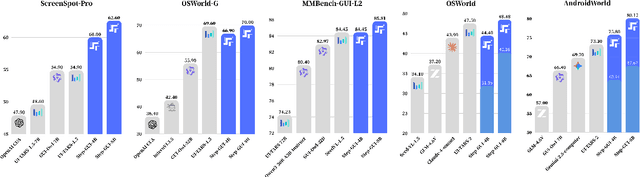
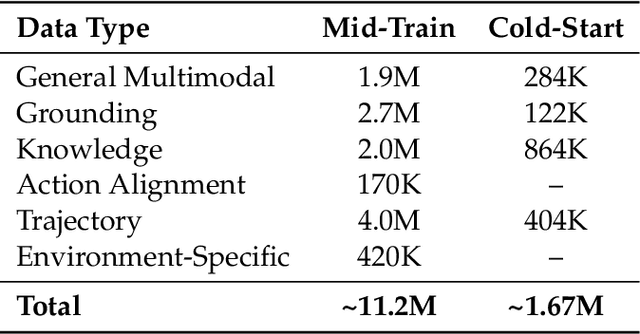
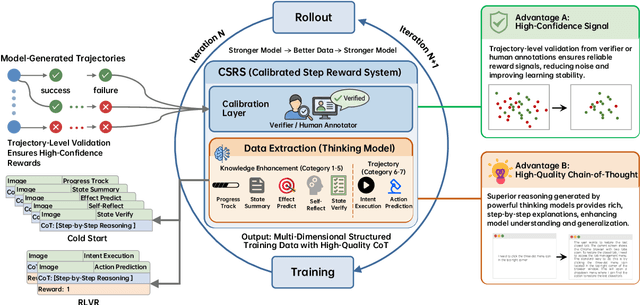
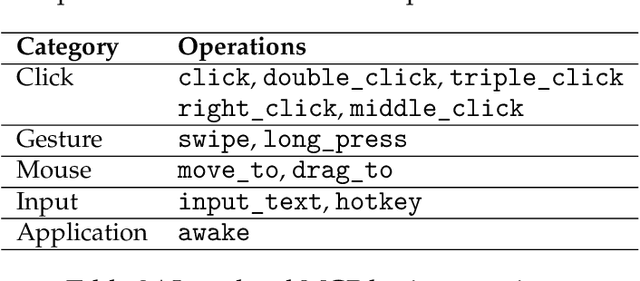
Recent advances in multimodal large language models unlock unprecedented opportunities for GUI automation. However, a fundamental challenge remains: how to efficiently acquire high-quality training data while maintaining annotation reliability? We introduce a self-evolving training pipeline powered by the Calibrated Step Reward System, which converts model-generated trajectories into reliable training signals through trajectory-level calibration, achieving >90% annotation accuracy with 10-100x lower cost. Leveraging this pipeline, we introduce Step-GUI, a family of models (4B/8B) that achieves state-of-the-art GUI performance (8B: 80.2% AndroidWorld, 48.5% OSWorld, 62.6% ScreenShot-Pro) while maintaining robust general capabilities. As GUI agent capabilities improve, practical deployment demands standardized interfaces across heterogeneous devices while protecting user privacy. To this end, we propose GUI-MCP, the first Model Context Protocol for GUI automation with hierarchical architecture that combines low-level atomic operations and high-level task delegation to local specialist models, enabling high-privacy execution where sensitive data stays on-device. Finally, to assess whether agents can handle authentic everyday usage, we introduce AndroidDaily, a benchmark grounded in real-world mobile usage patterns with 3146 static actions and 235 end-to-end tasks across high-frequency daily scenarios (8B: static 89.91%, end-to-end 52.50%). Our work advances the development of practical GUI agents and demonstrates strong potential for real-world deployment in everyday digital interactions.
GitTaskBench: A Benchmark for Code Agents Solving Real-World Tasks Through Code Repository Leveraging
Aug 26, 2025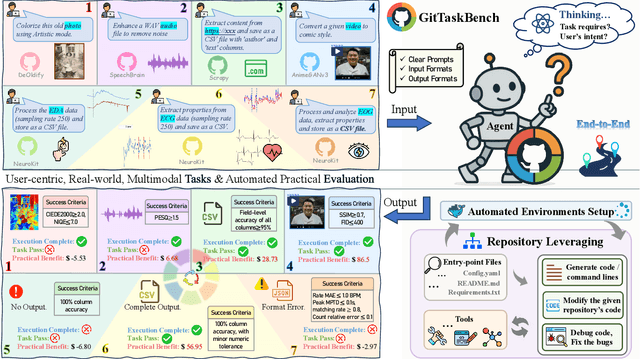
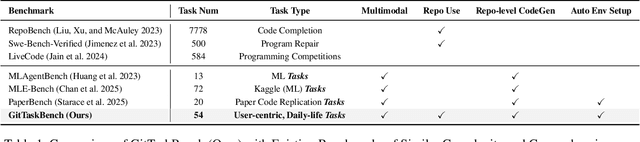
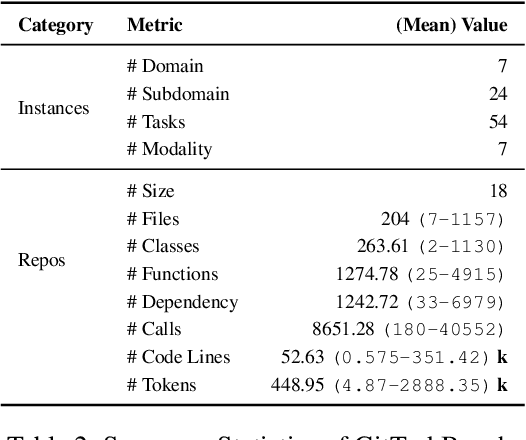
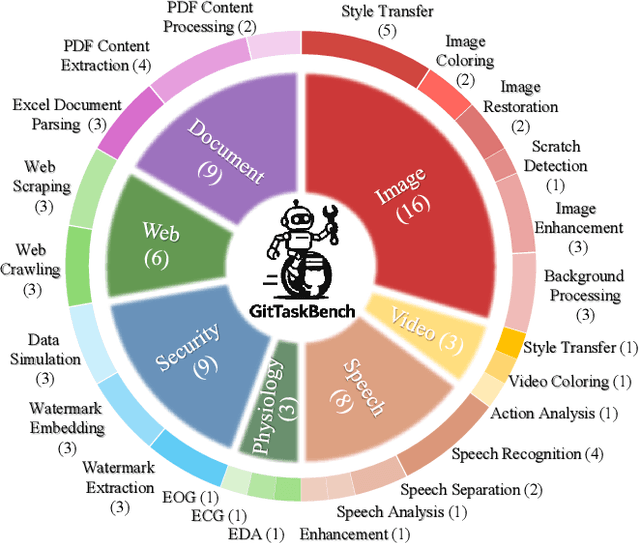
Beyond scratch coding, exploiting large-scale code repositories (e.g., GitHub) for practical tasks is vital in real-world software development, yet current benchmarks rarely evaluate code agents in such authentic, workflow-driven scenarios. To bridge this gap, we introduce GitTaskBench, a benchmark designed to systematically assess this capability via 54 realistic tasks across 7 modalities and 7 domains. Each task pairs a relevant repository with an automated, human-curated evaluation harness specifying practical success criteria. Beyond measuring execution and task success, we also propose the alpha-value metric to quantify the economic benefit of agent performance, which integrates task success rates, token cost, and average developer salaries. Experiments across three state-of-the-art agent frameworks with multiple advanced LLMs show that leveraging code repositories for complex task solving remains challenging: even the best-performing system, OpenHands+Claude 3.7, solves only 48.15% of tasks. Error analysis attributes over half of failures to seemingly mundane yet critical steps like environment setup and dependency resolution, highlighting the need for more robust workflow management and increased timeout preparedness. By releasing GitTaskBench, we aim to drive progress and attention toward repository-aware code reasoning, execution, and deployment -- moving agents closer to solving complex, end-to-end real-world tasks. The benchmark and code are open-sourced at https://github.com/QuantaAlpha/GitTaskBench.
Step-Audio 2 Technical Report
Jul 24, 2025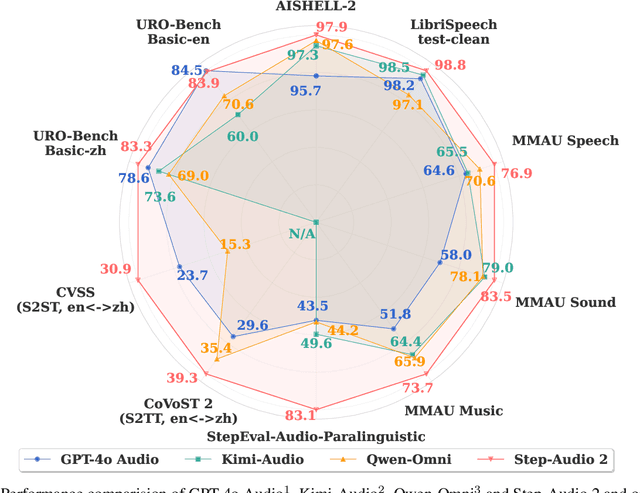
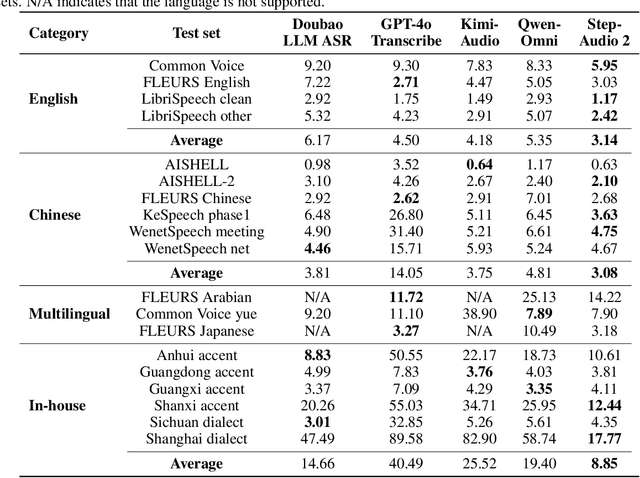
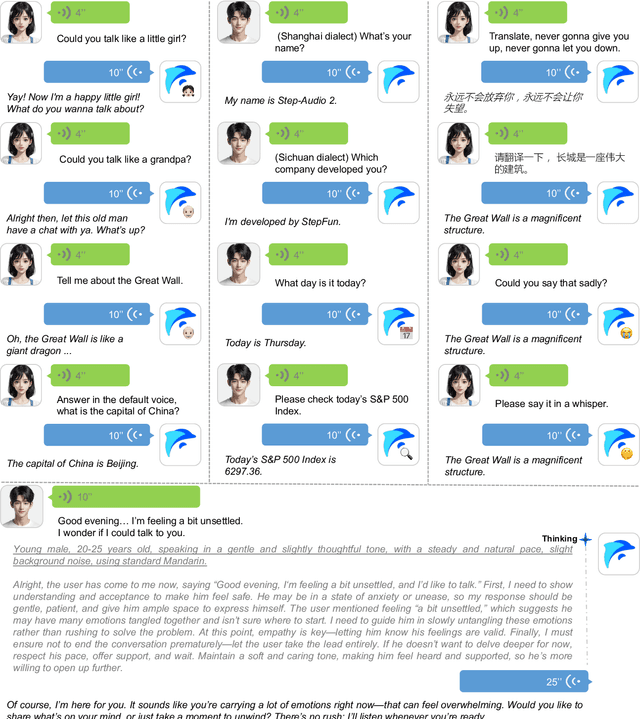
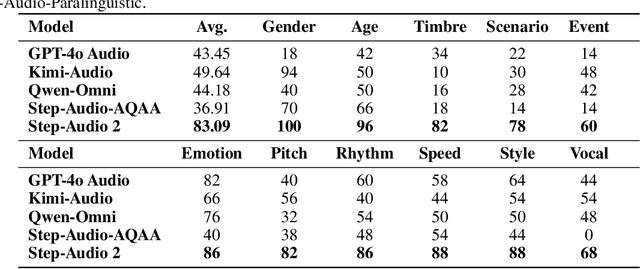
This paper presents Step-Audio 2, an end-to-end multi-modal large language model designed for industry-strength audio understanding and speech conversation. By integrating a latent audio encoder and reasoning-centric reinforcement learning (RL), Step-Audio 2 achieves promising performance in automatic speech recognition (ASR) and audio understanding. To facilitate genuine end-to-end speech conversation, Step-Audio 2 incorporates the generation of discrete audio tokens into language modeling, significantly enhancing its responsiveness to paralinguistic information such as speaking styles and emotions. To effectively leverage the rich textual and acoustic knowledge in real-world data, Step-Audio 2 integrates retrieval-augmented generation (RAG) and is able to call external tools such as web search to mitigate hallucination and audio search to switch timbres. Trained on millions of hours of speech and audio data, Step-Audio 2 delivers intelligence and expressiveness across diverse conversational scenarios. Evaluation results demonstrate that Step-Audio 2 achieves state-of-the-art performance on various audio understanding and conversational benchmarks compared to other open-source and commercial solutions. Please visit https://github.com/stepfun-ai/Step-Audio2 for more information.
Step-Audio-AQAA: a Fully End-to-End Expressive Large Audio Language Model
Jun 10, 2025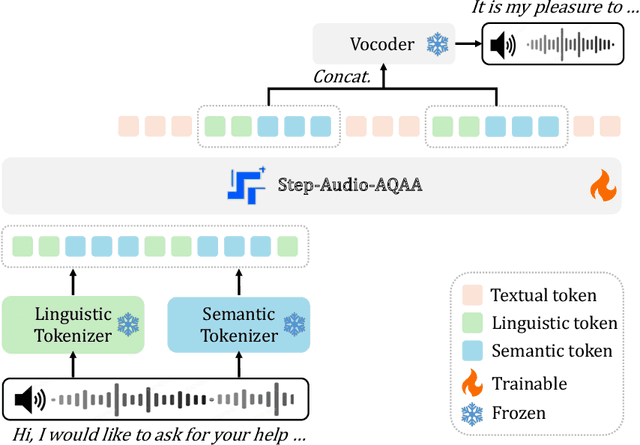
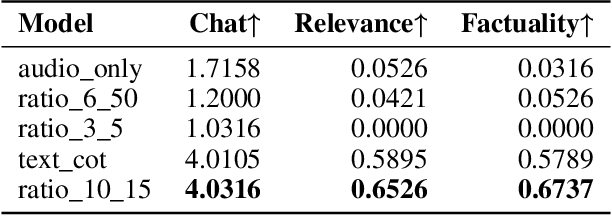
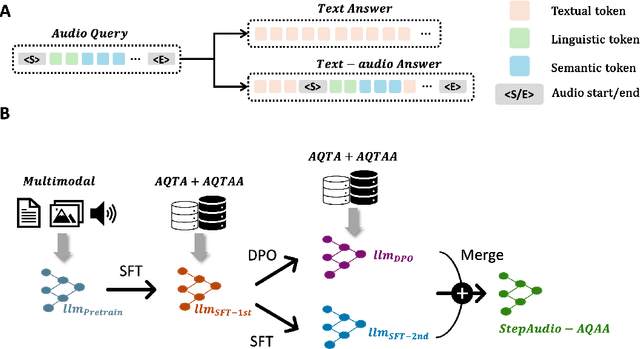

Large Audio-Language Models (LALMs) have significantly advanced intelligent human-computer interaction, yet their reliance on text-based outputs limits their ability to generate natural speech responses directly, hindering seamless audio interactions. To address this, we introduce Step-Audio-AQAA, a fully end-to-end LALM designed for Audio Query-Audio Answer (AQAA) tasks. The model integrates a dual-codebook audio tokenizer for linguistic and semantic feature extraction, a 130-billion-parameter backbone LLM and a neural vocoder for high-fidelity speech synthesis. Our post-training approach employs interleaved token-output of text and audio to enhance semantic coherence and combines Direct Preference Optimization (DPO) with model merge to improve performance. Evaluations on the StepEval-Audio-360 benchmark demonstrate that Step-Audio-AQAA excels especially in speech control, outperforming the state-of-art LALMs in key areas. This work contributes a promising solution for end-to-end LALMs and highlights the critical role of token-based vocoder in enhancing overall performance for AQAA tasks.
Step1X-Edit: A Practical Framework for General Image Editing
Apr 24, 2025In recent years, image editing models have witnessed remarkable and rapid development. The recent unveiling of cutting-edge multimodal models such as GPT-4o and Gemini2 Flash has introduced highly promising image editing capabilities. These models demonstrate an impressive aptitude for fulfilling a vast majority of user-driven editing requirements, marking a significant advancement in the field of image manipulation. However, there is still a large gap between the open-source algorithm with these closed-source models. Thus, in this paper, we aim to release a state-of-the-art image editing model, called Step1X-Edit, which can provide comparable performance against the closed-source models like GPT-4o and Gemini2 Flash. More specifically, we adopt the Multimodal LLM to process the reference image and the user's editing instruction. A latent embedding has been extracted and integrated with a diffusion image decoder to obtain the target image. To train the model, we build a data generation pipeline to produce a high-quality dataset. For evaluation, we develop the GEdit-Bench, a novel benchmark rooted in real-world user instructions. Experimental results on GEdit-Bench demonstrate that Step1X-Edit outperforms existing open-source baselines by a substantial margin and approaches the performance of leading proprietary models, thereby making significant contributions to the field of image editing.
Step-Video-TI2V Technical Report: A State-of-the-Art Text-Driven Image-to-Video Generation Model
Mar 14, 2025We present Step-Video-TI2V, a state-of-the-art text-driven image-to-video generation model with 30B parameters, capable of generating videos up to 102 frames based on both text and image inputs. We build Step-Video-TI2V-Eval as a new benchmark for the text-driven image-to-video task and compare Step-Video-TI2V with open-source and commercial TI2V engines using this dataset. Experimental results demonstrate the state-of-the-art performance of Step-Video-TI2V in the image-to-video generation task. Both Step-Video-TI2V and Step-Video-TI2V-Eval are available at https://github.com/stepfun-ai/Step-Video-TI2V.
Step-Audio: Unified Understanding and Generation in Intelligent Speech Interaction
Feb 18, 2025Real-time speech interaction, serving as a fundamental interface for human-machine collaboration, holds immense potential. However, current open-source models face limitations such as high costs in voice data collection, weakness in dynamic control, and limited intelligence. To address these challenges, this paper introduces Step-Audio, the first production-ready open-source solution. Key contributions include: 1) a 130B-parameter unified speech-text multi-modal model that achieves unified understanding and generation, with the Step-Audio-Chat version open-sourced; 2) a generative speech data engine that establishes an affordable voice cloning framework and produces the open-sourced lightweight Step-Audio-TTS-3B model through distillation; 3) an instruction-driven fine control system enabling dynamic adjustments across dialects, emotions, singing, and RAP; 4) an enhanced cognitive architecture augmented with tool calling and role-playing abilities to manage complex tasks effectively. Based on our new StepEval-Audio-360 evaluation benchmark, Step-Audio achieves state-of-the-art performance in human evaluations, especially in terms of instruction following. On open-source benchmarks like LLaMA Question, shows 9.3% average performance improvement, demonstrating our commitment to advancing the development of open-source multi-modal language technologies. Our code and models are available at https://github.com/stepfun-ai/Step-Audio.
Are You Copying My Model? Protecting the Copyright of Large Language Models for EaaS via Backdoor Watermark
May 17, 2023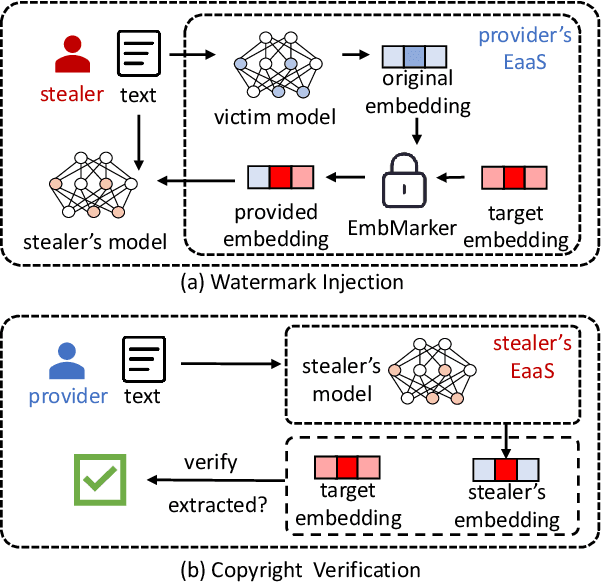
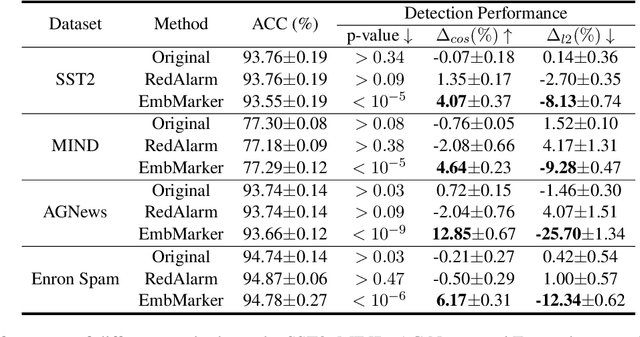
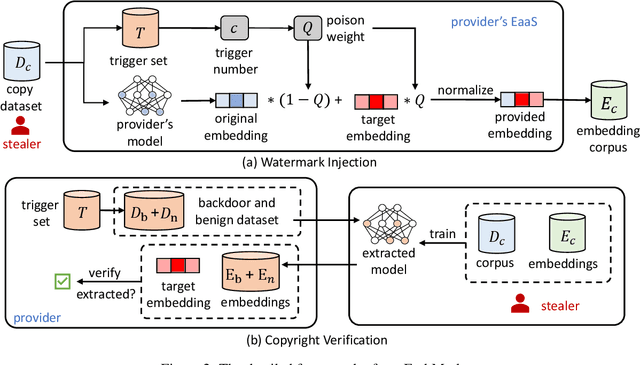
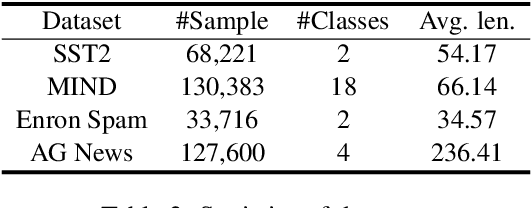
Large language models (LLMs) have demonstrated powerful capabilities in both text understanding and generation. Companies have begun to offer Embedding as a Service (EaaS) based on these LLMs, which can benefit various natural language processing (NLP) tasks for customers. However, previous studies have shown that EaaS is vulnerable to model extraction attacks, which can cause significant losses for the owners of LLMs, as training these models is extremely expensive. To protect the copyright of LLMs for EaaS, we propose an Embedding Watermark method called EmbMarker that implants backdoors on embeddings. Our method selects a group of moderate-frequency words from a general text corpus to form a trigger set, then selects a target embedding as the watermark, and inserts it into the embeddings of texts containing trigger words as the backdoor. The weight of insertion is proportional to the number of trigger words included in the text. This allows the watermark backdoor to be effectively transferred to EaaS-stealer's model for copyright verification while minimizing the adverse impact on the original embeddings' utility. Our extensive experiments on various datasets show that our method can effectively protect the copyright of EaaS models without compromising service quality.