 Add to Chrome
 Add to Firefox
 Add to Edge
Skill-Guided Continuation Distillation for GUI Agents
Jun 17, 2026
Improving GUI agents typically relies on behavior cloning on expert trajectories. However, as the current policy deviates from the expert policy, it inevitably encounters policy-induced off-trajectory states during closed-loop execution, i.e., states that fall outside the expert trajectories. Since expert trajectories provide no demonstrations for these unseen states, such states receive no effective supervision, leaving the policy unable to select the correct action. To close this supervision gap, we propose Skill-Guided Continuation Distillation (SGCD), an iterative self-improvement framework. SGCD first runs the plain policy without skill guidance for a few steps to reach realistic off-trajectory states. From these states, a skill-guided policy then completes the task and produces successful continuations, which are mixed with expert trajectories to supply supervision over policy-induced off-trajectory states. The skills are extracted from both successful and failed rollouts, consisting of Continuation Plans, Critical Targets, Failure Traps, and Success Criteria. On OSWorld-Verified, SGCD improves the success rate of three base models from the low-30\% range to over 50\%, demonstrating its effectiveness and generality.

AndroidDaily: A Verifiable Benchmark for Mobile GUI Agents on Real-World Closed-Source Applications
May 26, 2026The rapid development of GUI foundation models and mobile GUI agents has spurred numerous evaluation benchmarks, yet most rely on simulated environments or open-source applications, leaving real-world closed-source applications largely unevaluated. The core difficulty is that closed-source applications do not expose internal states, making traditional automatic verification inapplicable. To bridge this gap, we introduce AndroidDaily, a large-scale benchmark comprising 350 realistic daily-use tasks across 94 high-frequency Android applications spanning transportation, shopping, local services, entertainment, content creation, social media, and everyday utilities. To enable automatic and verifiable assessment in these opaque environments, we propose Guideline-grounded Reviewer for Automatic Diagnostic Evaluation (GRADE), a process-aware evaluator built on a three-tiered system of observable external guidelines: operational obligations, output quality, and negative constraints. GRADE tracks the agent's visual trajectory against these criteria and produces step-level diagnostic judgments, turning long-horizon, open-ended mobile interactions into verifiable evaluation without relying on hidden internal states. Experiments show that GRADE achieves 87.37\% agreement with human evaluators. The strongest model reaches a 62.0\% success rate on AndroidDaily, highlighting a substantial gap between current reasoning capabilities and practical execution in realistic mobile workflows.
DetailVerifyBench: A Benchmark for Dense Hallucination Localization in Long Image Captions
Apr 07, 2026Accurately detecting and localizing hallucinations is a critical task for ensuring high reliability of image captions. In the era of Multimodal Large Language Models (MLLMs), captions have evolved from brief sentences into comprehensive narratives, often spanning hundreds of words. This shift exponentially increases the challenge: models must now pinpoint specific erroneous spans or words within extensive contexts, rather than merely flag response-level inconsistencies. However, existing benchmarks lack the fine granularity and domain diversity required to evaluate this capability. To bridge this gap, we introduce DetailVerifyBench, a rigorous benchmark comprising 1,000 high-quality images across five distinct domains. With an average caption length of over 200 words and dense, token-level annotations of multiple hallucination types, it stands as the most challenging benchmark for precise hallucination localization in the field of long image captioning to date. Our benchmark is available at https://zyx-hhnkh.github.io/DetailVerifyBench/.
STEP3-VL-10B Technical Report
Jan 15, 2026We present STEP3-VL-10B, a lightweight open-source foundation model designed to redefine the trade-off between compact efficiency and frontier-level multimodal intelligence. STEP3-VL-10B is realized through two strategic shifts: first, a unified, fully unfrozen pre-training strategy on 1.2T multimodal tokens that integrates a language-aligned Perception Encoder with a Qwen3-8B decoder to establish intrinsic vision-language synergy; and second, a scaled post-training pipeline featuring over 1k iterations of reinforcement learning. Crucially, we implement Parallel Coordinated Reasoning (PaCoRe) to scale test-time compute, allocating resources to scalable perceptual reasoning that explores and synthesizes diverse visual hypotheses. Consequently, despite its compact 10B footprint, STEP3-VL-10B rivals or surpasses models 10$\times$-20$\times$ larger (e.g., GLM-4.6V-106B, Qwen3-VL-235B) and top-tier proprietary flagships like Gemini 2.5 Pro and Seed-1.5-VL. Delivering best-in-class performance, it records 92.2% on MMBench and 80.11% on MMMU, while excelling in complex reasoning with 94.43% on AIME2025 and 75.95% on MathVision. We release the full model suite to provide the community with a powerful, efficient, and reproducible baseline.
Step-GUI Technical Report
Dec 19, 2025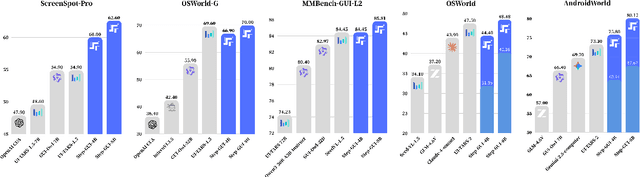
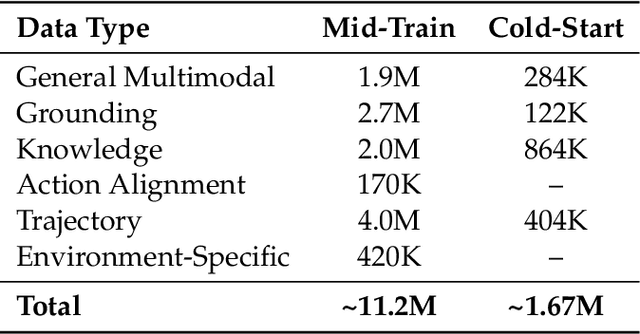
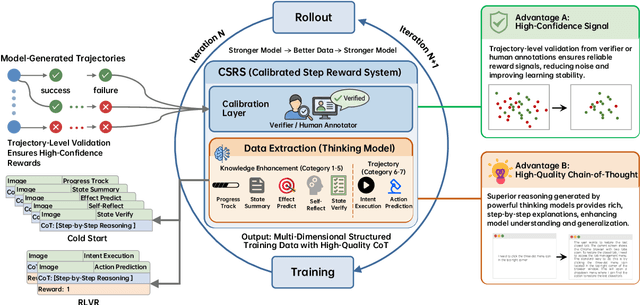
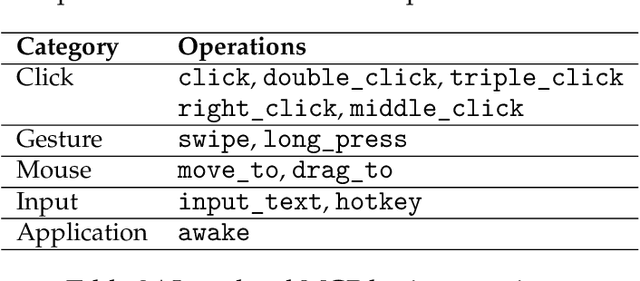
Recent advances in multimodal large language models unlock unprecedented opportunities for GUI automation. However, a fundamental challenge remains: how to efficiently acquire high-quality training data while maintaining annotation reliability? We introduce a self-evolving training pipeline powered by the Calibrated Step Reward System, which converts model-generated trajectories into reliable training signals through trajectory-level calibration, achieving >90% annotation accuracy with 10-100x lower cost. Leveraging this pipeline, we introduce Step-GUI, a family of models (4B/8B) that achieves state-of-the-art GUI performance (8B: 80.2% AndroidWorld, 48.5% OSWorld, 62.6% ScreenShot-Pro) while maintaining robust general capabilities. As GUI agent capabilities improve, practical deployment demands standardized interfaces across heterogeneous devices while protecting user privacy. To this end, we propose GUI-MCP, the first Model Context Protocol for GUI automation with hierarchical architecture that combines low-level atomic operations and high-level task delegation to local specialist models, enabling high-privacy execution where sensitive data stays on-device. Finally, to assess whether agents can handle authentic everyday usage, we introduce AndroidDaily, a benchmark grounded in real-world mobile usage patterns with 3146 static actions and 235 end-to-end tasks across high-frequency daily scenarios (8B: static 89.91%, end-to-end 52.50%). Our work advances the development of practical GUI agents and demonstrates strong potential for real-world deployment in everyday digital interactions.
M-DocSum: Do LVLMs Genuinely Comprehend Interleaved Image-Text in Document Summarization?
Mar 27, 2025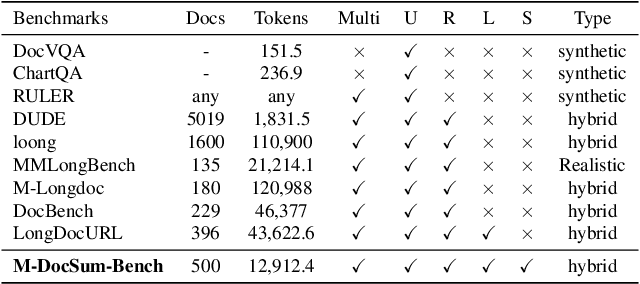
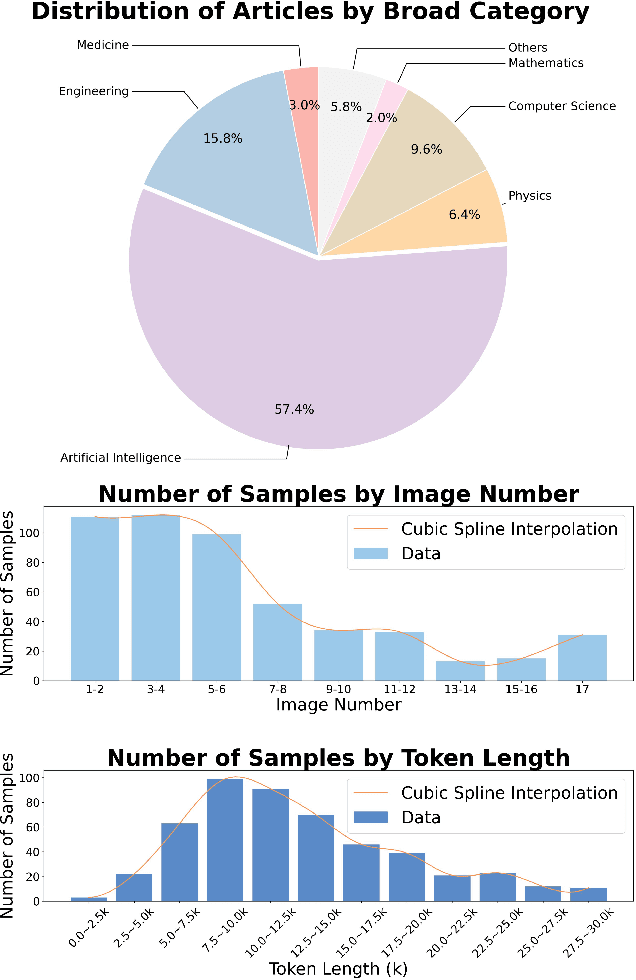
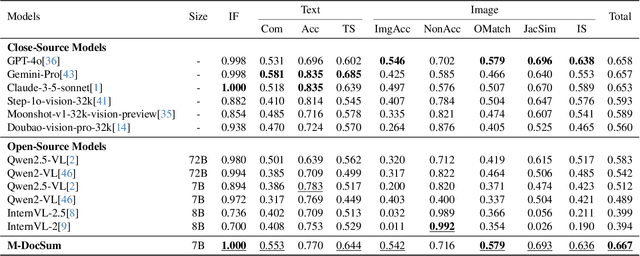
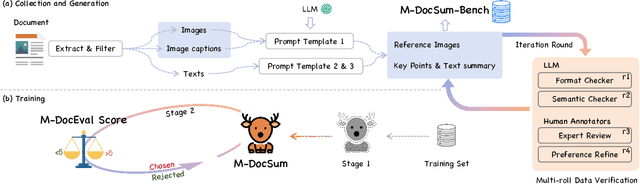
We investigate a critical yet under-explored question in Large Vision-Language Models (LVLMs): Do LVLMs genuinely comprehend interleaved image-text in the document? Existing document understanding benchmarks often assess LVLMs using question-answer formats, which are information-sparse and difficult to guarantee the coverage of long-range dependencies. To address this issue, we introduce a novel and challenging Multimodal Document Summarization Benchmark (M-DocSum-Bench), which comprises 500 high-quality arXiv papers, along with interleaved multimodal summaries aligned with human preferences. M-DocSum-Bench is a reference-based generation task and necessitates the generation of interleaved image-text summaries using provided reference images, thereby simultaneously evaluating capabilities in understanding, reasoning, localization, and summarization within complex multimodal document scenarios. To facilitate this benchmark, we develop an automated framework to construct summaries and propose a fine-grained evaluation method called M-DocEval. Moreover, we further develop a robust summarization baseline, i.e., M-DocSum-7B, by progressive two-stage training with diverse instruction and preference data. The extensive results on our M-DocSum-Bench reveal that the leading LVLMs struggle to maintain coherence and accurately integrate information within long and interleaved contexts, often exhibiting confusion between similar images and a lack of robustness. Notably, M-DocSum-7B achieves state-of-the-art performance compared to larger and closed-source models (including GPT-4o, Gemini Pro, Claude-3.5-Sonnet and Qwen2.5-VL-72B, etc.), demonstrating the potential of LVLMs for improved interleaved image-text understanding. The code, data, and models are available at https://github.com/stepfun-ai/M-DocSum-Bench.