 Add to Chrome
 Add to Firefox
 Add to Edge
PixelSmile: Toward Fine-Grained Facial Expression Editing
Mar 26, 2026
Fine-grained facial expression editing has long been limited by intrinsic semantic overlap. To address this, we construct the Flex Facial Expression (FFE) dataset with continuous affective annotations and establish FFE-Bench to evaluate structural confusion, editing accuracy, linear controllability, and the trade-off between expression editing and identity preservation. We propose PixelSmile, a diffusion framework that disentangles expression semantics via fully symmetric joint training. PixelSmile combines intensity supervision with contrastive learning to produce stronger and more distinguishable expressions, achieving precise and stable linear expression control through textual latent interpolation. Extensive experiments demonstrate that PixelSmile achieves superior disentanglement and robust identity preservation, confirming its effectiveness for continuous, controllable, and fine-grained expression editing, while naturally supporting smooth expression blending.

Step-Video-TI2V Technical Report: A State-of-the-Art Text-Driven Image-to-Video Generation Model
Mar 14, 2025We present Step-Video-TI2V, a state-of-the-art text-driven image-to-video generation model with 30B parameters, capable of generating videos up to 102 frames based on both text and image inputs. We build Step-Video-TI2V-Eval as a new benchmark for the text-driven image-to-video task and compare Step-Video-TI2V with open-source and commercial TI2V engines using this dataset. Experimental results demonstrate the state-of-the-art performance of Step-Video-TI2V in the image-to-video generation task. Both Step-Video-TI2V and Step-Video-TI2V-Eval are available at https://github.com/stepfun-ai/Step-Video-TI2V.
DreaMoving: A Human Video Generation Framework based on Diffusion Models
Dec 11, 2023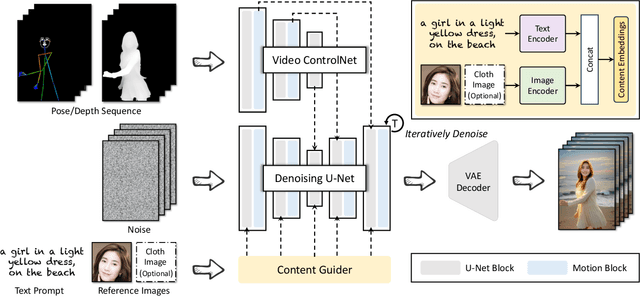
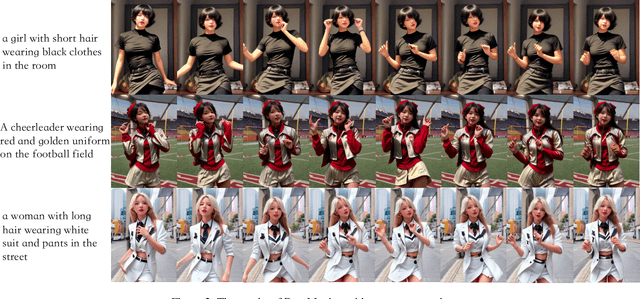
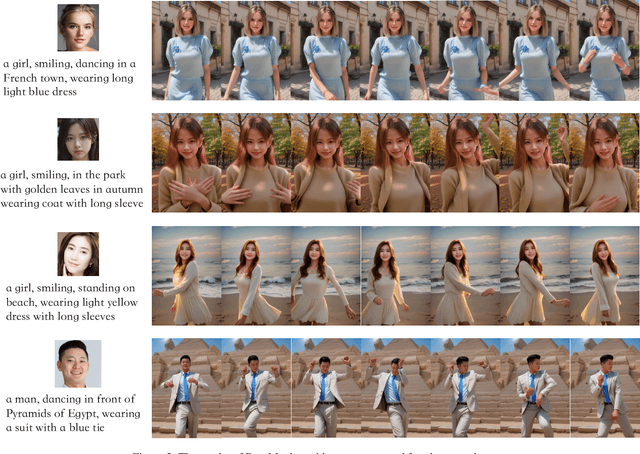
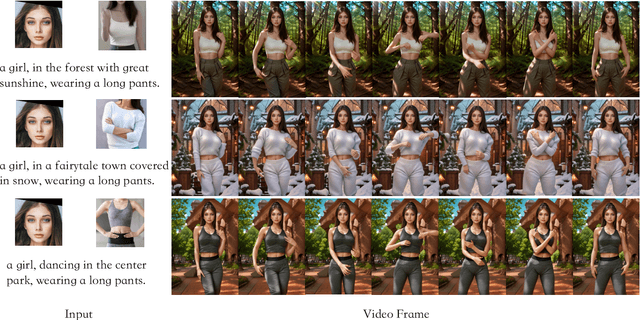
In this paper, we present DreaMoving, a diffusion-based controllable video generation framework to produce high-quality customized human videos. Specifically, given target identity and posture sequences, DreaMoving can generate a video of the target identity moving or dancing anywhere driven by the posture sequences. To this end, we propose a Video ControlNet for motion-controlling and a Content Guider for identity preserving. The proposed model is easy to use and can be adapted to most stylized diffusion models to generate diverse results. The project page is available at https://dreamoving.github.io/dreamoving