 Add to Chrome
 Add to Firefox
 Add to Edge
Balancing multiscale similarity and cartographic constraints: A similarity-driven optimization framework for line generalization
Jul 28, 2026
Cartographic generalization is essential for generating multiscale map representations by balancing information preservation and cartographic readability. However, automated generalization remains challenging because existing approaches often treat spatial similarity evaluation, cartographic constraints, and parameter optimization as separate processes, limiting adaptive and interpretable control across scales. This study formulates cartographic generalization as a constrained multiscale similarity optimization problem and proposes a similarity-driven framework for adaptive generalization control. The framework integrates multiscale spatial similarity as an optimization objective to quantify representation consistency between original and generalized data, while incorporating cartographic constraints to regulate readability, smoothness, and geometric validity. A unified objective function is optimized to automatically identify scale-dependent parameter configurations for different generalization algorithms. Experiments using multiple line simplification algorithms, target scales, and similarity measures, including geometric, structural, and learning-based metrics, demonstrate that the proposed framework achieves an effective balance between similarity preservation and cartographic abstraction. The results further show that combining similarity optimization with cartographic constraints provides more consistent and interpretable parameter control than relying on similarity evaluation alone. This study provides a unified optimization perspective that connects similarity assessment, constraint modeling, and algorithm control, contributing to adaptive and automated cartographic generalization.

From Self-Attention to Connection Laplacian: A Unified Operator View of Transformers
Jul 12, 2026Self-attention is a ubiquitous primitive in modern sequence models, yet its operator-level geometry is only partially understood. We view a token sequence as a vector field over the token-position graph and identify attention as a connection walk: messages are aggregated by a nonnegative walk matrix while being transported along each edge by a learned linear map. Within this framework, we prove that single-head attention (SHA) is exactly a connection propagation step with constant transport, and that multi-head attention (MHA) is exactly a single edge-dependent connection walk whose effective transport is an attention-gated mixture of headwise transports. We further clarify the conditions under which the corresponding generator reduces to a random-walk connection Laplacian, highlighting the roles of stochasticity, reversibility, and metric-compatible transports. Empirically, we find that trained Transformers across scales (from 124M to 8B) and structures (encoder/decoder) exhibit geometric structure consistent with our theory: effective attention graphs converge to stable geometric operators in deeper layers, learned transports self-organize into approximate scaled isometries, and both phenomena strengthen consistently with scale. Overall, the paper provides a precise connection-walk formalism that links self-attention to classical geometric operators, along with a set of operator-level tools for analyzing transformer models from a geometric perspective.
PVCap: Towards Accurate 3D Dense Captioning via PseudoCap and VoxelCapNet
Jul 07, 20263D dense captioning, an emerging vision-language task, aims to generate descriptive sentences for each object in the 3D scene. Despite the impressive results achieved by previous methods, they suffer from two limitations. First, current research often employs global rigid transformations, such as rotation, to augment scenes without changing their spatial layouts. However, diverse spatial layouts are crucial for training a 3D dense captioning model to describe spatial relations between objects. Second, previous works mainly focus on the design of the caption generation pipeline while utilizing a simple network architecture for other components, i.e., backbone and detection head, which is crucial for extracting rich semantic information for captioning. In this paper, we propose PVCap to alleviate the aforementioned problems. Our PVCap consists of PseudoCap and VoxelCapNet. Specifically, PseudoCap employs a random mixing technique on instances within the dataset, generating numerous pseudo frames with diverse spatial layouts at the instance level. By utilizing a teacher-student framework, PseudoCap obtains pseudo caption labels for these pseudo frames. This data augmentation approach significantly increases the number of training samples and enhances the model's ability to describe the environment effectively. Regarding VoxelCapNet, we introduce a robust caption network that utilizes voxel features and adapts the caption head to the voxel-based network architecture. Our VoxelCapNet can serve as a competitive baseline for future research on 3D dense captioning. Extensive experiments are conducted on two prevalent benchmarks, i.e., ScanRefer and Nr3D. Notably, our method surpasses current state-of-the-art by 11.41% and 13.99% in CIDEr@0.5IoU, respectively. Codes will be made publicly available.
Heterogeneous and Adept Snapshot Distillation for 3D Semantic Segmentation
Jun 24, 2026Multi-modal fusion and multi-model ensembling are prevalent in enhancing the performance of 3D semantic segmentation. Despite the impressive performance, these methods either rely on auxiliary input signals or suffer from costly computational expense. To efficaciously enhance the segmentation performance without introducing intolerable costs, we propose to transfer the rich knowledge from the multi-modal model (i.e., point clouds and images) and multiple model experts to the point-cloudbased network through knowledge distillation. Specifically, we present Information-oriented Heterogeneous Distillation (IHD) to help the uni-modal model absorb the complementary knowledge from the multi-modal teacher. We design the Information-Oriented Filtering (IOF) strategy to select informative images from the continuous image sequence for multi-modal fusion. This practice can boost the performance of the multi-modal teacher, thus benefiting the learning of the student. Besides, as opposed to vanilla model ensembling that requires the separate training of each expert, we propose Adept Snapshot Distillation (ASD). ASD treats the freely available model snapshots generated during the training phase as multiple experts, which significantly reduces the training cost for model ensembling. For each expert teacher, it only provides supervision to the student in the class where it is adept. The resulting Heterogeneous and Adept Snapshot Knowledge Distillation, dubbed HAS-KD, attains state-of-the-art results on ScanNetV2 and S3DIS datasets. HAS-KD can be seamlessly integrated into contemporary 3D segmentation algorithms and bring considerable gains without introducing extra inference burdens. The code will be made publicly available upon publication.
SPAR: Support-Preserving Action Rectification
May 27, 2026Offline policy improvement faces an inherent conflict between maximizing value and fitting the data distribution. While in-sample weighted regression is stable, it suffers from over-conservatism that suppresses high-value actions in the distribution tail; conversely, gradient-based approaches often exhibit a fitting-optimization conflict of gradients, which drives the policy off the data manifold. To address this, we propose Support-Preserving Action Rectification (SPAR), which reframes global learning as a local residual rectification anchored to a frozen pure behavior cloning policy. This framework performs fine-grained fitting and local policy improvement in the residual space, thereby contracting the search space. We further introduce Latent Self-Imitation, utilizing a latent-sampling weighted-regression mechanism to address fitting-improvement gradient conflict in the residual space. Theoretically, we prove this mechanism eliminates the manifold-normal drift of standard value gradients, while extensive D4RL experiments show SPAR extracts significant gains from suboptimal baselines to achieve state-of-the-art performance.
Predicting Healthcare System Visitation Flow by Integrating Hospital Attributes and Population Socioeconomics with Human Mobility Data
Jan 22, 2026Healthcare visitation patterns are influenced by a complex interplay of hospital attributes, population socioeconomics, and spatial factors. However, existing research often adopts a fragmented approach, examining these determinants in isolation. This study addresses this gap by integrating hospital capacities, occupancy rates, reputation, and popularity with population SES and spatial mobility patterns to predict visitation flows and analyze influencing factors. Utilizing four years of SafeGraph mobility data and user experience data from Google Maps Reviews, five flow prediction models, Naive Regression, Gradient Boosting, Multilayer Perceptrons (MLPs), Deep Gravity, and Heterogeneous Graph Neural Networks (HGNN),were trained and applied to simulate visitation flows in Houston, Texas, U.S. The Shapley additive explanation (SHAP) analysis and the Partial Dependence Plot (PDP) method were employed to examine the combined impacts of different factors on visitation patterns. The findings reveal that Deep Gravity outperformed other models. Hospital capacities, ICU occupancy rates, ratings, and popularity significantly influence visitation patterns, with their effects varying across different travel distances. Short-distance visits are primarily driven by convenience, whereas long-distance visits are influenced by hospital ratings. White-majority areas exhibited lower sensitivity to hospital ratings for short-distance visits, while Asian populations and those with higher education levels prioritized hospital rating in their visitation decisions. SES further influence these patterns, as areas with higher proportions of Hispanic, Black, under-18, and over-65 populations tend to have more frequent hospital visits, potentially reflecting greater healthcare needs or limited access to alternative medical services.
TokenSqueeze: Performance-Preserving Compression for Reasoning LLMs
Nov 17, 2025Emerging reasoning LLMs such as OpenAI-o1 and DeepSeek-R1 have achieved strong performance on complex reasoning tasks by generating long chain-of-thought (CoT) traces. However, these long CoTs result in increased token usage, leading to higher inference latency and memory consumption. As a result, balancing accuracy and reasoning efficiency has become essential for deploying reasoning LLMs in practical applications. Existing long-to-short (Long2Short) methods aim to reduce inference length but often sacrifice accuracy, revealing a need for an approach that maintains performance while lowering token costs. To address this efficiency-accuracy tradeoff, we propose TokenSqueeze, a novel Long2Short method that condenses reasoning paths while preserving performance and relying exclusively on self-generated data. First, to prevent performance degradation caused by excessive compression of reasoning depth, we propose to select self-generated samples whose reasoning depth is adaptively matched to the complexity of the problem. To further optimize the linguistic expression without altering the underlying reasoning paths, we introduce a distribution-aligned linguistic refinement method that enhances the clarity and conciseness of the reasoning path while preserving its logical integrity. Comprehensive experimental results demonstrate the effectiveness of TokenSqueeze in reducing token usage while maintaining accuracy. Notably, DeepSeek-R1-Distill-Qwen-7B fine-tuned using our proposed method achieved a 50\% average token reduction while preserving accuracy on the MATH500 benchmark. TokenSqueeze exclusively utilizes the model's self-generated data, enabling efficient and high-fidelity reasoning without relying on manually curated short-answer datasets across diverse applications. Our code is available at https://github.com/zhangyx1122/TokenSqueeze.
Enhancing Spatial Reasoning through Visual and Textual Thinking
Jul 28, 2025The spatial reasoning task aims to reason about the spatial relationships in 2D and 3D space, which is a fundamental capability for Visual Question Answering (VQA) and robotics. Although vision language models (VLMs) have developed rapidly in recent years, they are still struggling with the spatial reasoning task. In this paper, we introduce a method that can enhance Spatial reasoning through Visual and Textual thinking Simultaneously (SpatialVTS). In the spatial visual thinking phase, our model is trained to generate location-related specific tokens of essential targets automatically. Not only are the objects mentioned in the problem addressed, but also the potential objects related to the reasoning are considered. During the spatial textual thinking phase, Our model conducts long-term thinking based on visual cues and dialogues, gradually inferring the answers to spatial reasoning problems. To effectively support the model's training, we perform manual corrections to the existing spatial reasoning dataset, eliminating numerous incorrect labels resulting from automatic annotation, restructuring the data input format to enhance generalization ability, and developing thinking processes with logical reasoning details. Without introducing additional information (such as masks or depth), our model's overall average level in several spatial understanding tasks has significantly improved compared with other models.
CheMatAgent: Enhancing LLMs for Chemistry and Materials Science through Tree-Search Based Tool Learning
Jun 12, 2025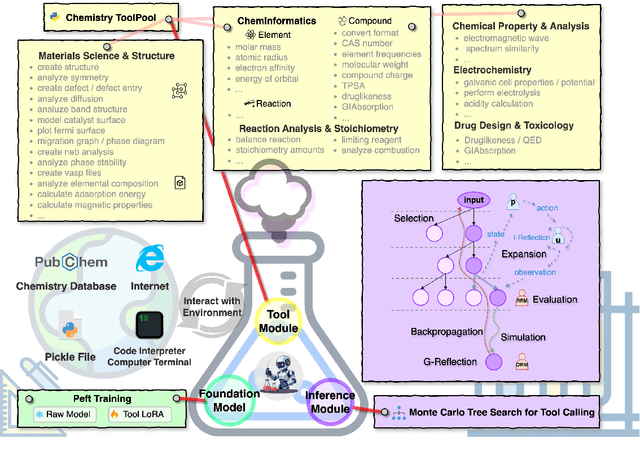
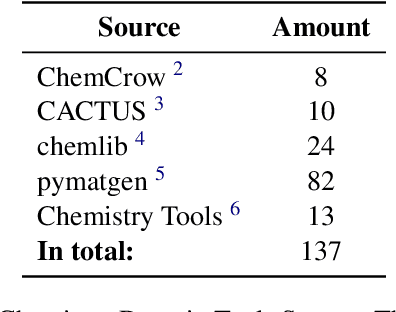
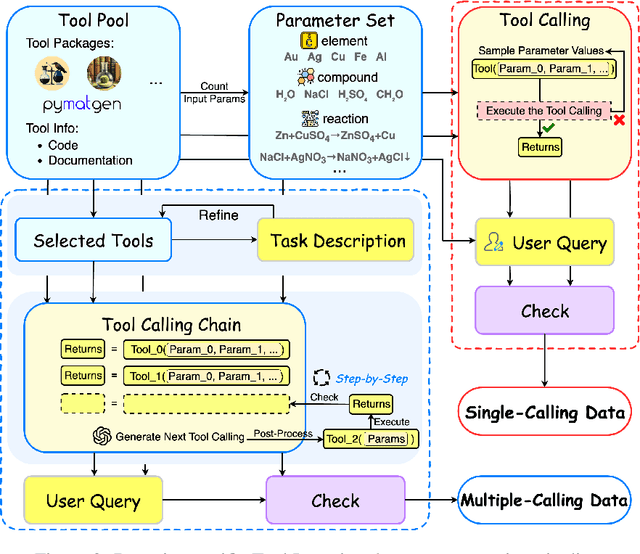
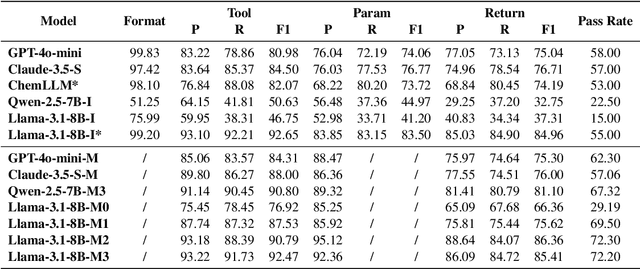
Large language models (LLMs) have recently demonstrated promising capabilities in chemistry tasks while still facing challenges due to outdated pretraining knowledge and the difficulty of incorporating specialized chemical expertise. To address these issues, we propose an LLM-based agent that synergistically integrates 137 external chemical tools created ranging from basic information retrieval to complex reaction predictions, and a dataset curation pipeline to generate the dataset ChemToolBench that facilitates both effective tool selection and precise parameter filling during fine-tuning and evaluation. We introduce a Hierarchical Evolutionary Monte Carlo Tree Search (HE-MCTS) framework, enabling independent optimization of tool planning and execution. By leveraging self-generated data, our approach supports step-level fine-tuning (FT) of the policy model and training task-adaptive PRM and ORM that surpass GPT-4o. Experimental evaluations demonstrate that our approach significantly improves performance in Chemistry QA and discovery tasks, offering a robust solution to integrate specialized tools with LLMs for advanced chemical applications. All datasets and code are available at https://github.com/AI4Chem/ChemistryAgent .
GeoCAD: Local Geometry-Controllable CAD Generation
Jun 12, 2025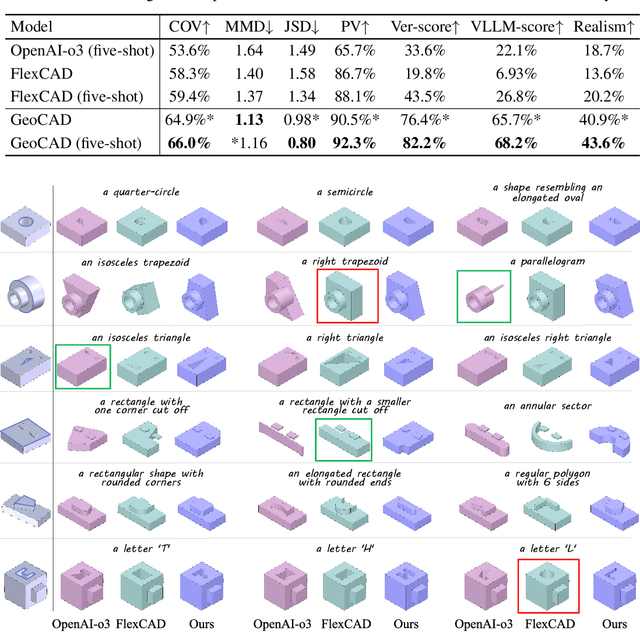
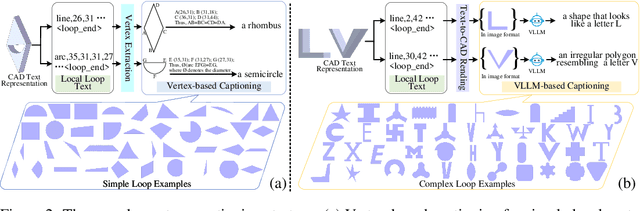
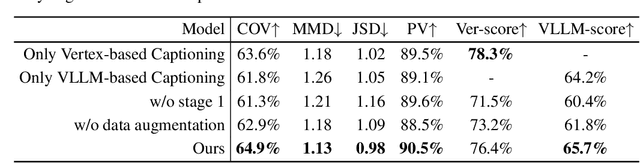

Local geometry-controllable computer-aided design (CAD) generation aims to modify local parts of CAD models automatically, enhancing design efficiency. It also ensures that the shapes of newly generated local parts follow user-specific geometric instructions (e.g., an isosceles right triangle or a rectangle with one corner cut off). However, existing methods encounter challenges in achieving this goal. Specifically, they either lack the ability to follow textual instructions or are unable to focus on the local parts. To address this limitation, we introduce GeoCAD, a user-friendly and local geometry-controllable CAD generation method. Specifically, we first propose a complementary captioning strategy to generate geometric instructions for local parts. This strategy involves vertex-based and VLLM-based captioning for systematically annotating simple and complex parts, respectively. In this way, we caption $\sim$221k different local parts in total. In the training stage, given a CAD model, we randomly mask a local part. Then, using its geometric instruction and the remaining parts as input, we prompt large language models (LLMs) to predict the masked part. During inference, users can specify any local part for modification while adhering to a variety of predefined geometric instructions. Extensive experiments demonstrate the effectiveness of GeoCAD in generation quality, validity and text-to-CAD consistency. Code will be available at https://github.com/Zhanwei-Z/GeoCAD.