 Add to Chrome
 Add to Firefox
 Add to Edge
Balancing multiscale similarity and cartographic constraints: A similarity-driven optimization framework for line generalization
Jul 28, 2026
Cartographic generalization is essential for generating multiscale map representations by balancing information preservation and cartographic readability. However, automated generalization remains challenging because existing approaches often treat spatial similarity evaluation, cartographic constraints, and parameter optimization as separate processes, limiting adaptive and interpretable control across scales. This study formulates cartographic generalization as a constrained multiscale similarity optimization problem and proposes a similarity-driven framework for adaptive generalization control. The framework integrates multiscale spatial similarity as an optimization objective to quantify representation consistency between original and generalized data, while incorporating cartographic constraints to regulate readability, smoothness, and geometric validity. A unified objective function is optimized to automatically identify scale-dependent parameter configurations for different generalization algorithms. Experiments using multiple line simplification algorithms, target scales, and similarity measures, including geometric, structural, and learning-based metrics, demonstrate that the proposed framework achieves an effective balance between similarity preservation and cartographic abstraction. The results further show that combining similarity optimization with cartographic constraints provides more consistent and interpretable parameter control than relying on similarity evaluation alone. This study provides a unified optimization perspective that connects similarity assessment, constraint modeling, and algorithm control, contributing to adaptive and automated cartographic generalization.

Efficient Encrypted Computation in Convolutional Spiking Neural Networks with TFHE
Mar 25, 2026With the rapid advancement of AI technology, we have seen more and more concerns on data privacy, leading to some cutting-edge research on machine learning with encrypted computation. Fully Homomorphic Encryption (FHE) is a crucial technology for privacy-preserving computation, while it struggles with continuous non-polynomial functions, as it operates on discrete integers and supports only addition and multiplication. Spiking Neural Networks (SNNs), which use discrete spike signals, naturally complement FHE's characteristics. In this paper, we introduce FHE-DiCSNN, a framework built on the TFHE scheme, utilizing the discrete nature of SNNs for secure and efficient computations. By leveraging bootstrapping techniques, we successfully implement Leaky Integrate-and-Fire (LIF) neuron models on ciphertexts, allowing SNNs of arbitrary depth. Our framework is adaptable to other spiking neuron models, offering a novel approach to homomorphic evaluation of SNNs. Additionally, we integrate convolutional methods inspired by CNNs to enhance accuracy and reduce the simulation time associated with random encoding. Parallel computation techniques further accelerate bootstrapping operations. Experimental results on the MNIST and FashionMNIST datasets validate the effectiveness of FHE-DiCSNN, with a loss of less than 3\% compared to plaintext, respectively, and computation times of under 1 second per prediction. We also apply the model into real medical image classification problems and analyze the parameter optimization and selection.
PointRFT: Explicit Reinforcement Fine-tuning for Point Cloud Few-shot Learning
Mar 25, 2026Understanding spatial dynamics and semantics in point cloud is fundamental for comprehensive 3D comprehension. While reinforcement learning algorithms such as Group Relative Policy Optimization (GRPO) have recently achieved remarkable breakthroughs in large language models by incentivizing reasoning capabilities through strategic reward design, their potential remains largely unexplored in the 3D perception domain. This naturally raises a pivotal question: Can RL-based methods effectively empower 3D point cloud fine-tuning? In this paper, we propose PointRFT, the first reinforcement fine-tuning paradigm tailored specifically for point cloud representation learning. We select three prevalent 3D foundation models and devise specialized accuracy reward and dispersion reward functions to stabilize training and mitigate distribution shifts. Through comprehensive few-shot classification experiments comparing distinct training paradigms, we demonstrate that PointRFT consistently outperforms vanilla supervised fine-tuning (SFT) across diverse benchmarks. Furthermore, when organically integrated into a hybrid Pretraining-SFT-RFT paradigm, the representational capacity of point cloud foundation models is substantially unleashed, achieving state-of-the-art performance particularly under data-scarce scenarios.
PointDico: Contrastive 3D Representation Learning Guided by Diffusion Models
Dec 09, 2025Self-supervised representation learning has shown significant improvement in Natural Language Processing and 2D Computer Vision. However, existing methods face difficulties in representing 3D data because of its unordered and uneven density. Through an in-depth analysis of mainstream contrastive and generative approaches, we find that contrastive models tend to suffer from overfitting, while 3D Mask Autoencoders struggle to handle unordered point clouds. This motivates us to learn 3D representations by sharing the merits of diffusion and contrast models, which is non-trivial due to the pattern difference between the two paradigms. In this paper, we propose \textit{PointDico}, a novel model that seamlessly integrates these methods. \textit{PointDico} learns from both denoising generative modeling and cross-modal contrastive learning through knowledge distillation, where the diffusion model serves as a guide for the contrastive model. We introduce a hierarchical pyramid conditional generator for multi-scale geometric feature extraction and employ a dual-channel design to effectively integrate local and global contextual information. \textit{PointDico} achieves a new state-of-the-art in 3D representation learning, \textit{e.g.}, \textbf{94.32\%} accuracy on ScanObjectNN, \textbf{86.5\%} Inst. mIoU on ShapeNetPart.
Corrected with the Latest Version: Make Robust Asynchronous Federated Learning Possible
Apr 09, 2025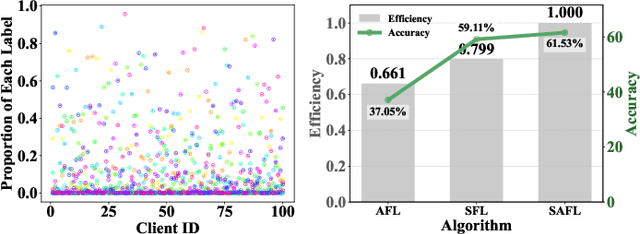
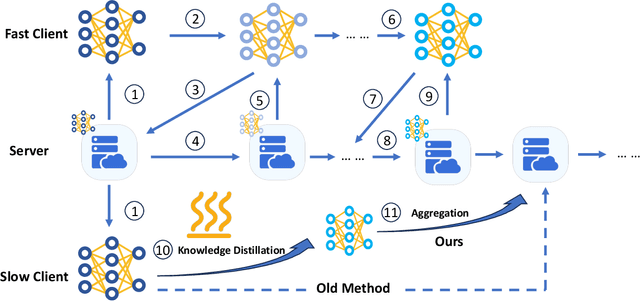
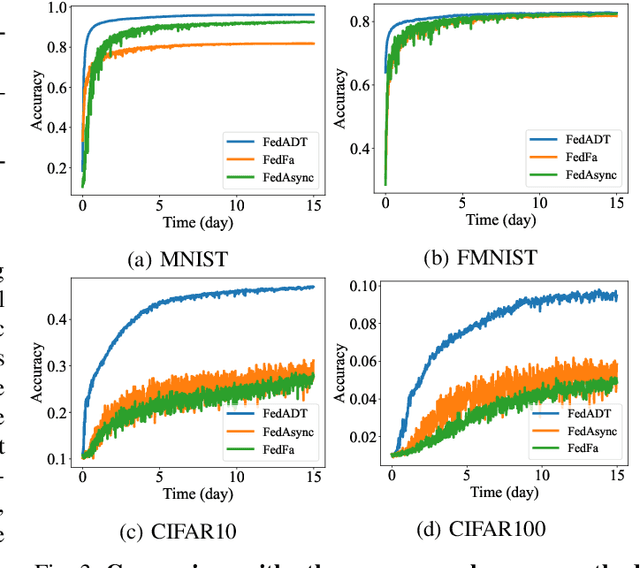
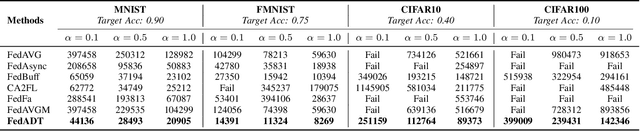
As an emerging paradigm of federated learning, asynchronous federated learning offers significant speed advantages over traditional synchronous federated learning. Unlike synchronous federated learning, which requires waiting for all clients to complete updates before aggregation, asynchronous federated learning aggregates the models that have arrived in realtime, greatly improving training speed. However, this mechanism also introduces the issue of client model version inconsistency. When the differences between models of different versions during aggregation become too large, it may lead to conflicts, thereby reducing the models accuracy. To address this issue, this paper proposes an asynchronous federated learning version correction algorithm based on knowledge distillation, named FedADT. FedADT applies knowledge distillation before aggregating gradients, using the latest global model to correct outdated information, thus effectively reducing the negative impact of outdated gradients on the training process. Additionally, FedADT introduces an adaptive weighting function that adjusts the knowledge distillation weight according to different stages of training, helps mitigate the misleading effects caused by the poorer performance of the global model in the early stages of training. This method significantly improves the overall performance of asynchronous federated learning without adding excessive computational overhead. We conducted experimental comparisons with several classical algorithms, and the results demonstrate that FedADT achieves significant improvements over other asynchronous methods and outperforms all methods in terms of convergence speed.