 Add to Chrome
 Add to Firefox
 Add to Edge
InternLM-XComposer-2.5: A Versatile Large Vision Language Model Supporting Long-Contextual Input and Output
Jul 03, 2024


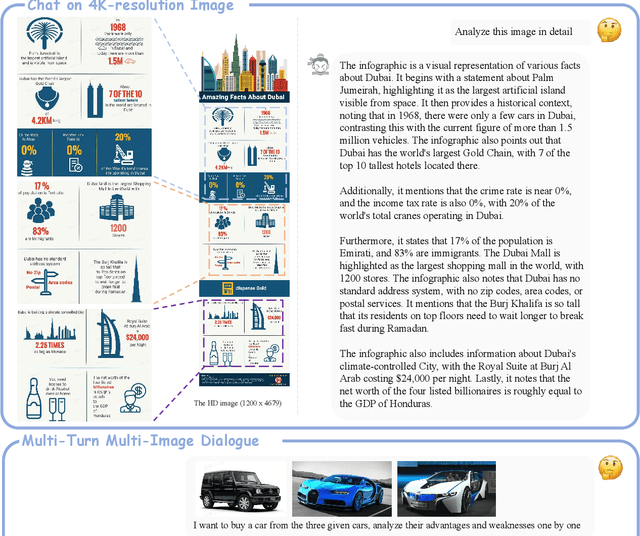
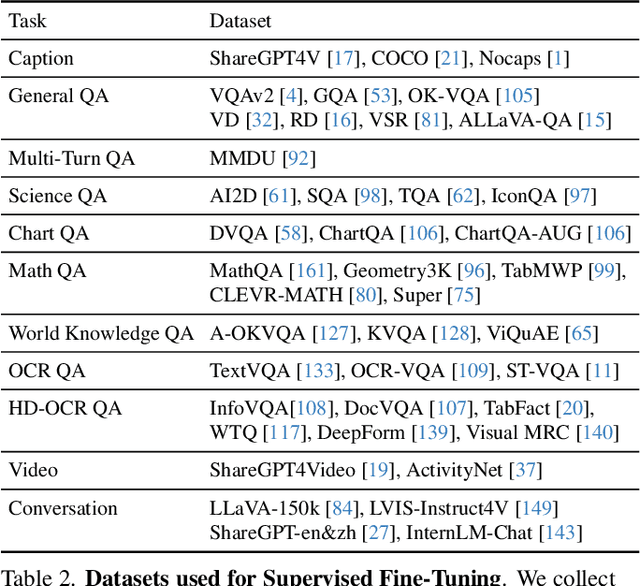
We present InternLM-XComposer-2.5 (IXC-2.5), a versatile large-vision language model that supports long-contextual input and output. IXC-2.5 excels in various text-image comprehension and composition applications, achieving GPT-4V level capabilities with merely 7B LLM backend. Trained with 24K interleaved image-text contexts, it can seamlessly extend to 96K long contexts via RoPE extrapolation. This long-context capability allows IXC-2.5 to excel in tasks requiring extensive input and output contexts. Compared to its previous 2.0 version, InternLM-XComposer-2.5 features three major upgrades in vision-language comprehension: (1) Ultra-High Resolution Understanding, (2) Fine-Grained Video Understanding, and (3) Multi-Turn Multi-Image Dialogue. In addition to comprehension, IXC-2.5 extends to two compelling applications using extra LoRA parameters for text-image composition: (1) Crafting Webpages and (2) Composing High-Quality Text-Image Articles. IXC-2.5 has been evaluated on 28 benchmarks, outperforming existing open-source state-of-the-art models on 16 benchmarks. It also surpasses or competes closely with GPT-4V and Gemini Pro on 16 key tasks. The InternLM-XComposer-2.5 is publicly available at https://github.com/InternLM/InternLM-XComposer.

Mobile-Bench: An Evaluation Benchmark for LLM-based Mobile Agents
Jul 01, 2024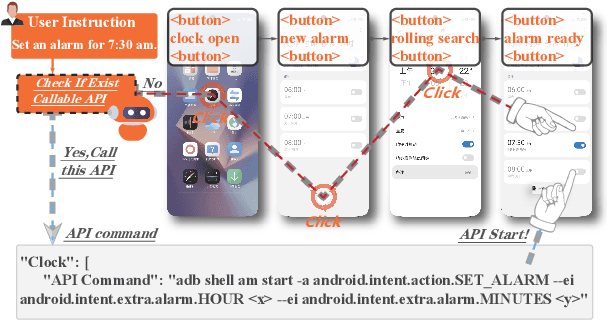
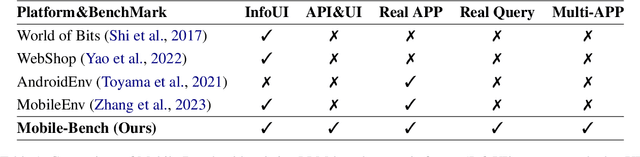
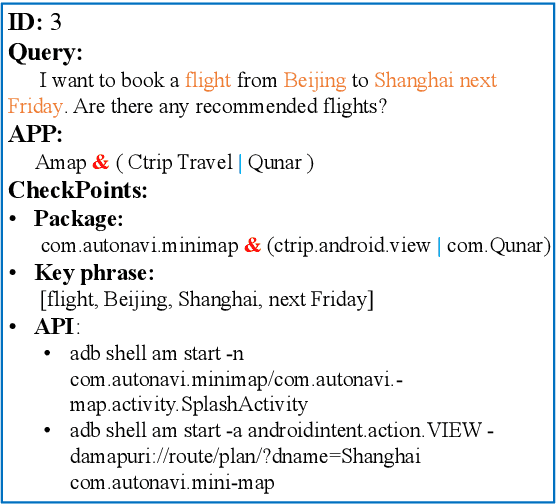
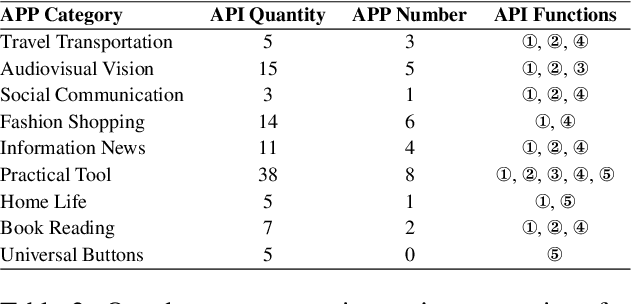
With the remarkable advancements of large language models (LLMs), LLM-based agents have become a research hotspot in human-computer interaction. However, there is a scarcity of benchmarks available for LLM-based mobile agents. Benchmarking these agents generally faces three main challenges: (1) The inefficiency of UI-only operations imposes limitations to task evaluation. (2) Specific instructions within a singular application lack adequacy for assessing the multi-dimensional reasoning and decision-making capacities of LLM mobile agents. (3) Current evaluation metrics are insufficient to accurately assess the process of sequential actions. To this end, we propose Mobile-Bench, a novel benchmark for evaluating the capabilities of LLM-based mobile agents. First, we expand conventional UI operations by incorporating 103 collected APIs to accelerate the efficiency of task completion. Subsequently, we collect evaluation data by combining real user queries with augmentation from LLMs. To better evaluate different levels of planning capabilities for mobile agents, our data is categorized into three distinct groups: SAST, SAMT, and MAMT, reflecting varying levels of task complexity. Mobile-Bench comprises 832 data entries, with more than 200 tasks specifically designed to evaluate multi-APP collaboration scenarios. Furthermore, we introduce a more accurate evaluation metric, named CheckPoint, to assess whether LLM-based mobile agents reach essential points during their planning and reasoning steps.
A Cross Spatio-Temporal Pathology-based Lung Nodule Dataset
Jun 26, 2024Recently, intelligent analysis of lung nodules with the assistant of computer aided detection (CAD) techniques can improve the accuracy rate of lung cancer diagnosis. However, existing CAD systems and pulmonary datasets mainly focus on Computed Tomography (CT) images from one single period, while ignoring the cross spatio-temporal features associated with the progression of nodules contained in imaging data from various captured periods of lung cancer. If the evolution patterns of nodules across various periods in the patients' CT sequences can be explored, it will play a crucial role in guiding the precise screening identification of lung cancer. Therefore, a cross spatio-temporal lung nodule dataset with pathological information for nodule identification and diagnosis is constructed, which contains 328 CT sequences and 362 annotated nodules from 109 patients. This comprehensive database is intended to drive research in the field of CAD towards more practical and robust methods, and also contribute to the further exploration of precision medicine related field. To ensure patient confidentiality, we have removed sensitive information from the dataset.
AudioBench: A Universal Benchmark for Audio Large Language Models
Jun 25, 2024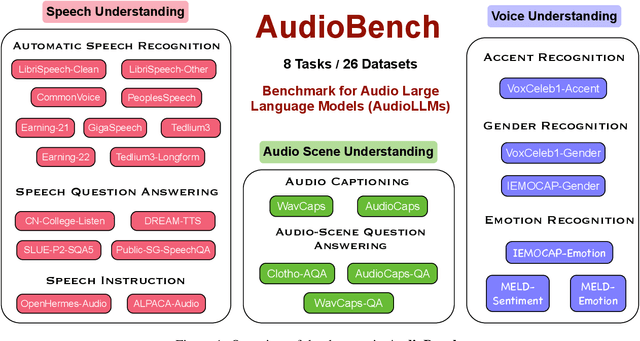
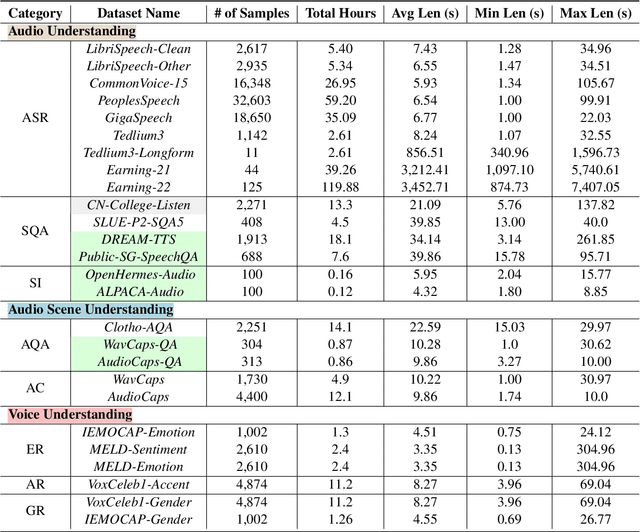
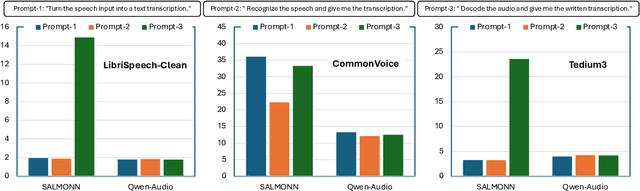
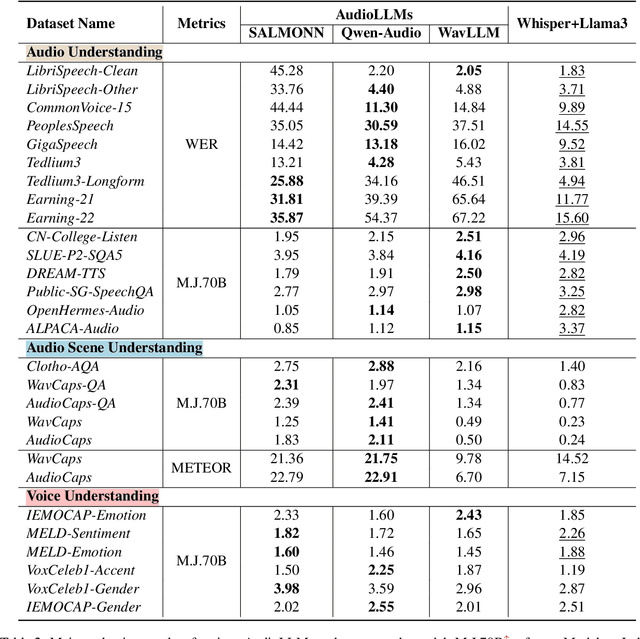
We introduce AudioBench, a new benchmark designed to evaluate audio large language models (AudioLLMs). AudioBench encompasses 8 distinct tasks and 26 carefully selected or newly curated datasets, focusing on speech understanding, voice interpretation, and audio scene understanding. Despite the rapid advancement of large language models, including multimodal versions, a significant gap exists in comprehensive benchmarks for thoroughly evaluating their capabilities. AudioBench addresses this gap by providing relevant datasets and evaluation metrics. In our study, we evaluated the capabilities of four models across various aspects and found that no single model excels consistently across all tasks. We outline the research outlook for AudioLLMs and anticipate that our open-source code, data, and leaderboard will offer a robust testbed for future model developments.
Gaze-directed Vision GNN for Mitigating Shortcut Learning in Medical Image
Jun 20, 2024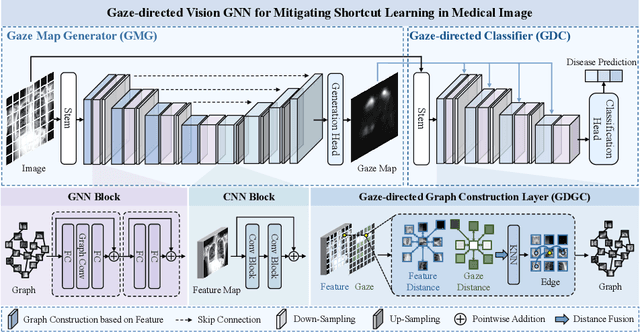
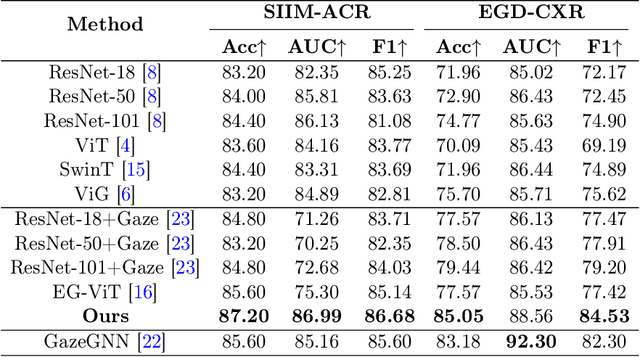
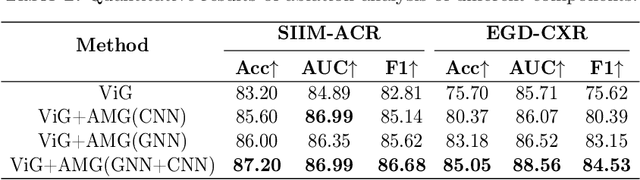
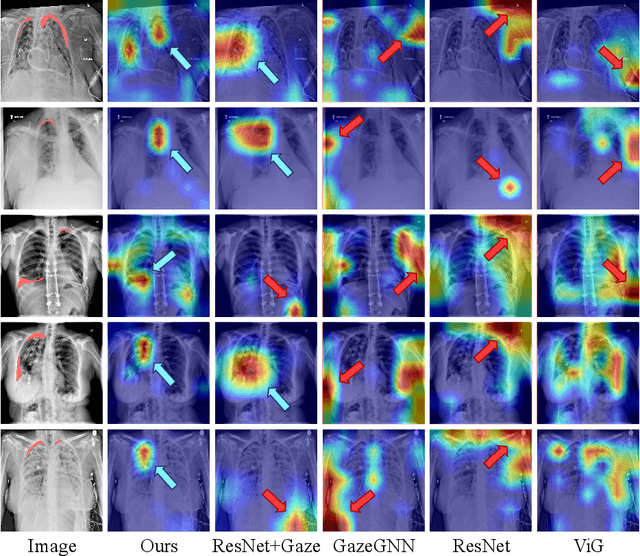
Deep neural networks have demonstrated remarkable performance in medical image analysis. However, its susceptibility to spurious correlations due to shortcut learning raises concerns about network interpretability and reliability. Furthermore, shortcut learning is exacerbated in medical contexts where disease indicators are often subtle and sparse. In this paper, we propose a novel gaze-directed Vision GNN (called GD-ViG) to leverage the visual patterns of radiologists from gaze as expert knowledge, directing the network toward disease-relevant regions, and thereby mitigating shortcut learning. GD-ViG consists of a gaze map generator (GMG) and a gaze-directed classifier (GDC). Combining the global modelling ability of GNNs with the locality of CNNs, GMG generates the gaze map based on radiologists' visual patterns. Notably, it eliminates the need for real gaze data during inference, enhancing the network's practical applicability. Utilizing gaze as the expert knowledge, the GDC directs the construction of graph structures by incorporating both feature distances and gaze distances, enabling the network to focus on disease-relevant foregrounds. Thereby avoiding shortcut learning and improving the network's interpretability. The experiments on two public medical image datasets demonstrate that GD-ViG outperforms the state-of-the-art methods, and effectively mitigates shortcut learning. Our code is available at https://github.com/SX-SS/GD-ViG.
Enhancing Automated Audio Captioning via Large Language Models with Optimized Audio Encoding
Jun 19, 2024Automated audio captioning (AAC) is an audio-to-text task to describe audio contents in natural language. Recently, the advancements in large language models (LLMs), with improvements in training approaches for audio encoders, have opened up possibilities for improving AAC. Thus, we explore enhancing AAC from three aspects: 1) a pre-trained audio encoder via consistent ensemble distillation (CED) is used to improve the effectivity of acoustic tokens, with a querying transformer (Q-Former) bridging the modality gap to LLM and compress acoustic tokens; 2) we investigate the advantages of using a Llama 2 with 7B parameters as the decoder; 3) another pre-trained LLM corrects text errors caused by insufficient training data and annotation ambiguities. Both the audio encoder and text decoder are optimized by -Base (LoRA). Experiments show that each of these enhancements is effective. Our method obtains a 33.0 SPIDEr-FL score, outperforming the winner of DCASE 2023 Task 6A.
DocGenome: An Open Large-scale Scientific Document Benchmark for Training and Testing Multi-modal Large Language Models
Jun 17, 2024


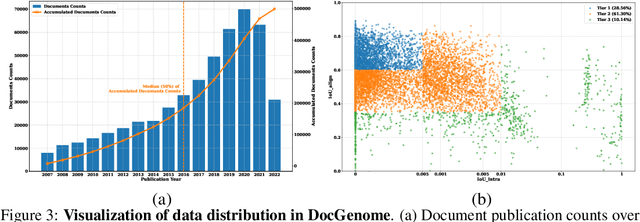
Scientific documents record research findings and valuable human knowledge, comprising a vast corpus of high-quality data. Leveraging multi-modality data extracted from these documents and assessing large models' abilities to handle scientific document-oriented tasks is therefore meaningful. Despite promising advancements, large models still perform poorly on multi-page scientific document extraction and understanding tasks, and their capacity to process within-document data formats such as charts and equations remains under-explored. To address these issues, we present DocGenome, a structured document benchmark constructed by annotating 500K scientific documents from 153 disciplines in the arXiv open-access community, using our custom auto-labeling pipeline. DocGenome features four key characteristics: 1) Completeness: It is the first dataset to structure data from all modalities including 13 layout attributes along with their LaTeX source codes. 2) Logicality: It provides 6 logical relationships between different entities within each scientific document. 3) Diversity: It covers various document-oriented tasks, including document classification, visual grounding, document layout detection, document transformation, open-ended single-page QA and multi-page QA. 4) Correctness: It undergoes rigorous quality control checks conducted by a specialized team. We conduct extensive experiments to demonstrate the advantages of DocGenome and objectively evaluate the performance of large models on our benchmark.
SEACrowd: A Multilingual Multimodal Data Hub and Benchmark Suite for Southeast Asian Languages
Jun 14, 2024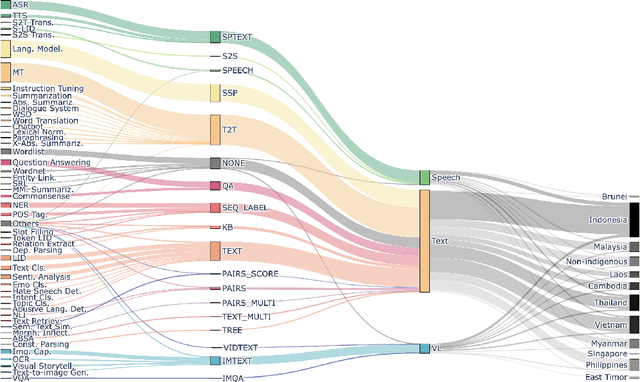
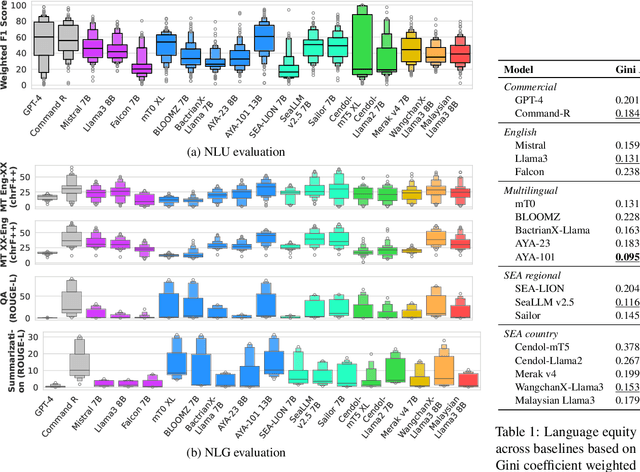
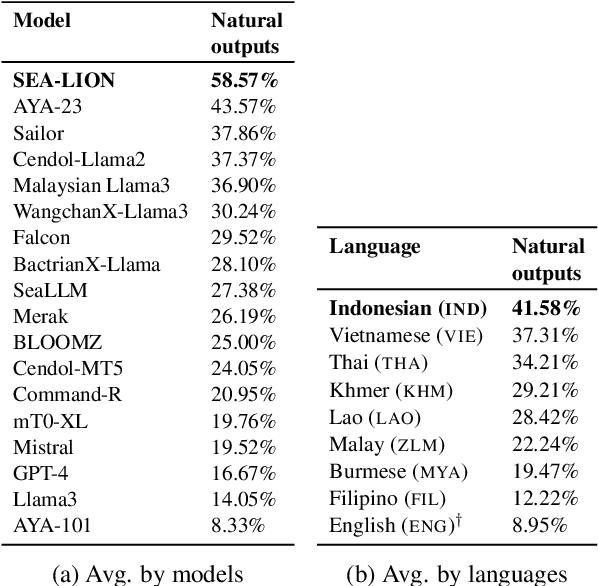

Southeast Asia (SEA) is a region rich in linguistic diversity and cultural variety, with over 1,300 indigenous languages and a population of 671 million people. However, prevailing AI models suffer from a significant lack of representation of texts, images, and audio datasets from SEA, compromising the quality of AI models for SEA languages. Evaluating models for SEA languages is challenging due to the scarcity of high-quality datasets, compounded by the dominance of English training data, raising concerns about potential cultural misrepresentation. To address these challenges, we introduce SEACrowd, a collaborative initiative that consolidates a comprehensive resource hub that fills the resource gap by providing standardized corpora in nearly 1,000 SEA languages across three modalities. Through our SEACrowd benchmarks, we assess the quality of AI models on 36 indigenous languages across 13 tasks, offering valuable insights into the current AI landscape in SEA. Furthermore, we propose strategies to facilitate greater AI advancements, maximizing potential utility and resource equity for the future of AI in SEA.
OmniCorpus: A Unified Multimodal Corpus of 10 Billion-Level Images Interleaved with Text
Jun 13, 2024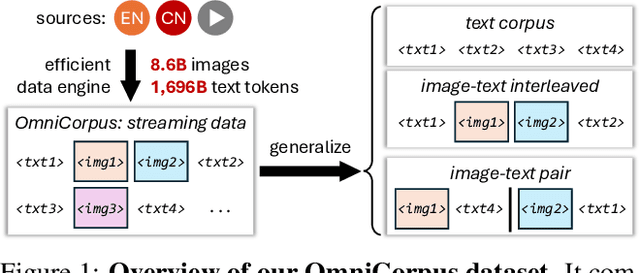


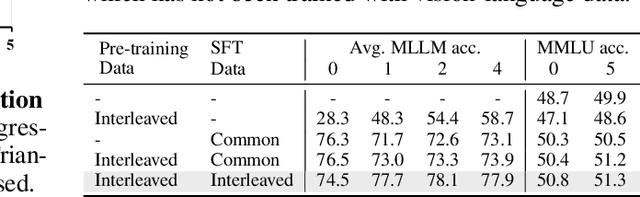
Image-text interleaved data, consisting of multiple images and texts arranged in a natural document format, aligns with the presentation paradigm of internet data and closely resembles human reading habits. Recent studies have shown that such data aids multimodal in-context learning and maintains the capabilities of large language models during multimodal fine-tuning. However, the limited scale and diversity of current image-text interleaved data restrict the development of multimodal large language models. In this paper, we introduce OmniCorpus, a 10 billion-scale image-text interleaved dataset. Using an efficient data engine, we filter and extract large-scale high-quality documents, which contain 8.6 billion images and 1,696 billion text tokens. Compared to counterparts (e.g., MMC4, OBELICS), our dataset 1) has 15 times larger scales while maintaining good data quality; 2) features more diverse sources, including both English and non-English websites as well as video-centric websites; 3) is more flexible, easily degradable from an image-text interleaved format to pure text corpus and image-text pairs. Through comprehensive analysis and experiments, we validate the quality, usability, and effectiveness of the proposed dataset. We hope this could provide a solid data foundation for future multimodal model research. Code and data are released at https://github.com/OpenGVLab/OmniCorpus.
OmniCorpus: An Unified Multimodal Corpus of 10 Billion-Level Images Interleaved with Text
Jun 12, 2024Image-text interleaved data, consisting of multiple images and texts arranged in a natural document format, aligns with the presentation paradigm of internet data and closely resembles human reading habits. Recent studies have shown that such data aids multimodal in-context learning and maintains the capabilities of large language models during multimodal fine-tuning. However, the limited scale and diversity of current image-text interleaved data restrict the development of multimodal large language models. In this paper, we introduce OmniCorpus, a 10 billion-scale image-text interleaved dataset. Using an efficient data engine, we filter and extract large-scale high-quality documents, which contain 8.6 billion images and 1,696 billion text tokens. Compared to counterparts (e.g., MMC4, OBELICS), our dataset 1) has 15 times larger scales while maintaining good data quality; 2) features more diverse sources, including both English and non-English websites as well as video-centric websites; 3) is more flexible, easily degradable from an image-text interleaved format to pure text corpus and image-text pairs. Through comprehensive analysis and experiments, we validate the quality, usability, and effectiveness of the proposed dataset. We hope this could provide a solid data foundation for future multimodal model research. Code and data are released at https://github.com/OpenGVLab/OmniCorpus.