 Add to Chrome
 Add to Firefox
 Add to Edge
From Spatial Semantics to Temporal Context: Leveraging Gaze Trajectory for Weakly Supervised Medical Image Segmentation
Jul 29, 2026
Medical image segmentation heavily depends on labor-intensive and time-consuming pixel-level annotations. Eye tracking offers a cost-effective solution that can be naturally integrated into clinical workflows. Recorded by eye trackers, gaze conveys the spatial regions of clinicians' attention through fixations and the temporal context of clinicians' progressive visual perception from trajectories. Nevertheless, effective modeling of temporal trajectories remains challenging, and noise in gaze caused by exploratory fixations greatly limits segmentation performance. To overcome these limitations, we propose the Trajectory-guided Uncertainty-aware Network (TrailNet), which exploits gaze-supervised medical image segmentation from spatial semantics modeling to temporal context by jointly leveraging fixations and trajectories. Specifically, the proposed trajectory-guided spatio-temporal encoder models temporal context and establishes complementary interactions with image spatial semantics to strengthen target perception. Furthermore, the multi-scale uncertainty decoder leverages category mutual-exclusivity constraints to produce deterministic predictions and mitigate supervision uncertainty induced by noise. To enable gaze-free inference, we further introduce a cycle distillation strategy that transfers feature-level knowledge via teacher-student networks. Experimental results on two public datasets demonstrate that TrailNet outperforms state-of-the-art methods, achieving Dice scores of 81.25% and 81.85%, respectively.

Following the Diagnostic Trace: Visual Cognition-guided Cooperative Network for Chest X-Ray Diagnosis
Feb 25, 2026Computer-aided diagnosis (CAD) has significantly advanced automated chest X-ray diagnosis but remains isolated from clinical workflows and lacks reliable decision support and interpretability. Human-AI collaboration seeks to enhance the reliability of diagnostic models by integrating the behaviors of controllable radiologists. However, the absence of interactive tools seamlessly embedded within diagnostic routines impedes collaboration, while the semantic gap between radiologists' decision-making patterns and model representations further limits clinical adoption. To overcome these limitations, we propose a visual cognition-guided collaborative network (VCC-Net) to achieve the cooperative diagnostic paradigm. VCC-Net centers on visual cognition (VC) and employs clinically compatible interfaces, such as eye-tracking or the mouse, to capture radiologists' visual search traces and attention patterns during diagnosis. VCC-Net employs VC as a spatial cognition guide, learning hierarchical visual search strategies to localize diagnostically key regions. A cognition-graph co-editing module subsequently integrates radiologist VC with model inference to construct a disease-aware graph. The module captures dependencies among anatomical regions and aligns model representations with VC-driven features, mitigating radiologist bias and facilitating complementary, transparent decision-making. Experiments on the public datasets SIIM-ACR, EGD-CXR, and self-constructed TB-Mouse dataset achieved classification accuracies of 88.40%, 85.05%, and 92.41%, respectively. The attention maps produced by VCC-Net exhibit strong concordance with radiologists' gaze distributions, demonstrating a mutual reinforcement of radiologist and model inference. The code is available at https://github.com/IPMI-NWU/VCC-Net.
HELPNet: Hierarchical Perturbations Consistency and Entropy-guided Ensemble for Scribble Supervised Medical Image Segmentation
Dec 25, 2024

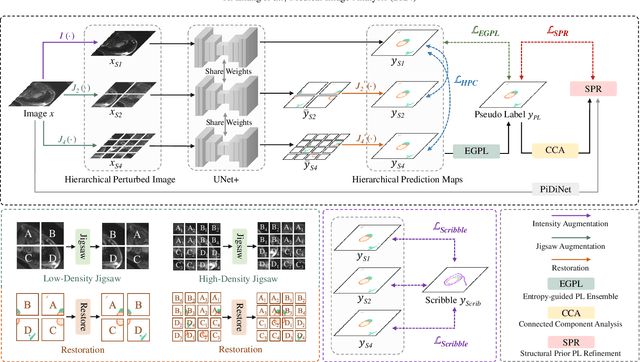

Creating fully annotated labels for medical image segmentation is prohibitively time-intensive and costly, emphasizing the necessity for innovative approaches that minimize reliance on detailed annotations. Scribble annotations offer a more cost-effective alternative, significantly reducing the expenses associated with full annotations. However, scribble annotations offer limited and imprecise information, failing to capture the detailed structural and boundary characteristics necessary for accurate organ delineation. To address these challenges, we propose HELPNet, a novel scribble-based weakly supervised segmentation framework, designed to bridge the gap between annotation efficiency and segmentation performance. HELPNet integrates three modules. The Hierarchical perturbations consistency (HPC) module enhances feature learning by employing density-controlled jigsaw perturbations across global, local, and focal views, enabling robust modeling of multi-scale structural representations. Building on this, the Entropy-guided pseudo-label (EGPL) module evaluates the confidence of segmentation predictions using entropy, generating high-quality pseudo-labels. Finally, the structural prior refinement (SPR) module incorporates connectivity and bounded priors to enhance the precision and reliability and pseudo-labels. Experimental results on three public datasets ACDC, MSCMRseg, and CHAOS show that HELPNet significantly outperforms state-of-the-art methods for scribble-based weakly supervised segmentation and achieves performance comparable to fully supervised methods. The code is available at https://github.com/IPMI-NWU/HELPNet.
Gaze-directed Vision GNN for Mitigating Shortcut Learning in Medical Image
Jun 20, 2024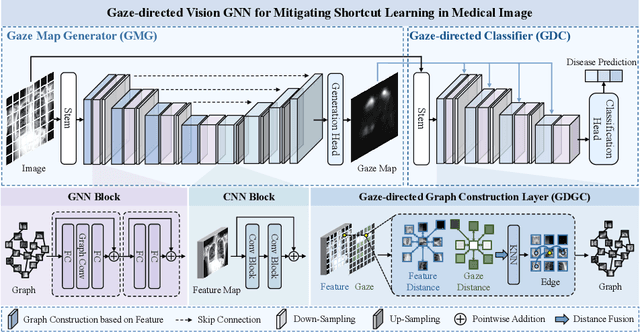
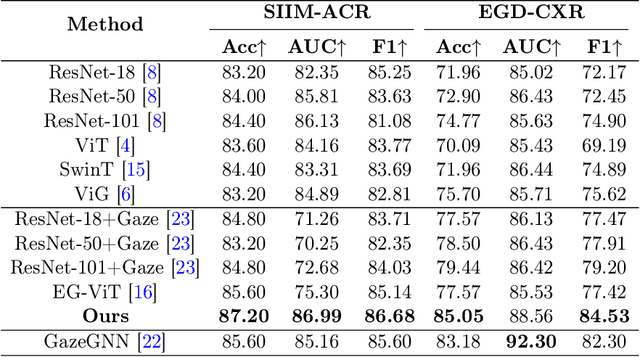
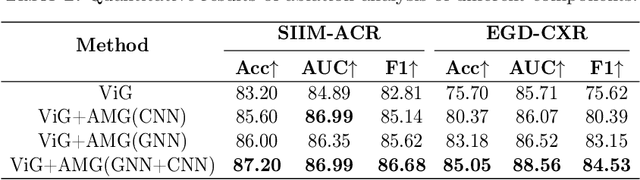
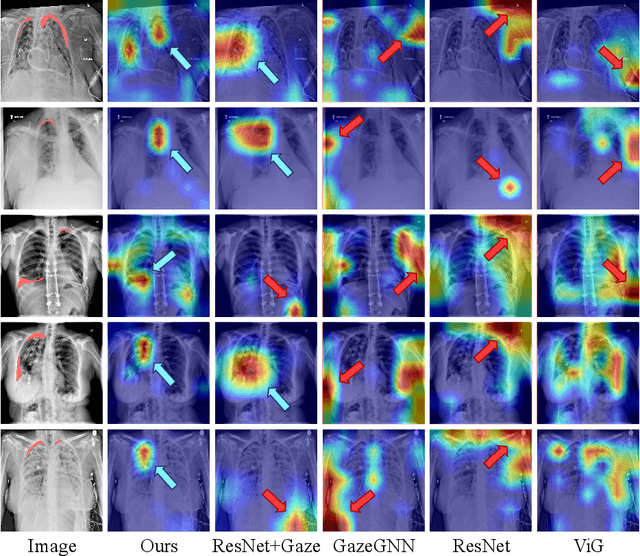
Deep neural networks have demonstrated remarkable performance in medical image analysis. However, its susceptibility to spurious correlations due to shortcut learning raises concerns about network interpretability and reliability. Furthermore, shortcut learning is exacerbated in medical contexts where disease indicators are often subtle and sparse. In this paper, we propose a novel gaze-directed Vision GNN (called GD-ViG) to leverage the visual patterns of radiologists from gaze as expert knowledge, directing the network toward disease-relevant regions, and thereby mitigating shortcut learning. GD-ViG consists of a gaze map generator (GMG) and a gaze-directed classifier (GDC). Combining the global modelling ability of GNNs with the locality of CNNs, GMG generates the gaze map based on radiologists' visual patterns. Notably, it eliminates the need for real gaze data during inference, enhancing the network's practical applicability. Utilizing gaze as the expert knowledge, the GDC directs the construction of graph structures by incorporating both feature distances and gaze distances, enabling the network to focus on disease-relevant foregrounds. Thereby avoiding shortcut learning and improving the network's interpretability. The experiments on two public medical image datasets demonstrate that GD-ViG outperforms the state-of-the-art methods, and effectively mitigates shortcut learning. Our code is available at https://github.com/SX-SS/GD-ViG.