 Add to Chrome
 Add to Firefox
 Add to Edge
Freeze, Then Select: Structured Field Adapters and Stability-Validated Weak Selection for PDE Discovery from Sparse Observations
Jul 31, 2026
PDE discovery from sparse observations requires reconstructing a continuous field and selecting the correct differential terms. Our analysis of optimization paths in coupled neural PDE discovery reveals three behaviors: the exact support can persist to the end of training, appear only transiently, or fail to emerge. To decouple equation selection from neural optimization, we develop a freeze-then-select method combining a structured field adapter with Stability-Validated Weak Selection (SVWS). Trained from observations without a PDE residual, the adapter factorizes the field into learned spatial features and temporal coefficients represented by cubic splines. After freezing the field, SVWS identifies recurrent terms across independent weak-form systems, refits candidate supports, and selects the final equation on held-out weak-form systems. Beyond fixed libraries, we apply the same principle to expressions generated by genetic programming and recover the power-law form of an unknown nonlinear diffusion function from sparse, noisy observations. Across all six sparse MDBench regimes, our method attains the highest exact support recovery rate, with its clearest gains over classical and neural baselines on challenging Kuramoto-Sivashinsky dynamics.

SkillForge: Forging Domain-Specific, Self-Evolving Agent Skills in Cloud Technical Support
Apr 09, 2026Deploying LLM-powered agents in enterprise scenarios such as cloud technical support demands high-quality, domain-specific skills. However, existing skill creators lack domain grounding, producing skills poorly aligned with real-world task requirements. Moreover, once deployed, there is no systematic mechanism to trace execution failures back to skill deficiencies and drive targeted refinements, leaving skill quality stagnant despite accumulating operational evidence. We introduce SkillForge, a self-evolving framework that closes an end-to-end creation-evaluation-refinement loop. To produce well-aligned initial skills, a Domain-Contextualized Skill Creator grounds skill synthesis in knowledge bases and historical support tickets. To enable continuous self-optimization, a three-stage pipeline -- Failure Analyzer, Skill Diagnostician, and Skill Optimizer -- automatically diagnoses execution failures in batch, pinpoints the underlying skill deficiencies, and rewrites the skill to eliminate them. This cycle runs iteratively, allowing skills to self-improve with every round of deployment feedback. Evaluated on five real-world cloud support scenarios spanning 1,883 tickets and 3,737 tasks, experiments show that: (1) the Domain-Contextualized Skill Creator produces substantially better initial skills than the generic skill creator, as measured by consistency with expert-authored reference responses from historical tickets; and (2) the self-evolution loop progressively improves skill quality from diverse starting points (including expert-authored, domain-created, and generic skills) across successive rounds, demonstrating that automated evolution can surpass manually curated expert knowledge.
CirrusBench: Evaluating LLM-based Agents Beyond Correctness in Real-World Cloud Service Environments
Mar 30, 2026The increasing agentic capabilities of Large Language Models (LLMs) have enabled their deployment in real-world applications, such as cloud services, where customer-assistant interactions exhibit high technical complexity and long-horizon dependencies, making robustness and resolution efficiency critical for customer satisfaction. However, existing benchmarks for LLM-based agents largely rely on synthetic environments that fail to capture the diversity and unpredictability of authentic customer inputs, often ignoring the resolution efficiency essential for real-world deployment. To bridge this gap, we introduce CirrusBench, a novel evaluation framework distinguished by its foundation in real-world data from authentic cloud service tickets. CirrusBench preserves the intricate multi-turn logical chains and realistic tool dependencies inherent to technical service environments. Moving beyond execution correctness, we introduce novel Customer-Centric metrics to define agent success, quantifying service quality through metrics such as the Normalized Efficiency Index and Multi-Turn Latency to explicitly measure resolution efficiency. Experiments utilizing our framework reveal that while state-of-the-art models demonstrate strong reasoning capabilities, they frequently struggle in complex, realistic multi-turn tasks and fail to meet the high-efficiency standards required for customer service, highlighting critical directions for the future development of LLM-based agents in practical technical service applications. CirrusBench evaluation framework is released at: https://github.com/CirrusAI
Lightweight Adaptation for LLM-based Technical Service Agent: Latent Logic Augmentation and Robust Noise Reduction
Mar 18, 2026Adapting Large Language Models in complex technical service domains is constrained by the absence of explicit cognitive chains in human demonstrations and the inherent ambiguity arising from the diversity of valid responses. These limitations severely hinder agents from internalizing latent decision dynamics and generalizing effectively. Moreover, practical adaptation is often impeded by the prohibitive resource and time costs associated with standard training paradigms. To overcome these challenges and guarantee computational efficiency, we propose a lightweight adaptation framework comprising three key contributions. (1) Latent Logic Augmentation: We introduce Planning-Aware Trajectory Modeling and Decision Reasoning Augmentation to bridge the gap between surface-level supervision and latent decision logic. These approaches strengthen the stability of Supervised Fine-Tuning alignment. (2) Robust Noise Reduction: We construct a Multiple Ground Truths dataset through a dual-filtering method to reduce the noise by validating diverse responses, thereby capturing the semantic diversity. (3) Lightweight Adaptation: We design a Hybrid Reward mechanism that fuses an LLM-based judge with a lightweight relevance-based Reranker to distill high-fidelity reward signals while reducing the computational cost compared to standard LLM-as-a-Judge reinforcement learning. Empirical evaluations on real-world Cloud service tasks, conducted across semantically diverse settings, demonstrate that our framework achieves stability and performance gains through Latent Logic Augmentation and Robust Noise Reduction. Concurrently, our Hybrid Reward mechanism achieves alignment comparable to standard LLM-as-a-judge methods with reduced training time, underscoring the practical value for deploying technical service agents.
RPG: A Repository Planning Graph for Unified and Scalable Codebase Generation
Sep 19, 2025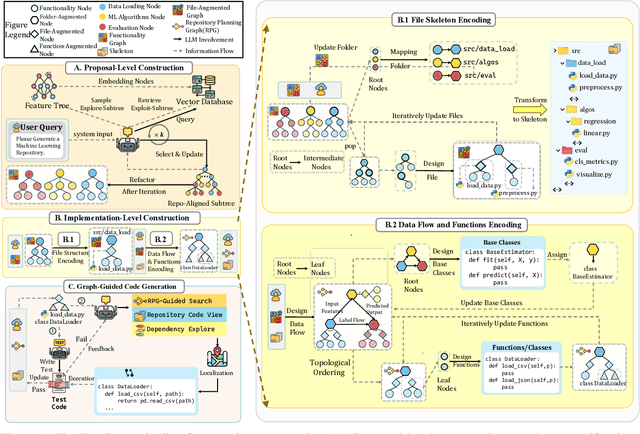
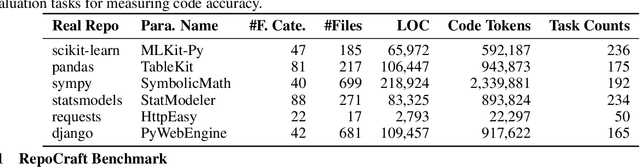
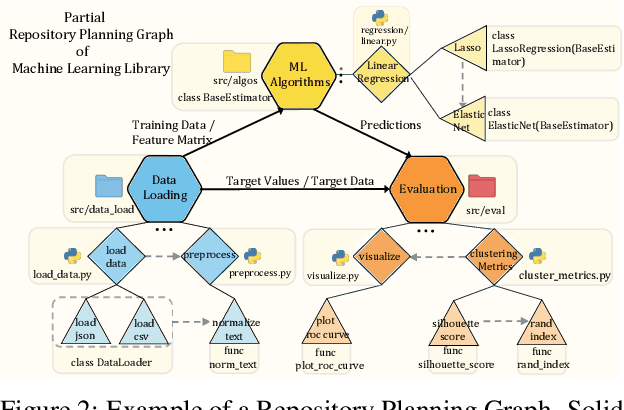
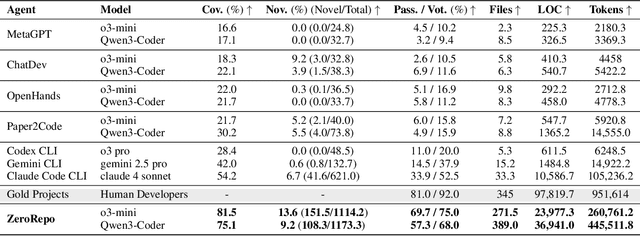
Large language models excel at function- and file-level code generation, yet generating complete repositories from scratch remains a fundamental challenge. This process demands coherent and reliable planning across proposal- and implementation-level stages, while natural language, due to its ambiguity and verbosity, is ill-suited for faithfully representing complex software structures. To address this, we introduce the Repository Planning Graph (RPG), a persistent representation that unifies proposal- and implementation-level planning by encoding capabilities, file structures, data flows, and functions in one graph. RPG replaces ambiguous natural language with an explicit blueprint, enabling long-horizon planning and scalable repository generation. Building on RPG, we develop ZeroRepo, a graph-driven framework for repository generation from scratch. It operates in three stages: proposal-level planning and implementation-level refinement to construct the graph, followed by graph-guided code generation with test validation. To evaluate this setting, we construct RepoCraft, a benchmark of six real-world projects with 1,052 tasks. On RepoCraft, ZeroRepo produces repositories averaging nearly 36K LOC, roughly 3.9$\times$ the strongest baseline (Claude Code) and about 64$\times$ other baselines. It attains 81.5% functional coverage and a 69.7% pass rate, exceeding Claude Code by 27.3 and 35.8 percentage points, respectively. Further analysis shows that RPG models complex dependencies, enables progressively more sophisticated planning through near-linear scaling, and enhances LLM understanding of repositories, thereby accelerating agent localization.
RePrompt: Reasoning-Augmented Reprompting for Text-to-Image Generation via Reinforcement Learning
May 23, 2025Despite recent progress in text-to-image (T2I) generation, existing models often struggle to faithfully capture user intentions from short and under-specified prompts. While prior work has attempted to enhance prompts using large language models (LLMs), these methods frequently generate stylistic or unrealistic content due to insufficient grounding in visual semantics and real-world composition. Inspired by recent advances in reasoning for language model, we propose RePrompt, a novel reprompting framework that introduces explicit reasoning into the prompt enhancement process via reinforcement learning. Instead of relying on handcrafted rules or stylistic rewrites, our method trains a language model to generate structured, self-reflective prompts by optimizing for image-level outcomes. The tailored reward models assesse the generated images in terms of human preference, semantic alignment, and visual composition, providing indirect supervision to refine prompt generation. Our approach enables end-to-end training without human-annotated data. Experiments on GenEval and T2I-Compbench show that RePrompt significantly boosts spatial layout fidelity and compositional generalization across diverse T2I backbones, establishing new state-of-the-art results.
MAIN: Mutual Alignment Is Necessary for instruction tuning
Apr 17, 2025Instruction tuning has enabled large language models (LLMs) to achieve remarkable performance, but its success heavily depends on the availability of large-scale, high-quality instruction-response pairs. However, current methods for scaling up data generation often overlook a crucial aspect: the alignment between instructions and responses. We hypothesize that high-quality instruction-response pairs are not defined by the individual quality of each component, but by the extent of their alignment with each other. To address this, we propose a Mutual Alignment Framework (MAIN) that ensures coherence between the instruction and response through mutual constraints. Experiments demonstrate that models such as LLaMA and Mistral, fine-tuned within this framework, outperform traditional methods across multiple benchmarks. This approach underscores the critical role of instruction-response alignment in enabling scalable and high-quality instruction tuning for LLMs.
GeAR: Generation Augmented Retrieval
Jan 06, 2025


Document retrieval techniques form the foundation for the development of large-scale information systems. The prevailing methodology is to construct a bi-encoder and compute the semantic similarity. However, such scalar similarity is difficult to reflect enough information and impedes our comprehension of the retrieval results. In addition, this computational process mainly emphasizes the global semantics and ignores the fine-grained semantic relationship between the query and the complex text in the document. In this paper, we propose a new method called $\textbf{Ge}$neration $\textbf{A}$ugmented $\textbf{R}$etrieval ($\textbf{GeAR}$) that incorporates well-designed fusion and decoding modules. This enables GeAR to generate the relevant text from documents based on the fused representation of the query and the document, thus learning to "focus on" the fine-grained information. Also when used as a retriever, GeAR does not add any computational burden over bi-encoders. To support the training of the new framework, we have introduced a pipeline to efficiently synthesize high-quality data by utilizing large language models. GeAR exhibits competitive retrieval and localization performance across diverse scenarios and datasets. Moreover, the qualitative analysis and the results generated by GeAR provide novel insights into the interpretation of retrieval results. The code, data, and models will be released after completing technical review to facilitate future research.
StreamAdapter: Efficient Test Time Adaptation from Contextual Streams
Nov 14, 2024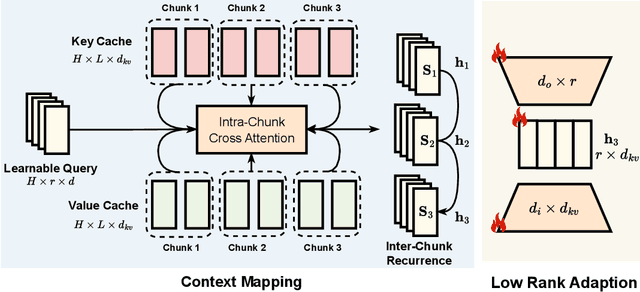
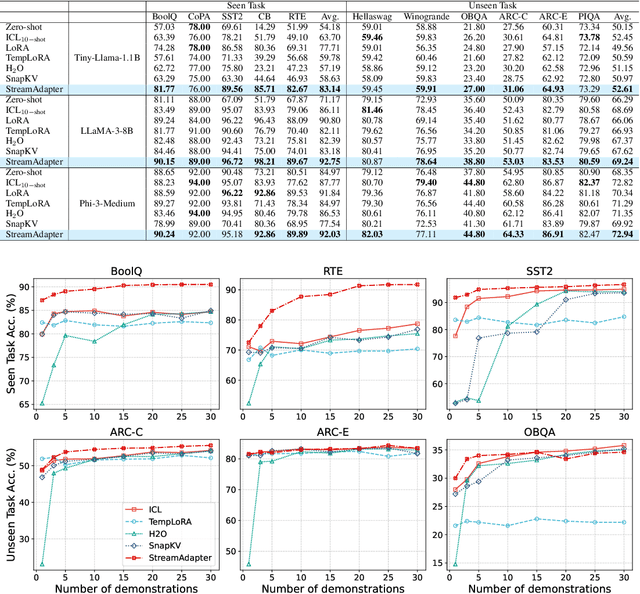
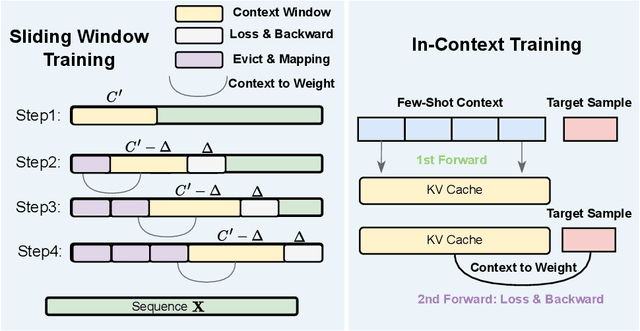
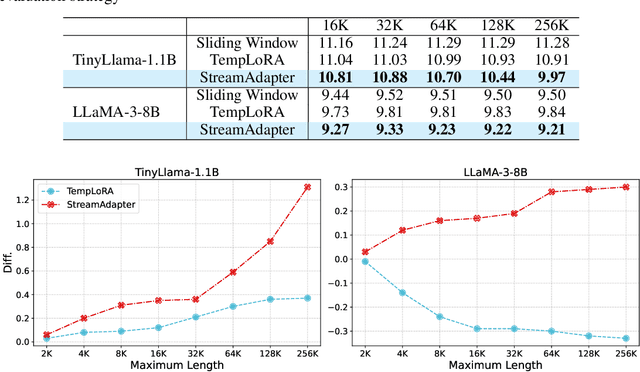
In-context learning (ICL) allows large language models (LLMs) to adapt to new tasks directly from the given demonstrations without requiring gradient updates. While recent advances have expanded context windows to accommodate more demonstrations, this approach increases inference costs without necessarily improving performance. To mitigate these issues, We propose StreamAdapter, a novel approach that directly updates model parameters from context at test time, eliminating the need for explicit in-context demonstrations. StreamAdapter employs context mapping and weight absorption mechanisms to dynamically transform ICL demonstrations into parameter updates with minimal additional parameters. By reducing reliance on numerous in-context examples, StreamAdapter significantly reduce inference costs and allows for efficient inference with constant time complexity, regardless of demonstration count. Extensive experiments across diverse tasks and model architectures demonstrate that StreamAdapter achieves comparable or superior adaptation capability to ICL while requiring significantly fewer demonstrations. The superior task adaptation and context encoding capabilities of StreamAdapter on both language understanding and generation tasks provides a new perspective for adapting LLMs at test time using context, allowing for more efficient adaptation across scenarios and more cost-effective inference
Token-level Proximal Policy Optimization for Query Generation
Nov 01, 2024Query generation is a critical task for web search engines (e.g. Google, Bing) and recommendation systems. Recently, state-of-the-art query generation methods leverage Large Language Models (LLMs) for their strong capabilities in context understanding and text generation. However, they still face challenges in generating high-quality queries in terms of inferring user intent based on their web search interaction history. In this paper, we propose Token-level Proximal Policy Optimization (TPPO), a noval approach designed to empower LLMs perform better in query generation through fine-tuning. TPPO is based on the Reinforcement Learning from AI Feedback (RLAIF) paradigm, consisting of a token-level reward model and a token-level proximal policy optimization module to address the sparse reward challenge in traditional RLAIF frameworks. To evaluate the effectiveness and robustness of TPPO, we conducted experiments on both open-source dataset and an industrial dataset that was collected from a globally-used search engine. The experimental results demonstrate that TPPO significantly improves the performance of query generation for LLMs and outperforms its existing competitors.