 Add to Chrome
 Add to Firefox
 Add to Edge
MERaLiON-GR: Speech Gender Recognition Model for English and SEA Languages
Aug 05, 2026
We present MERaLiON-GR, a speech gender recognition system that performs binary classification (female / male) on English and Southeast Asian (SEA) languages. The model finetunes MERaLiON-SpeechEncoder-2, a large conformer based transformer pre-trained on a broad speech corpus, and applies parameter efficient fine-tuning via Low-Rank Adaptation (LoRA) to adapt the encoder to the gender recognition task, and appends a multi-scale ECAPA-TDNN down stream network with attention pooling and a lightweight linear classifier. Extensive evaluations across multilingual Singaporean and Southeast Asian languages (English, Chinese, Malay, Tamil, Thai, Vietnamese, Indonesian, and Khmer) show that MERaLiON-GR consistently surpasses the state-of-the-art gender recognition model Vox-Profile and a large Audio-LLM, in both full-utterance and segment level evaluation modes. The results underscore the value of dedicated speech models in achieving accurate paralinguistic understanding and strong cross-lingual generalization.

SUV: Future Scene Understanding as Video Generation for End-to-End Driving
Aug 04, 2026End-to-end driving requires a coherent understanding of future scenes, yet existing methods model these scenes using task-specific heads and output formats, with limited scalability. Can video generation instead provide a shared predictor? We introduce SUV, a unified end-to-end driving framework that casts future Scene Understanding as Video generation using a pretrained video foundation model. SUV models future appearance, semantics, relative depth, and instance-level dynamics as video streams with a shared video expert, without stream-specific visual prediction heads. Through joint video-action attention, the action expert attends to the latent representations of all future streams and generates the ego trajectory. Experiments show that SUV directly predicts all four future streams, while controlled ablations show that structured future supervision and direct future-stream access yield higher trajectory planning scores. With only a single front camera and no candidate-trajectory selection, SUV outperforms a broad set of recent state-of-the-art methods on both NAVSIM-v2 splits, achieving 91.0 EPDMS on navtest and 36.9 on navhard. On the long-tail WOD-E2E benchmark, SUV achieves a competitive RFS of 7.94.
SportD: Can VLMs Physically Strategize?
Jul 16, 2026Vision--language models have become increasingly capable of interpreting visual scenes, but it remains unclear whether they can use information to make strategically effective decisions. We investigate this question in soccer, where models observe the seconds preceding an on-ball decision and must choose whether to shoot or pass to a specific teammate. Unlike conventional visual-understanding tasks, soccer enables decisions to be evaluated quantitatively by estimating the value of every available action. We introduce SportD, a benchmark comprising 478 on-ball decisions from the 2022 FIFA World Cup. Each model choice is evaluated against a possession-value model that estimates the action that most increases the attacking team's probability of scoring, allowing us to measure both optimal-action accuracy and the value forfeited by suboptimal decisions. Across three frontier VLMs, the best selects the highest-valued action on 31.4% of events, compared with 38.9% for the professional players, and all models incur significantly greater regret. Further analysis reveals a systematic preference for lower-variance and lower-reward actions: VLMs shoot less often and select substantially less progressive passes than either the optimal policy or the real players. The models also reproduce the player's specific action above chance even when that action is suboptimal, suggesting partial imitation of familiar play patterns rather than consistent evaluation of counterfactual alternatives. SportD provides a value-grounded testbed for measuring physical strategic reasoning in VLMs.
Compositional Text-to-Image Generation Via Region-aware Bimodal Direct Preference Optimization
May 27, 2026Despite the rapid progress of text-to-image (T2I) models, generating images that accurately reflect complex compositional prompts (covering attribute bindings, object relationships, counting) still remains challenging. To address this, we propose BiDPO, a framework to enhance T2I model's capability of compositional text-to-image generation. We begin by introducing an carefully designed pipeline to construct a large-scale preference dataset, BiComp, with strictly quality control. Then, we extend Diffusion DPO to jointly optimize image and text preferences, which is shown to greatly effective in improving the models to follow complex text prompt in generation. To further enhance the models for fine-grained alignment, we employ a region-level guidance method to focus on regions relevant to compositional concepts. Experimental results demonstrate that our BiDPO substantially improves compositional fidelity, consistently outperforming prior methods across multiple benchmarks. Our approach highlights the potential of preference-based fine-tuning for complex text-to-image tasks, offering a flexible and scalable alternative to existing techniques.
Unlocking Cognitive Capabilities and Analyzing the Perception-Logic Trade-off
Feb 27, 2026Recent advancements in Multimodal Large Language Models (MLLMs) pursue omni-perception capabilities, yet integrating robust sensory grounding with complex reasoning remains a challenge, particularly for underrepresented regions. In this report, we introduce the research preview of MERaLiON2-Omni (Alpha), a 10B-parameter multilingual omni-perception tailored for Southeast Asia (SEA). We present a progressive training pipeline that explicitly decouples and then integrates "System 1" (Perception) and "System 2" (Reasoning) capabilities. First, we establish a robust Perception Backbone by aligning region-specific audio-visual cues (e.g., Singlish code-switching, local cultural landmarks) with a multilingual LLM through orthogonal modality adaptation. Second, to inject cognitive capabilities without large-scale supervision, we propose a cost-effective Generate-Judge-Refine pipeline. By utilizing a Super-LLM to filter hallucinations and resolve conflicts via a consensus mechanism, we synthesize high-quality silver data that transfers textual Chain-of-Thought reasoning to multimodal scenarios. Comprehensive evaluation on our newly introduced SEA-Omni Benchmark Suite reveals an Efficiency-Stability Paradox: while reasoning acts as a non-linear amplifier for abstract tasks (boosting mathematical and instruction-following performance significantly), it introduces instability in low-level sensory processing. Specifically, we identify Temporal Drift in long-context audio, where extended reasoning desynchronizes the model from acoustic timestamps, and Visual Over-interpretation, where logic overrides pixel-level reality. This report details the architecture, the data-efficient training recipe, and a diagnostic analysis of the trade-offs between robust perception and structured reasoning.
Beyond Classification: Towards Speech Emotion Reasoning with Multitask AudioLLMs
Jun 07, 2025Audio Large Language Models (AudioLLMs) have achieved strong results in semantic tasks like speech recognition and translation, but remain limited in modeling paralinguistic cues such as emotion. Existing approaches often treat emotion understanding as a classification problem, offering little insight into the underlying rationale behind predictions. In this work, we explore emotion reasoning, a strategy that leverages the generative capabilities of AudioLLMs to enhance emotion recognition by producing semantically aligned, evidence-grounded explanations. To support this in multitask AudioLLMs, we introduce a unified framework combining reasoning-augmented data supervision, dual-encoder architecture, and task-alternating training. This approach enables AudioLLMs to effectively learn different tasks while incorporating emotional reasoning. Experiments on IEMOCAP and MELD show that our approach not only improves emotion prediction accuracy but also enhances the coherence and evidential grounding of the generated responses.
Advancing Singlish Understanding: Bridging the Gap with Datasets and Multimodal Models
Jan 02, 2025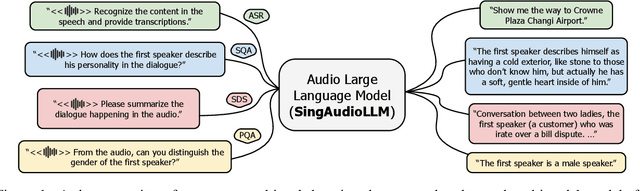
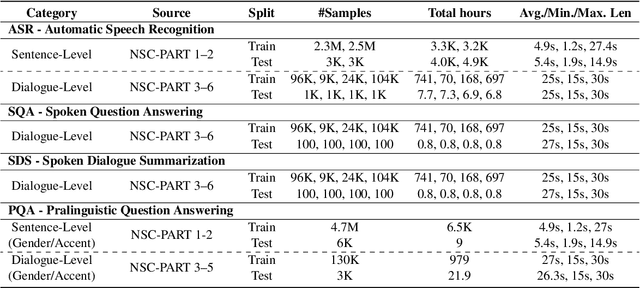
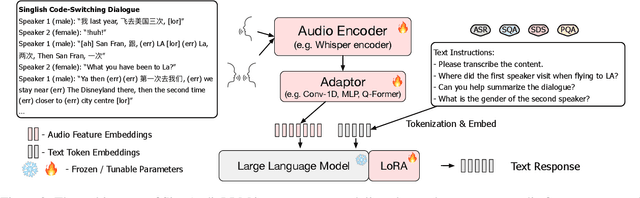
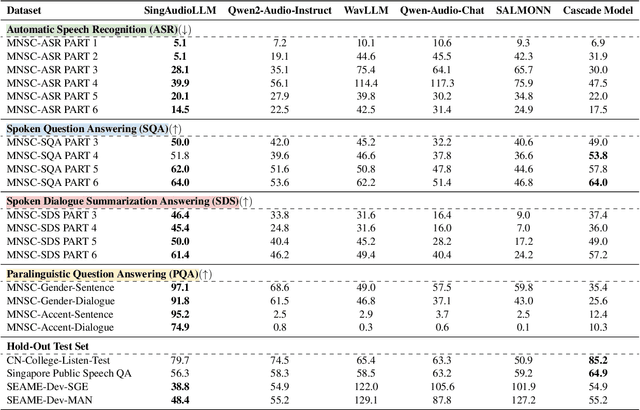
Singlish, a Creole language rooted in English, is a key focus in linguistic research within multilingual and multicultural contexts. However, its spoken form remains underexplored, limiting insights into its linguistic structure and applications. To address this gap, we standardize and annotate the largest spoken Singlish corpus, introducing the Multitask National Speech Corpus (MNSC). These datasets support diverse tasks, including Automatic Speech Recognition (ASR), Spoken Question Answering (SQA), Spoken Dialogue Summarization (SDS), and Paralinguistic Question Answering (PQA). We release standardized splits and a human-verified test set to facilitate further research. Additionally, we propose SingAudioLLM, a multi-task multimodal model leveraging multimodal large language models to handle these tasks concurrently. Experiments reveal our models adaptability to Singlish context, achieving state-of-the-art performance and outperforming prior models by 10-30% in comparison with other AudioLLMs and cascaded solutions.
MERaLiON-AudioLLM: Bridging Audio and Language with Large Language Models
Dec 18, 2024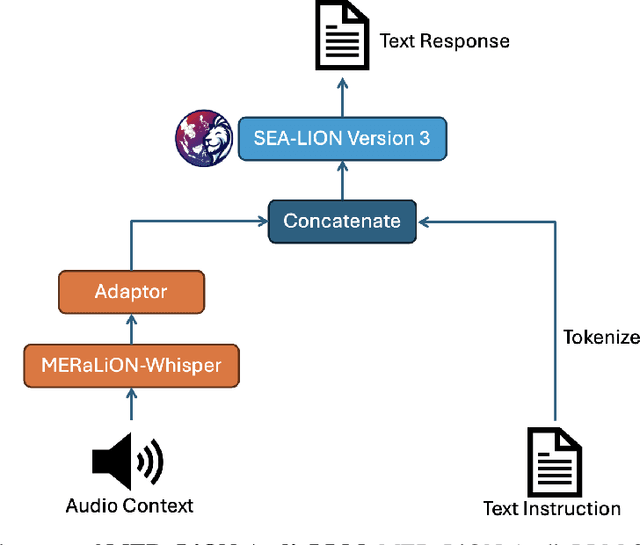
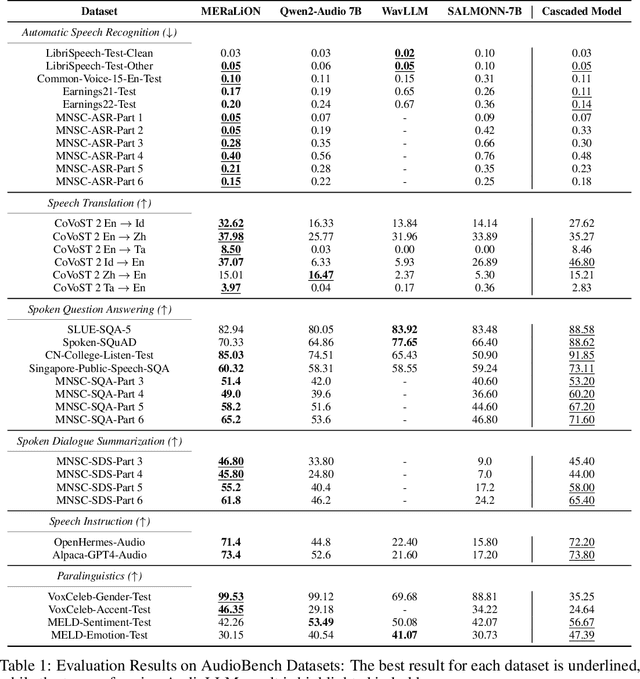
We introduce MERaLiON-AudioLLM (Multimodal Empathetic Reasoning and Learning in One Network), the first speech-text model tailored for Singapore's multilingual and multicultural landscape. Developed under the National Large Language Models Funding Initiative, Singapore, MERaLiON-AudioLLM integrates advanced speech and text processing to address the diverse linguistic nuances of local accents and dialects, enhancing accessibility and usability in complex, multilingual environments. Our results demonstrate improvements in both speech recognition and task-specific understanding, positioning MERaLiON-AudioLLM as a pioneering solution for region specific AI applications. We envision this release to set a precedent for future models designed to address localised linguistic and cultural contexts in a global framework.
MERaLiON-AudioLLM: Technical Report
Dec 13, 2024We introduce MERaLiON-AudioLLM (Multimodal Empathetic Reasoning and Learning in One Network), the first speech-text model tailored for Singapore's multilingual and multicultural landscape. Developed under the National Large Language Models Funding Initiative, Singapore, MERaLiON-AudioLLM integrates advanced speech and text processing to address the diverse linguistic nuances of local accents and dialects, enhancing accessibility and usability in complex, multilingual environments. Our results demonstrate improvements in both speech recognition and task-specific understanding, positioning MERaLiON-AudioLLM as a pioneering solution for region specific AI applications. We envision this release to set a precedent for future models designed to address localised linguistic and cultural contexts in a global framework.
MoWE-Audio: Multitask AudioLLMs with Mixture of Weak Encoders
Sep 10, 2024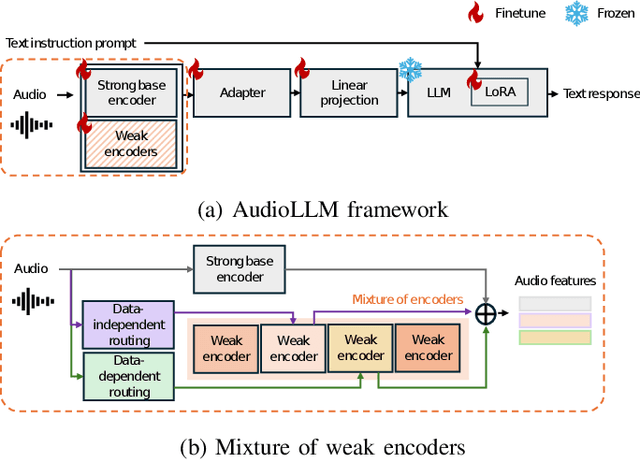

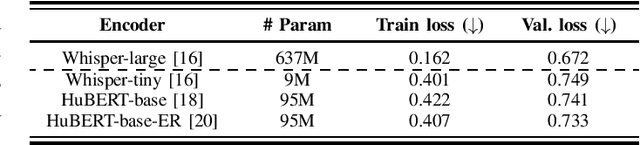

The rapid advancements in large language models (LLMs) have significantly enhanced natural language processing capabilities, facilitating the development of AudioLLMs that process and understand speech and audio inputs alongside text. Existing AudioLLMs typically combine a pre-trained audio encoder with a pre-trained LLM, which are subsequently finetuned on specific audio tasks. However, the pre-trained audio encoder has constrained capacity to capture features for new tasks and datasets. To address this, we propose to incorporate mixtures of `weak' encoders (MoWE) into the AudioLLM framework. MoWE supplements a base encoder with a pool of relatively light weight encoders, selectively activated based on the audio input to enhance feature extraction without significantly increasing model size. Our empirical results demonstrate that MoWE effectively improves multi-task performance, broadening the applicability of AudioLLMs to more diverse audio tasks.