 Add to Chrome
 Add to Firefox
 Add to Edge
ComplexityMT: Benchmarking the Interaction Between Text Complexity and Machine Translation
Jun 03, 2026
When a text is translated, does the translation retain the complexity of the original? We introduce ComplexityMT, a new challenge for assessing how text complexity and machine translation interact with and influence each other, using the Common European Framework of Reference for Languages (CEFR) levels as the measure of text complexity. Across six languages, including Arabic, Dutch, English, French, Hindi, and Russian, we evaluate three open-weight models, one closed model, and a commercial machine translation system on two tasks: i) correlation of CEFR with translation difficulty, and ii) shifts in CEFR levels of the source texts. Our experiments show that higher CEFR levels make texts more difficult to translate, and that machine translation shifts the CEFR level of the target text compared to the original source, for most languages. These findings provide new insights for researchers and practitioners working on multilingual pedagogical content generation and machine translation difficulty estimation.

SemEval-2026 Task 7: Everyday Knowledge Across Diverse Languages and Cultures
May 04, 2026We present our shared task on evaluating the adaptability of LLMs and NLP systems across multiple languages and cultures. The task data consist of an extended version of our manually constructed BLEnD benchmark (Myung et al. 2024), covering more than 30 language-culture pairs, predominantly representing low-resource languages spoken across multiple continents. As the task is designed strictly for evaluation, participants were not permitted to use the data for training, fine-tuning, few-shot learning, or any other form of model modification. Our task includes two tracks: (a) Short-Answer Questions (SAQ) and (b) Multiple-Choice Questions (MCQ). Participants were required to predict labels and were allowed to submit any NLP system and adopt diverse modelling strategies, provided that the benchmark was used solely for evaluation. The task attracted more than 140 registered participants, and we received final submissions from 62 teams, along with 19 system description papers. We report the results and present an analysis of the best-performing systems and the most commonly adopted approaches. Furthermore, we discuss shared insights into open questions and challenges related to evaluation, misalignment, and methodological perspectives on model behaviour in low-resource languages and for under-represented cultures.
Anthropogenic Regional Adaptation in Multimodal Vision-Language Model
Apr 13, 2026While the field of vision-language (VL) has achieved remarkable success in integrating visual and textual information across multiple languages and domains, there is still no dedicated framework for assessing human-centric alignment in vision-language systems. We offer two contributions to address this gap. First, we introduce Anthropogenic Regional Adaptation: a novel paradigm that aims to optimize model relevance to specific regional contexts while ensuring the retention of global generalization capabilities. Second, we present a simple, but effective adaptation method named Geographical-generalization-made-easy (GG-EZ), which utilizes regional data filtering and model merging. Through comprehensive experiments on 3 VL architectures: large vision-language models, text-to-image diffusion models, and vision-language embedding models, and a case study in Southeast Asia (SEA) regional adaptation, we demonstrate the importance of Anthropogenic Regional Adaptation and the effectiveness of GG-EZ, showing 5-15% gains in cultural relevance metrics across SEA while maintaining over 98% of global performance and even occasionally surpassing it. Our findings establish Anthropogenic Regional Alignment as a foundational paradigm towards applicability of multimodal vision-language models in diverse regions and demonstrate a simple-yet-effective baseline method that optimizes regional value alignment while preserving global generalization.
Safer Policy Compliance with Dynamic Epistemic Fallback
Jan 30, 2026Humans develop a series of cognitive defenses, known as epistemic vigilance, to combat risks of deception and misinformation from everyday interactions. Developing safeguards for LLMs inspired by this mechanism might be particularly helpful for their application in high-stakes tasks such as automating compliance with data privacy laws. In this paper, we introduce Dynamic Epistemic Fallback (DEF), a dynamic safety protocol for improving an LLM's inference-time defenses against deceptive attacks that make use of maliciously perturbed policy texts. Through various levels of one-sentence textual cues, DEF nudges LLMs to flag inconsistencies, refuse compliance, and fallback to their parametric knowledge upon encountering perturbed policy texts. Using globally recognized legal policies such as HIPAA and GDPR, our empirical evaluations report that DEF effectively improves the capability of frontier LLMs to detect and refuse perturbed versions of policies, with DeepSeek-R1 achieving a 100% detection rate in one setting. This work encourages further efforts to develop cognitively inspired defenses to improve LLM robustness against forms of harm and deception that exploit legal artifacts.
CommonLID: Re-evaluating State-of-the-Art Language Identification Performance on Web Data
Jan 25, 2026Language identification (LID) is a fundamental step in curating multilingual corpora. However, LID models still perform poorly for many languages, especially on the noisy and heterogeneous web data often used to train multilingual language models. In this paper, we introduce CommonLID, a community-driven, human-annotated LID benchmark for the web domain, covering 109 languages. Many of the included languages have been previously under-served, making CommonLID a key resource for developing more representative high-quality text corpora. We show CommonLID's value by using it, alongside five other common evaluation sets, to test eight popular LID models. We analyse our results to situate our contribution and to provide an overview of the state of the art. In particular, we highlight that existing evaluations overestimate LID accuracy for many languages in the web domain. We make CommonLID and the code used to create it available under an open, permissive license.
Kaleidoscope: In-language Exams for Massively Multilingual Vision Evaluation
Apr 09, 2025The evaluation of vision-language models (VLMs) has mainly relied on English-language benchmarks, leaving significant gaps in both multilingual and multicultural coverage. While multilingual benchmarks have expanded, both in size and languages, many rely on translations of English datasets, failing to capture cultural nuances. In this work, we propose Kaleidoscope, as the most comprehensive exam benchmark to date for the multilingual evaluation of vision-language models. Kaleidoscope is a large-scale, in-language multimodal benchmark designed to evaluate VLMs across diverse languages and visual inputs. Kaleidoscope covers 18 languages and 14 different subjects, amounting to a total of 20,911 multiple-choice questions. Built through an open science collaboration with a diverse group of researchers worldwide, Kaleidoscope ensures linguistic and cultural authenticity. We evaluate top-performing multilingual vision-language models and find that they perform poorly on low-resource languages and in complex multimodal scenarios. Our results highlight the need for progress on culturally inclusive multimodal evaluation frameworks.
Crowdsource, Crawl, or Generate? Creating SEA-VL, a Multicultural Vision-Language Dataset for Southeast Asia
Mar 10, 2025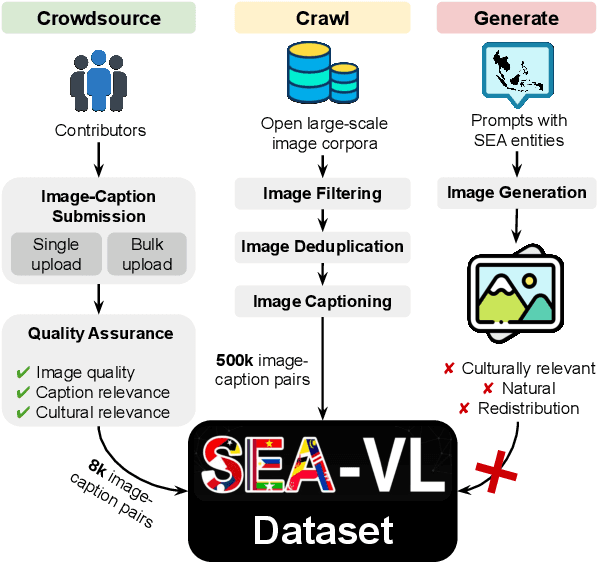
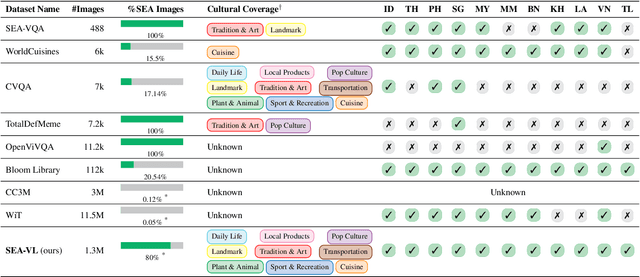
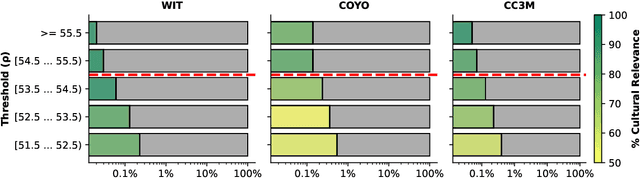
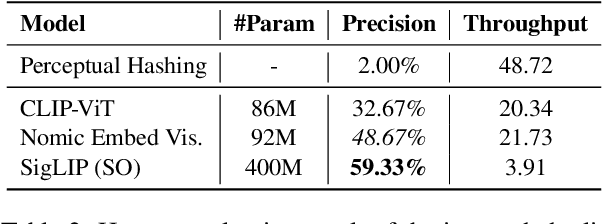
Southeast Asia (SEA) is a region of extraordinary linguistic and cultural diversity, yet it remains significantly underrepresented in vision-language (VL) research. This often results in artificial intelligence (AI) models that fail to capture SEA cultural nuances. To fill this gap, we present SEA-VL, an open-source initiative dedicated to developing high-quality, culturally relevant data for SEA languages. By involving contributors from SEA countries, SEA-VL aims to ensure better cultural relevance and diversity, fostering greater inclusivity of underrepresented languages in VL research. Beyond crowdsourcing, our initiative goes one step further in the exploration of the automatic collection of culturally relevant images through crawling and image generation. First, we find that image crawling achieves approximately ~85% cultural relevance while being more cost- and time-efficient than crowdsourcing. Second, despite the substantial progress in generative vision models, synthetic images remain unreliable in accurately reflecting SEA cultures. The generated images often fail to reflect the nuanced traditions and cultural contexts of the region. Collectively, we gather 1.28M SEA culturally-relevant images, more than 50 times larger than other existing datasets. Through SEA-VL, we aim to bridge the representation gap in SEA, fostering the development of more inclusive AI systems that authentically represent diverse cultures across SEA.
Humanity's Last Exam
Jan 24, 2025Benchmarks are important tools for tracking the rapid advancements in large language model (LLM) capabilities. However, benchmarks are not keeping pace in difficulty: LLMs now achieve over 90\% accuracy on popular benchmarks like MMLU, limiting informed measurement of state-of-the-art LLM capabilities. In response, we introduce Humanity's Last Exam (HLE), a multi-modal benchmark at the frontier of human knowledge, designed to be the final closed-ended academic benchmark of its kind with broad subject coverage. HLE consists of 3,000 questions across dozens of subjects, including mathematics, humanities, and the natural sciences. HLE is developed globally by subject-matter experts and consists of multiple-choice and short-answer questions suitable for automated grading. Each question has a known solution that is unambiguous and easily verifiable, but cannot be quickly answered via internet retrieval. State-of-the-art LLMs demonstrate low accuracy and calibration on HLE, highlighting a significant gap between current LLM capabilities and the expert human frontier on closed-ended academic questions. To inform research and policymaking upon a clear understanding of model capabilities, we publicly release HLE at https://lastexam.ai.
INCLUDE: Evaluating Multilingual Language Understanding with Regional Knowledge
Nov 29, 2024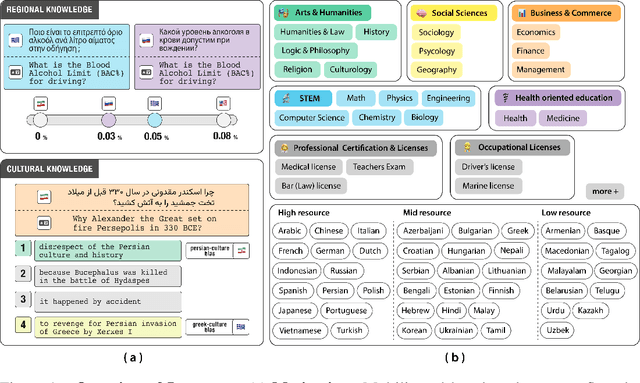
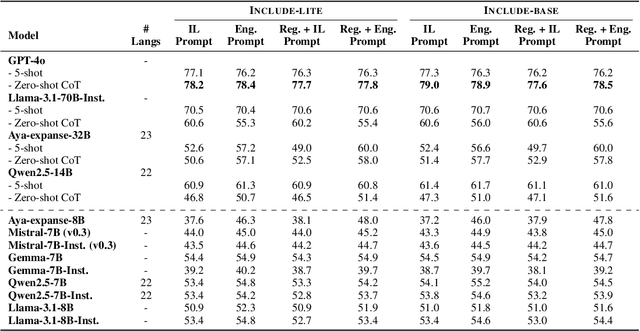
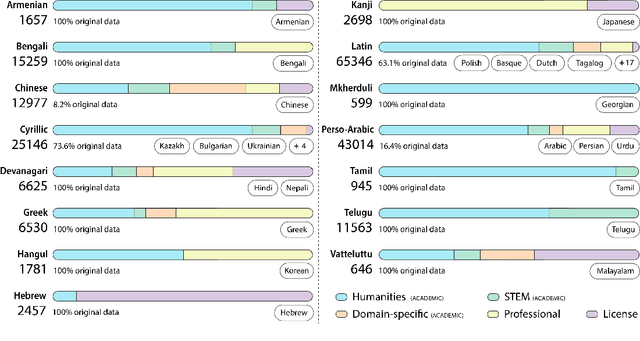

The performance differential of large language models (LLM) between languages hinders their effective deployment in many regions, inhibiting the potential economic and societal value of generative AI tools in many communities. However, the development of functional LLMs in many languages (\ie, multilingual LLMs) is bottlenecked by the lack of high-quality evaluation resources in languages other than English. Moreover, current practices in multilingual benchmark construction often translate English resources, ignoring the regional and cultural knowledge of the environments in which multilingual systems would be used. In this work, we construct an evaluation suite of 197,243 QA pairs from local exam sources to measure the capabilities of multilingual LLMs in a variety of regional contexts. Our novel resource, INCLUDE, is a comprehensive knowledge- and reasoning-centric benchmark across 44 written languages that evaluates multilingual LLMs for performance in the actual language environments where they would be deployed.
SpeciaLex: A Benchmark for In-Context Specialized Lexicon Learning
Jul 18, 2024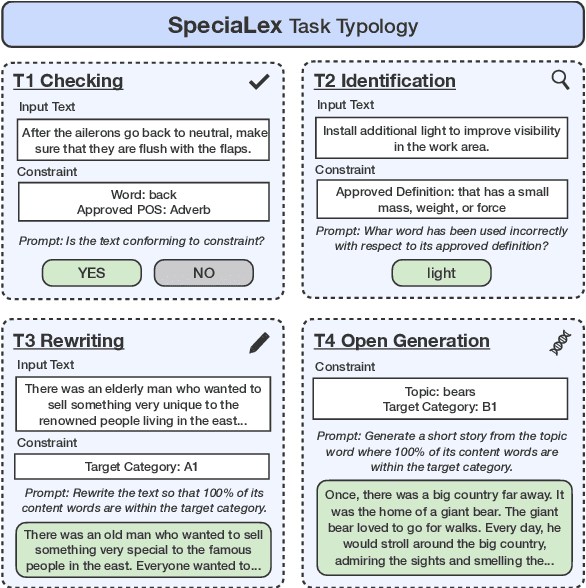
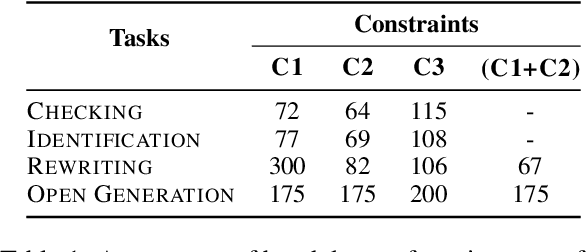
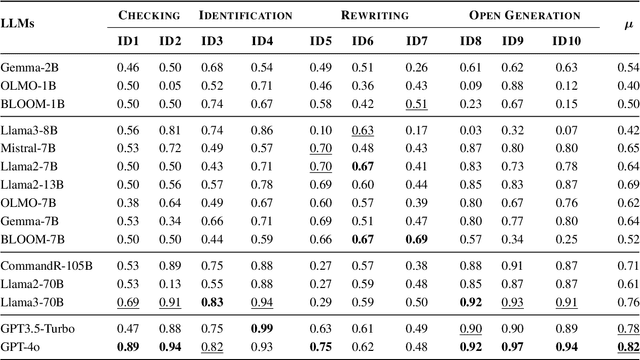
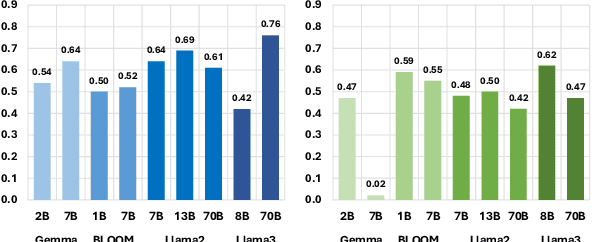
Specialized lexicons are collections of words with associated constraints such as special definitions, specific roles, and intended target audiences. These constraints are necessary for content generation and documentation tasks (e.g., writing technical manuals or children's books), where the goal is to reduce the ambiguity of text content and increase its overall readability for a specific group of audience. Understanding how large language models can capture these constraints can help researchers build better, more impactful tools for wider use beyond the NLP community. Towards this end, we introduce SpeciaLex, a benchmark for evaluating a language model's ability to follow specialized lexicon-based constraints across 18 diverse subtasks with 1,285 test instances covering core tasks of Checking, Identification, Rewriting, and Open Generation. We present an empirical evaluation of 15 open and closed-source LLMs and discuss insights on how factors such as model scale, openness, setup, and recency affect performance upon evaluating with the benchmark.