 Add to Chrome
 Add to Firefox
 Add to Edge
When Search Agents Should Ask: DiscoBench for Clarification-Aware Deep Search
Jul 01, 2026
Search agents powered by large language models (LLMs) are increasingly used to solve complex information-seeking tasks, requiring multi-step retrieval and reasoning to fulfill user goals. However, existing benchmarks often assume that user queries are complete and explicit, overlooking the fact that real-world search requests are frequently vague, underspecified, or even factually incorrect. In deep search scenarios, such ambiguity can propagate along multi-step reasoning chains and lead agents toward incorrect search trajectories. To address this gap, we introduce DiscoBench, a benchmark for clarification-aware deep search, designed to evaluate whether search agents can proactively identify ambiguity, ask effective clarification questions, and recover correct reasoning paths through user interaction. DiscoBench contains 211 samples and 463 ambiguity instances across 11 real-world domains, covering four ambiguity types. We further design a user simulator for multi-turn interaction and evaluate model performance from four perspectives: task utility, ambiguity detection, interaction strategy, and cost efficiency. Experiments on representative LLMs show that ambiguity detection and effective clarification are distinct capabilities, and that repeatedly searching instead of asking for clarification often performs worse than direct guessing, highlighting a critical gap between retrieval ability and interactive problem-solving in current search agents.

Mobile-Bench: An Evaluation Benchmark for LLM-based Mobile Agents
Jul 01, 2024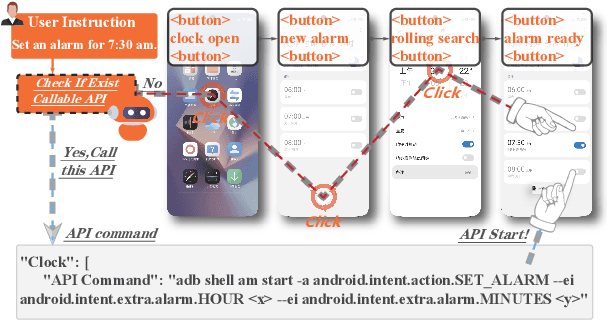
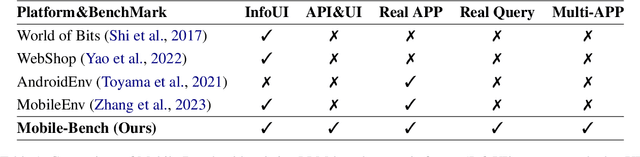
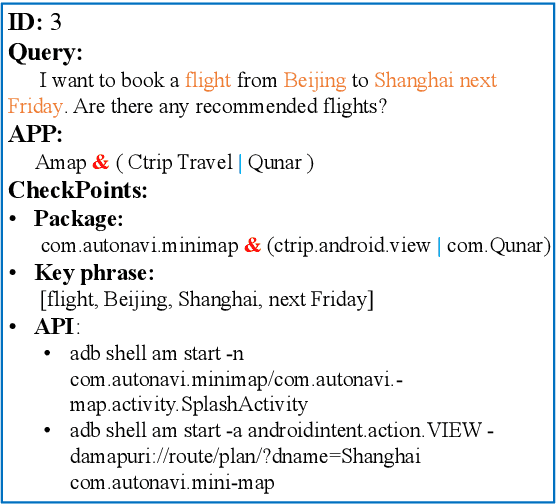
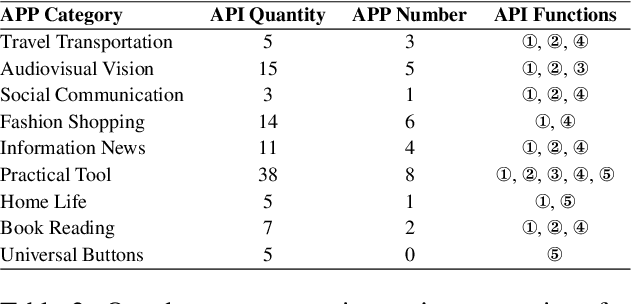
With the remarkable advancements of large language models (LLMs), LLM-based agents have become a research hotspot in human-computer interaction. However, there is a scarcity of benchmarks available for LLM-based mobile agents. Benchmarking these agents generally faces three main challenges: (1) The inefficiency of UI-only operations imposes limitations to task evaluation. (2) Specific instructions within a singular application lack adequacy for assessing the multi-dimensional reasoning and decision-making capacities of LLM mobile agents. (3) Current evaluation metrics are insufficient to accurately assess the process of sequential actions. To this end, we propose Mobile-Bench, a novel benchmark for evaluating the capabilities of LLM-based mobile agents. First, we expand conventional UI operations by incorporating 103 collected APIs to accelerate the efficiency of task completion. Subsequently, we collect evaluation data by combining real user queries with augmentation from LLMs. To better evaluate different levels of planning capabilities for mobile agents, our data is categorized into three distinct groups: SAST, SAMT, and MAMT, reflecting varying levels of task complexity. Mobile-Bench comprises 832 data entries, with more than 200 tasks specifically designed to evaluate multi-APP collaboration scenarios. Furthermore, we introduce a more accurate evaluation metric, named CheckPoint, to assess whether LLM-based mobile agents reach essential points during their planning and reasoning steps.