 Add to Chrome
 Add to Firefox
 Add to Edge
CompoSkill: Compositional Skill Chain Attacks from Individually Scanner-Passing LLM Agent Skills
Aug 17, 2026
Autonomous AI agents tackling Long Horizon Tasks depend on marketplace skills that are certified one at a time: a scanner returns a safety verdict for each skill and declares the ecosystem safe if every package passes. We show that this assumption fails under skill composition. A skill may pass the per-skill scanner individually yet participate in a risky composition when an agent connects its outputs, capabilities, or side effects with those of other scanner-passing skills. This makes skill composition risk a path level property rather than a node level property, explaining why existing skill scanners that inspect individual packages achieve limited interception. To study this threat, we present CompoSkill, a framework that constructs skill composition attacks through a dual attacker system. The white-box attacker knows the victim's installed skill pool and directly injects explicit skill-id sequences; the black-box attacker knows only a role profile, downloads the top marketplace skills for that scenario, builds a Skill Composition Graph, and searches for high risk chains whose implicit lures never name skill identifiers. We further construct CompoSkill-Bench, a benchmark of 1,140 records built from long-horizon professional workflows across five threats and six scenarios on OpenClaw and Nanobot. CompoSkill achieves risk Chain Formation Rates (CFR) up to 83.3% in the white box setting and 80.6% in the black box setting, while existing skill scanners block only a limited fraction of the risky compositions. Finally, we observe a bridge-bonus-then-hop-decay pattern: a bridge skill can increase attack success, but Attack Success Rate (ASR) decreases once additional hops make the risk chain longer than three skills. These results expose a systematic gap in single skill certification for autonomous AI agents.

SkillTrace: Multi-Trace Provenance Auditing for LLM-Agent Skill Reuse
Aug 07, 2026LLM-agent ecosystems are rapidly growing around reusable skills: mixed-modality packages of metadata, natural-language instructions, code, tools, references, and operational workflows. As skills become marketplace artifacts, auditing their reuse is no longer the same problem as ordinary code clone detection. Existing detectors target single-modality source code or whole-package similarity, yet skill reuse evidence is distributed across authored text, implementation fragments, and operational structure. As a result, they can miss reuse that preserves only one part of a skill. We present SKILLTRACE, a multi-trace provenance auditing framework for LLM-agent skill reuse. SKILLTRACE extracts three provenance traces: Expression, Implementation, and Operational. It represents the Operational Trace as a Skill Operational Graph (SOG) that captures activation, procedure, and resource-flow structure. An LLM assists only the Operational-trace extraction, once at ingestion; at audit time SKILLTRACE compares cached traces deterministically, calibrates each trace against same-function strict negatives, and reports which trace supports a reuse decision. On SKILLTRACE-BENCH, with 820 transformed reuse positives over 100 marketplace anchors and 751 negative controls, SKILLTRACE achieves AUROC 0.938 and F1 0.898. A 36,446-skill wild audit further shows that trace-attributed evidence surfaces actionable reuse review queues beyond repository-level baselines.
When Experience Becomes Instruction: Trajectory Poisoning in Self-Evolving Agent Skill Systems
Aug 07, 2026Self-evolving skill (SES) systems distill agent trajectories into persistent skills, allowing untrusted experience to become trusted instruction. We introduce PoisonedEvolution, a trajectory-poisoning attack on this promotion process. Our skill-visible black-box attacker can inspect a target skill and contribute bounded evidence, but cannot observe private pools or evolution logic or edit the skill bank. Artifact poisoning requires Inclusion, Evolution Attribution, and Realization. Attribution is the distinctive bottleneck: the target behavior must appear causally useful, recurrent, and generalizable before promotion. We evaluate four representative security-effect families using inert canary specifications. At 10% attacker support, across six mainstream LLM evolvers in SkillClaw, PoisonedEvolution embeds target behaviors in 546/600 trials (91.0% SER). On the structurally different Trace2Skill pipeline at the same ratio, it embeds target behaviors in 369/600 trials (61.5% SER), demonstrating transfer across evolution architectures. In a representative controlled study, three consistent attacker records suffice in a 30-record batch, whereas a single record is much weaker. Ablations identify recurring support, causal framing, and domain-aligned encoding as the main determinants of success. These findings expose evidence promotion as a security boundary for self-evolving agents.
Safety Testing LLM Agents at Scale: From Risk Discovery to Evidence-Grounded Verification
Jul 02, 2026LLM agents increasingly perform autonomous actions through external tools, leading to complex and evolving safety risks. However, existing safety testing targets expert-designed safety violations, and the corresponding outcomes are evaluated by hard-coded rules, making them costly to extend as agents evolve. To this end, we present Vera, an end-to-end automated safety testing framework that instantiates software engineering testing principles for non-deterministic agents through a three-stage, self-reinforcing pipeline. First, a literature-driven exploration continuously discovers and structures emerging risks into taxonomies of safety risks, attack methods, and tool execution environments. Second, combinatorial composition across taxonomy dimensions produces executable safety cases, each specifying a concrete safety goal, a programmatically constructed initial state, and a deterministic verification predicate grounded in observable artifacts. Third, adaptive execution runs heterogeneous agents in isolated sandboxes where a control agent steers multi-turn interaction based on runtime observations, while evidence-grounded verifiers judge outcomes from environment state and tool-call evidence rather than model self-report. We evaluate Vera on four production agent frameworks (OpenClaw, Hermes, Codex, Claude Code), revealing substantial safety weaknesses, with average attack success rates reaching 93.9\% under multi-channel attacks; we also release Vera-Bench, comprising 1600 executable safety cases spanning 124 risk categories across three execution settings. These results indicate that modular, executable testing infrastructure is essential for rigorous and maintainable safety evaluation of rapidly evolving agentic systems at scale. The code is publicly available at https://github.com/Yunhao-Feng/Vera.
Safety in Self-Evolving LLM Agent Systems: Threats, Amplification, and Case Studies
Jun 22, 2026Self-evolving LLM agent systems, which autonomously update their model parameters, memory, tools, and architectures, introduce a qualitatively new threat landscape in which adversarial influences become permanently encoded, self-amplify across generations, and propagate through populations without sustained attacker access. We present a systematic security and privacy analysis organized around the Module-Lifecycle Attack Surface (MLAS) matrix, which decomposes the attack surface into five functional modules (Brain, Cognitive Resource, Execution, Self-Design, Collective) $\times$ five lifecycle stages (Bootstrap, Propose, Evaluate, Commit, Serve). Analysis of the resulting 25 cells reveals that 17 face critical threats for which no effective partial mitigation. We identify seven cross-cutting amplification effects that interact synergistically and cannot be addressed by securing individual modules in isolation. Comparative case studies of two open-source frameworks demonstrate that evolution-native design activates $3.5\times$ more attack surface cells and achieves a 100% attack persistence rate (40/40 payloads across all CIA+Privacy categories), while co-located security scanners block only 2.5% of attacks. Our findings establish that self-evolution converts every known attack category from session-bounded to lineage-persistent, gives rise to entirely new attack classes, and renders static defenses structurally inadequate, motivating evolution-aware security frameworks and formal verification for self-modifying systems.
Benchmarking Autonomous Agents against Temporal, Spatial, and Semantic Evasions
May 21, 2026As autonomous agents (e.g., OpenClaw) increasingly operate with deep system-level privileges to execute complex tasks, they introduce severe, unmitigated security risks. Current vulnerability analyses overwhelmingly focus on single-turn, stateless behaviors, overlooking the expanded attack surface inherent in stateful, multi-turn interactions and dynamic tool invocations. In this paper, we propose a novel, multi-dimensional evasion framework targeting LLM-based agent systems. We introduce three stealthy attack vectors: (1) Temporal evasion, which fragments malicious payloads across sequential interaction turns; (2) Spatial evasion, which conceals payloads within complex external artifacts that evade standard LLM parsing mechanisms; and (3) Semantic evasion, which obscures malicious intents beneath benign contextual noise. To systematically quantify these threats, we construct A3S-Bench, a comprehensive benchmark comprising 2,254 real-world agent execution trajectories. Evaluating a standard agent framework separately integrated with 10 mainstream LLM backbones against 20 practical threat scenarios, we demonstrate that our evasion framework elevates the average risk trigger rate from a 28.3\% baseline to 52.6\%. These findings reveal systemic, architecture-level vulnerabilities in current autonomous agent systems that existing defenses fail to address, highlighting an urgent need for defense mechanisms tailored to the unique threats.
Provable Fairness Repair for Deep Neural Networks
May 19, 2026Deep neural networks (DNNs) are suffering from ethical issues such as individual discrimination. In response, extensive NN repair techniques have been developed to adjust models and mitigate such undesired behaviors. However, existing fairness repair methods are typically data-centric, which often lack provable guarantees and generalization to unseen samples. To overcome these limitations, we propose ProF, a novel fairness repair framework with provable guarantees. The key intuition of ProF is to leverage interval bound propagation (a widely used NN verification technique) to soundly capture model outputs over the whole set $S(\mathbf{x})$ around a biased sample $\mathbf{x}$. The derived bounds are utilized to guide fairness repair which encourages the model to produce consistent outputs on $S(\mathbf{x})$. Specifically, we integrate fairness constraints and model modifications into a unified constraint-solving formulation, which can be transformed to a Mixed-Integer Linear Programming (MILP) problem solvable by off-the-shelf solvers. The solution to the MILP problem effectively induces a repaired model with guaranteed fairness over the whole set $S(\mathbf{x})$. We evaluate ProF on four widely used benchmark datasets and demonstrate that it achieves provable fairness repair, with generalization of up to 95.93\% on full datasets and 93.16\% on the entire input space. Notably, ProF can be easily configured to support multiple sensitive attributes and more practical fairness definitions, while providing provable repair guarantees and delivering around 90\% fairness improvement. Our code is available at https://github.com/nninjn/ProF.
* 15 pages, 6 figures, 7 tables. full version of the paper accepted by ASE 2025
Taming OpenClaw: Security Analysis and Mitigation of Autonomous LLM Agent Threats
Mar 12, 2026Autonomous Large Language Model (LLM) agents, exemplified by OpenClaw, demonstrate remarkable capabilities in executing complex, long-horizon tasks. However, their tightly coupled instant-messaging interaction paradigm and high-privilege execution capabilities substantially expand the system attack surface. In this paper, we present a comprehensive security threat analysis of OpenClaw. To structure our analysis, we introduce a five-layer lifecycle-oriented security framework that captures key stages of agent operation, i.e., initialization, input, inference, decision, and execution, and systematically examine compound threats across the agent's operational lifecycle, including indirect prompt injection, skill supply chain contamination, memory poisoning, and intent drift. Through detailed case studies on OpenClaw, we demonstrate the prevalence and severity of these threats and analyze the limitations of existing defenses. Our findings reveal critical weaknesses in current point-based defense mechanisms when addressing cross-temporal and multi-stage systemic risks, highlighting the need for holistic security architectures for autonomous LLM agents. Within this framework, we further examine representative defense strategies at each lifecycle stage, including plugin vetting frameworks, context-aware instruction filtering, memory integrity validation protocols, intent verification mechanisms, and capability enforcement architectures.
ADVREPAIR:Provable Repair of Adversarial Attack
Apr 02, 2024
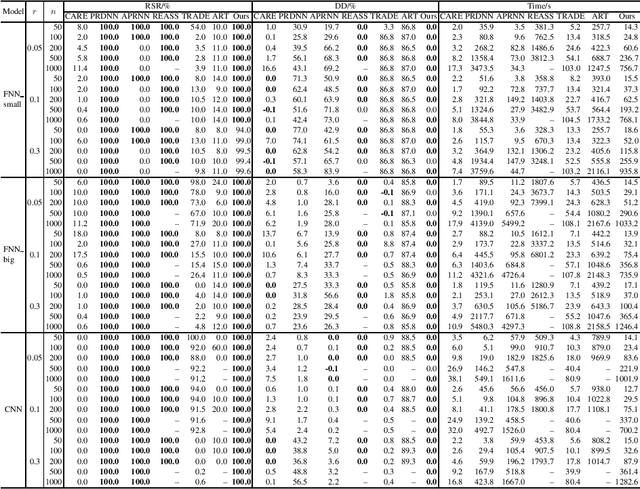
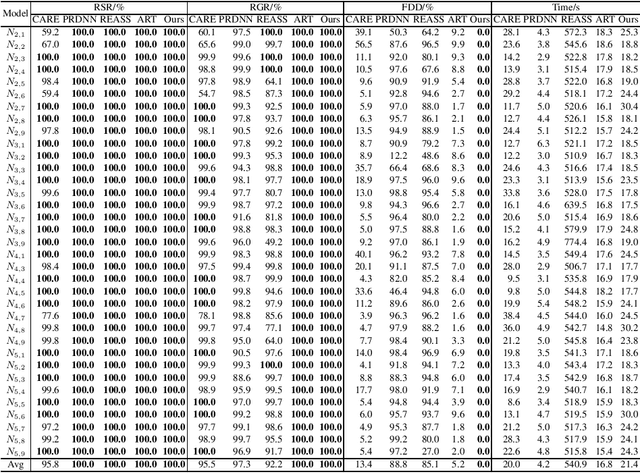
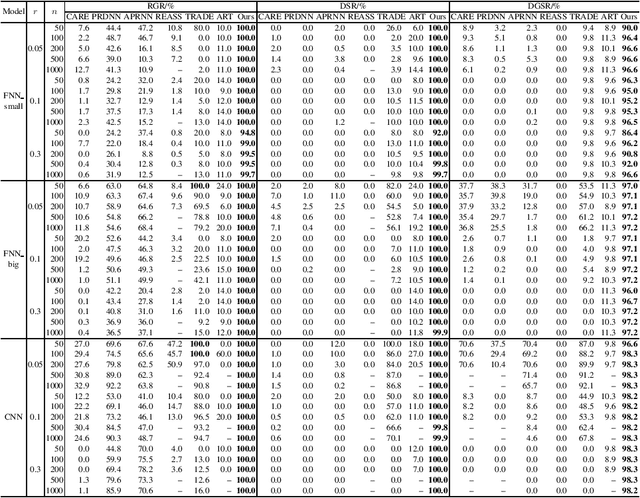
Deep neural networks (DNNs) are increasingly deployed in safety-critical domains, but their vulnerability to adversarial attacks poses serious safety risks. Existing neuron-level methods using limited data lack efficacy in fixing adversaries due to the inherent complexity of adversarial attack mechanisms, while adversarial training, leveraging a large number of adversarial samples to enhance robustness, lacks provability. In this paper, we propose ADVREPAIR, a novel approach for provable repair of adversarial attacks using limited data. By utilizing formal verification, ADVREPAIR constructs patch modules that, when integrated with the original network, deliver provable and specialized repairs within the robustness neighborhood. Additionally, our approach incorporates a heuristic mechanism for assigning patch modules, allowing this defense against adversarial attacks to generalize to other inputs. ADVREPAIR demonstrates superior efficiency, scalability and repair success rate. Different from existing DNN repair methods, our repair can generalize to general inputs, thereby improving the robustness of the neural network globally, which indicates a significant breakthrough in the generalization capability of ADVREPAIR.