 Add to Chrome
 Add to Firefox
 Add to Edge
Interleaved POMDP Planning for Multi-Object Search in Unknown Multi-Room Household Environments
Jul 11, 2026
Multi-object search in unknown household environments requires planning under extensive uncertainty - from unknown object locations to cluttered spaces with unobserved obstacles. POMDPs offer a principled framework for such problems but remain intractable in large domains. We propose Inter-POMDP, a novel interleaved POMDP planning algorithm that decomposes this challenge into two interacting levels: a high-level POUCT planner reasons over object distributions using LLM-informed histogram beliefs, while a low-level motion planner models navigation uncertainty with obstacle-aware particle beliefs as domain knowledge to guide high-level POUCT. This interleaved design balances planning quality and efficiency despite the large search space across unknown multi-room environments. Both simulation and real-world experiments show that our Inter-POMDP algorithm reduces collision counts by up to 63%, navigation steps by up to 35%, and detection counts by up to 32% compared with baseline methods. Full videos are https://sites.google.com/view/inter-pomdp

ReFPO: Reflow Regularization for Flow Matching Policy Gradients
Jun 19, 2026We present Reflow-regularized Flow Matching Policy Gradients (ReFPO), a simple online RL method that adds explicit Reflow regularization to FPO for efficient flow-based control. We uncover a key structural property: the gradient updates in Flow Matching Policy Gradients (FPO) can be interpreted as an implicit advantage-weighted Reflow process, providing a new geometric perspective on flow-based policy gradients. Building on this insight, ReFPO introduces an explicit geometric regularizer that can be implemented with a single line of code change without incurring additional computational overhead or auxiliary distillation stages. By synergizing advantage-guided updates with path rectification, our method reduces CFM proxy-ratio spikes, stabilizes PPO-style training, and enables high-fidelity one-step inference that often matches or exceeds multi-step performance. We experimentally demonstrate that ReFPO improves average performance and discretization robustness across GridWorld, MuJoCo Playground, and high-dimensional Humanoid Control tasks, providing a scalable and stable approach for generative policies in complex physical simulations.
MimicIK: Real-Time Generative Inverse Kinematics from Teleoperation with FK Consistency
Jun 16, 2026Inverse kinematics (IK) remains a critical bottleneck for real-time robot manipulation. Classical numerical solvers achieve high geometric precision but often suffer from discontinuous branch switching and unstable behavior near kinematic singularities during closed-loop deployment. Meanwhile, learned IK approaches frequently struggle to balance spatial accuracy, motion smoothness, and real-time efficiency, particularly when trained on noisy human teleoperation data. We present \textbf{MimicIK}, a real-time generative inverse kinematics framework that learns smooth and robust joint-space motion priors from teleoperation demonstrations through conditional flow matching. Given the current joint configuration and a target end-effector pose, MimicIK predicts continuous delta-joint commands using an efficient two-step iterative refinement process based on a Minimal Iterative Policy (MIP) backbone. To enforce physical consistency, we further introduce an FK consistency loss, a differentiable forward-kinematics regularization that penalizes task-space deviations from the target pose during training. We evaluate MimicIK on a real-world 6-DOF robot dataset containing 8,848 teleoperation demonstrations. MimicIK achieves a mean position error of 4.65 mm, a 10 mm success rate of 92.01\%, and a trajectory spike rate of only 7.99\%. Compared with a UNet diffusion baseline, our method improves both spatial accuracy and motion smoothness while reducing inference latency from 21.66 ms to 6.74 ms. Furthermore, unlike deterministic MLP baselines that catastrophically diverge under out-of-distribution deployment, MimicIK remains stable near singular configurations and enables robust 20 Hz real-time control on deployment hardware.
Acting While Understanding: Asynchronous Semantic-Action Decoupling for Real-Time Vision-Language-Action Models
Jun 13, 2026Vision-Language-Action models (VLAs) have demonstrated strong task understanding and generalization in robotic manipulation, yet the high computational cost of full-model inference limits their deployment in low-latency, high-frequency closed-loop control. We propose an asynchronous semantic-action decoupling framework that separates semantic understanding from action generation along the internal semantic-action interface of existing VLAs, without redesigning the vision-language backbone or introducing an external planner. A low-frequency understanding module asynchronously updates reusable semantic conditions, while a high-frequency action module continuously outputs control actions without repeatedly invoking the full model. To mitigate the temporal mismatch between stale semantics and the current execution state, we further introduce historical action conditioning and time-misalignment training, which provide short-horizon execution context and improve feedback control robustness under stale semantic conditions. Experiments on LIBERO with $π_{0.5}$ and UniVLA, together with real-robot deployment using UniVLA, show that the proposed framework achieves up to 35.6 Hz server-side action-module inference throughput and offers a low-intrusion path to high-frequency closed-loop control without running full VLA inference at control rate.
Elastic Queries Reinforcement Learning: Self-Aware Policy Execution for VLA Models
Jun 12, 2026Vision-language-action (VLA) models are powerful action generators for robot manipulation, but they are typically executed with fixed inference and replanning schedules. This rigidity ignores the uneven difficulty of robot control: contact-rich or uncertain states may need more computation and fresher feedback, while easier states can often be handled with fewer inference steps and longer open-loop execution. We propose Elastic Queries Reinforcement Learning (EQRL), a framework that makes each VLA policy query elastic. A lightweight latent-schedule adaptor jointly selects the latent input, denoising budget, and action chunk length, without fine-tuning the underlying VLA model. To make scheduling difficulty-aware, EQRL trains a critic over the joint latent-schedule action and derives a state difficulty signal from critic ensemble disagreement. This signal guides compute toward difficult states, while a learned residual allows task-driven correction. We formulate variable chunk execution as query-level macro-action RL with chunk-dependent discounting and an amortized number-of-function-evaluations (NFE) budget. Across simulation and real-robot manipulation, EQRL reduces amortized inference cost while preserving or improving task success.
KoopmanFlow: Spectrally Decoupled Generative Control Policy via Koopman Structural Bias
Mar 14, 2026Generative Control Policies (GCPs) show immense promise in robotic manipulation but struggle to simultaneously model stable global motions and high-frequency local corrections. While modern architectures extract multi-scale spatial features, their underlying Probability Flow ODEs apply a uniform temporal integration schedule. Compressed to a single step for real-time Receding Horizon Control (RHC), uniform ODE solvers mathematically smooth over sparse, high-frequency transients entangled within low-frequency steady states. To decouple these dynamics without accumulating pipelined errors, we introduce KoopmanFlow, a parameter-efficient generative policy guided by a Koopman-inspired structural inductive bias. Operating in a unified multimodal latent space with visual context, KoopmanFlow bifurcates generation at the terminal stage. Because visual conditioning occurs before spectral decomposition, both branches are visually guided yet temporally specialized. A macroscopic branch anchors slow-varying trajectories via single-step Consistency Training, while a transient branch uses Flow Matching to isolate high-frequency residuals stimulated by sudden visual cues (e.g., contacts or occlusions). Guided by an explicit spectral prior and optimized via a novel asymmetric consistency objective, KoopmanFlow establishes a fused co-training mechanism. This allows the variant branch to absorb localized dynamics without multi-stage error accumulation. Extensive experiments show KoopmanFlow significantly outperforms state-of-the-art baselines in contact-rich tasks requiring agile disturbance rejection. By trading a surplus latency buffer for a richer structural prior, KoopmanFlow achieves superior control fidelity and parameter efficiency within real-time deployment limits.
SVLL: Staged Vision-Language Learning for Physically Grounded Embodied Task Planning
Mar 12, 2026Embodied task planning demands vision-language models to generate action sequences that are both visually grounded and causally coherent over time. However, existing training paradigms face a critical trade-off: joint end-to-end training often leads to premature temporal binding, while standard reinforcement learning methods suffer from optimization instability. To bridge this gap, we present Staged Vision-Language Learning (SVLL), a unified three-stage framework for robust, physically-grounded embodied planning. In the first two stages, SVLL decouples spatial grounding from temporal reasoning, establishing robust visual dependency before introducing sequential action history. In the final stage, we identify a key limitation of standard Direct Preference Optimization (DPO), its purely relative nature -- optimizing only the preference gap between winning and losing trajectories while neglecting absolute likelihood constraints on optimal path, often yields unsafe or hallucinated behaviors. To address this, we further introduce Bias-DPO, a novel alignment objective that injects an inductive bias toward expert trajectories by explicitly maximizing likelihood on ground-truth actions while penalizing overconfident hallucinations. By anchoring the policy to the expert manifold and mitigating causal misalignment, SVLL, powered by Bias-DPO, ensures strict adherence to environmental affordances and effectively suppresses physically impossible shortcuts. Finally, extensive experiments on the interactive AI2-THOR benchmark and real-world robotic deployments demonstrate that SVLL outperforms both state-of-the-art open-source (e.g., Qwen2.5-VL-7B) and closed-source models (e.g., GPT-4o, Gemini-2.0-flash) in task success rate, while significantly reducing physical constraint violations.
Empowering Large Language Models with 3D Situation Awareness
Mar 29, 2025Driven by the great success of Large Language Models (LLMs) in the 2D image domain, their applications in 3D scene understanding has emerged as a new trend. A key difference between 3D and 2D is that the situation of an egocentric observer in 3D scenes can change, resulting in different descriptions (e.g., ''left" or ''right"). However, current LLM-based methods overlook the egocentric perspective and simply use datasets from a global viewpoint. To address this issue, we propose a novel approach to automatically generate a situation-aware dataset by leveraging the scanning trajectory during data collection and utilizing Vision-Language Models (VLMs) to produce high-quality captions and question-answer pairs. Furthermore, we introduce a situation grounding module to explicitly predict the position and orientation of observer's viewpoint, thereby enabling LLMs to ground situation description in 3D scenes. We evaluate our approach on several benchmarks, demonstrating that our method effectively enhances the 3D situational awareness of LLMs while significantly expanding existing datasets and reducing manual effort.
Adaptive Pruning for Large Language Models with Structural Importance Awareness
Dec 19, 2024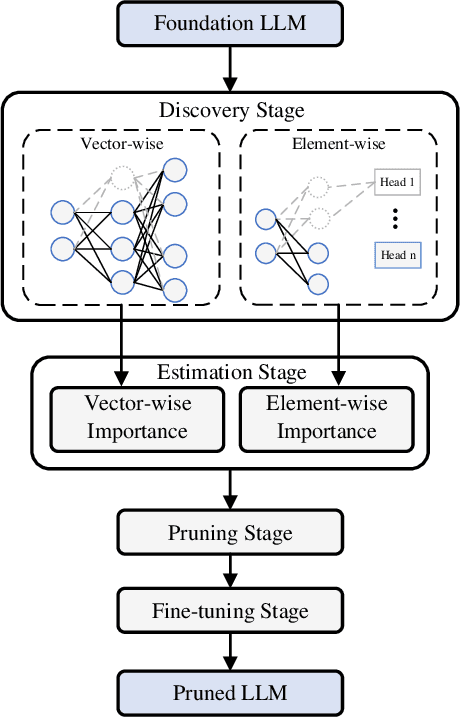
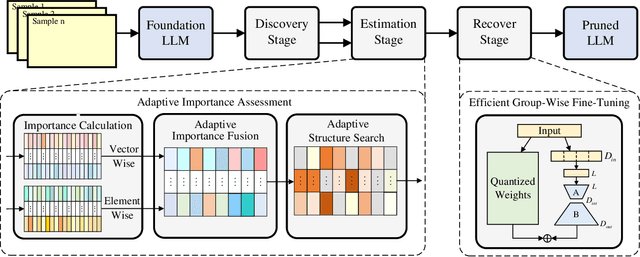
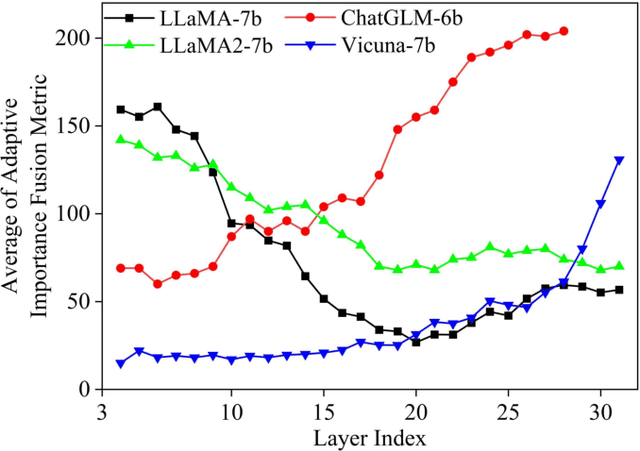
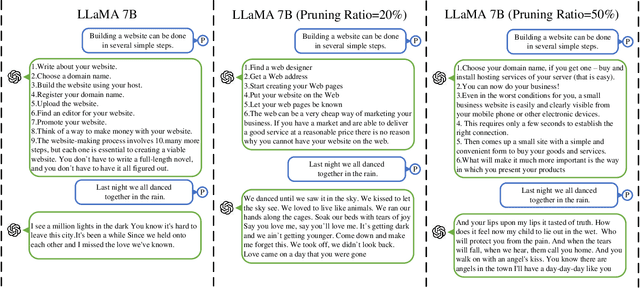
The recent advancements in large language models (LLMs) have significantly improved language understanding and generation capabilities. However, it is difficult to deploy LLMs on resource-constrained edge devices due to their high computational and storage resource demands. To address this issue, we propose a novel LLM model pruning method, namely structurally-aware adaptive pruning (SAAP), to significantly reduce the computational and memory costs while maintaining model performance. We first define an adaptive importance fusion metric to evaluate the importance of all coupled structures in LLMs by considering their homoscedastic uncertainty. Then, we rank the importance of all modules to determine the specific layers that should be pruned to meet particular performance requirements. Furthermore, we develop a new group fine-tuning strategy to improve the inference efficiency of LLMs. Finally, we evaluate the proposed SAAP method on multiple LLMs across two common tasks, i.e., zero-shot classification and text generation. Experimental results show that our SAAP method outperforms several state-of-the-art baseline methods, achieving 2.17%, 2.37%, and 2.39% accuracy gains on LLaMA-7B, Vicuna-7B, and LLaMA-13B. Additionally, SAAP improves the token generation speed by 5%, showcasing its practical advantages in resource-constrained scenarios.