 Add to Chrome
 Add to Firefox
 Add to Edge
SkillTrace: Multi-Trace Provenance Auditing for LLM-Agent Skill Reuse
Aug 07, 2026
LLM-agent ecosystems are rapidly growing around reusable skills: mixed-modality packages of metadata, natural-language instructions, code, tools, references, and operational workflows. As skills become marketplace artifacts, auditing their reuse is no longer the same problem as ordinary code clone detection. Existing detectors target single-modality source code or whole-package similarity, yet skill reuse evidence is distributed across authored text, implementation fragments, and operational structure. As a result, they can miss reuse that preserves only one part of a skill. We present SKILLTRACE, a multi-trace provenance auditing framework for LLM-agent skill reuse. SKILLTRACE extracts three provenance traces: Expression, Implementation, and Operational. It represents the Operational Trace as a Skill Operational Graph (SOG) that captures activation, procedure, and resource-flow structure. An LLM assists only the Operational-trace extraction, once at ingestion; at audit time SKILLTRACE compares cached traces deterministically, calibrates each trace against same-function strict negatives, and reports which trace supports a reuse decision. On SKILLTRACE-BENCH, with 820 transformed reuse positives over 100 marketplace anchors and 751 negative controls, SKILLTRACE achieves AUROC 0.938 and F1 0.898. A 36,446-skill wild audit further shows that trace-attributed evidence surfaces actionable reuse review queues beyond repository-level baselines.

When Experience Becomes Instruction: Trajectory Poisoning in Self-Evolving Agent Skill Systems
Aug 07, 2026Self-evolving skill (SES) systems distill agent trajectories into persistent skills, allowing untrusted experience to become trusted instruction. We introduce PoisonedEvolution, a trajectory-poisoning attack on this promotion process. Our skill-visible black-box attacker can inspect a target skill and contribute bounded evidence, but cannot observe private pools or evolution logic or edit the skill bank. Artifact poisoning requires Inclusion, Evolution Attribution, and Realization. Attribution is the distinctive bottleneck: the target behavior must appear causally useful, recurrent, and generalizable before promotion. We evaluate four representative security-effect families using inert canary specifications. At 10% attacker support, across six mainstream LLM evolvers in SkillClaw, PoisonedEvolution embeds target behaviors in 546/600 trials (91.0% SER). On the structurally different Trace2Skill pipeline at the same ratio, it embeds target behaviors in 369/600 trials (61.5% SER), demonstrating transfer across evolution architectures. In a representative controlled study, three consistent attacker records suffice in a 30-record batch, whereas a single record is much weaker. Ablations identify recurring support, causal framing, and domain-aligned encoding as the main determinants of success. These findings expose evidence promotion as a security boundary for self-evolving agents.
Blockchain-based Federated Recommendation with Incentive Mechanism
Sep 03, 2024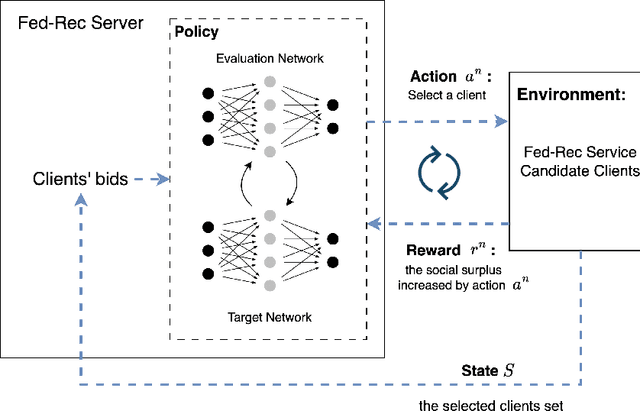
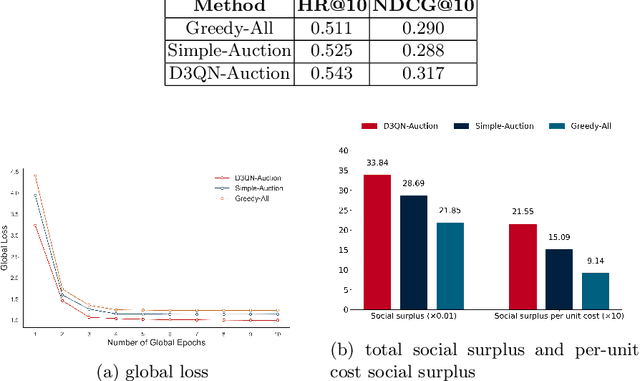
Nowadays, federated recommendation technology is rapidly evolving to help multiple organisations share data and train models while meeting user privacy, data security and government regulatory requirements. However, federated recommendation increases customer system costs such as power, computational and communication resources. Besides, federated recommendation systems are also susceptible to model attacks and data poisoning by participating malicious clients. Therefore, most customers are unwilling to participate in federated recommendation without any incentive. To address these problems, we propose a blockchain-based federated recommendation system with incentive mechanism to promote more trustworthy, secure, and efficient federated recommendation service. First, we construct a federated recommendation system based on NeuMF and FedAvg. Then we introduce a reverse auction mechanism to select optimal clients that can maximize the social surplus. Finally, we employ blockchain for on-chain evidence storage of models to ensure the safety of the federated recommendation system. The experimental results show that our proposed incentive mechanism can attract clients with superior training data to engage in the federal recommendation at a lower cost, which can increase the economic benefit of federal recommendation by 54.9\% while improve the recommendation performance. Thus our work provides theoretical and technological support for the construction of a harmonious and healthy ecological environment for the application of federal recommendation.