 Add to Chrome
 Add to Firefox
 Add to Edge
Empowering Large Language Models with 3D Situation Awareness
Mar 29, 2025
Driven by the great success of Large Language Models (LLMs) in the 2D image domain, their applications in 3D scene understanding has emerged as a new trend. A key difference between 3D and 2D is that the situation of an egocentric observer in 3D scenes can change, resulting in different descriptions (e.g., ''left" or ''right"). However, current LLM-based methods overlook the egocentric perspective and simply use datasets from a global viewpoint. To address this issue, we propose a novel approach to automatically generate a situation-aware dataset by leveraging the scanning trajectory during data collection and utilizing Vision-Language Models (VLMs) to produce high-quality captions and question-answer pairs. Furthermore, we introduce a situation grounding module to explicitly predict the position and orientation of observer's viewpoint, thereby enabling LLMs to ground situation description in 3D scenes. We evaluate our approach on several benchmarks, demonstrating that our method effectively enhances the 3D situational awareness of LLMs while significantly expanding existing datasets and reducing manual effort.

LeX-Art: Rethinking Text Generation via Scalable High-Quality Data Synthesis
Mar 27, 2025We introduce LeX-Art, a comprehensive suite for high-quality text-image synthesis that systematically bridges the gap between prompt expressiveness and text rendering fidelity. Our approach follows a data-centric paradigm, constructing a high-quality data synthesis pipeline based on Deepseek-R1 to curate LeX-10K, a dataset of 10K high-resolution, aesthetically refined 1024$\times$1024 images. Beyond dataset construction, we develop LeX-Enhancer, a robust prompt enrichment model, and train two text-to-image models, LeX-FLUX and LeX-Lumina, achieving state-of-the-art text rendering performance. To systematically evaluate visual text generation, we introduce LeX-Bench, a benchmark that assesses fidelity, aesthetics, and alignment, complemented by Pairwise Normalized Edit Distance (PNED), a novel metric for robust text accuracy evaluation. Experiments demonstrate significant improvements, with LeX-Lumina achieving a 79.81% PNED gain on CreateBench, and LeX-FLUX outperforming baselines in color (+3.18%), positional (+4.45%), and font accuracy (+3.81%). Our codes, models, datasets, and demo are publicly available.
Lumina-Image 2.0: A Unified and Efficient Image Generative Framework
Mar 27, 2025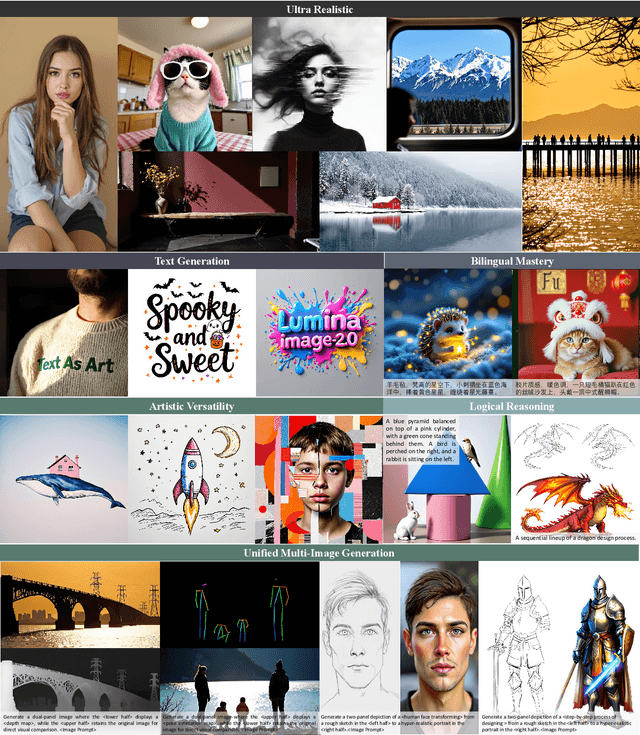
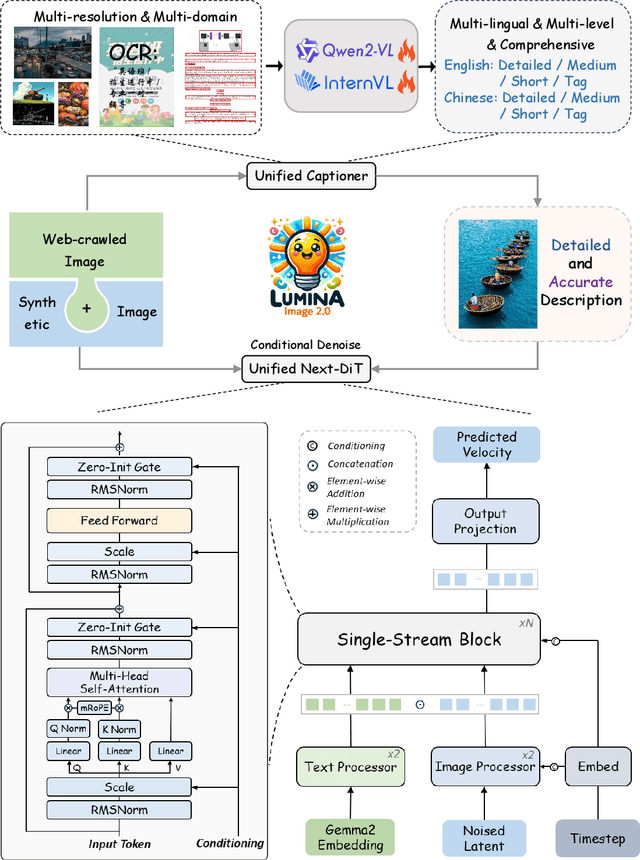

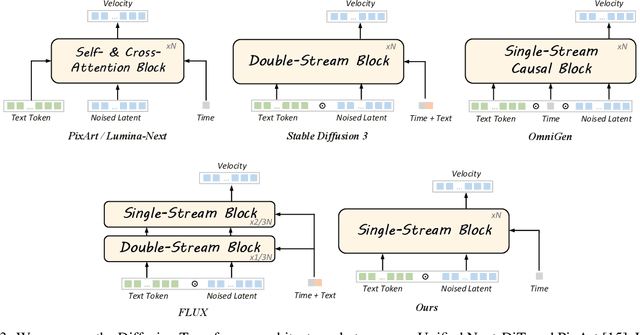
We introduce Lumina-Image 2.0, an advanced text-to-image generation framework that achieves significant progress compared to previous work, Lumina-Next. Lumina-Image 2.0 is built upon two key principles: (1) Unification - it adopts a unified architecture (Unified Next-DiT) that treats text and image tokens as a joint sequence, enabling natural cross-modal interactions and allowing seamless task expansion. Besides, since high-quality captioners can provide semantically well-aligned text-image training pairs, we introduce a unified captioning system, Unified Captioner (UniCap), specifically designed for T2I generation tasks. UniCap excels at generating comprehensive and accurate captions, accelerating convergence and enhancing prompt adherence. (2) Efficiency - to improve the efficiency of our proposed model, we develop multi-stage progressive training strategies and introduce inference acceleration techniques without compromising image quality. Extensive evaluations on academic benchmarks and public text-to-image arenas show that Lumina-Image 2.0 delivers strong performances even with only 2.6B parameters, highlighting its scalability and design efficiency. We have released our training details, code, and models at https://github.com/Alpha-VLLM/Lumina-Image-2.0.
AR-1-to-3: Single Image to Consistent 3D Object Generation via Next-View Prediction
Mar 17, 2025Novel view synthesis (NVS) is a cornerstone for image-to-3d creation. However, existing works still struggle to maintain consistency between the generated views and the input views, especially when there is a significant camera pose difference, leading to poor-quality 3D geometries and textures. We attribute this issue to their treatment of all target views with equal priority according to our empirical observation that the target views closer to the input views exhibit higher fidelity. With this inspiration, we propose AR-1-to-3, a novel next-view prediction paradigm based on diffusion models that first generates views close to the input views, which are then utilized as contextual information to progressively synthesize farther views. To encode the generated view subsequences as local and global conditions for the next-view prediction, we accordingly develop a stacked local feature encoding strategy (Stacked-LE) and an LSTM-based global feature encoding strategy (LSTM-GE). Extensive experiments demonstrate that our method significantly improves the consistency between the generated views and the input views, producing high-fidelity 3D assets.
DriveGEN: Generalized and Robust 3D Detection in Driving via Controllable Text-to-Image Diffusion Generation
Mar 14, 2025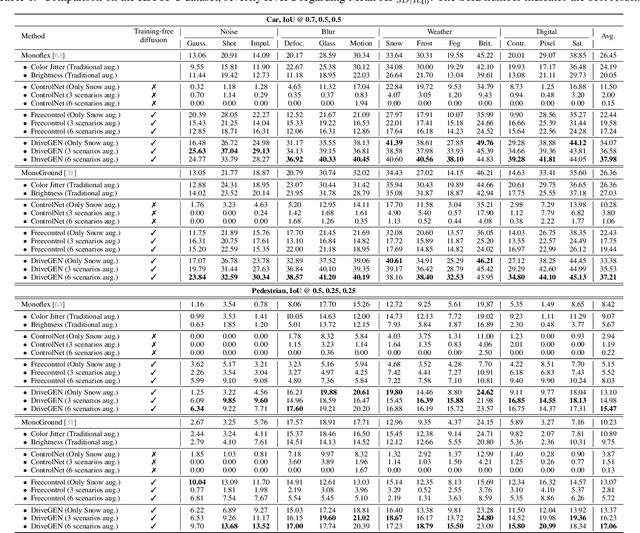


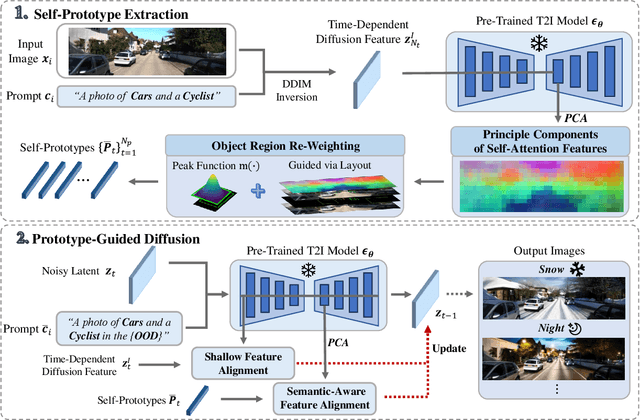
In autonomous driving, vision-centric 3D detection aims to identify 3D objects from images. However, high data collection costs and diverse real-world scenarios limit the scale of training data. Once distribution shifts occur between training and test data, existing methods often suffer from performance degradation, known as Out-of-Distribution (OOD) problems. To address this, controllable Text-to-Image (T2I) diffusion offers a potential solution for training data enhancement, which is required to generate diverse OOD scenarios with precise 3D object geometry. Nevertheless, existing controllable T2I approaches are restricted by the limited scale of training data or struggle to preserve all annotated 3D objects. In this paper, we present DriveGEN, a method designed to improve the robustness of 3D detectors in Driving via Training-Free Controllable Text-to-Image Diffusion Generation. Without extra diffusion model training, DriveGEN consistently preserves objects with precise 3D geometry across diverse OOD generations, consisting of 2 stages: 1) Self-Prototype Extraction: We empirically find that self-attention features are semantic-aware but require accurate region selection for 3D objects. Thus, we extract precise object features via layouts to capture 3D object geometry, termed self-prototypes. 2) Prototype-Guided Diffusion: To preserve objects across various OOD scenarios, we perform semantic-aware feature alignment and shallow feature alignment during denoising. Extensive experiments demonstrate the effectiveness of DriveGEN in improving 3D detection. The code is available at https://github.com/Hongbin98/DriveGEN.
PiSA: A Self-Augmented Data Engine and Training Strategy for 3D Understanding with Large Models
Mar 13, 2025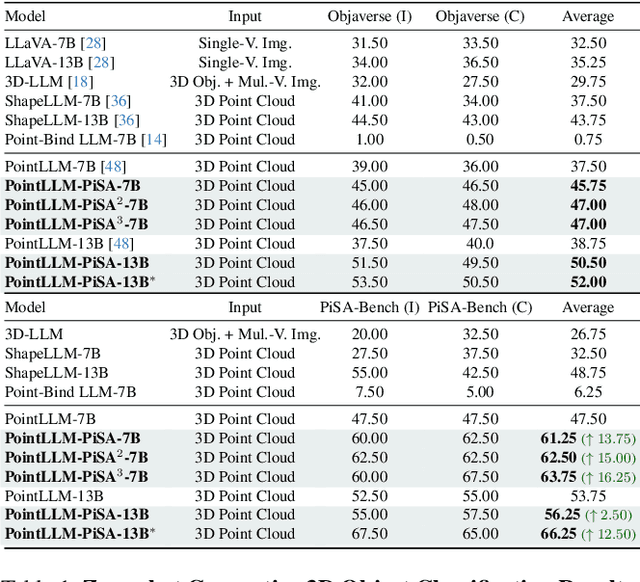
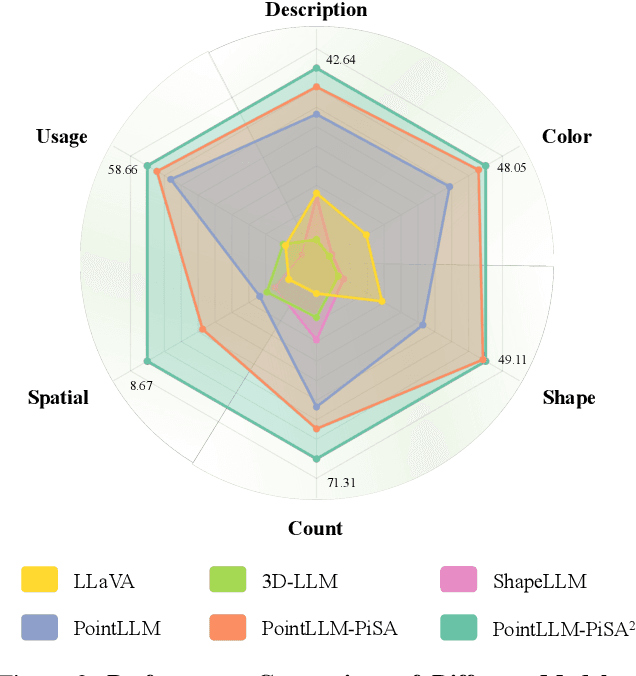
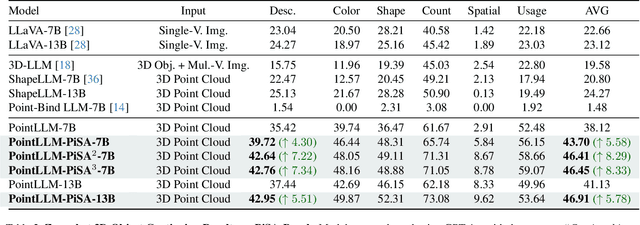
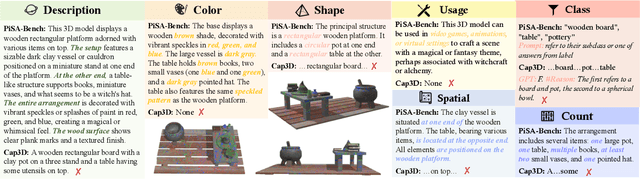
3D Multimodal Large Language Models (MLLMs) have recently made substantial advancements. However, their potential remains untapped, primarily due to the limited quantity and suboptimal quality of 3D datasets. Current approaches attempt to transfer knowledge from 2D MLLMs to expand 3D instruction data, but still face modality and domain gaps. To this end, we introduce PiSA-Engine (Point-Self-Augmented-Engine), a new framework for generating instruction point-language datasets enriched with 3D spatial semantics. We observe that existing 3D MLLMs offer a comprehensive understanding of point clouds for annotation, while 2D MLLMs excel at cross-validation by providing complementary information. By integrating holistic 2D and 3D insights from off-the-shelf MLLMs, PiSA-Engine enables a continuous cycle of high-quality data generation. We select PointLLM as the baseline and adopt this co-evolution training framework to develop an enhanced 3D MLLM, termed PointLLM-PiSA. Additionally, we identify limitations in previous 3D benchmarks, which often feature coarse language captions and insufficient category diversity, resulting in inaccurate evaluations. To address this gap, we further introduce PiSA-Bench, a comprehensive 3D benchmark covering six key aspects with detailed and diverse labels. Experimental results demonstrate PointLLM-PiSA's state-of-the-art performance in zero-shot 3D object captioning and generative classification on our PiSA-Bench, achieving significant improvements of 46.45% (+8.33%) and 63.75% (+16.25%), respectively. We will release the code, datasets, and benchmark.
DSPNet: Dual-vision Scene Perception for Robust 3D Question Answering
Mar 06, 20253D Question Answering (3D QA) requires the model to comprehensively understand its situated 3D scene described by the text, then reason about its surrounding environment and answer a question under that situation. However, existing methods usually rely on global scene perception from pure 3D point clouds and overlook the importance of rich local texture details from multi-view images. Moreover, due to the inherent noise in camera poses and complex occlusions, there exists significant feature degradation and reduced feature robustness problems when aligning 3D point cloud with multi-view images. In this paper, we propose a Dual-vision Scene Perception Network (DSPNet), to comprehensively integrate multi-view and point cloud features to improve robustness in 3D QA. Our Text-guided Multi-view Fusion (TGMF) module prioritizes image views that closely match the semantic content of the text. To adaptively fuse back-projected multi-view images with point cloud features, we design the Adaptive Dual-vision Perception (ADVP) module, enhancing 3D scene comprehension. Additionally, our Multimodal Context-guided Reasoning (MCGR) module facilitates robust reasoning by integrating contextual information across visual and linguistic modalities. Experimental results on SQA3D and ScanQA datasets demonstrate the superiority of our DSPNet. Codes will be available at https://github.com/LZ-CH/DSPNet.
Cite Before You Speak: Enhancing Context-Response Grounding in E-commerce Conversational LLM-Agents
Mar 05, 2025With the advancement of conversational large language models (LLMs), several LLM-based Conversational Shopping Agents (CSA) have been developed to help customers answer questions and smooth their shopping journey in e-commerce domain. The primary objective in building a trustworthy CSA is to ensure the agent's responses are accurate and factually grounded, which is essential for building customer trust and encouraging continuous engagement. However, two challenges remain. First, LLMs produce hallucinated or unsupported claims. Such inaccuracies risk spreading misinformation and diminishing customer trust. Second, without providing knowledge source attribution in CSA response, customers struggle to verify LLM-generated information. To address these challenges, we present an easily productionized solution that enables a "citation experience" utilizing In-context Learning (ICL) and Multi-UX-Inference (MUI) to generate responses with citations to attribute its original sources without interfering other existing UX features. With proper UX design, these citation marks can be linked to the related product information and display the source to our customers. In this work, we also build auto-metrics and scalable benchmarks to holistically evaluate LLM's grounding and attribution capabilities. Our experiments demonstrate that incorporating this citation generation paradigm can substantially enhance the grounding of LLM responses by 13.83% on the real-world data. As such, our solution not only addresses the immediate challenges of LLM grounding issues but also adds transparency to conversational AI.
A General Framework to Enhance Fine-tuning-based LLM Unlearning
Feb 25, 2025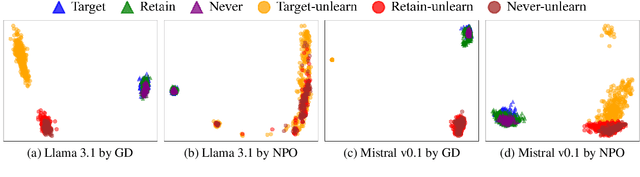
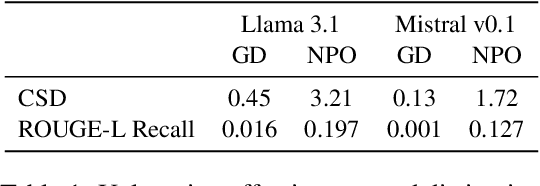
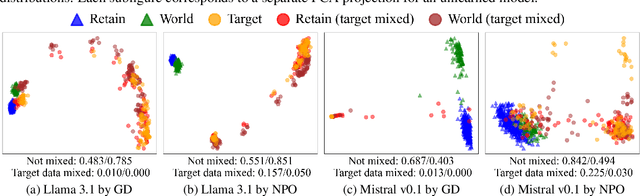
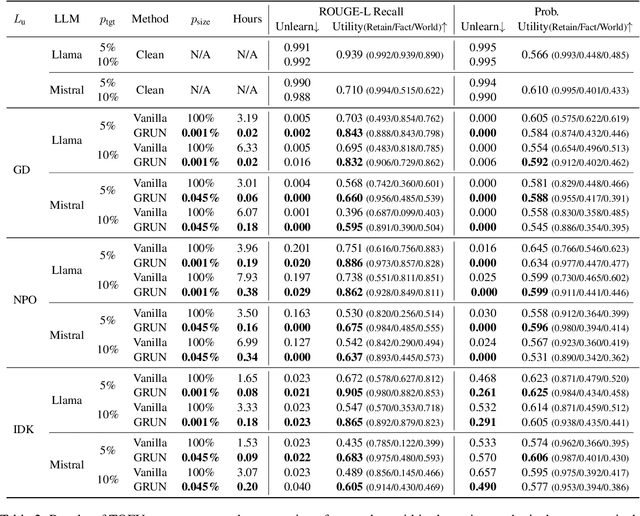
Unlearning has been proposed to remove copyrighted and privacy-sensitive data from Large Language Models (LLMs). Existing approaches primarily rely on fine-tuning-based methods, which can be categorized into gradient ascent-based (GA-based) and suppression-based methods. However, they often degrade model utility (the ability to respond to normal prompts). In this work, we aim to develop a general framework that enhances the utility of fine-tuning-based unlearning methods. To achieve this goal, we first investigate the common property between GA-based and suppression-based methods. We unveil that GA-based methods unlearn by distinguishing the target data (i.e., the data to be removed) and suppressing related generations, which is essentially the same strategy employed by suppression-based methods. Inspired by this finding, we introduce Gated Representation UNlearning (GRUN) which has two components: a soft gate function for distinguishing target data and a suppression module using Representation Fine-tuning (ReFT) to adjust representations rather than model parameters. Experiments show that GRUN significantly improves the unlearning and utility. Meanwhile, it is general for fine-tuning-based methods, efficient and promising for sequential unlearning.
K-LoRA: Unlocking Training-Free Fusion of Any Subject and Style LoRAs
Feb 25, 2025Recent studies have explored combining different LoRAs to jointly generate learned style and content. However, existing methods either fail to effectively preserve both the original subject and style simultaneously or require additional training. In this paper, we argue that the intrinsic properties of LoRA can effectively guide diffusion models in merging learned subject and style. Building on this insight, we propose K-LoRA, a simple yet effective training-free LoRA fusion approach. In each attention layer, K-LoRA compares the Top-K elements in each LoRA to be fused, determining which LoRA to select for optimal fusion. This selection mechanism ensures that the most representative features of both subject and style are retained during the fusion process, effectively balancing their contributions. Experimental results demonstrate that the proposed method effectively integrates the subject and style information learned by the original LoRAs, outperforming state-of-the-art training-based approaches in both qualitative and quantitative results.