 Add to Chrome
 Add to Firefox
 Add to Edge
Fast-dDrive: Efficient Block-Diffusion VLM for Autonomous Driving
May 25, 2026
End-to-end autonomous driving via Vision-Language-Action (VLA) models demands a precarious balance between high-fidelity trajectory planning and efficient inference. Existing paradigms typically fall short: autoregressive (AR) VLAs are memory-bandwidth-bound on edge hardware and prone to exposure-bias drift, while full-sequence diffusion models preclude KV-cache reuse and suffer from "logical leakage" that violates the fundamental perceive-then-plan causality. We present Fast-dDrive, a block-diffusion VLA that performs bidirectional refinement within semantic units while enforcing strict causal ordering across them. Leveraging the observation that driving VLAs often emit structured JSON-like outputs, Fast-dDrive freezes structural tokens into a section scaffold and employs a section-aware training recipe that prioritizes safety-critical planning. We further introduce Scaffold Speculative Decoding to achieve AR-equivalent quality at significantly higher throughput. Finally, we propose a low-overhead test-time scaling scheme: by forking $N$ stochastic trajectory rollouts from a single shared-prefix KV cache and averaging them, we effectively suppress prediction variance at a fractional computational cost. Empirical results demonstrate that Fast-dDrive redefines the speed-accuracy frontier for driving agents. On the WOD-E2E test set, Fast-dDrive achieves SOTA ADE@3s and ADE@5s, alongside the highest RFS among diffusion-based VLAs; on nuScenes, it reduces average L2 error to $0.32$m (a $22\%$ improvement). When integrated with SGLang, our framework delivers $12\times$ throughput speedup over the AR baseline, narrowing the gap between high-capacity VLAs and the efficiency demands of real-time on-vehicle deployment.

SciCore-Mol: Augmenting Large Language Models with Pluggable Molecular Cognition Modules
May 21, 2026Large Language Models (LLMs) are central to the one-for-all intelligent paradigm, but they face a fundamental challenge when dealing with heterogeneous scientific data such as molecules: the inherent gap between discrete linguistic symbols and topological molecular or continuous reaction data leads to significant information loss and semantic noise in text-based reasoning. We propose SciCore-Mol, a modular framework that bridges this gap through three deeply integrated pluggable cognitive modules: a topology-aware perception module, a latent diffusion-based molecular generation module, and a reaction-aware reasoning module. Each module is coupled to the LLM backbone through learned representation interfaces, enabling richer information exchange than is possible with text-only tool feedback. Our experiments on diverse chemical tasks demonstrate that SciCore-Mol achieves strong comprehensive performance across molecular understanding, generation, reaction prediction, and general chemistry knowledge, with an 8B-parameter open-source system that is competitive with and in several dimensions surpasses proprietary large models. This work provides a systematic blueprint for equipping LLMs with scientific expertise through decoupled, pluggable, and flexibly orchestrated modules, with direct implications for drug design, chemical synthesis, and broader scientific discovery.
StableVLA: Towards Robust Vision-Language-Action Models without Extra Data
May 18, 2026It is infeasible to encompass all possible disturbances within the training dataset. This raises a critical question regarding the robustness of Vision-Language-Action (VLA) models when encountering unseen real-world visual disturbances, particularly under imperfect visual conditions. In this work, we conduct a systematic study based on recent state-of-the-art VLA models and reveal a significant performance drop when visual disturbances absent from the training data are introduced. To mitigate this issue, we propose a lightweight adapter module grounded in information theory, termed the Information Bottleneck Adapter (IB-Adapter), which selectively filters potential noise from visual inputs. Without requiring any extra data or augmentation strategies, IB-Adapter consistently improves over the baseline by an average of 30%, while adding fewer than 10M parameters, demonstrating notable efficiency and effectiveness. Furthermore, even with a 14x smaller backbone (0.5B parameters) and no pre-training on the Open X-Embodiment dataset, our model StableVLA achieves robustness competitive with 7B-scale state-of-the-art VLAs. With negligible parameter overhead (<10M), our approach maintains accuracy on long-horizon tasks and surpasses OpenPi under both synthetic and physical visual corruptions.
Mutual Forcing: Dual-Mode Self-Evolution for Fast Autoregressive Audio-Video Character Generation
Apr 28, 2026In this work, we propose Mutual Forcing, a framework for fast autoregressive audio-video generation with long-horizon audio-video synchronization. Our approach addresses two key challenges: joint audio-video modeling and fast autoregressive generation. To ease joint audio-video optimization, we adopt a two-stage training strategy: we first train uni-modal generators and then couple them into a unified audio-video model for joint training on paired data. For streaming generation, we ask whether a native fast causal audio-video model can be trained directly, instead of following existing streaming distillation pipelines that typically train a bidirectional model first and then convert it into a causal generator through multiple distillation stages. Our answer is Mutual Forcing, which builds directly on native autoregressive model and integrates few-step and multi-step generation within a single weight-shared model, enabling self-distillation and improved training-inference consistency. The multi-step mode improves the few-step mode via self-distillation, while the few-step mode generates historical context during training to improve training-inference consistency; because the two modes share parameters, these two effects reinforce each other within a single model. Compared with prior approaches such as Self-Forcing, Mutual Forcing removes the need for an additional bidirectional teacher model, supports more flexible training sequence lengths, reduces training overhead, and allows the model to improve directly from real paired data rather than a fixed teacher. Experiments show that Mutual Forcing matches or surpasses strong baselines that require around 50 sampling steps while using only 4 to 8 steps, demonstrating substantial advantages in both efficiency and quality. The project page is available at https://mutualforcing.github.io.
TS-Attn: Temporal-wise Separable Attention for Multi-Event Video Generation
Apr 21, 2026Generating high-quality videos from complex temporal descriptions that contain multiple sequential actions is a key unsolved problem. Existing methods are constrained by an inherent trade-off: using multiple short prompts fed sequentially into the model improves action fidelity but compromises temporal consistency, while a single complex prompt preserves consistency at the cost of prompt-following capability. We attribute this problem to two primary causes: 1) temporal misalignment between video content and the prompt, and 2) conflicting attention coupling between motion-related visual objects and their associated text conditions. To address these challenges, we propose a novel, training-free attention mechanism, Temporal-wise Separable Attention (TS-Attn), which dynamically rearranges attention distribution to ensure temporal awareness and global coherence in multi-event scenarios. TS-Attn can be seamlessly integrated into various pre-trained text-to-video models, boosting StoryEval-Bench scores by 33.5% and 16.4% on Wan2.1-T2V-14B and Wan2.2-T2V-A14B with only a 2% increase in inference time. It also supports plug-and-play usage across models for multi-event image-to-video generation. The source code and project page are available at https://github.com/Hong-yu-Zhang/TS-Attn.
Enhancing Spatial Understanding in Image Generation via Reward Modeling
Feb 27, 2026Recent progress in text-to-image generation has greatly advanced visual fidelity and creativity, but it has also imposed higher demands on prompt complexity-particularly in encoding intricate spatial relationships. In such cases, achieving satisfactory results often requires multiple sampling attempts. To address this challenge, we introduce a novel method that strengthens the spatial understanding of current image generation models. We first construct the SpatialReward-Dataset with over 80k preference pairs. Building on this dataset, we build SpatialScore, a reward model designed to evaluate the accuracy of spatial relationships in text-to-image generation, achieving performance that even surpasses leading proprietary models on spatial evaluation. We further demonstrate that this reward model effectively enables online reinforcement learning for the complex spatial generation. Extensive experiments across multiple benchmarks show that our specialized reward model yields significant and consistent gains in spatial understanding for image generation.
Rethinking Video Generation Model for the Embodied World
Jan 21, 2026Video generation models have significantly advanced embodied intelligence, unlocking new possibilities for generating diverse robot data that capture perception, reasoning, and action in the physical world. However, synthesizing high-quality videos that accurately reflect real-world robotic interactions remains challenging, and the lack of a standardized benchmark limits fair comparisons and progress. To address this gap, we introduce a comprehensive robotics benchmark, RBench, designed to evaluate robot-oriented video generation across five task domains and four distinct embodiments. It assesses both task-level correctness and visual fidelity through reproducible sub-metrics, including structural consistency, physical plausibility, and action completeness. Evaluation of 25 representative models highlights significant deficiencies in generating physically realistic robot behaviors. Furthermore, the benchmark achieves a Spearman correlation coefficient of 0.96 with human evaluations, validating its effectiveness. While RBench provides the necessary lens to identify these deficiencies, achieving physical realism requires moving beyond evaluation to address the critical shortage of high-quality training data. Driven by these insights, we introduce a refined four-stage data pipeline, resulting in RoVid-X, the largest open-source robotic dataset for video generation with 4 million annotated video clips, covering thousands of tasks and enriched with comprehensive physical property annotations. Collectively, this synergistic ecosystem of evaluation and data establishes a robust foundation for rigorous assessment and scalable training of video models, accelerating the evolution of embodied AI toward general intelligence.
MHLA: Restoring Expressivity of Linear Attention via Token-Level Multi-Head
Jan 12, 2026While the Transformer architecture dominates many fields, its quadratic self-attention complexity hinders its use in large-scale applications. Linear attention offers an efficient alternative, but its direct application often degrades performance, with existing fixes typically re-introducing computational overhead through extra modules (e.g., depthwise separable convolution) that defeat the original purpose. In this work, we identify a key failure mode in these methods: global context collapse, where the model loses representational diversity. To address this, we propose Multi-Head Linear Attention (MHLA), which preserves this diversity by computing attention within divided heads along the token dimension. We prove that MHLA maintains linear complexity while recovering much of the expressive power of softmax attention, and verify its effectiveness across multiple domains, achieving a 3.6\% improvement on ImageNet classification, a 6.3\% gain on NLP, a 12.6\% improvement on image generation, and a 41\% enhancement on video generation under the same time complexity.
EgoReAct: Egocentric Video-Driven 3D Human Reaction Generation
Dec 28, 2025Humans exhibit adaptive, context-sensitive responses to egocentric visual input. However, faithfully modeling such reactions from egocentric video remains challenging due to the dual requirements of strictly causal generation and precise 3D spatial alignment. To tackle this problem, we first construct the Human Reaction Dataset (HRD) to address data scarcity and misalignment by building a spatially aligned egocentric video-reaction dataset, as existing datasets (e.g., ViMo) suffer from significant spatial inconsistency between the egocentric video and reaction motion, e.g., dynamically moving motions are always paired with fixed-camera videos. Leveraging HRD, we present EgoReAct, the first autoregressive framework that generates 3D-aligned human reaction motions from egocentric video streams in real-time. We first compress the reaction motion into a compact yet expressive latent space via a Vector Quantised-Variational AutoEncoder and then train a Generative Pre-trained Transformer for reaction generation from the visual input. EgoReAct incorporates 3D dynamic features, i.e., metric depth, and head dynamics during the generation, which effectively enhance spatial grounding. Extensive experiments demonstrate that EgoReAct achieves remarkably higher realism, spatial consistency, and generation efficiency compared with prior methods, while maintaining strict causality during generation. We will release code, models, and data upon acceptance.
MagicDistillation: Weak-to-Strong Video Distillation for Large-Scale Portrait Few-Step Synthesis
Mar 17, 2025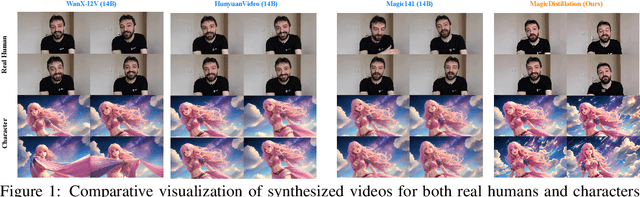
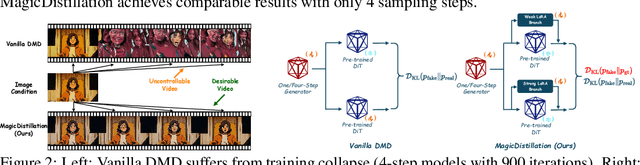
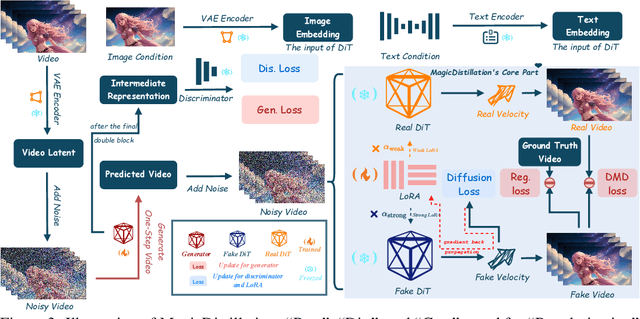
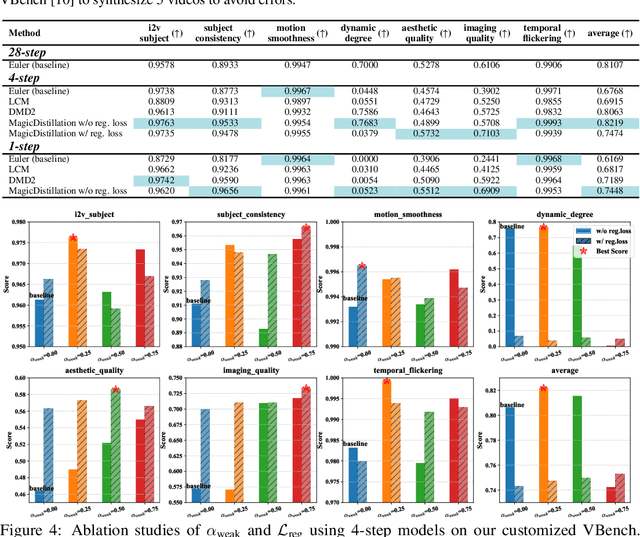
Fine-tuning open-source large-scale VDMs for the portrait video synthesis task can result in significant improvements across multiple dimensions, such as visual quality and natural facial motion dynamics. Despite their advancements, how to achieve step distillation and reduce the substantial computational overhead of large-scale VDMs remains unexplored. To fill this gap, this paper proposes Weak-to-Strong Video Distillation (W2SVD) to mitigate both the issue of insufficient training memory and the problem of training collapse observed in vanilla DMD during the training process. Specifically, we first leverage LoRA to fine-tune the fake diffusion transformer (DiT) to address the out-of-memory issue. Then, we employ the W2S distribution matching to adjust the real DiT's parameter, subtly shifting it toward the fake DiT's parameter. This adjustment is achieved by utilizing the weak weight of the low-rank branch, effectively alleviate the conundrum where the video synthesized by the few-step generator deviates from the real data distribution, leading to inaccuracies in the KL divergence approximation. Additionally, we minimize the distance between the fake data distribution and the ground truth distribution to further enhance the visual quality of the synthesized videos. As experimentally demonstrated on HunyuanVideo, W2SVD surpasses the standard Euler, LCM, DMD and even the 28-step standard sampling in FID/FVD and VBench in 1/4-step video synthesis. The project page is in https://w2svd.github.io/W2SVD/.