 Add to Chrome
 Add to Firefox
 Add to Edge
SAGE: Scalable AI Governance & Evaluation
Feb 08, 2026
Evaluating relevance in large-scale search systems is fundamentally constrained by the governance gap between nuanced, resource-constrained human oversight and the high-throughput requirements of production systems. While traditional approaches rely on engagement proxies or sparse manual review, these methods often fail to capture the full scope of high-impact relevance failures. We present \textbf{SAGE} (Scalable AI Governance \& Evaluation), a framework that operationalizes high-quality human product judgment as a scalable evaluation signal. At the core of SAGE is a bidirectional calibration loop where natural-language \emph{Policy}, curated \emph{Precedent}, and an \emph{LLM Surrogate Judge} co-evolve. SAGE systematically resolves semantic ambiguities and misalignments, transforming subjective relevance judgment into an executable, multi-dimensional rubric with near human-level agreement. To bridge the gap between frontier model reasoning and industrial-scale inference, we apply teacher-student distillation to transfer high-fidelity judgments into compact student surrogates at \textbf{92$\times$} lower cost. Deployed within LinkedIn Search ecosystems, SAGE guided model iteration through simulation-driven development, distilling policy-aligned models for online serving and enabling rapid offline evaluation. In production, it powered policy oversight that measured ramped model variants and detected regressions invisible to engagement metrics. Collectively, these drove a \textbf{0.25\%} lift in LinkedIn daily active users.

Decoupling Variance and Scale-Invariant Updates in Adaptive Gradient Descent for Unified Vector and Matrix Optimization
Feb 06, 2026Adaptive methods like Adam have become the $\textit{de facto}$ standard for large-scale vector and Euclidean optimization due to their coordinate-wise adaptation with a second-order nature. More recently, matrix-based spectral optimizers like Muon (Jordan et al., 2024b) show the power of treating weight matrices as matrices rather than long vectors. Linking these is hard because many natural generalizations are not feasible to implement, and we also cannot simply move the Adam adaptation to the matrix spectrum. To address this, we reformulate the AdaGrad update and decompose it into a variance adaptation term and a scale-invariant term. This decoupling produces $\textbf{DeVA}$ ($\textbf{De}$coupled $\textbf{V}$ariance $\textbf{A}$daptation), a framework that bridges between vector-based variance adaptation and matrix spectral optimization, enabling a seamless transition from Adam to adaptive spectral descent. Extensive experiments across language modeling and image classification demonstrate that DeVA consistently outperforms state-of-the-art methods such as Muon and SOAP (Vyas et al., 2024), reducing token usage by around 6.6\%. Theoretically, we show that the variance adaptation term effectively improves the blockwise smoothness, facilitating faster convergence. Our implementation is available at https://github.com/Tsedao/Decoupled-Variance-Adaptation
ERNIE 5.0 Technical Report
Feb 04, 2026In this report, we introduce ERNIE 5.0, a natively autoregressive foundation model desinged for unified multimodal understanding and generation across text, image, video, and audio. All modalities are trained from scratch under a unified next-group-of-tokens prediction objective, based on an ultra-sparse mixture-of-experts (MoE) architecture with modality-agnostic expert routing. To address practical challenges in large-scale deployment under diverse resource constraints, ERNIE 5.0 adopts a novel elastic training paradigm. Within a single pre-training run, the model learns a family of sub-models with varying depths, expert capacities, and routing sparsity, enabling flexible trade-offs among performance, model size, and inference latency in memory- or time-constrained scenarios. Moreover, we systematically address the challenges of scaling reinforcement learning to unified foundation models, thereby guaranteeing efficient and stable post-training under ultra-sparse MoE architectures and diverse multimodal settings. Extensive experiments demonstrate that ERNIE 5.0 achieves strong and balanced performance across multiple modalities. To the best of our knowledge, among publicly disclosed models, ERNIE 5.0 represents the first production-scale realization of a trillion-parameter unified autoregressive model that supports both multimodal understanding and generation. To facilitate further research, we present detailed visualizations of modality-agnostic expert routing in the unified model, alongside comprehensive empirical analysis of elastic training, aiming to offer profound insights to the community.
Self Voice Conversion as an Attack against Neural Audio Watermarking
Jan 28, 2026Audio watermarking embeds auxiliary information into speech while maintaining speaker identity, linguistic content, and perceptual quality. Although recent advances in neural and digital signal processing-based watermarking methods have improved imperceptibility and embedding capacity, robustness is still primarily assessed against conventional distortions such as compression, additive noise, and resampling. However, the rise of deep learning-based attacks introduces novel and significant threats to watermark security. In this work, we investigate self voice conversion as a universal, content-preserving attack against audio watermarking systems. Self voice conversion remaps a speaker's voice to the same identity while altering acoustic characteristics through a voice conversion model. We demonstrate that this attack severely degrades the reliability of state-of-the-art watermarking approaches and highlight its implications for the security of modern audio watermarking techniques.
Pitch-Conditioned Instrument Sound Synthesis From an Interactive Timbre Latent Space
Oct 05, 2025This paper presents a novel approach to neural instrument sound synthesis using a two-stage semi-supervised learning framework capable of generating pitch-accurate, high-quality music samples from an expressive timbre latent space. Existing approaches that achieve sufficient quality for music production often rely on high-dimensional latent representations that are difficult to navigate and provide unintuitive user experiences. We address this limitation through a two-stage training paradigm: first, we train a pitch-timbre disentangled 2D representation of audio samples using a Variational Autoencoder; second, we use this representation as conditioning input for a Transformer-based generative model. The learned 2D latent space serves as an intuitive interface for navigating and exploring the sound landscape. We demonstrate that the proposed method effectively learns a disentangled timbre space, enabling expressive and controllable audio generation with reliable pitch conditioning. Experimental results show the model's ability to capture subtle variations in timbre while maintaining a high degree of pitch accuracy. The usability of our method is demonstrated in an interactive web application, highlighting its potential as a step towards future music production environments that are both intuitive and creatively empowering: https://pgesam.faresschulz.com
Wan-Animate: Unified Character Animation and Replacement with Holistic Replication
Sep 17, 2025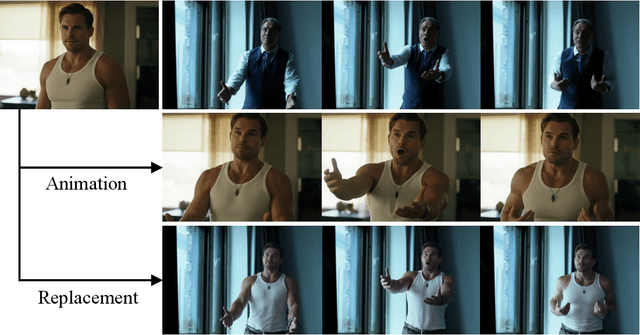
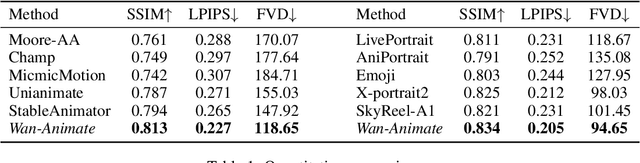
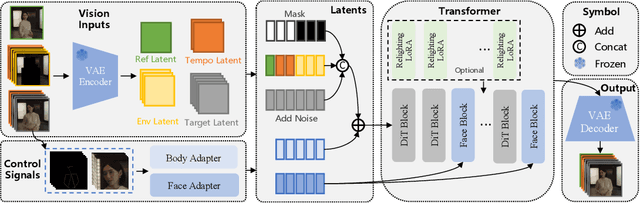
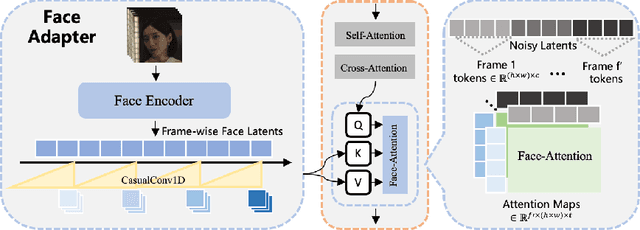
We introduce Wan-Animate, a unified framework for character animation and replacement. Given a character image and a reference video, Wan-Animate can animate the character by precisely replicating the expressions and movements of the character in the video to generate high-fidelity character videos. Alternatively, it can integrate the animated character into the reference video to replace the original character, replicating the scene's lighting and color tone to achieve seamless environmental integration. Wan-Animate is built upon the Wan model. To adapt it for character animation tasks, we employ a modified input paradigm to differentiate between reference conditions and regions for generation. This design unifies multiple tasks into a common symbolic representation. We use spatially-aligned skeleton signals to replicate body motion and implicit facial features extracted from source images to reenact expressions, enabling the generation of character videos with high controllability and expressiveness. Furthermore, to enhance environmental integration during character replacement, we develop an auxiliary Relighting LoRA. This module preserves the character's appearance consistency while applying the appropriate environmental lighting and color tone. Experimental results demonstrate that Wan-Animate achieves state-of-the-art performance. We are committed to open-sourcing the model weights and its source code.
Robust Docking Maneuvers for Autonomous Trolley Collection: An Optimization-Based Visual Servoing Scheme
Sep 09, 2025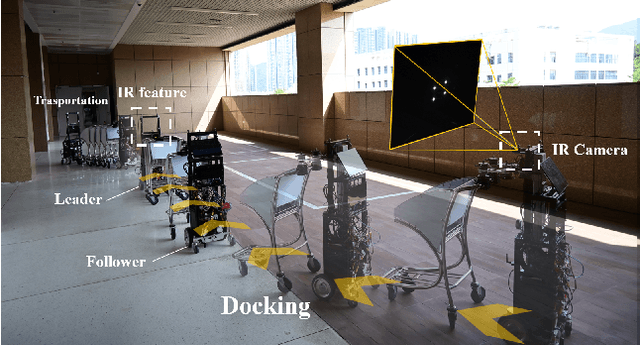
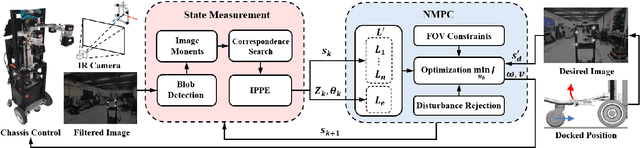
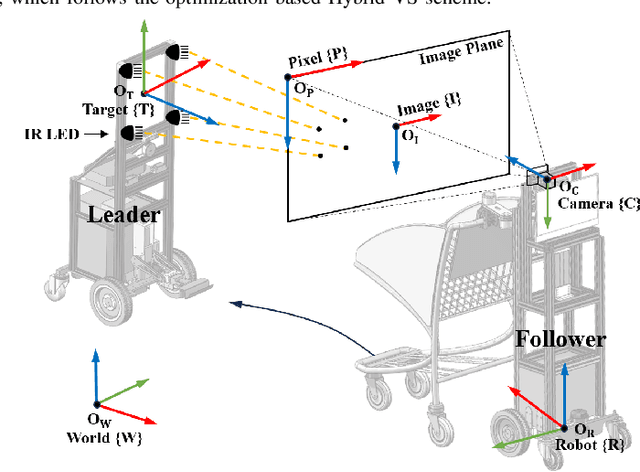
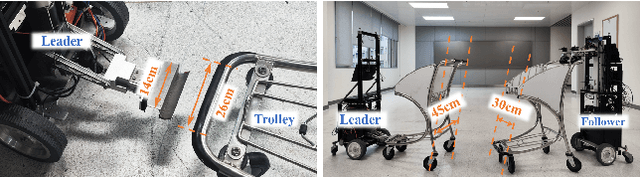
Service robots have demonstrated significant potential for autonomous trolley collection and redistribution in public spaces like airports or warehouses to improve efficiency and reduce cost. Usually, a fully autonomous system for the collection and transportation of multiple trolleys is based on a Leader-Follower formation of mobile manipulators, where reliable docking maneuvers of the mobile base are essential to align trolleys into organized queues. However, developing a vision-based robotic docking system faces significant challenges: high precision requirements, environmental disturbances, and inherent robot constraints. To address these challenges, we propose an optimization-based Visual Servoing scheme that incorporates active infrared markers for robust feature extraction across diverse lighting conditions. This framework explicitly models nonholonomic kinematics and visibility constraints within the Hybrid Visual Servoing problem, augmented with an observer for disturbance rejection to ensure precise and stable docking. Experimental results across diverse environments demonstrate the robustness of this system, with quantitative evaluations confirming high docking accuracy.
${C}^{3}$-GS: Learning Context-aware, Cross-dimension, Cross-scale Feature for Generalizable Gaussian Splatting
Aug 28, 2025Generalizable Gaussian Splatting aims to synthesize novel views for unseen scenes without per-scene optimization. In particular, recent advancements utilize feed-forward networks to predict per-pixel Gaussian parameters, enabling high-quality synthesis from sparse input views. However, existing approaches fall short in encoding discriminative, multi-view consistent features for Gaussian predictions, which struggle to construct accurate geometry with sparse views. To address this, we propose $\mathbf{C}^{3}$-GS, a framework that enhances feature learning by incorporating context-aware, cross-dimension, and cross-scale constraints. Our architecture integrates three lightweight modules into a unified rendering pipeline, improving feature fusion and enabling photorealistic synthesis without requiring additional supervision. Extensive experiments on benchmark datasets validate that $\mathbf{C}^{3}$-GS achieves state-of-the-art rendering quality and generalization ability. Code is available at: https://github.com/YuhsiHu/C3-GS.
ShortListing Model: A Streamlined SimplexDiffusion for Discrete Variable Generation
Aug 24, 2025Generative modeling of discrete variables is challenging yet crucial for applications in natural language processing and biological sequence design. We introduce the Shortlisting Model (SLM), a novel simplex-based diffusion model inspired by progressive candidate pruning. SLM operates on simplex centroids, reducing generation complexity and enhancing scalability. Additionally, SLM incorporates a flexible implementation of classifier-free guidance, enhancing unconditional generation performance. Extensive experiments on DNA promoter and enhancer design, protein design, character-level and large-vocabulary language modeling demonstrate the competitive performance and strong potential of SLM. Our code can be found at https://github.com/GenSI-THUAIR/SLM
Dynamic Benchmark Construction for Evaluating Large Language Models on Real-World Codes
Aug 10, 2025As large language models LLMs) become increasingly integrated into software development workflows, rigorously evaluating their performance on complex, real-world code generation tasks has become essential. However, existing benchmarks often suffer from data contamination and limited test rigor, constraining their ability to reveal model failures effectively. To address these, we present CODE2BENCH, a end-to-end pipeline for dynamically constructing robust and contamination-resistant benchmarks from real-world GitHub repositories. Specifically, CODE2BENCH introduces three key innovations: (1) Automated Dynamism, achieved through periodic ingestion of recent code to minimize training data contamination; (2) Scope Graph-based dependency analysis, which enables structured classification of functions into benchmark instances with controlled dependency levels (distinguishing between Self-Contained (SC) tasks for cross-language evaluation and Weakly Self-Contained (WSC) tasks involving permitted library usage); and (3) Property-Based Testing (PBT) for the automated synthesis of rigorous test suites to enable thorough functional verification. Using this pipeline, we construct CODE2BENCH-2505, the first benchmark derived from 880 recent Python projects spanning diverse domains, comprising 1,163 code generation tasks with 100% average branch coverage on ground-truth implementations. Extensive evaluation of 16 LLMs using CODE2BENCH-2505 reveals that models consistently struggle with SC tasks requiring complex, non-standard logic and cross-language transfer, while showing relatively stronger performance on WSC tasks in Python. Our work introduces a contamination-resistant, language-agnostic methodology for dynamic benchmark construction, offering a principled foundation for the comprehensive and realistic evaluation of LLMs on real-world software development tasks.