 Add to Chrome
 Add to Firefox
 Add to Edge
A Multi-Branch Hierarchy-Aware Framework for Heterogeneous Audio Classification
Jul 02, 2026
This technical report describes our system for Task 1 of the DCASE 2026 Challenge, which aims to classify heterogeneous audio recordings according to the Broad Sound Taxonomy (BST). The task requires both accurate second-level prediction and consistency with the top-level taxonomy. Our system is built on CLAP-based audio-text representations and is improved along three strategies: expanding the training set with a filtered subset of BSD35k, enhancing acoustic modeling with feature-specific branches, and refining predictions using hierarchy-aware classifiers and KNN-based post-processing. Among the acoustic features considered, the log-STFT branch provides the strongest single-model performance. With KNN-based post-processing, our best single system achieves a hierarchical F1 score (Hier. F1) of 80.84% on the BSD10k-v1.2 set under the same evaluation protocol as the baseline. We further construct ensemble systems by combining models with complementary acoustic features and classification heads, achieving Hier. F1 scores of 81.25% and 81.18%, respectively.

Rate-Splitting Multiple Access Enabled Probabilistic Semantic Communication in UAV Networks
Jun 30, 2026This article proposes an uncrewed aerial vehicle (UAV) downlink semantic communication framework, where probabilistic knowledge graphs (PKGs) are employed to model user equipment (UE) semantics and decompose semantic information into shared and private components. Leveraging the capability of rate-splitting multiple access (RSMA) in addressing such semantic structures, a PKG-assisted RSMA transmission scheme is developed to efficiently deliver multi-user semantic information under severe energy constraints and fast-varying UAV channels. To characterize the strongly coupled energy costs of communication, computation, and flight, a weighted energy minimization problem is formulated to jointly optimize the UAV trajectory, power allocation, beamforming design, and semantic compression ratio. The resulting non-convex problem is efficiently solved using an iterative semantic-aware weighted energy optimization (SWEO) algorithm that integrates Lagrangian dual decomposition and successive convex approximation. Furthermore, a semantic accuracy metric is proposed to quantify the reliability of reconstruction by assigning importance-based weights to informative KG triples. Extensive simulation results verify that the proposed framework achieves superior energy efficiency, enhanced semantic preservation, and consistently better performance than conventional RSMA, non-orthogonal multiple access (NOMA), and space division multiple access (SDMA) schemes in benchmarks across various network parameters.
NavIsaacLab: Generating Realistic Crowd via Parallel Robot Learning for Benchmarking Human-aware Navigation
Jun 24, 2026Robot autonomous navigation that accounts for surrounding human activities is crucial for ensuring both safety and natural human-robot interaction in real-world environments shared by humans and robots. Simulation of complex and diverse navigation scenarios serves as the foundation for training reliable robot navigation policies and accurately evaluating the performance of algorithms, offering an efficient alternative to manual supervision of real data. However, current human-aware navigation research faces significant challenges due to the scarcity of diverse, high-quality scene data. Existing simulation platforms often rely on handcrafted rules to approximate pedestrian behavior and lack the capability to provide extensive sensor signals, typically assuming perfect observations. To address these limitations, this paper presents NavIsaacLab, a comprehensive framework for benchmarking and training human-aware navigation policies through physics-based and photo-realistic simulations of pedestrians and scenes. Based on Isaac Lab, the proposed framework employs photo-realistic scene rendering capabilities and supports parallel simulation on GPU, delivering real-time and accurate 3D visual feedback to robots. To enhance the realism of human behavior, a data-driven approach is employed that incorporates a trajectory diffusion model and an adversarial motion learning controller, enabling controllable, physics-based pedestrian simulation. Furthermore, the integration of diverse cross-scale scenes provides a robust benchmark for state-of-the-art human-aware navigation methods.
Learning Robot Visual Navigation in Crowds via Intention-Aware Scene Representations
Jun 24, 2026Robot crowd navigation requires the ability to infer human intentions while accounting for the structural constraints of the environment. Currently, deep reinforcement learning (DRL) provides a promising method for learning navigation policies that understand human intentions. However, most of them rely on limited scene representations, treating pedestrians as simple 2D points and ignoring rich visual cues from both humans and the environment. To address this issue, we introduce iCrowdNav, a novel visual crowd navigation method with intention-aware scene representations, to encode behavioral and structural context from egocentric visual observations. Our method employs two key components: a spatio-temporal encoder for extracting occupancy features of the scene, and Intent-Interact Former (I$^2$ Former), an attention-based module that encodes human poses to infer pedestrians' motion intentions. These features are integrated into a compact state embedding that supports effective DRL policy training. Extensive experiments show that our method achieves superior performance over baselines, and real-world deployment demonstrates vision-based crowd navigation.
Can Single-View Mesh Reconstruction Generalize to Robot Camera Rotation?
Jun 22, 2026Single-view mesh reconstruction predicts object meshes and spatial layouts from a single observation, making it attractive for fast robot spatial reasoning and real-to-sim digital twins. However, robot-mounted cameras naturally rotate during manipulation and navigation, while learned single-view reconstruction models often rely on view-dependent priors and may generalize poorly to out-of-distribution camera rotations. Such rotations can introduce 3D inconsistencies, incorrect layouts, and violations of physical constraints, but this failure mode remains under-evaluated. We introduce an evaluation protocol with controlled axis-wise roll, pitch, and yaw sweeps to trace errors in monocular depth estimation (MDE), canonical object meshes, camera-space layout, and physical plausibility within a representative SAM3D-style pipeline. On the Aria Digital Twin dataset and a real Franka wrist-camera sequence, camera rotations induce MDE distortion, layout drift, and collision penetration, while canonical mesh predictions remain relatively stable. A two-stage SAM3D+FoundationPose pipeline is more robust than one-stage feed-forward layout prediction, and our Gravity-Aware Refinement reduces one-stage pairwise ICP-based layout-orientation error by 47.1$\%$. Our evaluation reveals that current single-view mesh reconstruction methods generalize poorly to robot camera rotation, and suggests that explicit gravity cues are important for reliable robotic single-view mesh reconstruction.
Joint Sensing and Covert Communications in RIS-NOMA Systems
Mar 27, 2026A reconfigurable intelligent surface (RIS)-assisted non-orthogonal multiple access (NOMA) system is investigated, where the transmitter (Alice) is a dual functional radar communication (DFRC) base station (BS) that aims to sense the location of a potential warden (Willie), while simultaneously transmitting public and covert signals to the legitimate users, Carol and Bob, respectively. Both cases of known and unknown Willie locations are considered. For the known-location case, assuming perfect channel state information (CSI) at Willie, a covert rate maximization is formulated with the joint optimization of active and passive beamforming, which is solved using successive convex approximation (SCA), penalty method, and semidefinite relaxation (SDR). For the unknown-location case, we propose to estimate Willie's location via radar sensing and develop a sensing-based imperfect CSI model. In particular, the CSI error uncertainty is bounded by the sensing accuracy, which is characterized by the Cramer-Rao bound (CRB). Subsequently, a robust communication rate maximization problem is formulated under the constraints on quality-of-service (QoS) of Carol, sensing accuracy, and covertness level. The Schur complement and S-procedure are employed to handle the non-convex constraints. Numerical results compare the system performance under the two cases, and demonstrate the significant covert performance superiority of the sensing-based imperfect CSI model and NOMA over the general norm-bounded imperfect CSI model and the orthogonal multiple access scheme. Furthermore, the dual yet contradictory effects of sensing on covert communications are revealed. It is also found that Alice primarily utilizes Carol's signal for sensing, while allocating almost all of Bob's signal for communication.
Robust Docking Maneuvers for Autonomous Trolley Collection: An Optimization-Based Visual Servoing Scheme
Sep 09, 2025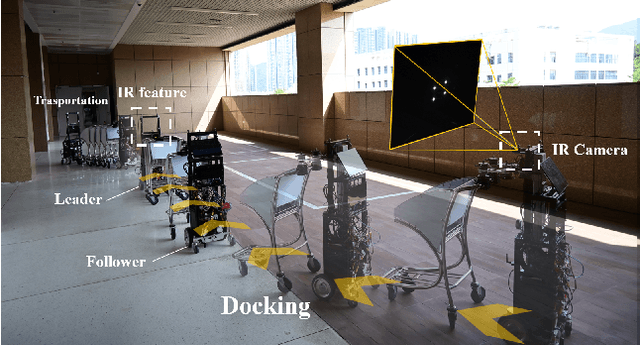
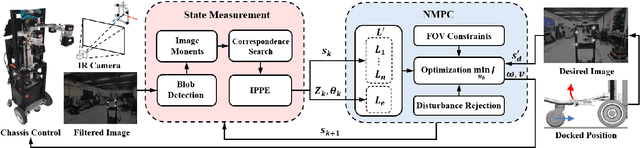
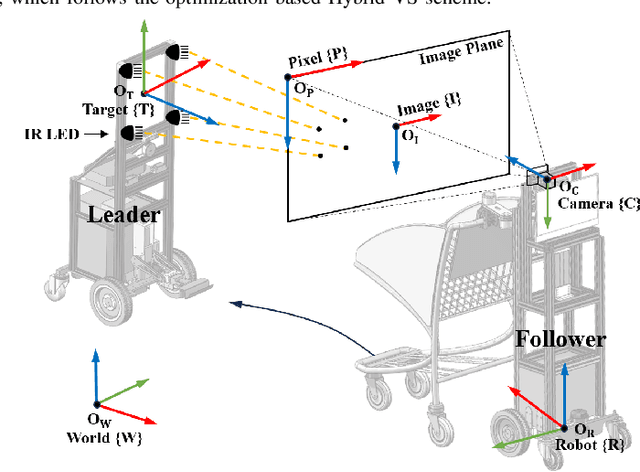
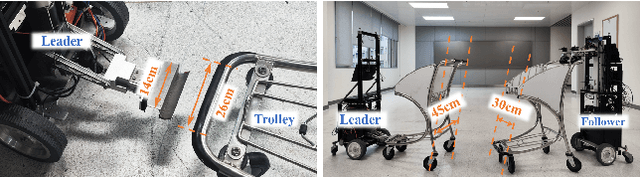
Service robots have demonstrated significant potential for autonomous trolley collection and redistribution in public spaces like airports or warehouses to improve efficiency and reduce cost. Usually, a fully autonomous system for the collection and transportation of multiple trolleys is based on a Leader-Follower formation of mobile manipulators, where reliable docking maneuvers of the mobile base are essential to align trolleys into organized queues. However, developing a vision-based robotic docking system faces significant challenges: high precision requirements, environmental disturbances, and inherent robot constraints. To address these challenges, we propose an optimization-based Visual Servoing scheme that incorporates active infrared markers for robust feature extraction across diverse lighting conditions. This framework explicitly models nonholonomic kinematics and visibility constraints within the Hybrid Visual Servoing problem, augmented with an observer for disturbance rejection to ensure precise and stable docking. Experimental results across diverse environments demonstrate the robustness of this system, with quantitative evaluations confirming high docking accuracy.
Token Communication in the Era of Large Models: An Information Bottleneck-Based Approach
Jul 02, 2025This letter proposes UniToCom, a unified token communication paradigm that treats tokens as the fundamental units for both processing and wireless transmission. Specifically, to enable efficient token representations, we propose a generative information bottleneck (GenIB) principle, which facilitates the learning of tokens that preserve essential information while supporting reliable generation across multiple modalities. By doing this, GenIB-based tokenization is conducive to improving the communication efficiency and reducing computational complexity. Additionally, we develop $\sigma$-GenIB to address the challenges of variance collapse in autoregressive modeling, maintaining representational diversity and stability. Moreover, we employ a causal Transformer-based multimodal large language model (MLLM) at the receiver to unify the processing of both discrete and continuous tokens under the next-token prediction paradigm. Simulation results validate the effectiveness and superiority of the proposed UniToCom compared to baselines under dynamic channel conditions. By integrating token processing with MLLMs, UniToCom enables scalable and generalizable communication in favor of multimodal understanding and generation, providing a potential solution for next-generation intelligent communications.
Task-Agnostic Semantic Communications Relying on Information Bottleneck and Federated Meta-Learning
Apr 30, 2025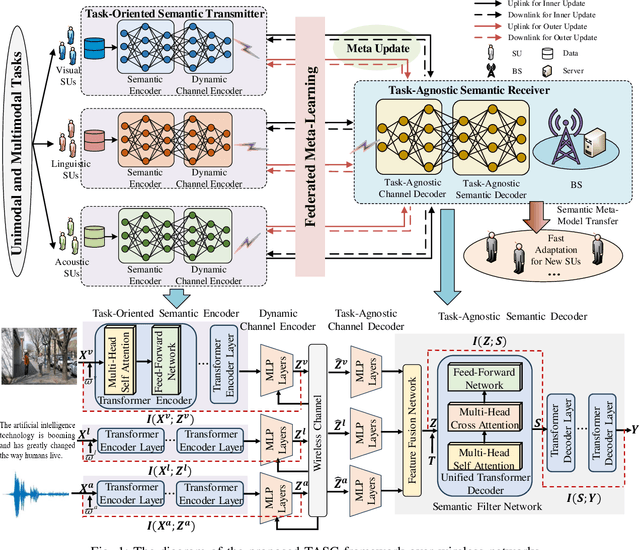
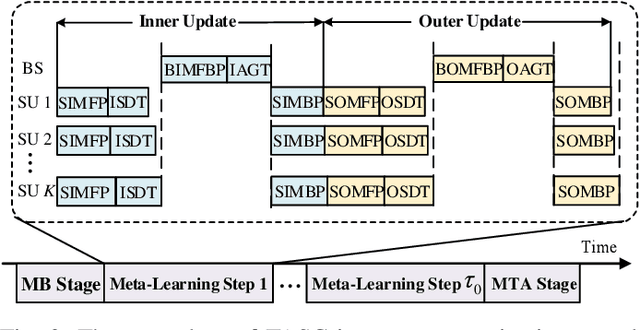
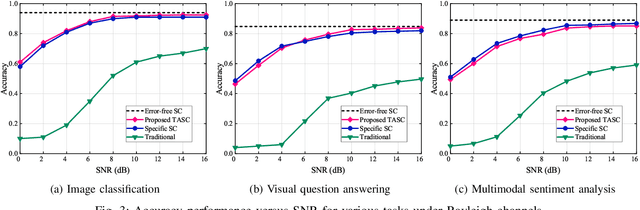
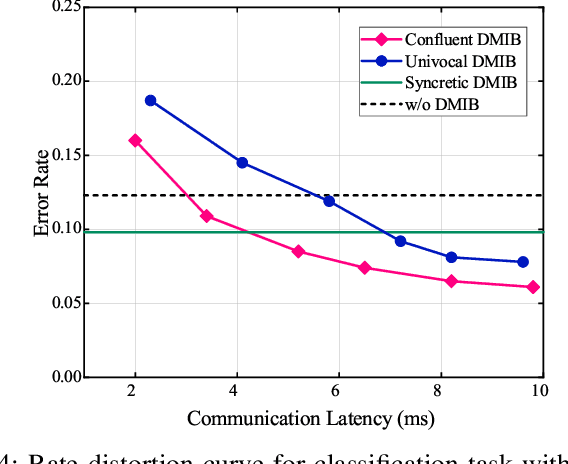
As a paradigm shift towards pervasive intelligence, semantic communication (SemCom) has shown great potentials to improve communication efficiency and provide user-centric services by delivering task-oriented semantic meanings. However, the exponential growth in connected devices, data volumes, and communication demands presents significant challenges for practical SemCom design, particularly in resource-constrained wireless networks. In this work, we first propose a task-agnostic SemCom (TASC) framework that can handle diverse tasks with multiple modalities. Aiming to explore the interplay between communications and intelligent tasks from the information-theoretical perspective, we leverage information bottleneck (IB) theory and propose a distributed multimodal IB (DMIB) principle to learn minimal and sufficient unimodal and multimodal information effectively by discarding redundancy while preserving task-related information. To further reduce the communication overhead, we develop an adaptive semantic feature transmission method under dynamic channel conditions. Then, TASC is trained based on federated meta-learning (FML) for rapid adaptation and generalization in wireless networks. To gain deep insights, we rigorously conduct theoretical analysis and devise resource management to accelerate convergence while minimizing the training latency and energy consumption. Moreover, we develop a joint user selection and resource allocation algorithm to address the non-convex problem with theoretical guarantees. Extensive simulation results validate the effectiveness and superiority of the proposed TASC compared to baselines.
A Physics-guided Multimodal Transformer Path to Weather and Climate Sciences
Apr 19, 2025With the rapid development of machine learning in recent years, many problems in meteorology can now be addressed using AI models. In particular, data-driven algorithms have significantly improved accuracy compared to traditional methods. Meteorological data is often transformed into 2D images or 3D videos, which are then fed into AI models for learning. Additionally, these models often incorporate physical signals, such as temperature, pressure, and wind speed, to further enhance accuracy and interpretability. In this paper, we review several representative AI + Weather/Climate algorithms and propose a new paradigm where observational data from different perspectives, each with distinct physical meanings, are treated as multimodal data and integrated via transformers. Furthermore, key weather and climate knowledge can be incorporated through regularization techniques to further strengthen the model's capabilities. This new paradigm is versatile and can address a variety of tasks, offering strong generalizability. We also discuss future directions for improving model accuracy and interpretability.