 Add to Chrome
 Add to Firefox
 Add to Edge
Exposing the Long-tail in Embodied Urban Navigation via Scalable Learning from In-the-Wild Videos
Aug 17, 2026
Learning embodied urban navigation policies from real-world data is constrained by the cost of task-specific data collection and the limited coverage of rare yet safety-critical scenarios. To address these challenges, we present a scalable framework for learning point-goal urban navigation from web-scale in-the-wild egocentric videos while systematically exposing its long tail. The framework automatically annotates uncurated web videos with metric trajectories and structured navigation semantics, which are then used to train a vision-language-action policy for interpretable navigation planning. We characterize the long tail based on model performance and the distribution of perception-motion patterns, and employ reflection-based analysis to diagnose recurring failure modes. Experiments on web-video data and real-world urban navigation tasks demonstrate effective knowledge transfer from unconstrained videos and reveal coherent long-tail structures beyond aggregate navigation performance.

NavIsaacLab: Generating Realistic Crowd via Parallel Robot Learning for Benchmarking Human-aware Navigation
Jun 24, 2026Robot autonomous navigation that accounts for surrounding human activities is crucial for ensuring both safety and natural human-robot interaction in real-world environments shared by humans and robots. Simulation of complex and diverse navigation scenarios serves as the foundation for training reliable robot navigation policies and accurately evaluating the performance of algorithms, offering an efficient alternative to manual supervision of real data. However, current human-aware navigation research faces significant challenges due to the scarcity of diverse, high-quality scene data. Existing simulation platforms often rely on handcrafted rules to approximate pedestrian behavior and lack the capability to provide extensive sensor signals, typically assuming perfect observations. To address these limitations, this paper presents NavIsaacLab, a comprehensive framework for benchmarking and training human-aware navigation policies through physics-based and photo-realistic simulations of pedestrians and scenes. Based on Isaac Lab, the proposed framework employs photo-realistic scene rendering capabilities and supports parallel simulation on GPU, delivering real-time and accurate 3D visual feedback to robots. To enhance the realism of human behavior, a data-driven approach is employed that incorporates a trajectory diffusion model and an adversarial motion learning controller, enabling controllable, physics-based pedestrian simulation. Furthermore, the integration of diverse cross-scale scenes provides a robust benchmark for state-of-the-art human-aware navigation methods.
Robust Docking Maneuvers for Autonomous Trolley Collection: An Optimization-Based Visual Servoing Scheme
Sep 09, 2025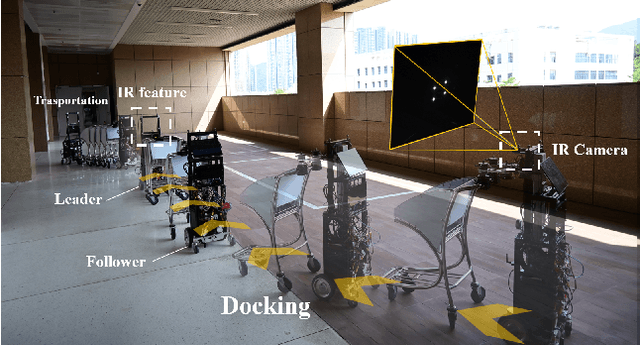
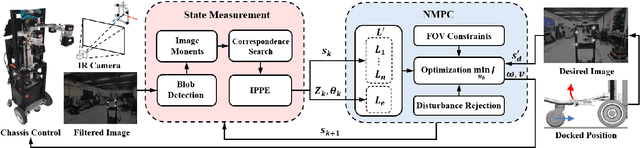
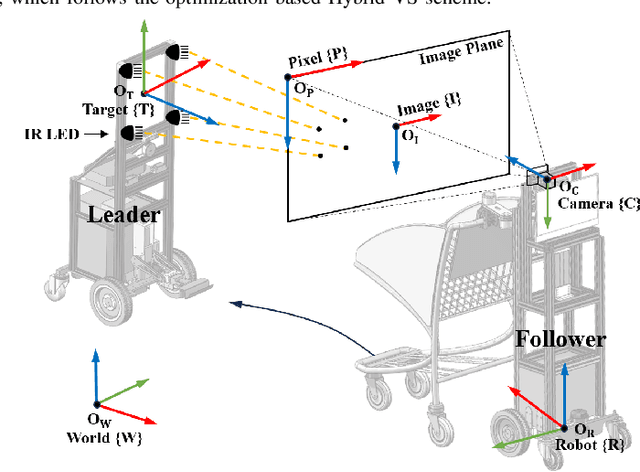
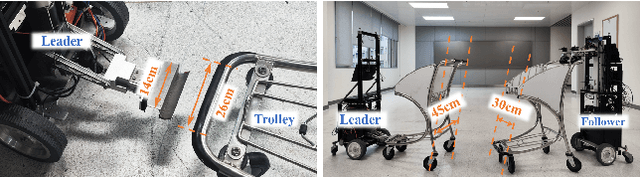
Service robots have demonstrated significant potential for autonomous trolley collection and redistribution in public spaces like airports or warehouses to improve efficiency and reduce cost. Usually, a fully autonomous system for the collection and transportation of multiple trolleys is based on a Leader-Follower formation of mobile manipulators, where reliable docking maneuvers of the mobile base are essential to align trolleys into organized queues. However, developing a vision-based robotic docking system faces significant challenges: high precision requirements, environmental disturbances, and inherent robot constraints. To address these challenges, we propose an optimization-based Visual Servoing scheme that incorporates active infrared markers for robust feature extraction across diverse lighting conditions. This framework explicitly models nonholonomic kinematics and visibility constraints within the Hybrid Visual Servoing problem, augmented with an observer for disturbance rejection to ensure precise and stable docking. Experimental results across diverse environments demonstrate the robustness of this system, with quantitative evaluations confirming high docking accuracy.