 Add to Chrome
 Add to Firefox
 Add to Edge
Wan-Animate-2: Pushing the Application Boundaries of Character Animation
Aug 06, 2026
Character image animation remains a foundational yet challenging task in computer vision. Existing approaches can be broadly categorized into three paradigms: methods based on explicit motion representations suffer from extraction errors and identity drift; methods based on implicit motion features lose fine-grained dynamics through compression; and in-context learning approaches avoid intermediate representations but incur prohibitive computational costs. Furthermore, all current systems are designed for offline synthesis, unable to meet the real-time requirements of interactive applications such as digital avatars and live-streaming hosts. To address these limitations, we present Wan-Animate-2, an end-to-end character animation framework that directly consumes the driving video within a redesigned Diffusion Transformer. Our architecture achieves superior motion fidelity and identity preservation by eliminating intermediate motion extractors entirely. We further introduce text driven viewpoint control that decouples the output camera perspective from the driving video--a capability rarely supported by prior character animation methods that rely on explicit motion representations. Beyond generation quality, we present Wan-Animate-2-Lite, an efficient variant that reduces inference latency to real-time thresholds through a three-stage training paradigm: teacher forcing pretraining with error buffer mechanism, and Self-Forcing distillation with chunk-wise backpropagation. This enables streaming character animation for interactive applications, opening new deployment scenarios that were previously infeasible. Qualitative evaluations and user studies demonstrate that Wan-Animate-2 achieves high-fidelity animation results across diverse characters and motion patterns. To foster further research and community development, we will release the Wan-Animate-2-Base model weights to the public.

Wan-Dancer: A Hierarchical Framework for Minute-scale Coherent Music-to-Dance Generation
Jul 13, 2026Generating long-duration, high-definition, and rhythmically synchronized dance videos directly from music remains a significant challenge, primarily due to the temporal constraints of current diffusion models, which typically fail beyond 20 seconds. Existing approaches, whether they rely on intermediate 3D skeletons or on end-to-end video synthesis, suffer from temporal drift, identity inconsistency, and repetitive motion patterns when extended to longer horizons. To address these limitations, we propose a novel hierarchical framework for minute-scale coherent music-to-dance generation. Our method decouples the process into global keyframe planning and local temporal refinement, leveraging full-track musical context to ensure long-range coherence. Key innovations include dynamic frame rate adaptation via time-mapped RoPE embeddings for precise alignment, an optical-flow-based loss function to enhance motion continuity, and motion-speed control to preserve high-fidelity details during rapid movements. Extensive experiments demonstrate that our framework surpasses the conventional duration barrier, generating stable, 720p/30fps videos exceeding one minute with superior temporal stability. Furthermore, the model exhibits robust versatility across five distinct dance genres, conditioned on both audio and textual prompts, establishing a new state-of-the-art in coherent, long-form dance video synthesis.
Event-Illumination Collaborative Low-light Image Enhancement with a High-resolution Real-world Dataset
May 21, 2026Event-based low-light image enhancement (LIE) methods mainly focus on incorporating high dynamic range (HDR) information from events while overlooking the essential global illumination in images and the inherent noise sensitivity of event signals in real-world scenarios. To address these issues, we propose EIC-LIE, an event-illumination collaborative LIE framework. Concretely, we first design an Event-Illumination Collaborative Interaction (EICI) module, which contains two key processes: forward gathering, which gathers HDR features across varying lighting conditions, and backward injection, which provides complementary content for illumination and event representations. Next, we introduce an Illumination-aware Event Filter (IAEF) that dynamically reduces event noise based on brightness statistics derived from images. Additionally, we build a beam-splitter-based hybrid imaging system to collect high-quality event-image pairs with temporal synchronization from dynamic scenes, providing the first high-resolution, real-world event-based LIE dataset. Extensive experiments show that our EIC-LIE outperforms state-of-the-art methods on five real-world and synthetic datasets, significantly surpassing previous methods with improvements of up to 1.24dB in PSNR and 0.069 in SSIM. The code and dataset are released at https://github.com/QUEAHREN/EIC-LIE.
Wan-Animate: Unified Character Animation and Replacement with Holistic Replication
Sep 17, 2025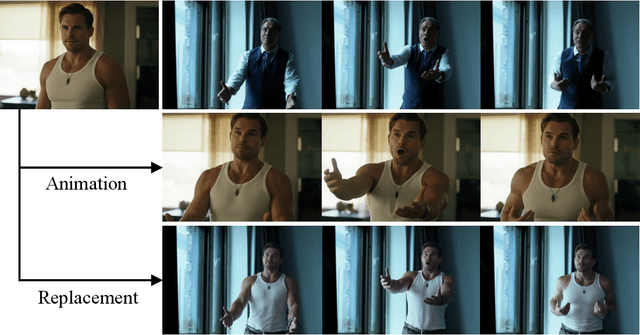
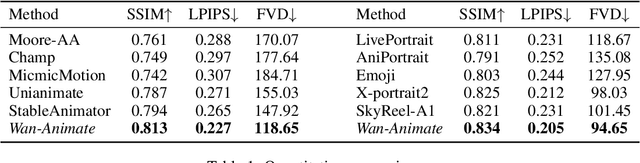
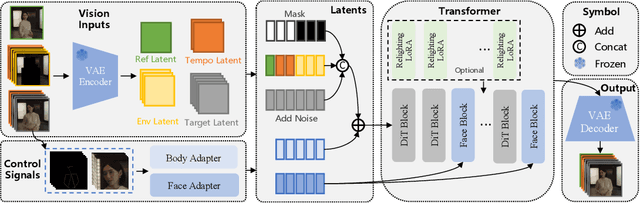
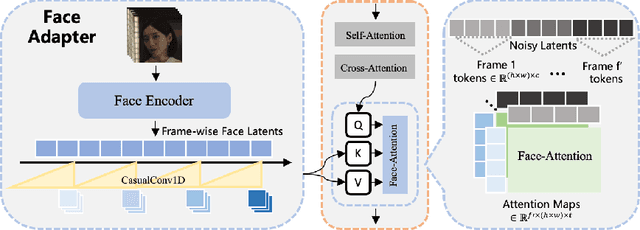
We introduce Wan-Animate, a unified framework for character animation and replacement. Given a character image and a reference video, Wan-Animate can animate the character by precisely replicating the expressions and movements of the character in the video to generate high-fidelity character videos. Alternatively, it can integrate the animated character into the reference video to replace the original character, replicating the scene's lighting and color tone to achieve seamless environmental integration. Wan-Animate is built upon the Wan model. To adapt it for character animation tasks, we employ a modified input paradigm to differentiate between reference conditions and regions for generation. This design unifies multiple tasks into a common symbolic representation. We use spatially-aligned skeleton signals to replicate body motion and implicit facial features extracted from source images to reenact expressions, enabling the generation of character videos with high controllability and expressiveness. Furthermore, to enhance environmental integration during character replacement, we develop an auxiliary Relighting LoRA. This module preserves the character's appearance consistency while applying the appropriate environmental lighting and color tone. Experimental results demonstrate that Wan-Animate achieves state-of-the-art performance. We are committed to open-sourcing the model weights and its source code.
Channel-wise Alignment for Adaptive Object Detection
Sep 07, 2020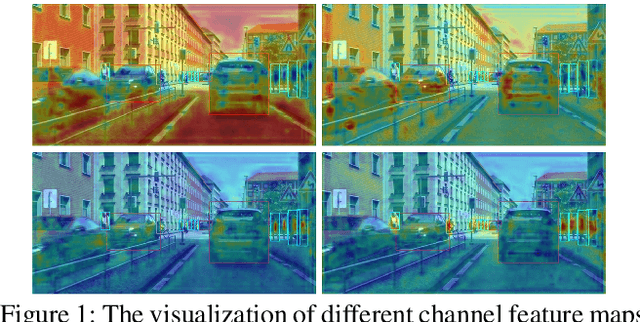
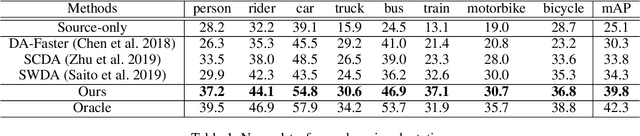
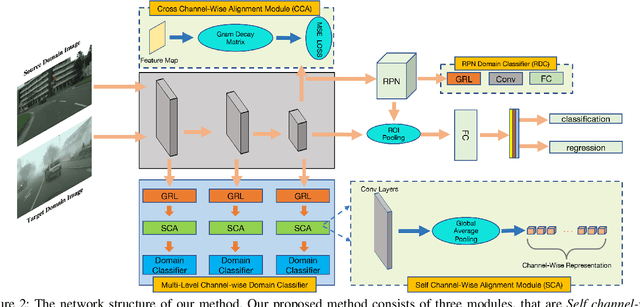
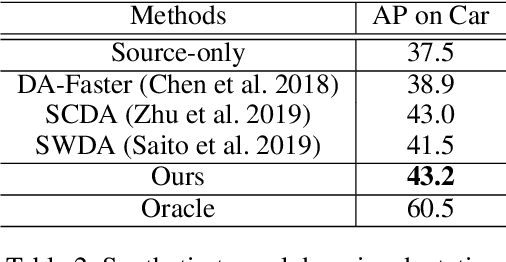
Generic object detection has been immensely promoted by the development of deep convolutional neural networks in the past decade. However, in the domain shift circumstance, the changes in weather, illumination, etc., often cause domain gap, and thus performance drops substantially when detecting objects from one domain to another. Existing methods on this task usually draw attention on the high-level alignment based on the whole image or object of interest, which naturally, cannot fully utilize the fine-grained channel information. In this paper, we realize adaptation from a thoroughly different perspective, i.e., channel-wise alignment. Motivated by the finding that each channel focuses on a specific pattern (e.g., on special semantic regions, such as car), we aim to align the distribution of source and target domain on the channel level, which is finer for integration between discrepant domains. Our method mainly consists of self channel-wise and cross channel-wise alignment. These two parts explore the inner-relation and cross-relation of attention regions implicitly from the view of channels. Further more, we also propose a RPN domain classifier module to obtain a domain-invariant RPN network. Extensive experiments show that the proposed method performs notably better than existing methods with about 5% improvement under various domain-shift settings. Experiments on different task (e.g. instance segmentation) also demonstrate its good scalability.
TSIT: A Simple and Versatile Framework for Image-to-Image Translation
Jul 25, 2020
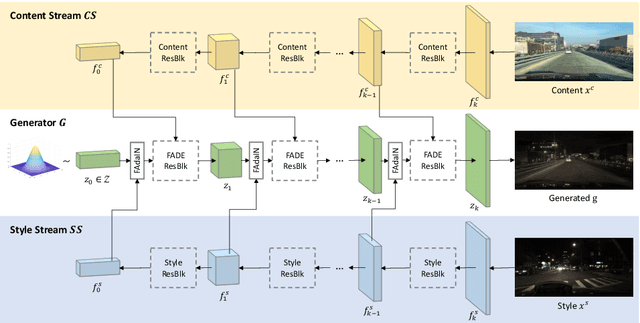
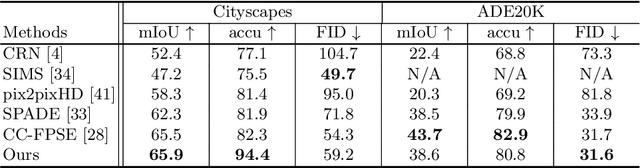
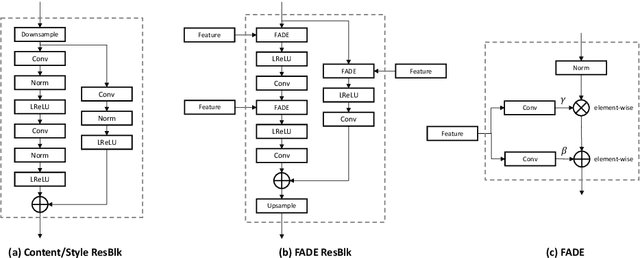
We introduce a simple and versatile framework for image-to-image translation. We unearth the importance of normalization layers, and provide a carefully designed two-stream generative model with newly proposed feature transformations in a coarse-to-fine fashion. This allows multi-scale semantic structure information and style representation to be effectively captured and fused by the network, permitting our method to scale to various tasks in both unsupervised and supervised settings. No additional constraints (e.g., cycle consistency) are needed, contributing to a very clean and simple method. Multi-modal image synthesis with arbitrary style control is made possible. A systematic study compares the proposed method with several state-of-the-art task-specific baselines, verifying its effectiveness in both perceptual quality and quantitative evaluations.
Towards Instance-level Image-to-Image Translation
May 05, 2019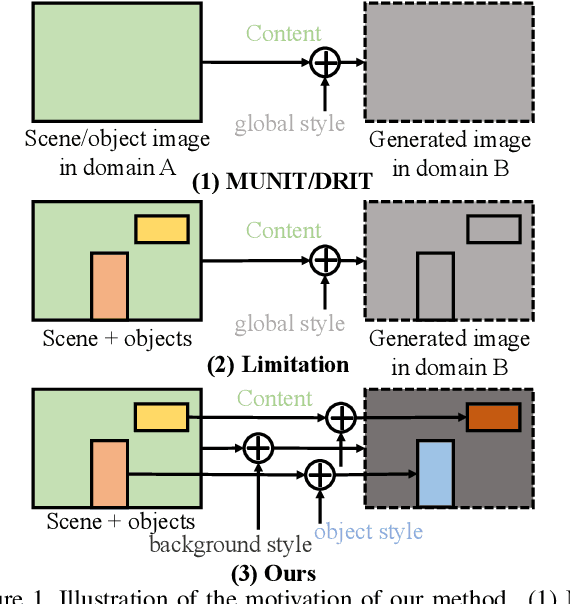
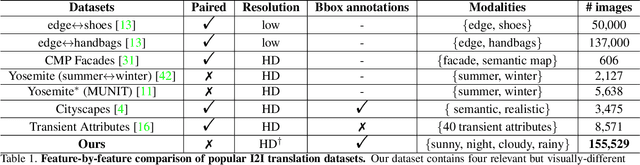
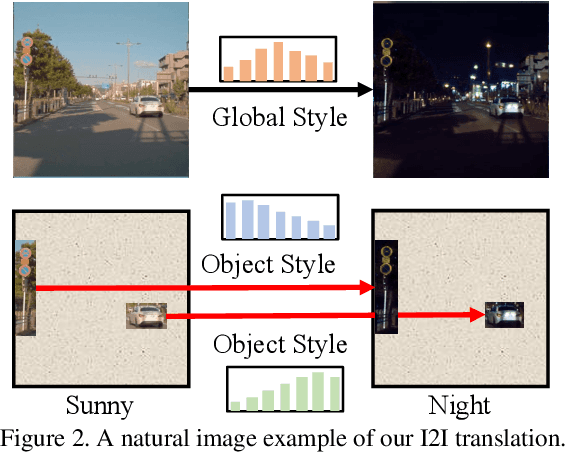
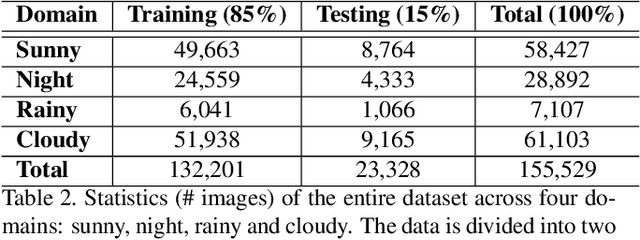
Unpaired Image-to-image Translation is a new rising and challenging vision problem that aims to learn a mapping between unaligned image pairs in diverse domains. Recent advances in this field like MUNIT and DRIT mainly focus on disentangling content and style/attribute from a given image first, then directly adopting the global style to guide the model to synthesize new domain images. However, this kind of approaches severely incurs contradiction if the target domain images are content-rich with multiple discrepant objects. In this paper, we present a simple yet effective instance-aware image-to-image translation approach (INIT), which employs the fine-grained local (instance) and global styles to the target image spatially. The proposed INIT exhibits three import advantages: (1) the instance-level objective loss can help learn a more accurate reconstruction and incorporate diverse attributes of objects; (2) the styles used for target domain of local/global areas are from corresponding spatial regions in source domain, which intuitively is a more reasonable mapping; (3) the joint training process can benefit both fine and coarse granularity and incorporates instance information to improve the quality of global translation. We also collect a large-scale benchmark for the new instance-level translation task. We observe that our synthetic images can even benefit real-world vision tasks like generic object detection.