 Add to Chrome
 Add to Firefox
 Add to Edge
Real-Time Human-Centric World Modeling for Upper-Body Human-Object Interaction
Jul 26, 2026
We present a real-time human-centric world model for upper-body interactive generation, aiming to synthesize coherent local world dynamics centered on a person, where coordinated body, hand, and facial motions evolve jointly with controllable human-object discrete interaction. To this end, we adopt a continuous-discrete joint control scheme with two complementary components: a continuous human state and a discrete interaction state. For continuous human-state control, we introduce a unified implicit representation based on multi-scale motion encoding, in which motion latents from the upper body, hands, and face are fused into a shared latent space. This multi-scale design improves expressiveness across different spatial scales, captures fine-grained human dynamics more effectively, and enables direct control without explicit retargeting. For discrete object interaction-state control, we represent object contact using a small set of language-encoded discrete interaction states, where text serves as an explicit interaction-state command, such as \emph{no contact} or \emph{grasp}, rather than an open-ended generation prompt, and we further construct a dedicated rendering pipeline for human-object interaction data to supervise such discrete interaction states. By combining continuous implicit human-state control with discrete interaction-state control, our model enables precise modeling of how a person moves and interacts with the local environment, including controllable changes to nearby scene states. Finally, we distill the model for efficient streaming real-time inference, achieving 25 FPS on two H100 GPUs. Experiments demonstrate improved fine-grained motion fidelity, more realistic hand-object coordination, and effective real-time interaction, establishing a practical step beyond motion reproduction toward real-time human-centric world modeling.

Video = World + Event Stream
Jul 16, 2026We present Wan-Streamer v0.3, which reframes our native-streaming interaction model under a single organizing view: a video is a world plus an event stream. The world is the persistent context in which a video unfolds, including the environment, scene, subjects, ambient acoustic conditions, voice characteristics, and other relatively stable conditions. The event stream is everything that changes over time within that world, including scene or environmental changes, subject behavior, speech, and other sounds. This yields a general-purpose pretraining task over large amounts of real video: given a world and incoming input, predict how the world moves, changes, and responds in real time. The resulting competence can be specialized to a broad family of real-time downstream tasks. We instantiate it on real-time full-duplex audio-visual interaction, where the event stream is the agent's speech together with free-form behavior. Functionally, the model's multimodal understanding process is vision-language-action-like: it maps multimodal user input to language-form speech and behavior actions. Wan-Streamer v0.3 preserves the v0.2 operating point: 640x368 video at 25 FPS, a 160 ms streaming unit, approximately 200 ms model-side response latency, and approximately 550 ms total interaction latency under a 350 ms bidirectional network budget.
Wan-Streamer v0.2: Higher Resolution, Same Latency
Jul 05, 2026We present Wan-Streamer v0.2, a latency-preserving upgrade of the native-streaming, end-to-end audio-visual interaction model. v0.2 keeps the v0.1 modeling formulation, but raises the interactive output stream from 192x336 to 640x368 while preserving approximately 200 ms model-side signal-to-signal latency at 25 FPS. The higher-resolution stream supports scene-grounded mid-shot agents whose posture, gaze, hands, nearby objects, and local scene layout remain legible during real-time conversation. To support the larger visual stream without adding user-visible delay, v0.2 keeps the thinker as a single-GPU low-latency path for streaming perception, the short language/state Transformer pass that builds the generation cache, and final decoding. The performer becomes a multi-GPU Ulysses-style context-parallel group for the expensive next-unit latent generation. Each performer rank writes incoming K/V into a pre-sharded local cache. The long high-resolution latent video sequence is split across ranks for denoising and gathered through Ulysses communication, while the much shorter audio latent sequence is generated without sequence sharding. In this split, the thinker's language/state computation reaches the performer only as K/V conditioning, so no separate language sequence has to be communicated inside the performer group. This concentrates additional hardware on visual generation while preserving the compact thinker-performer boundary, keeping total remote interaction latency at approximately 550 ms when a 350 ms bidirectional network budget is included.
Wan-Streamer v0.1: End-to-end Real-time Interactive Foundation Models
Jun 25, 2026We present Wan-Streamer, a native-streaming, end-to-end interactive foundation model designed from the ground up for real-time, low-latency, full-duplex audio-visual interaction. Wan-Streamer seamlessly models language, audio, and video as both input and output within a single Transformer, where the sequence is represented as interleaved visual, audio, and text input tokens together with visual, audio, and text output tokens, coordinated by block-causal attention for incremental streaming. Unlike cascaded interactive systems that rely on separate VAD, ASR, language, TTS, audio-driven animation, or video-generation modules, Wan-Streamer does not rely on external language, speech, avatar, or video-generation modules: perception, reasoning, generation, response timing, turn management, and cross-modal synchronization are learned jointly within one unified model, reducing pipeline latency and error accumulation. To support natural audio-visual responsiveness, we redesign the entire stack around streamability, including causal encoders, causal decoders, block-causal attention, and low-latency multimodal token scheduling, enabling streaming units as short as 160 ms at 25 fps. Wan-Streamer achieves approximately 200 ms model-side response latency and approximately 550 ms total interaction latency when combined with 350 ms bidirectional network latency, supporting sub-second duplex audio-visual communication. These results position Wan-Streamer as a unified, end-to-end, multimodal interactive foundation model for low-latency streaming interaction.
PortraitDirector: A Hierarchical Disentanglement Framework for Controllable and Real-time Facial Reenactment
Apr 21, 2026Existing facial reenactment methods struggle with a trade-off between expressiveness and fine-grained controllability. Holistic facial reenactment models often sacrifice granular control for expressiveness, while methods designed for control may struggle with fidelity and robust disentanglement. Instead of treating facial motion as a monolithic signal, we explore an alternative compositional perspective. In this paper, we introduce PortraitDirector, a novel framework that formulates face reenactment as a hierarchical composition task, achieving high-fidelity and controllable results. We employ a Hierarchical Motion Disentanglement and Composition strategy, deconstructing facial motion into a Spatial Layer for physical movements and a Semantic Layer for emotional content. The Spatial Layer comprises: (i) global head pose, managed via a dedicated representation and injection pathway; (ii) spatially separated local facial expressions, distilled from cropped facial regions and purged of emotional cues via Emotion-Filtering Module leveraging an information bottleneck. The Semantic Layer contains a derived global emotion. The disentangled components are then recomposed into an expressive motion latent. Furthermore, we engineer the framework for real-time performance through a suite of optimizations, including diffusion distillation, causal attention and VAE acceleration. PortraitDirector achieves streaming, high-fidelity, controllable 512 x 512 face reenactment at 20 FPS with a end-to-end 800 ms latency on a single 5090 GPU.
Wan-Animate: Unified Character Animation and Replacement with Holistic Replication
Sep 17, 2025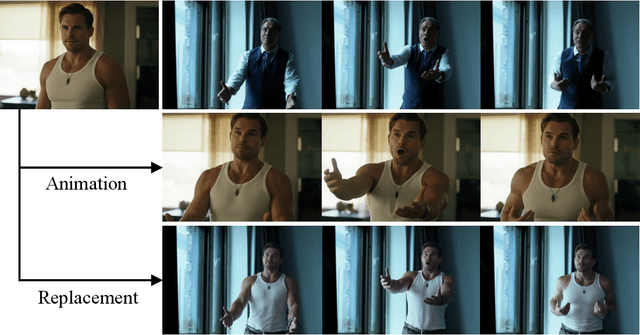
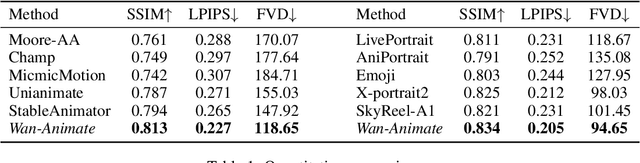
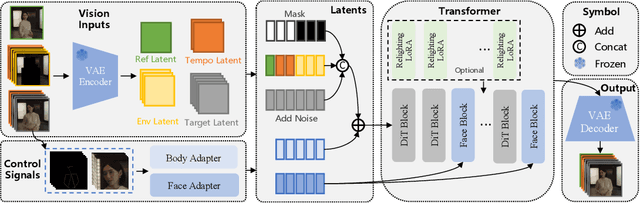
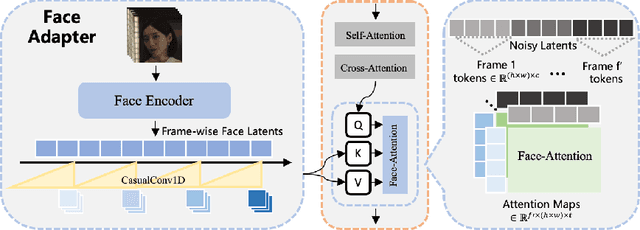
We introduce Wan-Animate, a unified framework for character animation and replacement. Given a character image and a reference video, Wan-Animate can animate the character by precisely replicating the expressions and movements of the character in the video to generate high-fidelity character videos. Alternatively, it can integrate the animated character into the reference video to replace the original character, replicating the scene's lighting and color tone to achieve seamless environmental integration. Wan-Animate is built upon the Wan model. To adapt it for character animation tasks, we employ a modified input paradigm to differentiate between reference conditions and regions for generation. This design unifies multiple tasks into a common symbolic representation. We use spatially-aligned skeleton signals to replicate body motion and implicit facial features extracted from source images to reenact expressions, enabling the generation of character videos with high controllability and expressiveness. Furthermore, to enhance environmental integration during character replacement, we develop an auxiliary Relighting LoRA. This module preserves the character's appearance consistency while applying the appropriate environmental lighting and color tone. Experimental results demonstrate that Wan-Animate achieves state-of-the-art performance. We are committed to open-sourcing the model weights and its source code.
Exploring Timeline Control for Facial Motion Generation
May 27, 2025This paper introduces a new control signal for facial motion generation: timeline control. Compared to audio and text signals, timelines provide more fine-grained control, such as generating specific facial motions with precise timing. Users can specify a multi-track timeline of facial actions arranged in temporal intervals, allowing precise control over the timing of each action. To model the timeline control capability, We first annotate the time intervals of facial actions in natural facial motion sequences at a frame-level granularity. This process is facilitated by Toeplitz Inverse Covariance-based Clustering to minimize human labor. Based on the annotations, we propose a diffusion-based generation model capable of generating facial motions that are natural and accurately aligned with input timelines. Our method supports text-guided motion generation by using ChatGPT to convert text into timelines. Experimental results show that our method can annotate facial action intervals with satisfactory accuracy, and produces natural facial motions accurately aligned with timelines.
OmniTalker: Real-Time Text-Driven Talking Head Generation with In-Context Audio-Visual Style Replication
Apr 03, 2025Recent years have witnessed remarkable advances in talking head generation, owing to its potential to revolutionize the human-AI interaction from text interfaces into realistic video chats. However, research on text-driven talking heads remains underexplored, with existing methods predominantly adopting a cascaded pipeline that combines TTS systems with audio-driven talking head models. This conventional pipeline not only introduces system complexity and latency overhead but also fundamentally suffers from asynchronous audiovisual output and stylistic discrepancies between generated speech and visual expressions. To address these limitations, we introduce OmniTalker, an end-to-end unified framework that simultaneously generates synchronized speech and talking head videos from text and reference video in real-time zero-shot scenarios, while preserving both speech style and facial styles. The framework employs a dual-branch diffusion transformer architecture: the audio branch synthesizes mel-spectrograms from text, while the visual branch predicts fine-grained head poses and facial dynamics. To bridge modalities, we introduce a novel audio-visual fusion module that integrates cross-modal information to ensure temporal synchronization and stylistic coherence between audio and visual outputs. Furthermore, our in-context reference learning module effectively captures both speech and facial style characteristics from a single reference video without introducing an extra style extracting module. To the best of our knowledge, OmniTalker presents the first unified framework that jointly models speech style and facial style in a zero-shot setting, achieving real-time inference speed of 25 FPS. Extensive experiments demonstrate that our method surpasses existing approaches in generation quality, particularly excelling in style preservation and audio-video synchronization.
ChatAnyone: Stylized Real-time Portrait Video Generation with Hierarchical Motion Diffusion Model
Mar 27, 2025Real-time interactive video-chat portraits have been increasingly recognized as the future trend, particularly due to the remarkable progress made in text and voice chat technologies. However, existing methods primarily focus on real-time generation of head movements, but struggle to produce synchronized body motions that match these head actions. Additionally, achieving fine-grained control over the speaking style and nuances of facial expressions remains a challenge. To address these limitations, we introduce a novel framework for stylized real-time portrait video generation, enabling expressive and flexible video chat that extends from talking head to upper-body interaction. Our approach consists of the following two stages. The first stage involves efficient hierarchical motion diffusion models, that take both explicit and implicit motion representations into account based on audio inputs, which can generate a diverse range of facial expressions with stylistic control and synchronization between head and body movements. The second stage aims to generate portrait video featuring upper-body movements, including hand gestures. We inject explicit hand control signals into the generator to produce more detailed hand movements, and further perform face refinement to enhance the overall realism and expressiveness of the portrait video. Additionally, our approach supports efficient and continuous generation of upper-body portrait video in maximum 512 * 768 resolution at up to 30fps on 4090 GPU, supporting interactive video-chat in real-time. Experimental results demonstrate the capability of our approach to produce portrait videos with rich expressiveness and natural upper-body movements.
CM-GANs: Cross-modal Generative Adversarial Networks for Common Representation Learning
Apr 26, 2018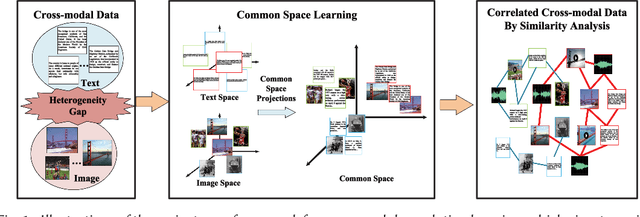
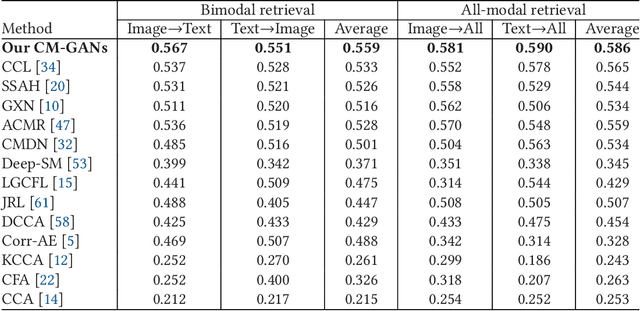
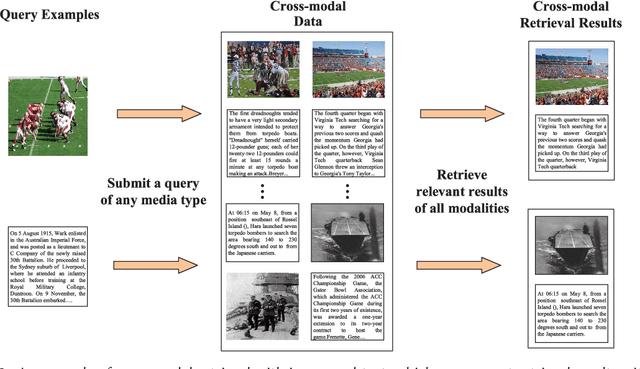
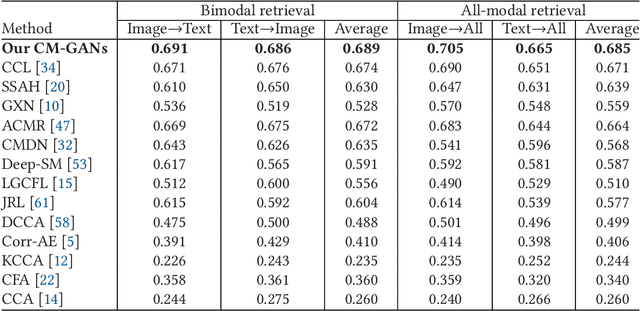
It is known that the inconsistent distribution and representation of different modalities, such as image and text, cause the heterogeneity gap that makes it challenging to correlate such heterogeneous data. Generative adversarial networks (GANs) have shown its strong ability of modeling data distribution and learning discriminative representation, existing GANs-based works mainly focus on generative problem to generate new data. We have different goal, aim to correlate heterogeneous data, by utilizing the power of GANs to model cross-modal joint distribution. Thus, we propose Cross-modal GANs to learn discriminative common representation for bridging heterogeneity gap. The main contributions are: (1) Cross-modal GANs architecture is proposed to model joint distribution over data of different modalities. The inter-modality and intra-modality correlation can be explored simultaneously in generative and discriminative models. Both of them beat each other to promote cross-modal correlation learning. (2) Cross-modal convolutional autoencoders with weight-sharing constraint are proposed to form generative model. They can not only exploit cross-modal correlation for learning common representation, but also preserve reconstruction information for capturing semantic consistency within each modality. (3) Cross-modal adversarial mechanism is proposed, which utilizes two kinds of discriminative models to simultaneously conduct intra-modality and inter-modality discrimination. They can mutually boost to make common representation more discriminative by adversarial training process. To the best of our knowledge, our proposed CM-GANs approach is the first to utilize GANs to perform cross-modal common representation learning. Experiments are conducted to verify the performance of our proposed approach on cross-modal retrieval paradigm, compared with 10 methods on 3 cross-modal datasets.