 Add to Chrome
 Add to Firefox
 Add to Edge
Wan-Animate-2: Pushing the Application Boundaries of Character Animation
Aug 06, 2026
Character image animation remains a foundational yet challenging task in computer vision. Existing approaches can be broadly categorized into three paradigms: methods based on explicit motion representations suffer from extraction errors and identity drift; methods based on implicit motion features lose fine-grained dynamics through compression; and in-context learning approaches avoid intermediate representations but incur prohibitive computational costs. Furthermore, all current systems are designed for offline synthesis, unable to meet the real-time requirements of interactive applications such as digital avatars and live-streaming hosts. To address these limitations, we present Wan-Animate-2, an end-to-end character animation framework that directly consumes the driving video within a redesigned Diffusion Transformer. Our architecture achieves superior motion fidelity and identity preservation by eliminating intermediate motion extractors entirely. We further introduce text driven viewpoint control that decouples the output camera perspective from the driving video--a capability rarely supported by prior character animation methods that rely on explicit motion representations. Beyond generation quality, we present Wan-Animate-2-Lite, an efficient variant that reduces inference latency to real-time thresholds through a three-stage training paradigm: teacher forcing pretraining with error buffer mechanism, and Self-Forcing distillation with chunk-wise backpropagation. This enables streaming character animation for interactive applications, opening new deployment scenarios that were previously infeasible. Qualitative evaluations and user studies demonstrate that Wan-Animate-2 achieves high-fidelity animation results across diverse characters and motion patterns. To foster further research and community development, we will release the Wan-Animate-2-Base model weights to the public.

Wan-Animate: Unified Character Animation and Replacement with Holistic Replication
Sep 17, 2025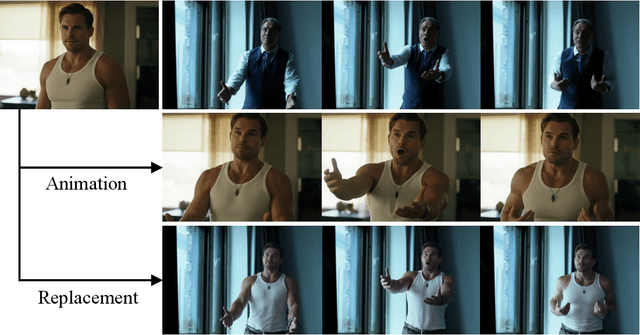
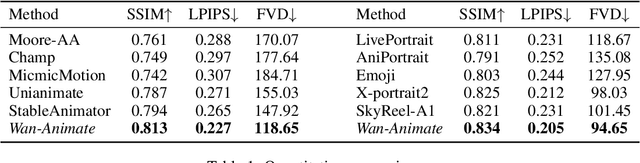
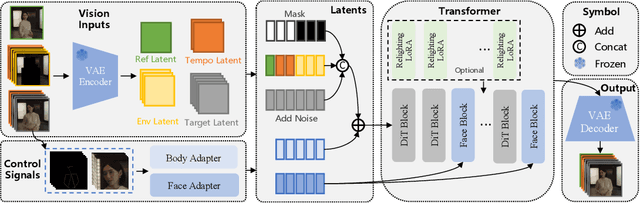
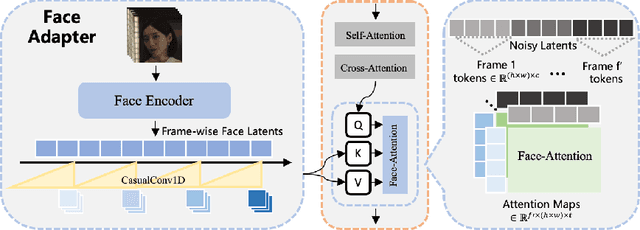
We introduce Wan-Animate, a unified framework for character animation and replacement. Given a character image and a reference video, Wan-Animate can animate the character by precisely replicating the expressions and movements of the character in the video to generate high-fidelity character videos. Alternatively, it can integrate the animated character into the reference video to replace the original character, replicating the scene's lighting and color tone to achieve seamless environmental integration. Wan-Animate is built upon the Wan model. To adapt it for character animation tasks, we employ a modified input paradigm to differentiate between reference conditions and regions for generation. This design unifies multiple tasks into a common symbolic representation. We use spatially-aligned skeleton signals to replicate body motion and implicit facial features extracted from source images to reenact expressions, enabling the generation of character videos with high controllability and expressiveness. Furthermore, to enhance environmental integration during character replacement, we develop an auxiliary Relighting LoRA. This module preserves the character's appearance consistency while applying the appropriate environmental lighting and color tone. Experimental results demonstrate that Wan-Animate achieves state-of-the-art performance. We are committed to open-sourcing the model weights and its source code.
Modeling Analog Dynamic Range Compressors using Deep Learning and State-space Models
Mar 24, 2024We describe a novel approach for developing realistic digital models of dynamic range compressors for digital audio production by analyzing their analog prototypes. While realistic digital dynamic compressors are potentially useful for many applications, the design process is challenging because the compressors operate nonlinearly over long time scales. Our approach is based on the structured state space sequence model (S4), as implementing the state-space model (SSM) has proven to be efficient at learning long-range dependencies and is promising for modeling dynamic range compressors. We present in this paper a deep learning model with S4 layers to model the Teletronix LA-2A analog dynamic range compressor. The model is causal, executes efficiently in real time, and achieves roughly the same quality as previous deep-learning models but with fewer parameters.
Modeling of SCADA and PMU Measurement Chains
Dec 06, 2023
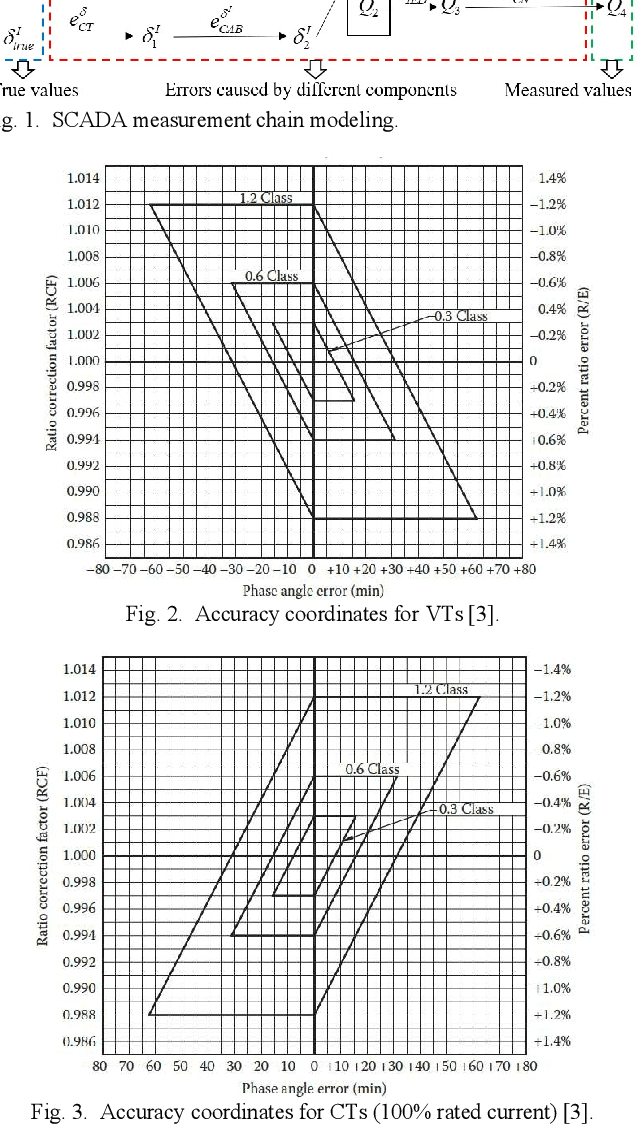
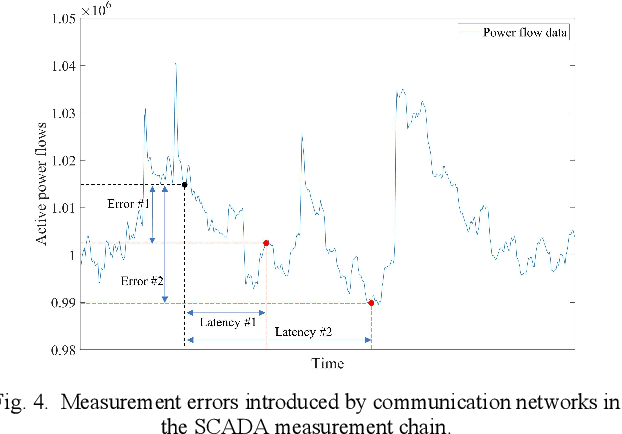
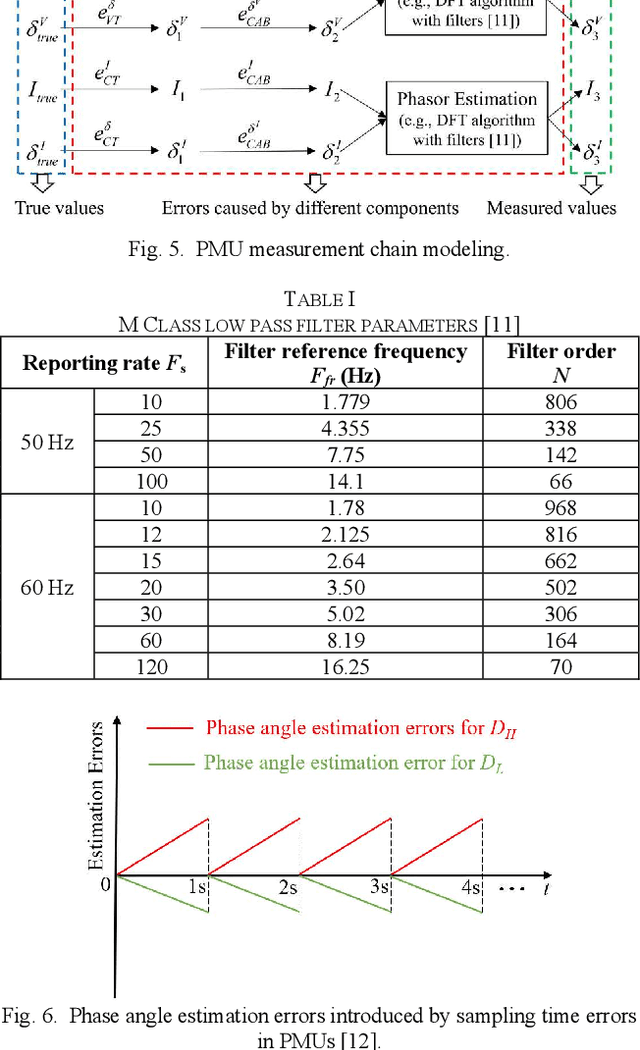
In this document, the supervisory control and data acquisition (SCADA) and phasor measurement unit (PMU) measurement chain modeling will be studied, where the measurement error sources of each component in the SCADA and PMU measurement chains and the reasons leading to measurement errors exhibiting non-zero-mean, non-Gaussian, and time-varying statistical characteristic are summarized and analyzed. This document provides a few equations, figures, and discussions about the details of the SCADA and PMU measurement error chain modeling, which are intended to facilitate the understanding of how the measurement errors are designed for each component in the SCADA and PMU measurement chains. The measurement chain models described here are also used for synthesizing measurement errors with realistic characteristics in simulation cases to test the developed algorithms or methodologies.