 Add to Chrome
 Add to Firefox
 Add to Edge
Edit-R2: Context-Aware Reinforcement Learning for Multi-Turn Image Editing
Jun 04, 2026
Text-guided image editing has advanced rapidly with diffusion models and unified multimodal foundation models. However, most existing methods remain confined to single-turn settings, overlooking the more realistic scenario of multi-turn in-context editing, where users iteratively refine an image through a sequence of instructions. In this setting, a model must follow each new instruction while preserving accumulated session-level constraints, challenged by two coupled failure modes: long-context dilution, where sparse textual constraints become difficult to recover from growing interleaved image-text histories, and state contamination, where earlier editing mistakes degrade subsequent generations. We introduce Edit-R2, a novel reinforcement learning post-training framework for unified multimodal models. Edit-R2 reconstructs the operative session intent, which effectively consolidates scattered historical constraints into an explicit reasoning trace before each editing turn. It further enables multi-turn RL over both reasoning and generation through a unified objective that jointly optimizes intent reconstruction generation in discrete text space and flow-matching image generation in continuous latent space, while a trajectory filtering mechanism suppresses corrupted rollouts to stabilize training under state contamination. To support systematic evaluation, we introduce MICE-Bench, a large-scale benchmark for multi-turn in-context editing with automated metrics for instruction following (IF), content consistency (CC), and global awareness (GA) over accumulated session constraints. Experiments show that Edit-R2 substantially improves multi-turn in-context editing and achieves competitive performance compared against strong baselines.

GARL: Game-Theoretic Reinforcement Learning for Multi-Agent Strategic Prioritisation
Jun 03, 2026LLM-based multi-agent systems are increasingly used for strategic decision-making tasks. In such settings, performance depends not only on individual model capabilities, but also on the policies by which agents interact and adapt. Multi-agent reinforcement learning can optimise these interaction policies, but its reward design often remains task-specific and weakly grounded in interaction structure. To address this gap, we propose GARL, a GAme-theoretic Reinforcement Learning framework for multi-agent strategic prioritisation. GARL formalises strategic prioritisation as a two-stage game: competing agents first allocate strategic resources over a shared candidate set, and a higher-level arbiter then produces the final ranking. The resulting game-theoretic utilities are converted into role-specific reinforcement signals, allowing policy optimisation to be guided by structured interaction. We instantiate GARL on issues-in-dispute ranking, where the goal is to prioritise core issues in legal proceedings. Experiments show that GARL improves ranking performance, enables small open-source LLMs to become competitive with a strong closed-source LLM under the same candidate-ranking setting, and yields gains in legal-domain competence and broader strategic decision-making. Overall, GARL demonstrates how game-theoretic interaction structure can be turned into reinforcement-learning objectives, providing a principled approach to policy optimisation in multi-agent strategic prioritisation.
CLASE: A Hybrid Method for Chinese Legalese Stylistic Evaluation
Feb 13, 2026Legal text generated by large language models (LLMs) can usually achieve reasonable factual accuracy, but it frequently fails to adhere to the specialised stylistic norms and linguistic conventions of legal writing. In order to improve stylistic quality, a crucial first step is to establish a reliable evaluation method. However, having legal experts manually develop such a metric is impractical, as the implicit stylistic requirements in legal writing practice are difficult to formalise into explicit rubrics. Meanwhile, existing automatic evaluation methods also fall short: reference-based metrics conflate semantic accuracy with stylistic fidelity, and LLM-as-a-judge evaluations suffer from opacity and inconsistency. To address these challenges, we introduce CLASE (Chinese LegAlese Stylistic Evaluation), a hybrid evaluation method that focuses on the stylistic performance of legal text. The method incorporates a hybrid scoring mechanism that combines 1) linguistic feature-based scores and 2) experience-guided LLM-as-a-judge scores. Both the feature coefficients and the LLM scoring experiences are learned from contrastive pairs of authentic legal documents and their LLM-restored counterparts. This hybrid design captures both surface-level features and implicit stylistic norms in a transparent, reference-free manner. Experiments on 200 Chinese legal documents show that CLASE achieves substantially higher alignment with human judgments than traditional metrics and pure LLM-as-a-judge methods. Beyond improved alignment, CLASE provides interpretable score breakdowns and suggestions for improvements, offering a scalable and practical solution for professional stylistic evaluation in legal text generation (Code and data for CLASE is available at: https://github.com/rexera/CLASE).
Learning While Staying Curious: Entropy-Preserving Supervised Fine-Tuning via Adaptive Self-Distillation for Large Reasoning Models
Feb 02, 2026The standard post-training recipe for large reasoning models, supervised fine-tuning followed by reinforcement learning (SFT-then-RL), may limit the benefits of the RL stage: while SFT imitates expert demonstrations, it often causes overconfidence and reduces generation diversity, leaving RL with a narrowed solution space to explore. Adding entropy regularization during SFT is not a cure-all; it tends to flatten token distributions toward uniformity, increasing entropy without improving meaningful exploration capability. In this paper, we propose CurioSFT, an entropy-preserving SFT method designed to enhance exploration capabilities through intrinsic curiosity. It consists of (a) Self-Exploratory Distillation, which distills the model toward a self-generated, temperature-scaled teacher to encourage exploration within its capability; and (b) Entropy-Guided Temperature Selection, which adaptively adjusts distillation strength to mitigate knowledge forgetting by amplifying exploration at reasoning tokens while stabilizing factual tokens. Extensive experiments on mathematical reasoning tasks demonstrate that, in SFT stage, CurioSFT outperforms the vanilla SFT by 2.5 points on in-distribution tasks and 2.9 points on out-of-distribution tasks. We also verify that exploration capabilities preserved during SFT successfully translate into concrete gains in RL stage, yielding an average improvement of 5.0 points.
LinguaGame: A Linguistically Grounded Game-Theoretic Paradigm for Multi-Agent Dialogue Generation
Jan 08, 2026Large Language Models (LLMs) have enabled Multi-Agent Systems (MASs) where agents interact through natural language to solve complex tasks or simulate multi-party dialogues. Recent work on LLM-based MASs has mainly focused on architecture design, such as role assignment and workflow orchestration. In contrast, this paper targets the interaction process itself, aiming to improve agents' communication efficiency by helping them convey their intended meaning more effectively through language. To this end, we propose LinguaGame, a linguistically-grounded game-theoretic paradigm for multi-agent dialogue generation. Our approach models dialogue as a signalling game over communicative intents and strategies, solved with a training-free equilibrium approximation algorithm for inference-time decision adjustment. Unlike prior game-theoretic MASs, whose game designs are often tightly coupled with task-specific objectives, our framework relies on linguistically informed reasoning with minimal task-specific coupling. Specifically, it treats dialogue as intentional and strategic communication, requiring agents to infer what others aim to achieve (intents) and how they pursue those goals (strategies). We evaluate our framework in simulated courtroom proceedings and debates, with human expert assessments showing significant gains in communication efficiency.
GARDO: Reinforcing Diffusion Models without Reward Hacking
Dec 30, 2025Fine-tuning diffusion models via online reinforcement learning (RL) has shown great potential for enhancing text-to-image alignment. However, since precisely specifying a ground-truth objective for visual tasks remains challenging, the models are often optimized using a proxy reward that only partially captures the true goal. This mismatch often leads to reward hacking, where proxy scores increase while real image quality deteriorates and generation diversity collapses. While common solutions add regularization against the reference policy to prevent reward hacking, they compromise sample efficiency and impede the exploration of novel, high-reward regions, as the reference policy is usually sub-optimal. To address the competing demands of sample efficiency, effective exploration, and mitigation of reward hacking, we propose Gated and Adaptive Regularization with Diversity-aware Optimization (GARDO), a versatile framework compatible with various RL algorithms. Our key insight is that regularization need not be applied universally; instead, it is highly effective to selectively penalize a subset of samples that exhibit high uncertainty. To address the exploration challenge, GARDO introduces an adaptive regularization mechanism wherein the reference model is periodically updated to match the capabilities of the online policy, ensuring a relevant regularization target. To address the mode collapse issue in RL, GARDO amplifies the rewards for high-quality samples that also exhibit high diversity, encouraging mode coverage without destabilizing the optimization process. Extensive experiments across diverse proxy rewards and hold-out unseen metrics consistently show that GARDO mitigates reward hacking and enhances generation diversity without sacrificing sample efficiency or exploration, highlighting its effectiveness and robustness.
LexRel: Benchmarking Legal Relation Extraction for Chinese Civil Cases
Dec 14, 2025Legal relations form a highly consequential analytical framework of civil law system, serving as a crucial foundation for resolving disputes and realizing values of the rule of law in judicial practice. However, legal relations in Chinese civil cases remain underexplored in the field of legal artificial intelligence (legal AI), largely due to the absence of comprehensive schemas. In this work, we firstly introduce a comprehensive schema, which contains a hierarchical taxonomy and definitions of arguments, for AI systems to capture legal relations in Chinese civil cases. Based on this schema, we then formulate legal relation extraction task and present LexRel, an expert-annotated benchmark for legal relation extraction in Chinese civil law. We use LexRel to evaluate state-of-the-art large language models (LLMs) on legal relation extractions, showing that current LLMs exhibit significant limitations in accurately identifying civil legal relations. Furthermore, we demonstrate that incorporating legal relations information leads to consistent performance gains on other downstream legal AI tasks.
OpenCUA: Open Foundations for Computer-Use Agents
Aug 12, 2025Vision-language models have demonstrated impressive capabilities as computer-use agents (CUAs) capable of automating diverse computer tasks. As their commercial potential grows, critical details of the most capable CUA systems remain closed. As these agents will increasingly mediate digital interactions and execute consequential decisions on our behalf, the research community needs access to open CUA frameworks to study their capabilities, limitations, and risks. To bridge this gap, we propose OpenCUA, a comprehensive open-source framework for scaling CUA data and foundation models. Our framework consists of: (1) an annotation infrastructure that seamlessly captures human computer-use demonstrations; (2) AgentNet, the first large-scale computer-use task dataset spanning 3 operating systems and 200+ applications and websites; (3) a scalable pipeline that transforms demonstrations into state-action pairs with reflective long Chain-of-Thought reasoning that sustain robust performance gains as data scales. Our end-to-end agent models demonstrate strong performance across CUA benchmarks. In particular, OpenCUA-32B achieves an average success rate of 34.8% on OSWorld-Verified, establishing a new state-of-the-art (SOTA) among open-source models and surpassing OpenAI CUA (GPT-4o). Further analysis confirms that our approach generalizes well across domains and benefits significantly from increased test-time computation. We release our annotation tool, datasets, code, and models to build open foundations for further CUA research.
Spider 2.0: Evaluating Language Models on Real-World Enterprise Text-to-SQL Workflows
Nov 12, 2024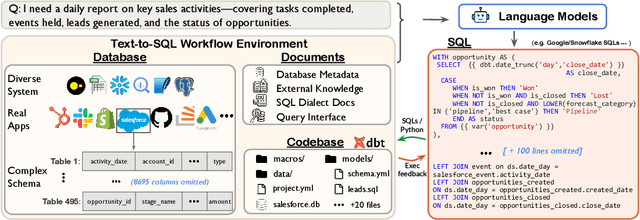
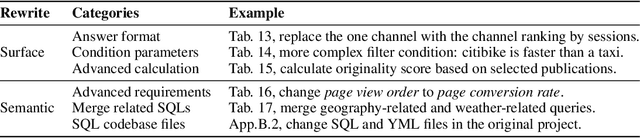


Real-world enterprise text-to-SQL workflows often involve complex cloud or local data across various database systems, multiple SQL queries in various dialects, and diverse operations from data transformation to analytics. We introduce Spider 2.0, an evaluation framework comprising 632 real-world text-to-SQL workflow problems derived from enterprise-level database use cases. The databases in Spider 2.0 are sourced from real data applications, often containing over 1,000 columns and stored in local or cloud database systems such as BigQuery and Snowflake. We show that solving problems in Spider 2.0 frequently requires understanding and searching through database metadata, dialect documentation, and even project-level codebases. This challenge calls for models to interact with complex SQL workflow environments, process extremely long contexts, perform intricate reasoning, and generate multiple SQL queries with diverse operations, often exceeding 100 lines, which goes far beyond traditional text-to-SQL challenges. Our evaluations indicate that based on o1-preview, our code agent framework successfully solves only 17.0% of the tasks, compared with 91.2% on Spider 1.0 and 73.0% on BIRD. Our results on Spider 2.0 show that while language models have demonstrated remarkable performance in code generation -- especially in prior text-to-SQL benchmarks -- they require significant improvement in order to achieve adequate performance for real-world enterprise usage. Progress on Spider 2.0 represents crucial steps towards developing intelligent, autonomous, code agents for real-world enterprise settings. Our code, baseline models, and data are available at https://spider2-sql.github.io.
PET-SQL: A Prompt-enhanced Two-stage Text-to-SQL Framework with Cross-consistency
Mar 18, 2024
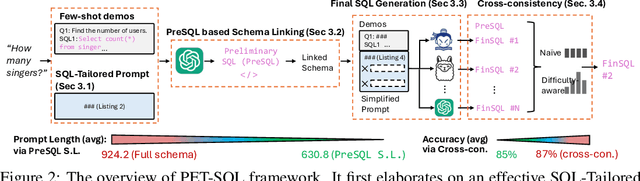
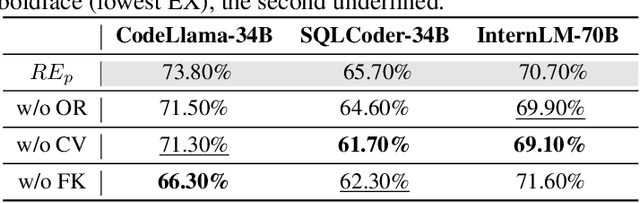
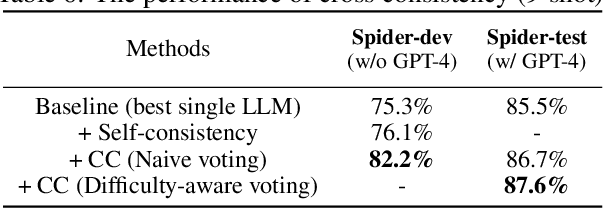
Recent advancements in Text-to-SQL (Text2SQL) emphasize stimulating the large language models (LLM) on in-context learning, achieving significant results. Nevertheless, they face challenges when dealing with verbose database information and complex user intentions. This paper presents a two-stage framework to enhance the performance of current LLM-based natural language to SQL systems. We first introduce a novel prompt representation, called reference-enhanced representation, which includes schema information and randomly sampled cell values from tables to instruct LLMs in generating SQL queries. Then, in the first stage, question-SQL pairs are retrieved as few-shot demonstrations, prompting the LLM to generate a preliminary SQL (PreSQL). After that, the mentioned entities in PreSQL are parsed to conduct schema linking, which can significantly compact the useful information. In the second stage, with the linked schema, we simplify the prompt's schema information and instruct the LLM to produce the final SQL. Finally, as the post-refinement module, we propose using cross-consistency across different LLMs rather than self-consistency within a particular LLM. Our methods achieve new SOTA results on the Spider benchmark, with an execution accuracy of 87.6%.