 Add to Chrome
 Add to Firefox
 Add to Edge
A General-Purpose VLM Can Teach an Astronomy Foundation Model to Better Recognize Galaxy Morphology
Aug 03, 2026
Existing astronomy foundation models provide strong galaxy representations, but adapting them to new survey conditions and survey-specific morphology recognition tasks still requires substantial human supervision. We show that VLM-based VQA systems contain meaningful visual-semantic priors that can serve as weak supervision for downstream morphology classifiers and improve morphology classification under limited human-label budgets. We first introduce a survey-oriented VQA benchmark spanning two representative imaging regimes and evaluate state-of-the-art VLMs on galaxy morphology questions. The results show that these models capture useful morphology signals and informative uncertainty, but are not sufficiently reliable to replace human annotators. Motivated by this finding, we use a general-purpose VLM as a morphology teacher for Zoobot, an astronomy foundation model pretrained on large-scale Galaxy Zoo annotations. Across two survey domains and multiple annotation budgets, the VLM teacher consistently improves Zoobot's downstream morphology classification. These results demonstrate that a general-purpose VLM provides knowledge complementary to an astronomy foundation model and can teach it to better recognize galaxy morphology under limited human supervision. The resulting pipeline is designed for label-efficient adaptation to forthcoming large-scale surveys, including the Vera C. Rubin Observatory's Legacy Survey of Space and Time (LSST) and the Nancy Grace Roman Space Telescope. The benchmark and code are publicly available at https://github.com/fw-ic/VLM-morphology-teacher.

Dual Inversion for Text-to-Image Diffusion Models: From Both Prompt and Noise Perspectives
Jul 29, 2026Prompt inversion, as a typical reverse engineering technique, enables text-to-image (T2I) diffusion models to generate the desired target images without extensive prompt engineering. However, existing prompt inversion methods suffer from significant limitations: (1) gradient-based methods are unstable and uninterpretable, often resulting in generated images with severe artifacts; (2) gradient-free methods yield human-readable prompts but still fail to preserve visual fidelity due to the lack of fine-grained detail alignment. We contend that the limitations stem from treating prompt inversion as a sufficient condition for reverse engineering, ignoring the critical role of the latent noise that encodes structural information. Consequently, we propose Dualin (Dual inversion), a two-stage method that jointly recovers both the semantic prompt and latent noise of the target image. In the first stage, we integrate vision-language model, CLIP and large language model to invert a faithful, human-interpretable hard prompt. In the second stage, unconditional DDIM inversion reconstructs the exact latent noise of the target image, guaranteeing the consistency at the structural information level. Theoretically, we prove that the inverted noise enables flexible image editing without re-optimization. Extensive experiments on diverse datasets demonstrate that Dualin simultaneously generates high-quality inverted prompts and achieves state-of-the-art image fidelity. Additionally, Dualin can establish a robust foundation for the precise and controllable image editing.
Kimi K3: Open Frontier Intelligence
Jul 27, 2026We introduce Kimi K3, a 2.8T parameter Mixture-of-Experts model with 104 billion activated parameters, native vision capabilities, and a 1-million-token context window. Kimi K3 is built on Kimi Delta Attention and Attention Residuals, which improve information flow across sequence length and model depth. Together with Stable LatentMoE, which effectively activates 16 of 896 routed experts per token, and refined training and data recipes, these advances yield an approximately 2.5x improvement in overall scaling efficiency over Kimi K2. Post-training highlights reinforcement learning across general, agentic, and coding domains and multiple reasoning-effort levels, enabling compositional generalization and robust long-horizon execution. At 2.8T scale, Kimi K3 is supported by infrastructure advances in multiple areas: algorithm-system co-design for KDA, perfectly balanced expert-parallel training with efficient memory management, million-token agentic RL with persistent rollout and sandbox states, and deployment innovations. Extensive evaluations show that Kimi K3 achieves frontier-level performance across long-horizon coding, agentic, knowledge, reasoning, and vision tasks. While its overall performance still trails the most powerful proprietary models, namely Claude Fable 5 and GPT-5.6 Sol, Kimi K3 consistently outperforms other open and proprietary models evaluated in our suite. We release the full Kimi K3 model weights to facilitate future research and accelerate the broader deployment and adoption of frontier intelligence.
Wrong Before Right: Late Rescue and Interface Failure in Aligned Language Models
Jul 06, 2026We study how correctness is assembled inside aligned language models, not only whether the final answer is right. Using layer-wise difference-in-differences (DiD) trajectories over polarity-controlled minimal pairs, we identify the wrong-dip: in mid layers (25-90% depth), internal preference transiently commits to the incorrect answer and is rescued only by late-layer correction. We verify this causally with patchscope-style activation transplantation across 17 models, three families, and 64x scale (0.5B-32B). Four findings follow. (1) Alignment amplification of the causal wrong-dip is recipe-specific and emergent: it emerges at 3B in Qwen2.5, remains high, and peaks at 32B (paired t up to 9.7), reverses in Llama-3-8B (t=-2.31), and sits between for Mistral-7B. (2) The dip predicts real compression failures: high-dip items are 3-7x more likely to flip under late-layer low-rank compression, block dropping, or structured pruning, while quantization flips are dip-blind, a double dissociation confirmed by late-layer ablation. (3) The dip is trainable: a LoRA fine-tune with a mid-layer wrong-margin penalty matches output-only SFT accuracy while cutting the causal dip by 67-70% and improving compression robustness; output-only SFT worsens the causal dip by up to 2.8x at perfect surface accuracy. (4) With controlled readouts, the phenomenon survives natural-language I/O: dip stratification of structural-damage failures is significant on naturalistic vignettes, and free-form fragility separates into a dip-auditable late-rescue layer and a dip-blind interface layer. Together, output-level correctness can hide a late-rescue process that governs compression risk, post-training quality, and evaluation distortion.
Beyond Forecasting: The Belief-to-Trade Layer in Prediction-Market Agents
Jul 03, 2026Forecasting future events has attracted growing attention as a testbed for general-purpose AI. A natural way to ground this evaluation is let the models trade in the prediction markets. Trading, however, requires more than forecasting. Moreover, recent benchmarks report a substantial gap between calibrated probability scores and the trading results. We propose Raven-Agent, to the best of our knowledge, the first autonomous trading agent for prediction markets. On a controlled replay over an archived decision set, our architecture achieves the only positive return and the only positive risk-adjusted return among all tested policies. We have released our code in https://github.com/Alchemist-X/predict-raven .
OSWorld2.0: Benchmarking Computer Use Agents on Long-Horizon Real-World Tasks
Jun 28, 2026Existing computer-use benchmarks fail to capture the realism, complexity, and long-horizon demands of real-world computer use, limiting their ability to reveal the limitations of frontier agents. We introduce OSWorld 2.0, a benchmark of 108 long-horizon computer-use workflows across everyday and professional tasks, designed to capture complex and challenging real-world phenomena. Each task represents a realistic end-to-end workflow that takes human users a median of about 1.6 hours to complete and requires an average of 318 tool calls with Claude Opus 4.7 using maximum thinking, compared with about 30 in OSWorld 1.0. OSWorld 2.0 targets challenge phenomena that are common in real workflows yet underrepresented in prior benchmarks, spanning interaction-design challenges such as streaming interaction and dynamic environments, as well as agent-pattern challenges such as cross-source reasoning, implicit-state inference, and visual-spatial precision. Tasks are grounded in authentic input artifacts and cross-referenced against realistic stateful user profile data, and include separate safety reports auditing safety-sensitive execution. Under our primary binary-completion metric at 500 steps, Claude Opus 4.8 with maximum thinking and batched tool calls scores best but still completes only 20.6% of tasks at a 54.8% partial score; GPT-5.5 is far more token-efficient yet plateaus near 13%. These results show that current agents are still far from professional-level computer use: rather than stumbling on basic GUI control or coding, they lose track of constraints, miss information that arrives mid-task, guess rather than ask the user, and skip verification, struggling most when a task hinges on hidden state they must recover.
Kimi K2.5: Visual Agentic Intelligence
Feb 02, 2026We introduce Kimi K2.5, an open-source multimodal agentic model designed to advance general agentic intelligence. K2.5 emphasizes the joint optimization of text and vision so that two modalities enhance each other. This includes a series of techniques such as joint text-vision pre-training, zero-vision SFT, and joint text-vision reinforcement learning. Building on this multimodal foundation, K2.5 introduces Agent Swarm, a self-directed parallel agent orchestration framework that dynamically decomposes complex tasks into heterogeneous sub-problems and executes them concurrently. Extensive evaluations show that Kimi K2.5 achieves state-of-the-art results across various domains including coding, vision, reasoning, and agentic tasks. Agent Swarm also reduces latency by up to $4.5\times$ over single-agent baselines. We release the post-trained Kimi K2.5 model checkpoint to facilitate future research and real-world applications of agentic intelligence.
Towards a Holistic and Automated Evaluation Framework for Multi-Level Comprehension of LLMs in Book-Length Contexts
Aug 27, 2025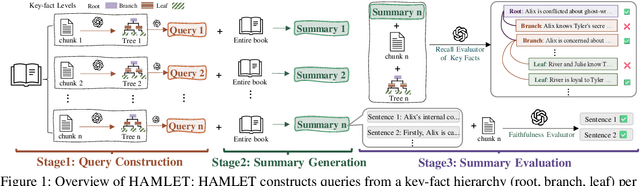
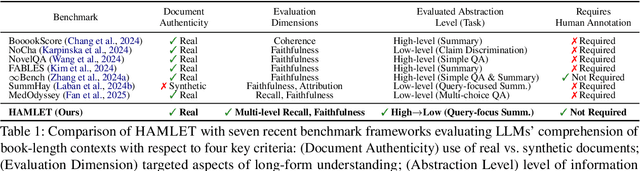
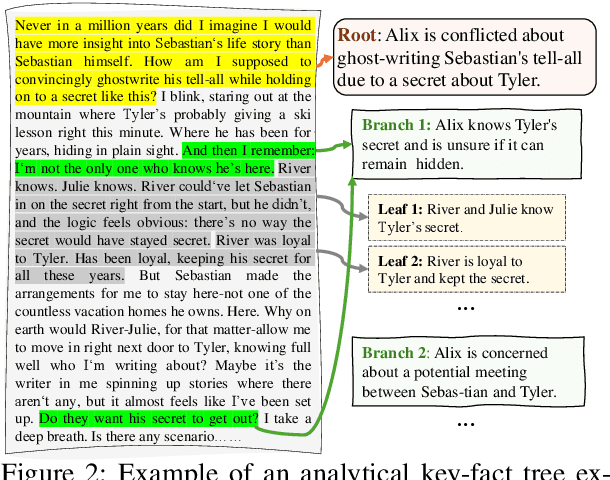
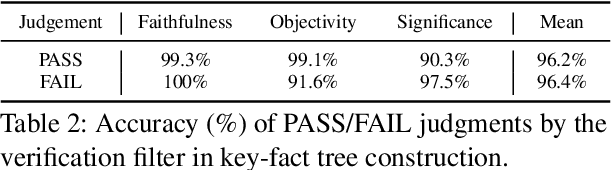
We introduce HAMLET, a holistic and automated framework for evaluating the long-context comprehension of large language models (LLMs). HAMLET structures source texts into a three-level key-fact hierarchy at root-, branch-, and leaf-levels, and employs query-focused summarization to evaluate how well models recall and faithfully represent information at each level. To validate the reliability of our fully automated pipeline, we conduct a systematic human study, showing that our automatic evaluation achieves over 90% agreement with expert human judgments, while reducing the cost by up to 25 times. HAMLET reveals that LLMs struggle with fine-grained comprehension, especially at the leaf level, and are sensitive to positional effects like the lost-in-the-middle. Analytical queries pose greater challenges than narrative ones, and consistent performance gaps emerge between open-source and proprietary models, as well as across model scales. Our code and dataset are publicly available at https://github.com/DISL-Lab/HAMLET.
OpenCUA: Open Foundations for Computer-Use Agents
Aug 12, 2025Vision-language models have demonstrated impressive capabilities as computer-use agents (CUAs) capable of automating diverse computer tasks. As their commercial potential grows, critical details of the most capable CUA systems remain closed. As these agents will increasingly mediate digital interactions and execute consequential decisions on our behalf, the research community needs access to open CUA frameworks to study their capabilities, limitations, and risks. To bridge this gap, we propose OpenCUA, a comprehensive open-source framework for scaling CUA data and foundation models. Our framework consists of: (1) an annotation infrastructure that seamlessly captures human computer-use demonstrations; (2) AgentNet, the first large-scale computer-use task dataset spanning 3 operating systems and 200+ applications and websites; (3) a scalable pipeline that transforms demonstrations into state-action pairs with reflective long Chain-of-Thought reasoning that sustain robust performance gains as data scales. Our end-to-end agent models demonstrate strong performance across CUA benchmarks. In particular, OpenCUA-32B achieves an average success rate of 34.8% on OSWorld-Verified, establishing a new state-of-the-art (SOTA) among open-source models and surpassing OpenAI CUA (GPT-4o). Further analysis confirms that our approach generalizes well across domains and benefits significantly from increased test-time computation. We release our annotation tool, datasets, code, and models to build open foundations for further CUA research.
Scaling Computer-Use Grounding via User Interface Decomposition and Synthesis
May 19, 2025Graphical user interface (GUI) grounding, the ability to map natural language instructions to specific actions on graphical user interfaces, remains a critical bottleneck in computer use agent development. Current benchmarks oversimplify grounding tasks as short referring expressions, failing to capture the complexity of real-world interactions that require software commonsense, layout understanding, and fine-grained manipulation capabilities. To address these limitations, we introduce OSWorld-G, a comprehensive benchmark comprising 564 finely annotated samples across diverse task types including text matching, element recognition, layout understanding, and precise manipulation. Additionally, we synthesize and release the largest computer use grounding dataset Jedi, which contains 4 million examples through multi-perspective decoupling of tasks. Our multi-scale models trained on Jedi demonstrate its effectiveness by outperforming existing approaches on ScreenSpot-v2, ScreenSpot-Pro, and our OSWorld-G. Furthermore, we demonstrate that improved grounding with Jedi directly enhances agentic capabilities of general foundation models on complex computer tasks, improving from 5% to 27% on OSWorld. Through detailed ablation studies, we identify key factors contributing to grounding performance and verify that combining specialized data for different interface elements enables compositional generalization to novel interfaces. All benchmark, data, checkpoints, and code are open-sourced and available at https://osworld-grounding.github.io.