 Add to Chrome
 Add to Firefox
 Add to Edge
LexKairos: Benchmarking Legal Temporal Capabilities in LLMs
Aug 10, 2026
Large language models (LLMs) have demonstrated strong performance across a wide range of legal tasks. In legal practice, time is a critical concept that governs the validity of statutes, the progression of legal cases, and the enforcement of procedural deadlines. However, legal temporal capabilities remain underexplored in existing legal AI benchmarks. To address this gap, we propose LexKairos, a comprehensive benchmark for evaluating the temporal capabilities of LLMs in the Chinese legal context across three dimensions: statutory temporal knowledge, case temporal modeling, and statute-case temporal reasoning. LexKairos comprises nine sub-tasks drawn from real-world Chinese judicial cases and statutes. We conduct systematic evaluations of eight LLMs under multiple inference settings, including vanilla, Chain-of-Thought (CoT), and thinking modes. Our results show that Gemini-3-Flash achieves the strongest overall performance, yet even the best-performing model exhibits notable limitations on tasks demanding precise time-sensitive statutory metadata recall or complex reasoning in time limits, indicating that legal temporal knowledge and reasoning remain open challenges for current LLMs. Data and code are available at https://github.com/thunlp/LexKairos.

REFACT: Adaptive Fact Restatement for Compact and Faithful Chain-of-Thought Reasoning
Jul 23, 2026Large language models increasingly rely on long-form reasoning for complex tasks, yet their reasoning traces may drift away from the supplied context when evidence is sparse, noisy, or in conflict with parametric knowledge. Existing grounding methods either attach citations after generation or encourage evidence retrieval inside the trace, but they often do not ensure that cited content is sufficient for the local inference and final answer. We propose REFACT, an adaptive fact-restatement citation framework that trains models to decide when a reasoning step needs contextual grounding and at what granularity source facts should be restated. This design avoids both unsupported inference and indiscriminate fact copying by turning citations into answer-supporting intermediate states. REFACT is optimized with a two-stage SFT-to-RL pipeline in which a citation-utility reward encourages cited facts to be well-formed, source-traceable, and answer-sufficient. Experiments on LongBench, LV-Eval, and ConFiQA show that REFACT improves long-context QA and counterfactual faithfulness while substantially reducing token consumption. Further analysis shows that REFACT preserves more answer-bearing evidence with fewer restated facts, yielding reasoning traces that are denser rather than longer. All code and data are available at https://github.com/NEUIR/REFACT.
Shortcut Learning in Legal Judgment Prediction: Empirical Evidence from the UK Employment Tribunal
Jul 05, 2026Current Legal Judgment Prediction (LJP) is constrained by its reliance on post-hoc judicial materials, increasing the likelihood that models perform retrospective classification rather than true forecasting. This paper empirically investigates shortcut learning in this context by studying claim-level outcome prediction in UK Employment Tribunal (UKET) decisions. Using a corpus of 33,158 individual claims, we predict outcomes from claim texts and LLM-extracted case summaries, evaluating models ranging from interpretable TF-IDF-based classifiers to black-box LLMs. While headline predictive performance figures appear strong, we demonstrate that such performance in LJP systems trained on post-hoc judicial text can be driven by the retrospective nature of the source material. Stratifying the test data by human judgments of leakage reveals that performance increases where outcome-revealing cues are embedded in the narrative. Moreover, a model trained on just the 4% of features identified as leakage achieves high performance, outperforming human experts. These findings substantiate concerns that LJP performance may be exaggerated by linguistic artefacts. Yet this vulnerability is not fatal to the research agenda. Instead, post-hoc judgments might be treated as potentially contaminated texts, requiring active auditing. Retraining models after masking leakage features results in only a negligible reduction in Macro-F1. Hence, while models will opportunistically exploit shortcuts when available, they remain capable of extracting useful predictive signals when these artefacts are removed.
SHIFT: Gate-Modulated Activation Steering for Knowledge Conflict Mitigation in Retrieval-Augmented Generation
Jun 26, 2026Retrieval-augmented generation (RAG) enhances LLMs by incorporating external knowledge to support response generation. However, conflicts between retrieved context and parametric knowledge have emerged as a critical challenge in RAG systems. To mitigate such conflicts, numerous studies have attempted to identify and edit knowledge-related internal neurons, aiming to improve the ability of LLMs to rely on contextual evidence during generation. However, these neuron-level approaches may introduce unintended cascading effects that compromise the general capabilities of LLMs, as the modified neurons are often entangled with broader model behaviors and functionalities. In this paper, we introduce SHIFT, a novel framework that reformulates neuron-level modification as learnable gate modulation, allowing LLMs to adaptively regulate internal activations for knowledge conflict resolution. Technically, our SHIFT equips LLMs with a lightweight gate module and optimizes fewer than 0.01% trainable parameters while keeping the backbone model frozen. During generation, the gate module adjusts the model's internal representations to adaptively leverage contextual and parametric knowledge. Extensive experiments on six datasets validate the effectiveness of our SHIFT in comparison with various competing baselines. All datasets and code are available at https://github.com/OpenBMB/SHIFT.
GARL: Game-Theoretic Reinforcement Learning for Multi-Agent Strategic Prioritisation
Jun 03, 2026LLM-based multi-agent systems are increasingly used for strategic decision-making tasks. In such settings, performance depends not only on individual model capabilities, but also on the policies by which agents interact and adapt. Multi-agent reinforcement learning can optimise these interaction policies, but its reward design often remains task-specific and weakly grounded in interaction structure. To address this gap, we propose GARL, a GAme-theoretic Reinforcement Learning framework for multi-agent strategic prioritisation. GARL formalises strategic prioritisation as a two-stage game: competing agents first allocate strategic resources over a shared candidate set, and a higher-level arbiter then produces the final ranking. The resulting game-theoretic utilities are converted into role-specific reinforcement signals, allowing policy optimisation to be guided by structured interaction. We instantiate GARL on issues-in-dispute ranking, where the goal is to prioritise core issues in legal proceedings. Experiments show that GARL improves ranking performance, enables small open-source LLMs to become competitive with a strong closed-source LLM under the same candidate-ranking setting, and yields gains in legal-domain competence and broader strategic decision-making. Overall, GARL demonstrates how game-theoretic interaction structure can be turned into reinforcement-learning objectives, providing a principled approach to policy optimisation in multi-agent strategic prioritisation.
CLASE: A Hybrid Method for Chinese Legalese Stylistic Evaluation
Feb 13, 2026Legal text generated by large language models (LLMs) can usually achieve reasonable factual accuracy, but it frequently fails to adhere to the specialised stylistic norms and linguistic conventions of legal writing. In order to improve stylistic quality, a crucial first step is to establish a reliable evaluation method. However, having legal experts manually develop such a metric is impractical, as the implicit stylistic requirements in legal writing practice are difficult to formalise into explicit rubrics. Meanwhile, existing automatic evaluation methods also fall short: reference-based metrics conflate semantic accuracy with stylistic fidelity, and LLM-as-a-judge evaluations suffer from opacity and inconsistency. To address these challenges, we introduce CLASE (Chinese LegAlese Stylistic Evaluation), a hybrid evaluation method that focuses on the stylistic performance of legal text. The method incorporates a hybrid scoring mechanism that combines 1) linguistic feature-based scores and 2) experience-guided LLM-as-a-judge scores. Both the feature coefficients and the LLM scoring experiences are learned from contrastive pairs of authentic legal documents and their LLM-restored counterparts. This hybrid design captures both surface-level features and implicit stylistic norms in a transparent, reference-free manner. Experiments on 200 Chinese legal documents show that CLASE achieves substantially higher alignment with human judgments than traditional metrics and pure LLM-as-a-judge methods. Beyond improved alignment, CLASE provides interpretable score breakdowns and suggestions for improvements, offering a scalable and practical solution for professional stylistic evaluation in legal text generation (Code and data for CLASE is available at: https://github.com/rexera/CLASE).
LinguaGame: A Linguistically Grounded Game-Theoretic Paradigm for Multi-Agent Dialogue Generation
Jan 08, 2026Large Language Models (LLMs) have enabled Multi-Agent Systems (MASs) where agents interact through natural language to solve complex tasks or simulate multi-party dialogues. Recent work on LLM-based MASs has mainly focused on architecture design, such as role assignment and workflow orchestration. In contrast, this paper targets the interaction process itself, aiming to improve agents' communication efficiency by helping them convey their intended meaning more effectively through language. To this end, we propose LinguaGame, a linguistically-grounded game-theoretic paradigm for multi-agent dialogue generation. Our approach models dialogue as a signalling game over communicative intents and strategies, solved with a training-free equilibrium approximation algorithm for inference-time decision adjustment. Unlike prior game-theoretic MASs, whose game designs are often tightly coupled with task-specific objectives, our framework relies on linguistically informed reasoning with minimal task-specific coupling. Specifically, it treats dialogue as intentional and strategic communication, requiring agents to infer what others aim to achieve (intents) and how they pursue those goals (strategies). We evaluate our framework in simulated courtroom proceedings and debates, with human expert assessments showing significant gains in communication efficiency.
LexRel: Benchmarking Legal Relation Extraction for Chinese Civil Cases
Dec 14, 2025Legal relations form a highly consequential analytical framework of civil law system, serving as a crucial foundation for resolving disputes and realizing values of the rule of law in judicial practice. However, legal relations in Chinese civil cases remain underexplored in the field of legal artificial intelligence (legal AI), largely due to the absence of comprehensive schemas. In this work, we firstly introduce a comprehensive schema, which contains a hierarchical taxonomy and definitions of arguments, for AI systems to capture legal relations in Chinese civil cases. Based on this schema, we then formulate legal relation extraction task and present LexRel, an expert-annotated benchmark for legal relation extraction in Chinese civil law. We use LexRel to evaluate state-of-the-art large language models (LLMs) on legal relation extractions, showing that current LLMs exhibit significant limitations in accurately identifying civil legal relations. Furthermore, we demonstrate that incorporating legal relations information leads to consistent performance gains on other downstream legal AI tasks.
Legal$Δ$: Enhancing Legal Reasoning in LLMs via Reinforcement Learning with Chain-of-Thought Guided Information Gain
Aug 17, 2025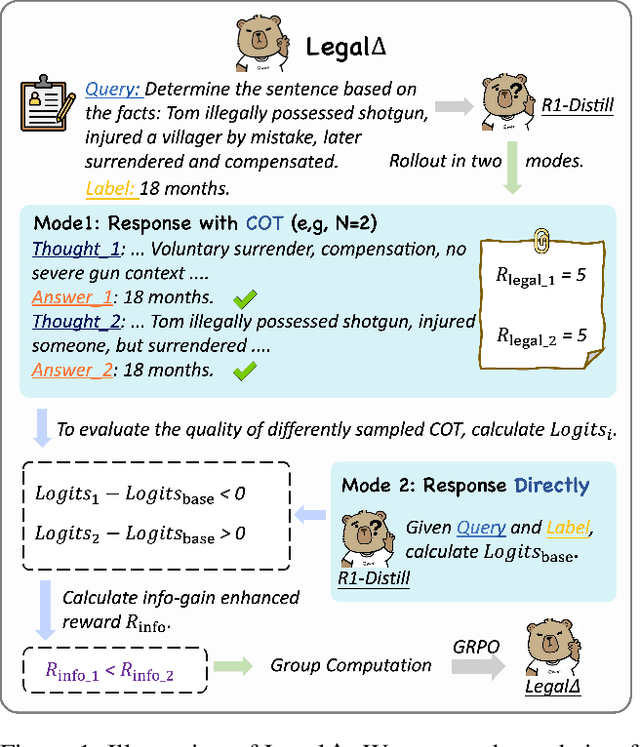
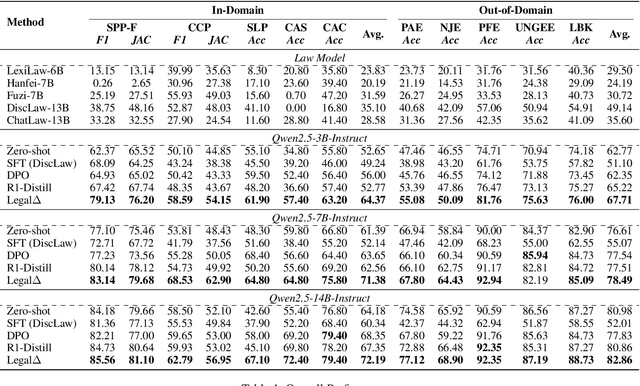
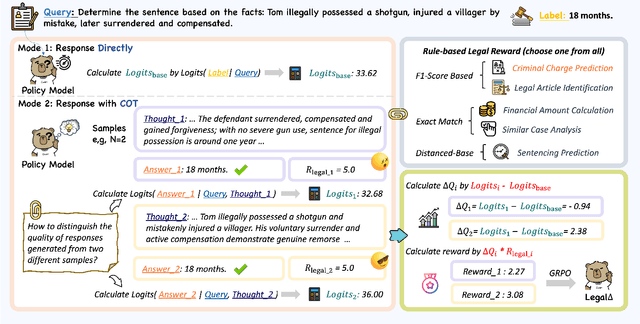
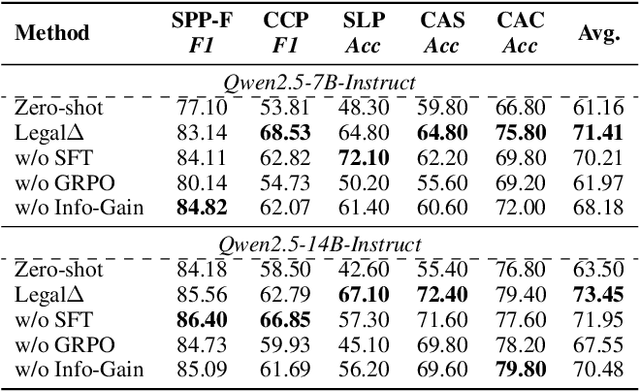
Legal Artificial Intelligence (LegalAI) has achieved notable advances in automating judicial decision-making with the support of Large Language Models (LLMs). However, existing legal LLMs still struggle to generate reliable and interpretable reasoning processes. They often default to fast-thinking behavior by producing direct answers without explicit multi-step reasoning, limiting their effectiveness in complex legal scenarios that demand rigorous justification. To address this challenge, we propose Legal$\Delta$, a reinforcement learning framework designed to enhance legal reasoning through chain-of-thought guided information gain. During training, Legal$\Delta$ employs a dual-mode input setup-comprising direct answer and reasoning-augmented modes-and maximizes the information gain between them. This encourages the model to acquire meaningful reasoning patterns rather than generating superficial or redundant explanations. Legal$\Delta$ follows a two-stage approach: (1) distilling latent reasoning capabilities from a powerful Large Reasoning Model (LRM), DeepSeek-R1, and (2) refining reasoning quality via differential comparisons, combined with a multidimensional reward mechanism that assesses both structural coherence and legal-domain specificity. Experimental results on multiple legal reasoning tasks demonstrate that Legal$\Delta$ outperforms strong baselines in both accuracy and interpretability. It consistently produces more robust and trustworthy legal judgments without relying on labeled preference data. All code and data will be released at https://github.com/NEUIR/LegalDelta.
The CLC-UKET Dataset: Benchmarking Case Outcome Prediction for the UK Employment Tribunal
Sep 12, 2024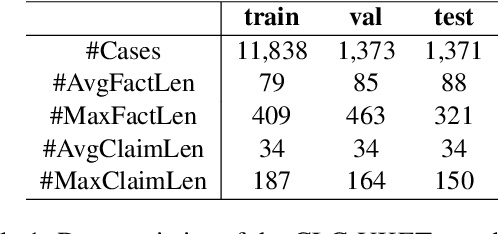
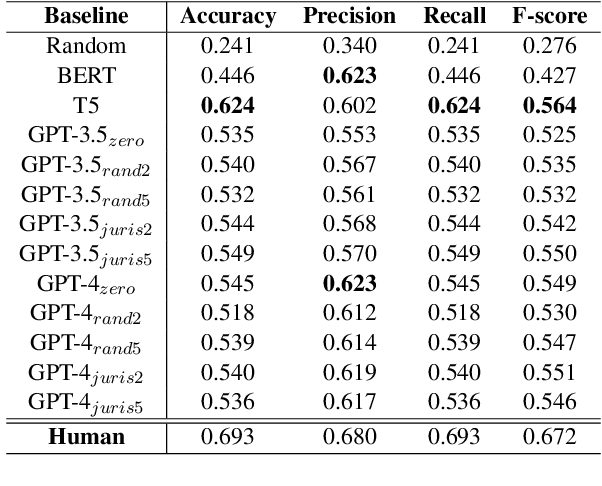
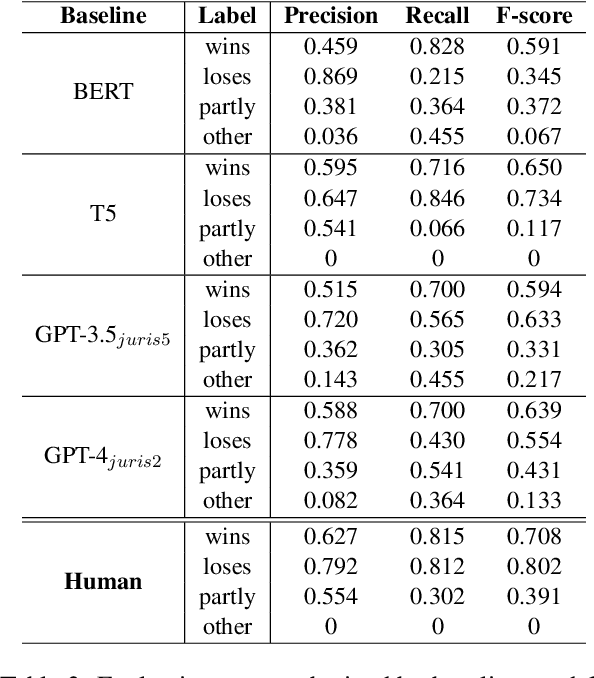
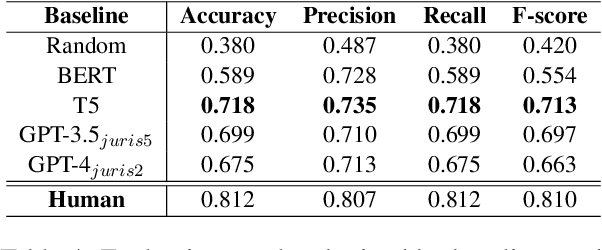
This paper explores the intersection of technological innovation and access to justice by developing a benchmark for predicting case outcomes in the UK Employment Tribunal (UKET). To address the challenge of extensive manual annotation, the study employs a large language model (LLM) for automatic annotation, resulting in the creation of the CLC-UKET dataset. The dataset consists of approximately 19,000 UKET cases and their metadata. Comprehensive legal annotations cover facts, claims, precedent references, statutory references, case outcomes, reasons and jurisdiction codes. Facilitated by the CLC-UKET data, we examine a multi-class case outcome prediction task in the UKET. Human predictions are collected to establish a performance reference for model comparison. Empirical results from baseline models indicate that finetuned transformer models outperform zero-shot and few-shot LLMs on the UKET prediction task. The performance of zero-shot LLMs can be enhanced by integrating task-related information into few-shot examples. We hope that the CLC-UKET dataset, along with human annotations and empirical findings, can serve as a valuable benchmark for employment-related dispute resolution.